Lisa Phu

Managing Editor, KTOO

"As Managing Editor, I work with the KTOO news team to develop and shape news and information for the Juneau community that's accurate and digestible."
Accessible playgrounds in Juneau a work in progress

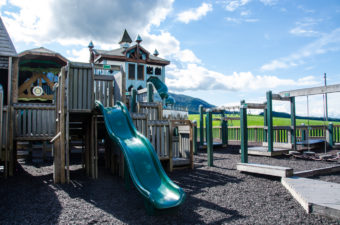
National Public Radio launched Playgrounds for Everyone this week looking at how communities and local governments are adapting to new standards for playgrounds that make them more accessible for children with disabilities. KTOO wanted to know how Juneau’s playgrounds measure up.

Kids play on the climbing web at Glacier Valley Elementary School.
Kids play on the climbing web at Glacier Valley Elementary School. (Photo by Lisa Phu/KTOO)

It’s recess at Glacier Valley Elementary School. A dozen kids run straight to a piece of playground equipment that looks like a three dimensional spider web. They climb onto the webbing where they hover ten feet off the ground. Elsewhere in the playground, students crawl up ladders, go down slides, pump their legs on swings.

But not all kids can access the playground so easily.

Cindle Stolarik is a special education teacher at Glacier Valley. She teaches eight students in kindergarten to fifth grade. They have a range of abilities and disabilities including “cognitive impairments, learning disabilities, cerebral palsy, autism, and traumatic brain injury.”

For two students in wheelchairs, the school playground equipment can be a challenge.

“It definitely would be helpful if there were wheelchair ramps and swings that accommodated our students. I feel like we make it work and we incorporate our students. We get them out of the wheelchairs and we make sure they can participate with their friends but it would definitely be easier if it was more accessible,” Stolarik says.

Para-educator Jamie Lachester works with one of these students during recess.

“I help him transfer out of his wheelchair into the rubber chip area because he will crawl around and that’s softer on his knees. When it comes to getting up on the equipment, I will help him go up the stairs and then stand very close proximity to him as he is crawling around make sure he doesn’t slide of the sides because it gets very slippery,” Lachester says.

Juneau has a total of 17 playgrounds with play equipment – 11 in city parks and six in the schools.

The Americans with Disabilities Act requires that playgrounds are built to be accessible for all children. That means making it possible for every child, including those with disabilities, to get on and off, as well as move around the equipment.

Slides and play equipment at Twin Lakes playground.
The playground at Twin Lakes was built in 2007 and Project Playground is currently in phase 2 of the project. (Photo by Heather Bryant/KTOO)

Project Playground at Twin Lakes is supposed to do just that.

Chris Mertl is a landscape architect with Corvus Design:

“The idea with transfer platforms is a child in a wheelchair can use their upper body strength and pull themselves out of the chair and get onto the pieces of play equipment. We’re also fortunate here at Project Playground that we have ramps, so kids in chairs and walkers can actually go up the ramps systems and get into the higher elevation play elements.”

Southeast Alaska Independent Living, or SAIL, is one of the organizations that helped get Project Playground built in 2007. SAIL executive director Joan O’Keefe says it was supposed to be an ADA showcase.

“There’s a number of accessible features over there, but unfortunately it’s difficult for someone who uses a wheelchair to get to those features.”

Like other Juneau playgrounds, the surface beneath the play equipment at Twin Lakes is covered with what looks like wood chips. They’re actually shredded rubber pieces, which are good for cushioning a fall but terrible for moving a wheelchair through.

O’Keefe hopes phase two of Project Playground can fix the problem. The goal is to create pathways that start at the playground’s entrance and connect different pieces of equipment at the transfer platforms.

Compressed rubber bricks
The next step for Project Playground is to create pathways from compressed blocks of shredded rubber that would give a more solid surface for equipment to travel over. (Photo by Heather Bryant/KTOO)

Landscape architect Mertl says the pathways can be made from the same shredded rubber…

“but what it is is it’s bound together so we have a fairly stable solid surface that still has the same impact absorption capacity as the loose stuff but it allows wheelchairs to get over it, it allows people with walkers or crutches that they’re not going to get buried into the loose stuff.”

Mertl says this type of surfacing is expensive. A cost estimate is over $110,000.

“It’s all up to funding. We have a playground that is functional, but can we go further and make it better? Of course we can.”
Phase two of Project Playground is currently on the city’s parks and recreation priority list but funds won’t be made available until at least 2016.

Additional reporting by Heather Bryant.
Use our map to find a playground near you.

[googlemaps https://www.google.com/maps/ms?msa=0&msid=207552761365349066661.0004e506ffc921fa13f0f&hl=en&ie=UTF8&t=h&ll=58.341218,-134.527588&spn=0.144157,0.445633&z=11&output=embed&w=650&h=400]

Is there a playground missing? Email heather@ktoo.org

Freedom rings from capitol hill

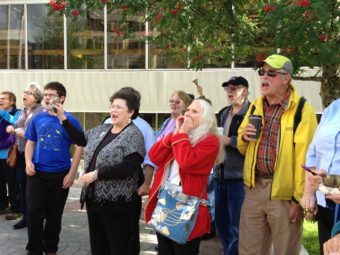
Bells rang in the capital city at 11 am today to celebrate the 50th anniversary of the March on Washington and Dr. Martin Luther King Jr.’s “I Have a Dream” speech.

About 40 Juneau residents gathered at the Dimond Courthouse plaza in front of the state capitol. After a brief introduction by the president of Juneau’s Black Awareness Association Sherry Patterson, participants rang cow bells, bear bells, cell phones, Buddhist bells, keys, tambourines, and bike bells. Juneau Police Department added a police car siren.

Bell ringing events took place today all over the country, but when Lin Davis realized last week there was none planned in Alaska, she decided to organize one.

“It’s certainly wonderful to be part of a national bell ringing where we acknowledge the civil rights pioneers that have so changed our life and starting with all those marchers in 1963 and then all the brave acts that came forward from that. As a member of the LGBT community, we wouldn’t have had our role models and mentors without the civil rights movement,” Davis said.

After the bell ringing, the crowd joined hands in a circle and sang ‘We Shall Overcome.’

50th anniversary celebration events continue at 5 pm tonight at the Douglas Library.


Front Street clinic could close Oct. 1

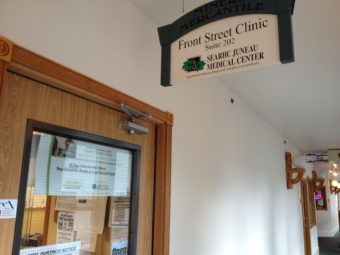
Front Street Clinic is upstairs in the Miners’ Mercantile building. It’s open Monday through Friday, 8 am to 5 pm. (Photo by Lisa Phu/KTOO)

The Southeast Alaska Regional Health Consortium plans to close Front Street Clinic on October 1, according to SEARHC COO Dan Neumeister. The decision by the board of directors comes after two days of meetings last week.
Neumeister says deciding to close the clinic geared for homeless and low-income patients was difficult. He cites budgetary constraints, including sequestration.

Dan Austin with the Juneau Coalition on Housing and Homelessness says he’s not surprised with SEARHC’s decision.

“I think we have reached a point where we need to make that transition. I believe that for 10 years, SEARHC has done a wonderful service for the community, but we need to find an alternative.”

According to Neumeister, Front Street Clinic costs about $600,000 a year to operate. $160,000 of that comes from a U.S. Health Resources and Services Administration grant. The remaining more than $400,000, he says, comes from SEARHC. Neumeister says SEARHC makes that money through billings at its facilities.

The HRSA grant went into effect May 1 and is good for one year. Neumeister does not know how much, if any, of the $160,000 remains, but says he is working with the federal agency on how leftover funds can be re-designated.

Neumeister plans to hold a meeting in Juneau Tuesday to facilitate discussions on how the clinic can stay open. Neumeister did not identify who would be at the meeting but the city and borough of Juneau and the Juneau Coalition on Housing and Homelessness confirm they will have representatives present.

Dan Austin with the Coalition is optimistic that the community will find a solution.

“The big issue is going to be, in the event that the HRSA grant cannot keep the doors open at Front Street Clinic, where can we go to find some additional resources? That’s a big challenge in this time, but this is a community that can step up to the plate and do that.”

Neumeister says SEARHC remains committed to taking care of Alaska Native homeless. The responsibility of the general public, says Neumeister, needs to go back to the general public. He says Juneau has other organizations responsible for the homeless.

Neumeister also plans on meeting with Front Street Clinic staff today.


Previous Story:

Decision on Front Street Clinic could come today

Front Street Clinic on the chopping block

Paddleboarders find unique way to experience Juneau

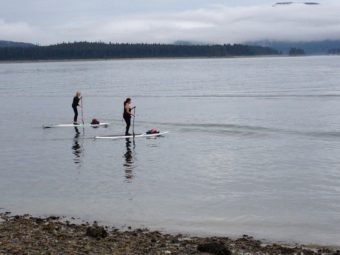
A group of people from all over the U.S. traveled to the capital city this week for one reason – stand up paddle boarding.

Jan and Jeff Lipscomb, Carol Fontius, and Bob Stafford went to Auke Lake for their first Alaska stand up paddle board experience.

Fontius describes the sport which has its roots in Hawaii.

“It’s like a big long surf board that you can stand on. And if you’re really good, you can do yoga on or something. With a paddle, you stand up and you just move through the water. You know sometimes people fall in when they first start but it’s easy not to even get wet after a while.”

Sunday was North Douglas. The group took off toward Mendenhall Glacier.

“Heading straight for that glacier was like being in an IMAX movie for me. It’s only something I’ve seen in movies. And to be on the water, looking at it, it’s really surreal.”

Jan Lipscomb says the trip so far has been fun and not too strenuous.

The two couples traveled to Juneau from San Diego and Las Vegas with the help of Florida-based company SURFit. Karla Gore runs the business with her husband Aaron Pollard. One component is setting up stand up paddle boarding trips in different parts of the world.

“Almost anywhere there’s water you can paddleboard. We’re really used to warm water paddle boarding, but I thought we know that it’s beautiful here. There’s so much to see, so much water, so much place to paddle, so we thought well we’d just try it here.”

For Jeff Lipscomb, paddle boarding in Alaska is how he wanted to celebrate turning 60.

“For me, this is something that surrealistically you could only dream about and it has been, two days in a row – all I can say is, this is phenomenal. You’re paddling on the water looking at arguably one of the most beautiful places on earth.”

Lipscomb says being on the water on a paddleboard is different than being on the water in a boat.

“When you’re paddling, there’s the sound of your paddle in the water and that’s it. And then everything else you hear are things like eagles, birds, salmon thrashing around. You can hear and see everything with clarity.”

Stafford describes the schedule for the rest of their week in Juneau.

“We’ll paddleboard at least once every day, and maybe twice, and we’ll go 5-6 miles in the morning, 5-6 miles in the afternoon. And we look for wind or some texture in the water and we follow that a little bit.”

Other Juneau paddle boarding destinations include Amalga Harbor, Boy Scout Beach, Auke Rec, and Echo Cove.

Tree cutting causes morning power outage

Residents out the road in Auke Bay and Lena Loop lost power for about 20 minutes this morning. The rest of Juneau may have noticed a brief power glitch.

Debbie Driscoll with Alaska Electric Light and Power says a tree that was being cut down fell on a line.

It took out power to feeders in Auke Bay and Lena Loop. A crew isolated the affected transformer and restored power within 20 minutes.

Driscoll says AEL&P was not responsible for the tree cutting.

Decision on Front Street Clinic could come today

For many homeless people, Front Street Clinic is the most visible form of help. It connects them to other health and social services. (Photo by Lisa Phu/KTOO)

Representative Cathy Munoz is hopeful Front Street Clinic will stay open even if the Southeast Alaska Regional Health Consortium decides to stop operating and funding it.

On Tuesday, the representative held a meeting in her office. Present were SEARHC CEO Charles Clement, Representative Beth Kerttula, Coalition on Housing and Homelessness Joanne Witta, and a representative from Senator Dennis Egan’s office.

“We were encouraged by Mr. Clement’s candor and his concern and his willingness to work with members of the homeless coalition and supporters of the Front Street Clinic on a transition plan.”

Munoz says this involves Front Street Clinic becoming its own non-profit organization or finding an umbrella organization to take it over.

“The issue really is a financial question. The grant that goes directly to Front Street Clinic is $145,000 but the total operation expense for the clinic is about $600,000 so SEARHC is in essence subsidizing the amount over $145,000.”

SEARHC COO Dan Neumeister says funding for the clinic comes from multiple sources. SEARHC is one of the main funders, U.S. Health Resources and Services Administration is another. Money from HRSA is specifically for homeless clinics.

SEARHC Board of Directors is currently meeting in Juneau. Starting yesterday and continuing into today, Neumeister says the body is discussing the organization’s entire work plan for the coming year, including Front Street Clinic.

Clinic manager and medical provider Janna Brewster says she’s nervous about what the board of directors will decide, and she’s not the only one.

“The patients are absolutely freaked out. They are scared. They’re very worried – ‘What’s going to happen to me? What’s going to happen to us?’ ‘Cause they really don’t know what their fate will be. Just everyone is on pins and needles about this.”

Brewster is also hopeful.

“It’s just a waiting game. We’re hoping that they’ll do what we would like them to do and that’s to give us time, at least. We won’t know until after the board meeting is over.”

SEARHC COO Neumeister anticipates a final decision on Front Street Clinic when the board meeting ends today.

Earlier Story: Front Street Clinic on the chopping block

Site notifications
Update notification options
Subscribe to notifications