Lisa Phu

Managing Editor, KTOO

"As Managing Editor, I work with the KTOO news team to develop and shape news and information for the Juneau community that's accurate and digestible."

Juneau performing arts pioneer retires

After 53 years as a teacher, director, and choreographer, Janice Holst is retiring at the end of the month.

Holst has been in charge of various performing arts events in the capital city for the past 35 years, including the Gold Nugget Review, Dancers Against Drugs, and the Grumpsicle.

Generations of Juneau residents have taken classes at the Janice D. Holst School of Dance. For all but two years of her teaching career in Juneau, Janice Holst was the only teacher at the school. She taught more than 20 classes a week in disciplines ranging from ballet to hip hop.

“If you studied with Janice D. Holst, you had Janice D. Holst. There was never a substitute, because I love all my dancers and I wanted them to be exactly the way I wanted them to be,” Holst says.

Holst was a dance teacher in many places, including Virginia, New Jersey, and Canada, before she arrived in Alaska in 1978. She taught in Juneau’s VFW hall for 29 years, then the Elks, before moving into her own space in the Mendenhall Mall.

Holst developed a love for dance as a small girl in Fairfield, Connecticut.

“We had big drapes in our house and my uncle would always close them up and then he’d pull them aside and he’d make a big deal about it and everybody was sitting on the sofa and all the chairs and they were clapping and everything. From the minute when I did my first little turnaround, everyone was clapping and loved it so it made people happy,” she remembers. “It made me happy.”

As an adult, Holst found motivation in her son Caje who had a leg amputated due to bone cancer at the age of 15. “He was a one legged gymnast, a one-legged wrestler, and a one legged soccer player,” says Holst.

After Holst put on a telethon in Juneau to raise money for cancer research, Governor Jay Hammond extended the effort to 167 villages and towns all over the state. Holst was responsible for helping raise more than $300,000 for cancer research.

In the arts community, Holst took on many roles at the same time.

“She was the director, choreographer, producer. She was everything, and so she was just a ball of fire,” says Juneau resident Jack Marshall.

Marshall danced in the Gold Nugget Review in the role of Richard Harris, one of Juneau’s founders. He starred as Santa Claus in the annual production of Grumpsicle. Marshall’s daughter Tawney grew up dancing at the Holst School of Dance.

“She probably taught those kids more about growing up and taking responsibility than any school teacher ever taught. She did more for those kids than you can imagine and made sure they did what they were supposed to do and marched to the right tune,” Marshall says.

21-year-old Nicole Solanoy started taking classes with Holst at the age of four and is still dancing. She says Holst pushed her to go to Chicago last summer to broaden her dance experience.

“She actually arranged everything for me. I didn’t have to do anything. I was like, ‘Wow, Janice.’ And she’s like, ‘I know you like to dance and this is my little gift to you because you’ve been helping me with the creative classes where you started.’ And that was like the best thank you gift I’ve ever gotten in my whole like. And I got to dance with professional dancers and in the Chicago theaters,” explains Solanoy.

Tracy-Diane Lazaro is another dedicated dancer.

“She really tries to get you to be your best ’cause she can see potential. I really am going to miss her pushing me although I can do that myself, but I liked knowing that there’s somebody there as well that sees what I see,” Lazaro says.

Holst had a massive stroke in 2010 and says continuing to teach for the past three years helped with her recovery.

Holst plans to close her studio at the end of month and officially retire.

“That doesn’t mean I don’t want to keep dancing or be involved or sit through a rehearsal or rehearse somebody else’s dancers or something like that. I’m just not looking for a job or looking to do anything special, but if you play music I might go crazy,” Holst says.

When she talks about the future, Holst is excited to attend a high school reunion in October which she’s never been able to do before because she’s always been teaching.

And she wants to write two books – one about the history of the Grumpsicle and one about her son Caje.


Community raises $100,000 in one week to keep clinic open

For many homeless people, Front Street Clinic is the most visible form of help. It connects them to other health and social services. (Photo by Lisa Phu/KTOO)

The clinic for Juneau’s homeless and low-income residents will stay open at least through April 30th thanks to the fundraising efforts of local community members and organizations.

The Southeast Alaska Regional Health Consortium recently announced plans to close Front Street Clinic October 1 due to budgetary constraints.

More than $100,000 has been raised in the past week. Mariya Lovishchuk is executive director of Glory Hole, Juneau’s soup kitchen and shelter:

“It was kind of like one of the most clear things I’ve ever had to do in my life. You have to call everyone you know and you have to ask them all for money and you have to just very honestly explain what you’re asking for and because what I was asking for is just so rudimentary, people gave money. We just absolutely have to keep them going.”

COO Dan Neumeister says SEARHC will use $90,000 from a U.S. Health Resources and Services Administration grant to run the clinic. Total costs to keep Front Street open an additional six months are about $250,000. Neumeister says the shortfall will be covered by community fundraising.

The Juneau Coalition on Housing and Homelessness led the effort to keep the clinic open. It was supported by Representatives Munoz and Kerttula, the city and borough of Juneau, Bartlett Regional Hospital, SEARHC, and other local organizations.

But clinic supporters still need to raise $46,000 by September 30.

Juneau Community Foundation executive director Amy Skilbred says that’s possible to do in this community. The Foundation is launching a campaign to raise the needed additional funds.

“The Front Street Clinic has been really important for providing medical services for homeless people and other underserved populations and we just want to show there’s a community-wide effort to support the Front Street Clinic and keep it going not only through this six month period, but keep the doors open forever.”

Lovishchuk says the long term goal is to turn Front Street Clinic into a community health center.

To donate to Front Street Clinic, go to juneaucf.org.


Previous Stories:

Front Street Clinic on the chopping block

Decision on Front Street Clinic could come today

Front Street Clinic could close Oct. 1

Union files for arbitration over state office space

The state’s largest public employee union and the Parnell administration will enter into arbitration over the issue of office space.

An arbitrator has been selected, but the time frame for the negotiations are still unknown.
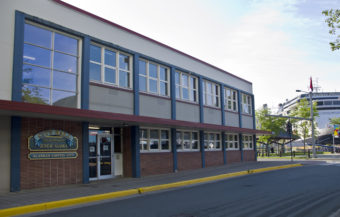
Arbitration depends on the availability of the state, the union, and the person selected to settle the dispute. The state says that may not be until August 2014.

Alaska State Employees Union Executive director Jim Duncan says that’s not acceptable.

“Members have a right to have their issues heard in a timely manner and a year from now is not timely. And meanwhile, during that period of time, we will have members who’ll continue to be negatively impacted by the issue that we are in arbitration about.”

The union filed a class action grievance in July because it believes the state’s office standards drastically change the work environment. Duncan says the state failed to negotiate with the union prior to implementing the standards, which violates the collective bargaining agreement.

Deputy administration commissioner Curtis Thayer says the state has had space standards for at least 33 years.

“They’re never bargained them with the union. Management has always had the right to establish the space and the desk and the working environment,” he says.

Duncan says putting more employees into a smaller number of floors poses safety and health concerns in regards to the number of fire exits and restrooms. The number of those isn’t increasing. Privacy is also a concern.

“We have members who deal with a lot of issues that are confidential in nature, protected issues under federal law,” explains Duncan. “The clientele they serve needs to know their conversations are being held in private.”

The state’s office standards include private telephone booths, conference rooms, and other features that Thayer believes improve the work environment.

“We’re giving them ergonomically correct furniture. We’re giving them right to light. They’re getting new break rooms and dishwashers and microwaves and coffee pots that they never had before and the employees are thanking us for it,” Thayer says.

Duncan says the state is painting a picture that employees are happy with the new office space. “That’s entirely false. I am getting emails constantly. We are getting many more members attending our work site meeting than we’ve ever had on this topic. There is more interest in this. There is more opposition to this. There is more concern on this issue from our members than any other issue that we’ve been addressing in recent times.”

Deputy commissioner Thayer doesn’t know what the union wants out of the arbitration. He says employees are already in the new cubicles.

“We can’t put them back into the old stuff. It’s not here anymore. The old break rooms are already triple the size they used to be. We’re not going to return the new refrigerator and the dishwasher to the local appliance store. So that’s one of the things that I’m trying to understand is what do they want?”

Duncan says the union continues to ask the state for the same thing, “Before they proceed, they have to sit down and negotiate those changes with the union and get our involvement. That would mean that they wouldn’t proceed until have an agreement. By delaying the arbitration until August of next year, it’s working in their benefit. They’re going to continue to install the cubicles and it’s going to continue to have a negative impact on our membership.”

According to Thayer, the Division of Insurance on the 15th floor of the Robert Atwood Building in Anchorage is up next for a space renovation. He says the division asked for it.

Juneau advertises for a new lobbyist

The city and borough of Juneau is advertising for a new lobbyist to replace Clark Gruening who retired at the end of July.

The assembly previously discussed a short list of potential candidates. Assembly member Carlton Smith says the assembly decided to issue a solicitation of interest instead to broaden the selection. Carlton sits on the lobbyist selection subcommittee.

“The solicitation is designed to identify any persons of interest that have a commitment to work with Juneau and an interest in this role and we just weren’t certain if there were folks that were interested who were not on that initial list,” he says.

Smith anticipates the capital budget would be the biggest priority for a new CBJ lobbyist.

“The governor has made preliminary suggestions that the capital budget is going to be a very challenging thing to come up with really much in the way of extra funds at all for municipalities to work with,” he says.

The subcommittee will review submissions when it meets next Monday and make recommendations to the assembly on candidates to interview.

Smith does not know how much the city will pay a new lobbyist.

“In the past, the city lobbyist position, that role, has been in the $60,000 range. I’m not sure if that includes expenses. I think those were just direct fees, and that’s been a pretty conservative number, in our judgment, considering what some of the numbers look like today. So what we’re doing is we’re asking the new applicants, those that are considering this role, to give us a proposed fee schedule of their own,” explains Smith.

CBJ issued the solicitation yesterday. Letters of interest, resumes, and fee proposals are due to the city manager by Friday.

City considering additional regulations for bear-proofing garbage

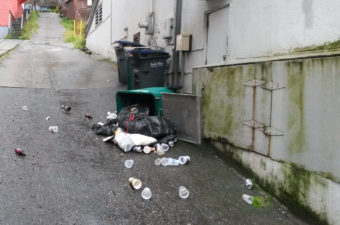
Trash can raided by a bear
(Courtesy photo)

A potential change to Juneau’s bear laws would encourage business owners and residents to better secure their garbage.

Currently, city law states that trash must be stored in a container which requires hands or tools to open, is secured by a bear resistant device, or located behind barriers.

Community services officer Bob Dilley says bears are still getting into containers and structures considered “bear-proof.”

“There’s bear calls coming in every day. It’s been a pretty busy season for bears. They’re kind of spread out all over town. We get residential complaints. We get commercial complaints.”

Dilley says having bear resistant devices or structures is no longer enough if bears are still getting into them.

“If somebody had a large apt building that has metal bear lids on their dumpster and they have cables but the residents are keeping the cables fastened, so the bear keeps getting into it, then they would have to go to something like a gravity latch or a different type of system that automatically keeps the dumpster locked up so bears can’t get into it.”

CBJ assembly member Jesse Kiehl says some housing developments are successful in keeping bears away either by dumpster structures or making sure the lid is properly closed. But, he says, people at other housing developments aren’t making the same effort.

“At some point here, those people have to take responsibility too. And if that means the landlord has to build three walls around it and put a gate up in the front, then that’s what that has to mean. Or if it means that they have to get a better garbage can holder, that’s what it has to mean.”

Ryan Scott is a wildlife management biologist for the Department of Fish and Game. He says the proposed ordinance is a good start.

“It’s certainly not going to be a fix all, but at the same time if we run up against these situations where we have an attractant that just continues to be a concern and a problem without seeing any progress made, this might be the tool to turn the tide on that.”

Officer Dilley says if a bear gets into a garbage container more than three times in a 30-day period, it would be deemed a bear attraction nuisance, according to the ordinance, and a ticket would be issued.

The fine for the first offense is $50. A second offense within two years is $100. A third offense is $300.

NOAA reviewing ESA protections for humpback whales

Humpback Whale
Humpback Whale (Photo courtesy NOAA)

The National Oceanic and Atmospheric Administration will initiate an in-depth review into whether the North Pacific humpback still needs protection under the Endangered Species Act.

A group of Hawaiian fishermen submitted a petition to de-list the whale in April and NOAA released its first finding Thursday.

NOAA has determined the petition submitted by the Hawaii Fishermen’s Alliance for Conservation and Tradition has enough substantial information to justify taking a deeper look.

Humpback whales have been designated endangered since 1970.

“Our initial review of a petition, frankly, is rather cursory. We look at the information that is in the petition itself and other information that is available in our files just to determine whether the petition presents enough information to suggest that a full analysis is appropriate. So we did that initial review and that’s the stage we’re at,” says Jon Kurland, assistant regional administrator for protected resources in Juneau.

What comes next is a two-step process.

First, NOAA must determine if the North Pacific humpback should be considered its own distinct population.

“Right now, humpbacks are listed globally. There’s just one listing for all humpback whales and so we’re going to need to consider whether the humpbacks in the North Pacific meet the relevant criteria to be considered a listable entity under the Endangered Species Act,” Kurland explains. “In other words, should they be treated as essentially their own species?”

NOAA then decides if changing the whale’s endangered status is justified. Kurland says several factors are considered.

“That includes things like whether there are any threats to the habitat or the extent of severity of threats, whether there’s over-utilization of a species, so if a species is harvested commercially or hunted. We have to look the adequacy of existing regulatory mechanisms, whether there are enough rules in place to protect the species if it no longer had the protection of the Endangered Species Act.”

NOAA’s review will also look at the possibility of changing the whale’s status from endangered to threatened.

The agency has until next April to make another finding. If it’s determined a change is warranted, NOAA will issue a proposed regulation which would be open for public comment.

Kurland says he’s sure people will be very interested.

“Whales tend to engender strong opinions from people. Some people have strong beliefs that they should be protected. Some people have different philosophies on the amount of government involvement that’s needed to protect wildlife, so I’m sure there will be a lot of different opinions.”

NOAA is currently requesting scientific and commercial information on humpback whales that will help the agency decide. Submit information at www.regulations.gov by October 28th.

Site notifications
Update notification options
Subscribe to notifications