Mandy Nguyen

‘One-stop shop’ social services center planned for Juneau’s Mendenhall Valley


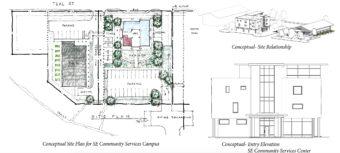
The conceptual site plan of the Southeast Community Services Campus, featuring The Glory Hall’s new building (TGH) and the nonprofit center (UHS) (Courtesy of United Human Services)

About a year ago, Glory Hall director Mariya Lovishchuk was figuring out the relocation of Juneau’s downtown homeless shelter when she got a call from Joan O’ Keefe, executive director of both United Human Services and Southeast Alaska Independent Living, to collaborate on the creation of a social services campus. The campus would be a space where people could access a variety of social services in one location, cutting costs and increasing accessibility for all involved. It’s a vision service providers have held for almost a decade.

“It really seemed the stars were completely aligned,” Lovishchuk said in a Juneau Afternoon interview.

United Human Services, in collaboration with The Glory Hall and other service providers, is coordinating the development of the Southeast Community Services Campus.

“It’s a one-stop-shop model for people who need services,” O’Keefe said.

The Southeast Community Services Campus will consist of two buildings: the Glory Hall’s new shelter and a nonprofit center.

The nonprofit center will house organizations like National Alliance on Mental Illness, United Way, Southeast Alaska Independent Living, Alaska Legal Services, Big Brother Big Sister, The Disability Law Center and United Human Services — all of which have a 10-year commitment to be on the campus. There will also be a garden and a pedestrian walkway connecting the buildings.

The campus will be located near the airport, at the intersection of Teal St. and Alpine Ave., conveniently placed near Juneau Youth Services, Tlingit and Haida Central Council and St. Vincent de Paul Society.

There are more than 200 multi-tenant nonprofit centers already across the U.S., O’Keefe says. The one-stop-shop model allows for local service providers, who often share clients, to collaborate while making it easier for anyone to access services by mitigating the costs of transportation, resources and the time it would usually take to shuttle from appointment to appointment around the city.

“It’s hard to connect to services, and you really need a lot of resources to get out of homelessness,” Lovishchuk said. “Having a nonprofit center right next door, not worrying about getting people to services — I can’t imagine anything better.”

It’s the right time for this to come to fruition, Lovishchuk said. With COVID-19, there is an even greater strain on service providers: the Glory Hall has lost three-fourths of their capacity, and staff at SAIL are busier than ever.

“There’s a lot of need out there, and unfortunately I think it’s going to get worse than better,” O’Keefe said.

The Southeast Community Services Campus is currently in the fundraising phase of development. The Glory Hall has completed its architectural design and is aiming to complete the construction of its new shelter in the next year.

Listen to the entire interview featuring Mariya Lovishchuk and Joan O’ Keefe:

Pandemic isn’t stopping Juneau’s graduates from being hopeful about life after high school

Like many around the country, Juneau’s recent high school graduates have had to navigate online classes, separation from their peers and a socially-distant graduation ceremony without precedent. Though not all seniors have experienced the pandemic in the same way.

Zakia McCorkle, a graduate from Juneau-Douglas High School: Yadaa.at Kalé, has prioritized her health during her last semester, staying socially isolated with her family.

(Courtesy of Zakia McCorkle)

“I’ve a bad immune system, so I’ve been really locking down and holding up and kind of, like, borderline paranoid, but I know it’s for the best,” McCorkle said.

Some students are dealing with housing and health insecurity. Others have struggled with online classes and mental health. And many have been floundering with their endless free time.

Monie Dunlap, a graduate from Yaakoosge Daakahidi High School, had just finished up all their school credits before they were told to stay home.

Dunlap also had plans to make their own regalia to dance at Celebration before the event was canceled.  They’ve managed these changes by pouring energy into other activities, like learning Tlingit and making masks at Elizabeth Pretatrovich hall to send to other Alaska communities.

Max Wheat, a graduate at Yaakoosge Daakahidi High School, said on Juneau Afternoon that he and his friends have mainly been “bored out of their minds” while finishing their senior year at home. He says that’s a relief since he had expected mental health issues in his community to soar.

Wheat remains optimistic and is looking forward to the day he can hug people again.

(Courtesy of Max Wheat)

“You see a friend, give him a hug. You see an uncle you haven’t seen in forever, give him a hug. You know what I mean? It’s going to be good,” Wheat said.

The pandemic has brought immense uncertainty for students, but for some, it has brought a renewed sense of purpose.

For McCorkle, the pandemic has reaffirmed her commitment to tackling social inequality after graduation. She intends to work at Job Corp, a free vocational training program by the United States Department of Labor, and wants to one day open a domestic violence shelter.

“The rates have drastically shot up for domestic violence,” McCorkle explained, ”I feel like it’s something that we’re becoming more aware of, but we still don’t have enough resources for those that are in need … In most of high school, it was me trying to pursue how to help others … so I can better address everything from domestic violence to LGBTQ circumstances and other bad situations.”

As for what she’s looking forward to after graduating, she said without hesitation: “Freedom.”

A little abashed, she clarified, “You know it’s the little things!… From going to classes that I choose to go to or eating ice cream when I want to. ”

As she and other graduates pack and prepare for life after high school, McCorkle thinks that the pandemic shouldn’t stop them from staying hopeful.

“I think time is really precious. And I don’t think we should be wasting it on anything that you think is not worth it, whether that’s friends you have or jobs you’re pursuing,” McCorkle said. “If you don’t see yourself loving it or you’re not enjoying what you’re doing, why do it?…That could just be me sounding young, but I don’t see the point.”

Digital drag: Gigi Monroe takes Juneau’s drag scene online

(Image courtesy of Gigi Monroe)

“Performing in drag is a necessary creative outlet for me,” said Gigi Monroe, a local drag queen and wig stylist on Tuesday’s Juneau Afternoon. “It has the power to inspire, comfort, and entertain, even when we cannot gather physically,” said Monroe.

Monroe is one of many artists whose livelihoods are cast into uncertainty as events countrywide are canceled in response to COVID-19. Performers have been forced to find creative ways to connect to their audiences, with many turning to online broadcasting.

Monroe’s appearance on KTOO’s daily talk show was to promote an online solo drag performance on Thursday, April 9, at 7 p.m. The performance is pay-as-you-can.

Monroe has been doing drag for 16 years and has produced countless shows in Juneau. Thursday will be her second broadcast performance.

“Half the fun of a drag show is getting up close and personal,” admitted Monroe. But on Thursday, viewers will get a first: They’ll be able to see makeup and wardrobe transformations in between musical numbers — a process typically reserved for backstage.

Monroe is optimistic about the experience of watching a performance from home. Her show will be hosted on Stageit, a platform dedicated to live music broadcasting, where viewers can interact closely with the performer through a chat interface and tipping system.

“It’s BYOB!” Monroe said. ”Feel free to dress up, feel free to wear your sweatpants. You can get up and dance in your living room with me. … You can do whatever you want to do.”

Juneau’s drag scene has been a source of vitality for the local LGTBQIA+ community. Monroe hopes that other performers and artists continue to create, undeterred by the circumstances.

“I’m really hoping that some of the other performers, locally, are inspired to get their act together, so we can do some broadcasts live from our living rooms,” Monroe said. “If you want to hear it, make it known, get those requests out there!”

The full interview can be heard below:

Juneau’s mutual aid network rallies neighborhood support groups

Illustration by Grace Hernandes
(Illustration by Grace Hernandes)

Community organizing has blossomed around the country in response to the COVID-19 pandemic.

“Mutual aid networks” are volunteer-led, grassroots efforts to connect people with resources that might be more difficult to access during social isolation.

Sarah Lubiner, one of the facilitators of Juneau’s burgeoning mutual aid network, said it simply on Tuesday’s Juneau Afternoon: “We’re a group of neighbors in Juneau. … We work together in solidarity to connect folks who can give things and who need things.”

The scope of Juneau’s mutual aid network includes people’s “daily, timely needs,” which have been made more difficult to fulfill due to social isolation: “Things like grocery shopping and delivery, prescription pickup, remote tutoring, checking in via phone …” Lubiner said.

“We’re not replicating the service of any direct service agencies or connecting individuals to existing organizations,” she clarified in a later interview. “We want to connect neighbors.”

How you can help

The network is entirely volunteer-led. All information can be found at the Juneau Mutual Aid website.

There are three ways anyone can get involved:

  1. Person-to-person help: Anyone can offer resources, skills or time to others through the network. “If you have an ability to drive to the grocery store, and you aren’t immunocompromised and someone is … we can help connect those two types of people,” Lubiner provided as an example.
  2.  Neighborhood coordination: For smaller-scale neighborhood support networks, “we’re hoping to have folks act as neighborhood point-people to get groups of between five and 30 people, whether it’s your apartment building or on your street, that you reach out to, to make sure that needs are met,” Lubiner said. “If, you know, one person is going to the grocery store instead of 5 people … that’s even furthering this goal of social distancing and making sure we’re not spreading the virus.”
  3. Resource coordination and organizing: Volunteers can coordinate requests for assistance with those who have offered to give help. Volunteers can also take charge of various behind-the-scenes coordination efforts. “We’ve had people volunteer to build the website, map out neighborhood networks,” Lubiner said. “If you want to get creative and contribute your strengths, we’re here as a platform. Just reach out.”

The mutual aid effort isn’t meant to be a last resort to supply people with resources amid scarcity. Rather, Lubiner said it’s an opportunity for anyone to feel more connected within their communities: “While we are starting this organization in a time of pandemic, we hope that it creates connection and value in the community long beyond this time.”

Lubiner closed her interview by reminding listeners of the ethos of mutual aid networks: “It comes from the idea that person-to-person connection and organizing is the root of justice, and is the way we can support in each other in hardship and day-to-day life. … We want to honor that history.”

There are more than 140 mutual aid networks across the country, self-organized by volunteers equipped with shared spreadsheets, Zoom calls and the belief that effectively responding to societal crises means taking care of one another.

Those interested in learning more and getting involved with the mutual aid network can visit juneaumutualaid.weebly.com.

The full interview can be heard below:

Advice from a life coach: How to develop a ‘resilience mindset’ in times of adversity

(Photo courtesy of Brandee Gerke)

“How can you make this obstacle your greatest gift?”
— Brandee Gerke

“As a life coach, I help people become clear about desired changes they want in their life,” said Brandee Gerke on Wednesday’s Juneau Afternoon. “The first thing we want to do is get people into a resourceful and positive place.”

Gerke is a Juneau-based life coach who runs Thrive Life Coaching. Gerke frames her coaching strategies around what she calls a “resilience mindset,” or the capacity to navigate change and adversity.

“We can keep moving forward in life in spite of all of these uncertainties,” said Gerke. “I’d love to see all of us come out on the other side of this experience with a stronger resilience mindset which will serve us for the rest of our lives.”

Here are two of Gerke’s strategies for reframing adversity and cultivating a resilience mindset.

Practice redirecting attention toward the good in your life

“What we think about expands,” Gerke explained.

She shared her own practice to expand joy in her life, working against the pervasive anxiety that comes from only attending to bad news.

“I would invite people to place focus on what is going right. A very common practice is a gratitude practice: Look around, pause, take a second to remember what you’re grateful for in the moment. A way to really expand the benefits of that is to share with someone else and to get their perspectives on what they’re grateful for. Those conversations will be really reinforcing on finding what’s going right,” said Gerke.

Equip yourself for the challenge of social isolation and distancing

Referring to a previous Juneau Afternoon interview with therapist Dr. Elaine Schroeder, Gerke emphasized the importance of setting up structures and resources to move through social isolation.

(Creative Commons illustration by Michael Driver)

“I have an item on my to-do list to connect with a friend every day via phone. Most people are home and more available than ever,” said Gerke.

Gerke caveats that there are limits to life coaching and self-advocacy, urging those who feel paralyzed by anxiety or depression to access a therapist.

There are also many free online resources for mental health:

  • For online therapy: BetterHelp and Talkspace.
  • For educational content: Sounds True, an online learning platform for spiritual healing, meditation and working through emotional uncertainty.

Gerke encouraged listeners to ask themselves, “How can you make this obstacle your greatest gift? Just explore that. See if there are things you can do in this time to make this time work for you,” said Gerke.

Listen to the full interview here:

Site notifications
Update notification options
Subscribe to notifications