Pablo Arauz Peña, KTOO

Newscast — Thursday, July 2, 2020

In this newscast:

  • The Central Council of Tlingit and Haida fireworks sale was a big hit from day one.
  • Homeless service providers say there hasn’t been a drop in demand for services from people experiencing homelessness this year.
  • As national dialogues on race continue to evolve, the Juneau school district is grappling with how to best address race and equity in the classroom.
  • Alaska recorded fifty new coronavirus cases from Wednesday, but no new deaths or hospitalizations.
  • Anchorage officials and trade groups have released new suggested guidelines they hope bars and restaurants will adopt to spread the slow of the virus.

A former student speaks out about racism in Juneau schools; administration says it’ll do better

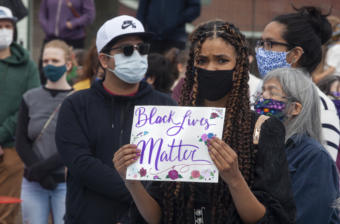
Lacey Davis joined about 250 people gathered for a public “I Can’t Breathe” rally protesting the death of a black man, George Floyd, who was killed after a white officer pressed a knee into his neck while taking him into custody in Minnesota. People held signs decrying violence against black people and calling out institutional racism, many supporting the Black Lives Matter movement on Saturday, May 30, 2020 in Juneau, Alaska. Similar protests happened throughout the state with hundreds turning out in Fairbanks and Anchorage, they’ve also erupted in dozens of cities all over the country. (Photo by Rashah McChesney/KTOO)

After watching protests unfold for Black lives in Alaska and across the country, Lacey Davis posted a video on Facebook about her experiences of growing up Black in Juneau.

“I live in a town that is very small. It’s rather secluded and that it’s generally a really friendly place. The people here for the most part are very open minded and accepting,” Davis said in the video.

Davis moved to Juneau when she was 13 and graduated from Thunder Mountain High School in 2016. She says that one day in high school, a boy asked her if she wanted to be her friend so he could call her the “n-word.”

“I didn’t really understand the implications of it. I thought that he was just trying to be dumb and funny,” she said. “My dad was the one that had to tell me like, no, this was wrong and when somebody says that to you, they don’t actually want to be your friend.”

And that wasn’t the only time Davis experienced racism in the classroom.

A few weeks after starting high school at Thunder Mountain, one of her teachers spoke about former First Lady Michelle Obama’s work on encouraging Black women to understand that they’re beautiful and powerful.

“A boy sitting behind me in history class said, ‘Yeah, except they’re not though.’ He said it quiet enough so that the teacher at the front wasn’t able to hear but I heard it and I turned around and I looked at him, and he just looked directly at me and smiled.”

Davis didn’t report that incident to the school. She says she felt like her experiences weren’t serious enough and also that her issues with anxiety played a much larger factor as to why she didn’t report it.

Juneau School District Superintendent Bridget Weiss saw Davis’ video. She says she wishes Davis would have reported what happened to her. And even though that was a missed opportunity for the school, Weiss says that she hopes that students would report inappropriate comments and behaviors.

“We want to support students,” said Weiss. “We would hope that she would, or a student in her situation would share her experience and so we have multiple ways we can respond. Discipline is one of them.”

According to school policy, derogatory language or any other negative racial comment is considered verbal harassment and bullying. It can also fall under threats to students, staff and members of the school community.

These are called Category I infractions which could mean a meeting with a parent, suspension and even expulsion.

But Weiss says that in recent years, the district has put in place new protocols for so-called restorative practices when it comes to issues related to race: things like conflict resolution, reducing harmful behavior and holding individuals accountable. They’re meant to repair harm, build healthy relationships and ultimately address the needs of the school community.

“Where there really is an opportunity for students to have a more productive, conducive conversation, if it’s appropriate there or with a student individually if the two students shouldn’t or couldn’t be together,” said Weiss.

While Juneau schools don’t have an office or department to deal specifically with racial equity, Weiss published a statement on the district’s website committing the district to anti-racism.

In it, Weiss writes that the district acknowledges that it “is not exempt from racial injustices and that each child deserves better.”

The statement also mentions a new strategic plan that highlights narrowing the achievement gap and building a more respectful district.

The district also has an equity workbook for families and a team of cultural specialists to advocate for Alaska Native students. Still, Weiss says that’s not enough to address race in the classroom for other students of color.

“We are not finding the right ways yet to support them to achieve at the same level as other students,” said Weiss. “We’re working on that.”

As for Davis, who is now a working professional, she hasn’t heard from the district since she published her video or the boys who said those things to her and about Black women. She doesn’t expect them to apologize.

“I just want people to be able to have that closure with themselves if that makes sense,” said Davis. “Like to be able to acknowledge what they did within themselves and then move forward from there.”

With the escalating nationwide conversation on race, Weiss says the district is looking at what next steps make sense to prioritize learning environments that are supportive of every student.

In a previous version of this story, the author incorrectly wrote that the first incident Lacey Davis experienced happened on her first day of middle school. It happened in high school. Additionally, Davis says she did not report the incidents because her issues with anxiety played a much larger factor as to why she didn’t report them.

Newscast — Wednesday, July 1, 2020

In this newscast:

  • State public health experts gathered Wednesday to discuss the latest science and the medical response to COVID-19.
  • Neiman Marcus is one of the clothing retailers that’s seen a decline in sales because of the coronavirus.
  • Federal wildlife officials are asking the public to be on the lookout for an entangled humpback whale reported near Sitka.
  • June was the second-wettest June ever recorded with 7.3 inches of rain.
  • AEL&P customers are expected to experience lower electric bills as a result of surplus energy and a rainy June.

Newscast — Tuesday, June 30, 2020

In this newscast:

  • Alaska has 400 active COVID-19 cases, another record high as numbers continue to climb.
  • Juneau will not see a downtown fireworks show this Independence Day weekend after all.
  • The city of Kotzebue recently lifted its mandatory COVID-19 closure order for churches.
  • Nearly half of Thorne Bay’s city council is facing a recall election today.
  • A company wants to use an advanced balloon to fly customers for Earth’s surface in Alaska to the highest reaches of planet’s atmosphere.
  • A proposed project in Juneau would use federal coronavirus funds to help restaurants feed residents experiencing homelessness or food insecurity.
Here’s Juneau’s plan for getting students back to school this year

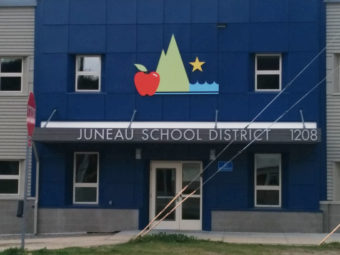
The Juneau School District offices. (Photo by Heather Bryant/KTOO)
The Juneau School District offices in 2014. (Photo by Heather Bryant/KTOO)


The Juneau School District released its plan for the start of the 2020 / 2021 school year.

Superintendent Bridget Weiss says the plan follows state guidelines for what will be the largest sanctioned public gatherings in Juneau since the pandemic began.

“We have built-in many mitigation factors in order to put us in the best position to be successful and be able to maintain some face-to-face instruction, as well as possibly grow into more face-to-face time with students,” said Weiss.

But that face-to-face time all depends on the risk level. The plan defines three levels from low to high.

Low risk (green) means there is no increase in reported cases in Juneau within the last two weeks. Medium risk (yellow) means a minimal number of cases as determined by the community. High risk (red) would mean a significant outbreak.

The plan says the district will likely begin the school year at a yellow, or medium, risk level.

“The most responsible thing we can do is start in a place that is most likely to secure face-to-face learning for a longer period of time and that we don’t end up in a risk situation in Juneau, where we end up having to go to full distance delivery,” said Weiss.

According to the plan, elementary students will be physically in the classroom four days a week for half days. There will be a morning group and an afternoon group. 

High school and middle school students will be in classes for two full days a week but will be in A and B groups to allow for social distancing. The rest of the week, they will learn from home.

The district plans to clean rooms in between groups, including wiping down desks, chairs and any community areas. Staff will also increase ventilation and limit student movements. 

Students will stay home on Wednesdays for distance learning, while the school is cleaned and teachers prepare for their classes. 

“It’s really a matter of layering several mitigation pieces together. It’s not any one mitigation strategy that’s going to keep us safe. It really is the combination and blend of strategies as we move ahead,” said Weiss.

In addition to the schedule changes, faculty and staff will be required to wear face coverings and students will be encouraged to wear cloth masks at school. Social distancing will be prioritized in the hallways and on buses. 

The district’s website says the plan will be updated as needed. Classes are scheduled to start August 17, though the district is considering delaying that start to August 24.

A previous version of this story stated that students will be in classes four days a week but did not specify that this only applies to elementary school students. The district’s plan states that high school and middle school students will only attend classes in-person two days a week while learning from home the rest of the week. The story has been corrected.

Newscast — Monday, June 29, 2020

In this newscast:

  • The pandemic has put a damper on most of Juneau’s usual July Fourth festivities, but one resident is still hoping for a parade.
  • A former big box store in Juneau that’s been vacant since 2016 is now for sale — about $2.3 million below what the city assessor’s office says it’s worth.
  • Trump administration officials with the National Marine Fisheries Service are telling staff not to use the words COVID-19 or pandemic.
  • A federal bankcruptcy judge has approved a plan for an auction to sell Alaska’s RavnAir Group in whole or in part.
  • The mayor of Anchorage has asked the Native Village of Eklutna to determine what happens to a statue of a British explorer following calls for its removal.
Site notifications
Update notification options
Subscribe to notifications