Pablo Arauz Peña, KTOO

Tlingit and Haida launch emergency response center for tribal citizens

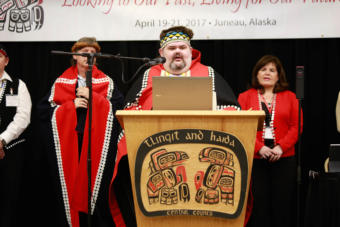
Tlingit and Haida President Richard Chalyee Éesh Peterson speaks at a meeting of Tribal Assembly Delegates in 2017. (Photo courtesy Central Council of the Tlingit and Haida Indian Tribes of Alaska)

The Central Council of the Tlingit and Haida Indian Tribes of Alaska recently created an emergency response center to keep tribal citizens updated about the pandemic in the state and across the country.

President Richard Chalyee Éesh Peterson and his team created the digital center as part of its emergency response coordination with federal, state and local governments.

The site features case counts in Alaska and in states with high populations of tribal citizens, prevention tips and other resources for citizens to stay up to date on the pandemic.

Peterson also appointed Public Safety Manager Jason Wilson to serve as the incident commander during the crisis, according to a press release.

Tlingit and Haida communications coordinator Raeanne Holmes told KTOO that the tribe is encouraging citizens who are struggling as a result of the pandemic to seek assistance on the Tlingit and Haida website.

“There are many tribal citizens in need right now and we must all work together especially to overcome this pandemic and the economic impact that it has had on our families and communities,” said Holmes in an email.

Those living outside of the Southeast Alaska service area can go to the Bureau of Indian Affairs directory and locate the nearest tribe to request assistance. More information on eligibility requirements can be found here.

The tribe also posted a call to action for consultation on CARES Act relief funds on its social media pages. The deadline for written comments is Monday, April 13.

Holmes also said one of the tribe’s most important values is to hold each other up.

“It is not our way to be disconnected from each other and many of our people are feeling isolated, emotional distress and even financial hardship related to COVID-19. Please take the time to reach out to your loved ones, check on them and lift them up. In this time of uncertainty, it is especially important that we take extra care in holding up our Elders to make sure they are safe,” said Holmes in the email.

Additionally, the tribe continues to operate the Community Drive for Food and Sundries to help the communities affected by the recent delay in ferry service before the pandemic. Donations are still being accepted at Super Bear IGA and Fred Meyer.


Tlingit and Haida leaders coordinate pandemic response efforts for citizens

(KTOO file photo)

As state, federal and local governments ramp up their responses to the COVID-19 pandemic crisis, tribal governments are also coordinating efforts to keep citizens safe and healthy.

Last week, the Central Council of the Tlingit and Haida Indian Tribes of Alaska sent an emergency declaration to its 31,000 citizens. Tlingit and Haida President Richard Peterson said they did so for two reasons.
“One is to make ourselves eligible for the funding,” said Peterson. “And two, just make sure that everybody understands how serious the situation is.”

The declaration is unprecedented in Tlingit and Haida’s 85-year history as a federally-recognized tribal organization. The council has also had to postpone its tribal assembly for the first time.

Peterson said the council is especially concerned for citizens in rural villages with elderly populations and those with compromised immune systems.

Meanwhile, tribal leaders are advocating for its citizens to receive economic relief payments as part of the federal government’s CARE Act package enacted last week. The package includes aid for tribal citizens across the country.

“I think that’s (an) important recognition by the federal government that the tribes are integral parts of our communities and that we, as governments ourselves, have a role to play,” said Peterson.

And while Tlingit and Haida adapts its social services during the crisis, Peterson is asking citizens to maintain physical distancing — but to still reach out to the Central Council however they can.


Capital Transit asks residents to ride bus only when absolutely necessary

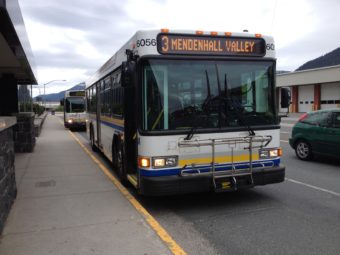
A Capital Transit bus stops at the Federal Building. (Photo by Lisa Phu/KTOO)

Capital Transit is asking Juneau residents to use buses strictly for essential travel during the COVID-19 outbreak.

In addition to free fares announced last week, it has enacted new measures effective today. 

Engineering and Public Works director Robert Barr said it’s crucial that residents stay at home unless they absolutely must use the bus for critical reasons such as:

  • Healthcare appointments and pharmacy visits
  • Grocery shopping
  • Employment at a critical job

Barr said the service has already implemented measures to keep people safe — they’re requiring passengers to board the bus from the back door to create distance between passengers and bus drivers. Riders with disabilities can still board from the front door. 

All passengers are encouraged to follow social distancing guidelines.

“Please only ride the bus when you really need to ride the bus,” Barr said. “Do your best to practice all those good hygiene practices. Cough into your shoulder if you have to cough. Don’t touch your face. Wash your hands. Try not to touch surfaces unless you need to touch them.”

That goes along with new changes the service made to its routes to adapt to official prevention guidelines. As of today, the following changes go into effect:

  • Limiting bus capacity to nine riders at at time
  • Canceling Express Routes 5 and 6 — those go to the University of Alaska and Riverside Drive
  • Adding additional buses on Routes 3 and 4 — those travel between downtown and Mendenhall Valley

For more, see Capital Transit’s COVID-19 information page.

UAS students return to class, but most are staying home

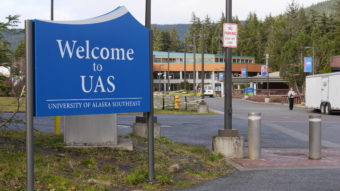
University of Alaska Southeast's Juneau campus on Tuesday, Nov. 15, 2016. (Photo by Quinton Chandler/KTOO)
Students returned to classes at the University of Alaska Southeast this week. (Photo by Quinton Chandler/KTOO)

Classes resumed this week at the University of Alaska Southeast after an extended spring break.

Most students are studying remotely, but Lori Klein, vice chancellor of enrollment management and student affairs, said that a handful of classes with 10 students or less are meeting in person with the expressed consent of both faculty and students. Students in those classes who want to study from home have that option.

Klein said campus dorms have also been evacuated except for students who do not have a safe place to return to. Out of about 150 students living on campus, only about 30 are still living on campus within social distancing guidelines.

Most faculty and staff are also working from home except for essential personnel. That includes safety, housing, facilities and dining staff.

“It’s just very quiet around here,” said Klein.  “In many cases, (we are) seeing an increase of volume in how we’re serving students compared to past years because some students are making an adjustment to a new normal that they need a lot of support for.”

Klein said the staff is encouraging students to reach out by phone or online for advising, tech support or counseling.

The health clinic is also open for students — but only for phone or video appointments.

For more, see the UAS coronavirus response page and the student services dashboard.


Site notifications
Update notification options
Subscribe to notifications