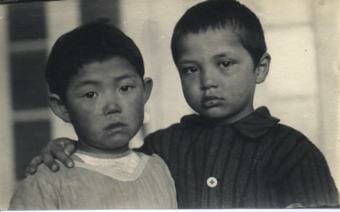
The so-called Spanish flu in 1918-1919 killed more than half of adults and Elders in villages across Alaska. Here, two orphans who survived the pandemic are near Bristol Bay. (Photo courtesy of the Alaska State Archives via Kathryn Ringsmuth and the Alaska Packers Association)
It’s October 1918 in Juneau, and the future of Alaska depends on which comes first — winter or the so-called Spanish flu.
At that time the flu had already been ravaging the outside world, infecting one-third of the global population. It added to the tragic loss of human life in World War I, which was about to end. When it was all over, records show at least 50 million total deaths from the flu worldwide.
Alaska Territorial Governor Thomas Riggs Jr. had read reports of Spanish flu infections and over 350 deaths in Seattle. He asked all steamship companies to inspect passengers for symptoms and to not allow any sick passengers on board.
The S.S. Admiral Farragut docked in Juneau. (Photo courtesy of the Juneau-Douglas City Museum)
But despite the community’s best efforts, the first influenza case in Alaska was reported in Juneau on Oct. 14, 1918 — before winter stopped ships from coming.
Niko Sanguinetti is a curator at the Juneau-Douglas City Museum.
“The main thing was that ships leaving Seattle, if they would do a visual inspection of everyone getting on the ship, and if they looked sick, then they would be told they couldn’t go,” said Sanguinetti. “Obviously the problem with that is that a lot of people didn’t show symptoms until they were already up here.”
Sanguinetti said there are many historical parallels between the influenza pandemic over a century ago and the coronavirus pandemic.
A newspaper article describes Juneau under quarantine in December 1918. (Image courtesy Library of Congress)
Articles from the Alaska Daily Empire (now called the Juneau Empire) paint a gloomy and eerily familiar picture of Juneau during the flu pandemic: stories of schools shutting down, businesses closing and mandatory self-quarantines.

“Some of these newspaper articles honestly could be printed two days ago. The same mentality, the same fears, the same concerns, the same uncertainties,” Sanguinetti said. “It’s very creepy.”
Haida Elder Tom Abel said his Aunt Carrie witnessed the flu pandemic firsthand as it spread through Southeast Alaska.
“She kind of described the situation to me, you know: ‘There’s people are dying so fast that they couldn’t bury them, and bodies are rotting in the streets and … were literally rotting where they dropped,’” said Abel.
A group of orphans build a path outside of Bristol Bay. (Photo courtesy of Charles Black and the family of Linus H. French)
Abel’s family survived in isolation, but going into 1919, whole villages in Alaska were decimated as the second wave of influenza traveled on ships and dog sleds up north.
“It made its way all the way up to the Seward Peninsula and ravaged northern Alaska and, you know, killing and devastating villages,” said Katie Ringsmuth, an Alaska historian at the University of Alaska Anchorage.
It was the second wave of the flu that hit Alaska the hardest. And for many Alaska Natives, it came with the history of colonization.
“This was a terrible, terrible disease that wiped out really the heart and soul of the population and left behind a population of orphans,” said Ringsmuth.
A group of orphans stands outside in Bristol Bay with Dr. Linus H. French, the only doctor in the area at the time. (Photo courtesy of Charles Black and the family of Linus H. French.)
Historical documents show gruesome scenes. Cannery workers found orphans left to fend for themselves, surrounded by dogs and the remains of their relatives.
Overall, the flu killed a greater percentage of people in Alaska than in any other state or territory in the U.S. except for Samoa.
A group of Alaska Native orphans sit outside near Bristol Bay. (Photo courtesy of the Alaska State Archives via Kathryn Ringsmuth)
But Ringsmuth said the survival stories of those orphans in the face of a pandemic would inspire generations.
“Those courageous kids survived. And not only survived, they would go on to give birth to a generation that’s, you know, gonna lead Alaska into the (Alaska Native Claims Settlement Act) days and (Alaska National Interest Lands Conservation Act) and in subsistence and becoming some of the most powerful Indigenous people on the planet,” said Ringsmuth.
Stories that go to show that, in times of great tragedy, there are also extraordinary triumphs.
Lots of people must have needed a laugh. The overwhelming number of calls has taken down the phone line. No joke! The techs are on it, stay tuned. https://t.co/h4XPIOEbZu
A gag a day keeps the virus away — or, at least it’ll brighten up your day.
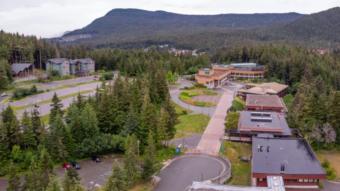
Juneau’s parks and recreation department recently started a joke hotline for residents to call in case they need a quick laugh.
Recreation coordinator Dawn Welch said the department got the idea from a parks-and-rec group page.
“It’s just a joke a day,” said Welch. “Call the number and you’ll hear a joke, and it will get updated every day before 10 a.m. It is seven days a week.”
The phone line was originally used as the hiking hotline, but the department is trying to innovate because that program is suspended. Whether or not it will stick around is up in the air.
“I think that is yet to be determined,” said Welch. “I guess we’ll see how it goes.”
Welch also said the line hit a snag on the second day — she thinks it’s because too many people called in. But hopefully, they’ll get the line back up soon.
Juneau's new joke hotline hit a snag on the second day: Too many people like jokes.
ICYMI, here's Wednesday's joke, courtesy of @cbjuneau.
The University of Alaska Southeast campus in Juneau, shown on July 25, 2019. (Photo by David Purdy/KTOO)
Last month, the University of Alaska Southeast closed down its physical campus, removing most students and transitioning to largely online learning.
But students and teachers say that transition has not been smooth.
Robin Gilcrest is a professor of architecture and construction technology. Normally her classes are a hybrid of physical and digital learning. Before the pandemic, she was teaching students how to use drafting software.
“I’ve been calling or texting them individually to make sure that they’re OK. But no, this is very traumatic and some of my students were working and now they’re not,” she said.
Now her classes are fully online. And, without that in-person interaction, she said some students aren’t as engaged as she hoped they’d be.
“They’re probably more worried about how they’re going to pay their rent than whether they get an assignment done,” said Gilcrest.
For many students, online learning just isn’t compatible with their classwork.
Sadie Inman’s focus is geography and the environment, as well as outdoor studies.
“A lot of the professors don’t know what to do,” she said. “Some of my classes have dropped assignments and other classes have made up more assignments. And so everything’s kind of just upside down.”
On top of the stress of classwork during the pandemic, housing is increasingly becoming an issue.
Inman is one of about 150 students who were living on campus before the pandemic. Only about 30 students are still there. They didn’t have safe places to go home to.
And while Inman was able to find housing through her work as a volunteer firefighter, options were limited for other students, like Sage Logan.
Logan left campus in a hurry when the university asked students living on campus to leave on March 17.
He’s now back home in Washington state, living in close quarters with his family, but he feels the impact of being removed from the community.
“People are close. You often refer to your professors by their first name,” he said. “It’s a very familiar kind of feeling. So kind of being removed from that environment feels like it kind of adds a little salt in the wound for this isolation.”
But — there are still ways for students to stay connected. Online meet-ups and art therapy sessions are held regularly through the university’s social media pages.
A Sealaska corporate logo adorns the roof of the Southeast Alaska Native corporation’s headquarters in Juneau on May 2, 2018. (Photo by Jeremy Hsieh/KTOO)
Story updated Saturday, April 11 at 8:50 a.m.
Sealaska Corp. is pledging $1 million to communities of its 22,000 shareholders impacted by the COVID-19 pandemic.
CEO Anthony Mallott said the company has been in a good position to help their most vulnerable populations — especially Elders and youth — in Native villages and in areas with concentrations of shareholders, like Anchorage and Seattle.
“We know that a million dollars pales in comparison to the government stimulus,” said Mallott. “If we can help entities, first off, make sure they’re getting access to that government stimulus, and then use our million to offer it to areas that have unmet needs that the government stimulus doesn’t cover.”
The first round of relief will go to first responders and Native villages that were already impacted by recent ferry service delays.
Sealaska Board Chair Joe Nelson said the company will see if communities need more assistance after they get the relief.
“I’m sure we’ll assess the needs down the road here as things do evolve, because obviously there’s going to be lingering impacts and residual impacts and things that are just going to continue for quite a while here, as far as the economy and all these other issues,” said Nelson.
The first half of the money was expected to be dispersed starting Friday. The second half will be utilized to assist shareholder entities in the coming months.