Rhonda McBride

Alaska Natives: Pandemics past and present

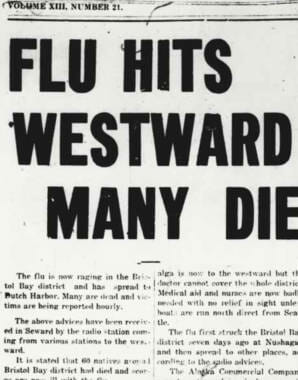
The year is 1919. The second wave of the Spanish Flu sweeps across Bristol Bay, leaving death and devastation in its wake.

On Friday’s Juneau Afternoon, the story of what happened in Bristol Bay – the lessons from the past that are driving today’s decisions for Alaska Natives in the battle against COVID-19.

A brother puts his arm around his sister to reassure her. Both were orphaned in the 1919 Bristol Bay flu epidemic. Photo courtesy of Tim Troll and the Dr. Linus French family.

In the first part of the program, we hear from two historians — Tim Troll who wrote Bristol Bay Remembers: The Great Flu of 1919 — and Katie Ringsmuth, who teaches history at the University of Alaska Anchorage.  Ringsmuth recently accepted a position as the state historian.

Although many parts of Alaska were hit hard by the Spanish Flu, compared to other places, the history in Bristol Bay is well documented, because of the presence of large fish cannery operations. Troll and Ringsmuth talk about what the cannery records reveal and how an estimated 40 percent of the region’s population, mostly Alaska Native, did not survive the pandemic.

The historical trauma from this epidemic and others — from polio to tuberculosis — is still very much alive today for Alaska Natives.

In the next part of our program, we hear from two Tlingit writers, Joaqlin Estus and Vera Starbard. Estus is a longtime Alaska journalist and currently a national correspondent for Indian Country today. Starbard is a playwright and editor of the First Alaskans Magazine. She also has the Writing Raven blog.

Both women have worn a lot of hats over the years, including handling communications for Native health organizations. What a difference a hundred years makes. Estus and Starbard talk about how tribal organizations are part of the reason why Alaska currently has the highest COVID-19 vaccination rate in the county.

Rhonda McBride hosts Juneau Afternoon on Friday, Feb. 4, 2021, live at 3:00 p.m. on KTOO Juneau 104.3, online at KTOO.org, and repeated at 4:00 p.m. on KRNN 102.7.

Nurses holding babies orphaned in the Bristol Bay flu epidemic. Photos courtesy of Tim Troll and the family of Dr. Linus French
Children orphaned in the Bristol Bay flu epidemic had to grow up early. Photo courtesy of Tim Troll and the family of Dr. Linus French.
Many of the children were sickened by the flu but survived while their parents did not. Photo courtesy of Tim Troll and the family of Dr. Linus French.
Nurse tending to a group of children orphaned in the Bristol Bay flu epidemic. The girls had their hair shorn, to prevent the spread of lice. Photo courtesy of Tim Troll and the family of Dr. Linus French.
 Many of the orphans only spoke Yup’ik. When they were housed in an orphanage near Dillingham, they not only had to learn a new language but a new way of life. Photo courtesy of Tim Troll and the family of Dr. Linus French.
Nurses at the cannery initially cared for the children until an orphanage could be built. Photos, courtesy of Tim Troll and the family of Dr. Linus French.
The orphans not only lost their families to the flu, but a way of life. Photo courtesy of Tim Troll and the family of Dr. Linus French.
These children are the ancestor’s of today’s Bristol Bay population. Photo courtesy of Tim Troll and the family of Dr. Linus French.

Some of the best Black history is family history

For some, Black History Month is an opportunity to explore their own Black history, stories passed down across the generations.

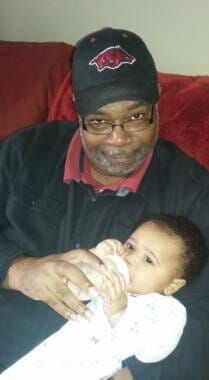
Kenneth Monts and his granddaughter. Monts believes the best Black history is made up of family stories. Photo courtesy of Monts’ Facebook page.

As host of this Thursday’s Juneau Afternoon, Kelli Patterson takes us on her own personal journey of discovery. Her guest is her uncle Kenneth Monts, a history buff, now living and working in Katy, Texas as a graphic design and marketing consultant.

Monts has storehouse of knowledge about Black history, that grew out of his daily ritual of researching and posting items on his Facebook page. But Monts says African Americans should look to their own families for some of the best stories. In this show, he tells his niece Kelli just how to do that.

Monts says,  in the process of researching his own family’s history, he uncovered stories about overcoming slavery and an inter-generational passion for getting a good education, stories that almost sound like fodder for a good movie.

Kenneth Monts’ mother worked hard to raise nine kids. She also impressed upon them the value of getting a good education.

This week’s presentation from the Juneau Black Awareness Association kicks off a month-long series on Black history. Live at 3:00 p.m. on KTOO Juneau 104.3 on Thursday, February 4th, 2021. Also online at KTOO.org and rebroadcast at 4:00 p.m. on KRNN 102.7.

Kenneth Months grew up in a family of nine. He says he collected a lot of good stories at family gatherings.


Crowded calendar for February’s First Friday

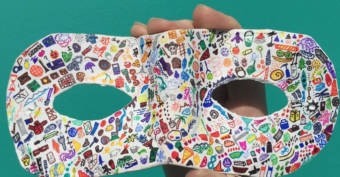
On this Wednesday’s Juneau Afternoon, arts are front and center stage, starting with the Juneau-Douglas City Museum. You’ll hear about some small pieces of art. Only 12 by 12. But the museum has big plans for them in its 17th annual Community Art Exhibit. Find out about the entry requirements and hear about First Friday highlights. Guest: Niko Sanguinetti, Curator of Exhibits and Collections.

For its First Friday event, the Juneau Arts and Humanities Council features the genius of Gabrielle Vance, a geologist, an artist and a cartoonist. Also a preview of JAHC’s February events. Guest: Nancy DeCherney, Executive Director.

Some other highlights:

What’s on the Juneau Police Department’s radar screen for this month? Also an update on department staffing levels. Guest: Chief Ed Mercer.

Juneau Police Chief Ed Mercer, who gives regularly gives Juneau Afternoon audiences updates on staffing in his department. Courtesy of the Juneau Police Department.


The Juneau Economic Development Council’s hopes that a cell phone app will encourage you to shop local.  Also, hear about what it calls its investment in youth — it’s FIRST Robotics program. Guests: Brian Holst, Executive Director, Alyson Cooper, FIRST Program Manager, and Ben Macauley, Thunder Mountain student.

Students competing in the Juneau Economic Development Council’s FIRST Robotics program. Photo courtesy of JEDC. 


Students from all over the state compete in the Juneau Economic Development Council’s Robotics program.

Sheli DeLaney is your host for Juneau Afternoon on Wednesday, February 3rd, 2021, which airs live at 3:00 p.m. on KTOO Juneau 104.3, online at KTOO.org, and repeated at 4:00 p.m. on KRNN 102.7.


Alaska Folk Festival and drive-in Pamyua concert

When it comes to the performing arts in Juneau, the response to the pandemic has been, “The show must go on.”  And it has. In some safe and surprisingly enjoyable ways.

This Tuesday’s Juneau Afternoon will have the latest on the Alaska Folk Festival. Guest: Andrew Heist, President of the AFF Board.

Some other upcoming events you’ll hear about:

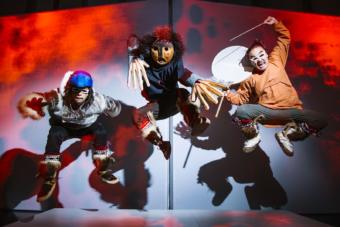
  • A drive-in concert featuring Pamyua. Guest: Juliette Alldredge from the University of Alaska Southeast
Wall of Love. Visitors to the Juneau Artists Gallery are asked to post personal notes inside this heart display to express what they love about Juneau. One will be selected to receive a $100 gift certificate. The winner will be announced at noon on Saturday, Feb. 13th on the gallery’s FaceBook Live feed. Photo courtesy of Laurie Craig.
  • Juneau Artists Gallery First Friday and its Valentine’s Day theme. Guest: Laurie Craig, artist.
  • 14th Annual Luna Film Festival, which features films for women, by women and about women. Guest: LaRae Jones, Juneau Pro Choice Coalition.

Sheli Delaney hosts Juneau Afternoon on Tuesday, February 2nd, 2021, live at 3:00 p.m. on KTOO Juneau 104.3, online at KTOO.org, and repeated at 4:00 p.m. on KRNN 102.7.


Celebrating Tlingit art: from Google Doodles, to national book awards, to postage stamps

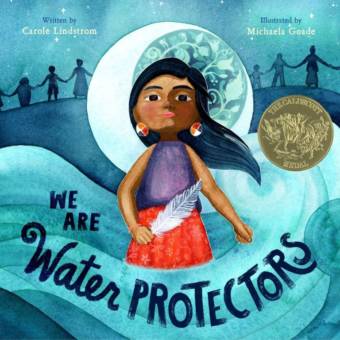
It’s been a whirlwind couple of months for Michaela Goade, a watercolor artist who grew up in Juneau and found herself in the national spotlight for her Tlingit-inspired work.

Michaela Goade grew up in Juneau and moved to Sitka in April. She’s a member of the Kiks.ádi Clan of Sitka. (Photo by Sydney Akagi)


From the birth of her Google Doodle to her recent national children’s book award, Goade shares the story of how the seeds to these successes were planted in the fertile ground of Juneau’s artistic community.

Rico Worl designed the U.S. postage stamp which tells the story of how Raven stole the moon and the stars.

Also on Monday’s show, we hear from Rico Worl, another Tlingit artist whose work will soon find a national audience in the form of a U.S. postage stamp.  How his design tells the story of Raven, stealing the moon and the stars.

And have you ever wondered how illustrators of children’s books approach their work? The State Museum opens an exhibit this month, which highlights four Alaskans, who have mastered the art of bringing stories to life for young children. Sarah Asper Smith and Evon Zerbetz  talk about how it’s designed to give insight into the artistic process, with a component for kids — in hopes of inspiring them to illustrate their own books.

Rhonda McBride hosts this edition of Juneau Afternoon on Monday, Feb. 1, 2021,  which airs live at 3:00 p.m. on KTOO Juneau 104.3, online at KTOO.org, and rebroadcasts at 4:00 p.m. on KRNN 102.7.


Sticks and stones…

Maybe it’s that childhood rhyme about sticks and stones that make us underestimate the power of words to do more than break bones. On Friday’s  Juneau Afternoon, why a license plate, stamped with hate, has Alaska talking.

Eva Gardner, John McKay, Libby Bakalar and Rebecca Braun offer their perspectives on two state personalized license plates with the words Fuhrer and 3Reich.

Some other highlights:

  • Peter Micciche talks about the difficult cards he’s been dealt as Senate President. How he hopes to turn them into a winning hand.
Sen. Peter Micciche, R-Soldotna. Micciche says he hopes he can get lawmakers to compromise on the size of the Permanent Fund Dividend. (Photo by Skip Gray/360 North)
  • How a shared passion for ice cream — and free ice cream at that — brought two lawmakers on the opposite side of the political spectrum together.  Marc Wheeler of Coppa, an handmade ice cream shop, offered them a deal they couldn’t refuse.
Rep. Jonathan Kreiss- Tomkins (D-Sikta) and Sen. Shelley Hughes (R-Palmer) took advantage of Coppa’s free bi-partisan ice cream offer.

Rhonda McBride hosts this edition of Juneau Afternoon  on Friday, January 28th at 3:00 p.m. on KTOO Juneau 104.3, online at KTOO.org and repeated at 4:00 p.m. on KRNN 102.7.

Site notifications
Update notification options
Subscribe to notifications