Southeast News

Ketchikan considers International Joint Commission involvement on transboundary mines issue

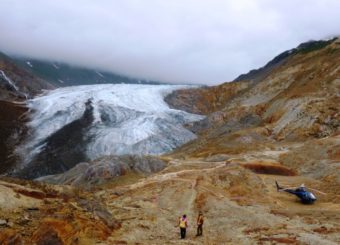
Oxidized rock colors a valley where one of Seabridge Gold’s KSM project’s open pit mines will be dug. (Ed Schoenfeld/ CoastAlaska News)

A resolution urging the International Joint Commission to get involved in the issue of transboundary mines will be in front of the Ketchikan Gateway Borough Assembly on Monday.

The International Joint Commission allows U.S. and Canadian officials to talk about and, hopefully, resolve issues of mutual concern. A number of proposed mines close to rivers that flow from British Columbia into Alaska have raised concerns among conservation, fishing industry and Native groups.

The summertime dam breach at the Mount Polley Mine, which released millions of cubic meters of tailings, heightened those concerns.

The Assembly’s resolution specifically mentions five mines of concern: the Tulsequah Chief in the Taku River watershed; the Galore Creek, Red Chris and Schaft Creek mines in the Stikine River watershed; and the proposed Kerr-Sulpherets-Mitchell mine in the headwaters of the Unuk River.

Other Southeast Alaska communities have taken similar action. Sitka, Wrangell, Petersburg, Tenakee Springs and Port Alexander all have either passed resolutions or written to Alaska’s congressional delegation, urging the United States to intervene.

Sitka herring forecast lowest in a decade

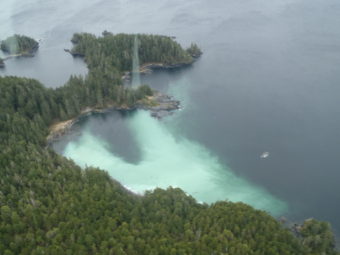
Herring spawn, on the west side of Middle Island Tuesday morning (3-25-14). (Photo courtesy ADF&G/Dave Gordon)
Herring spawn on the west side of Middle Island in March of 2014. (ADF&G/Dave Gordon)

Sitka’s commercial herring fleet should expect to catch significantly fewer fish this spring. The Alaska Department of Fish and Game, which released its preliminary harvest level for the 2015 Sitka Sound sac roe herring fishery Friday.

The preliminary guideline harvest level is 8,712 tons; that’s the lowest its been since 2003 and about half of last year’s target of 16,333 tons. The herring fleet brought in 16,957 tons last year, exceeding the target and making that harvest one of the largest ever.

Fish and Game expects 44,237 tons of herring to spawn in and around Sitka Sound. That’s the lowest forecast in a decade, and well below the past several years when forecasts have consistently been above 70,000 tons.

The department forecast a biomass of 81,663 tons for last year. Sampling and aerial surveys suggest the actual population was 68,399 tons.

Fish and Game will take samples again in late January or early February; the final harvest level will be announced by early March when the sac roe herring fishery usually opens.


Bear cub shot and killed after fatal mauling

Authorities shot and killed a brown bear cub Monday on Chichagof Island. It’s believed to be one of three responsible for the fatal mauling of a Sitka man over the weekend.
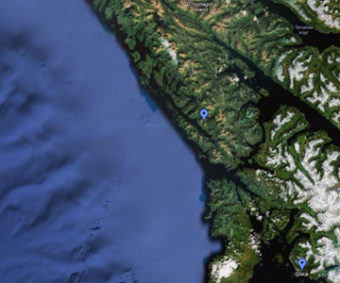
Sitka Police Lt. Barry Allen says a team performed a necropsy on the cub, but that the results are pending. A Sitka detective and two Alaska Wildlife Troopers spent Monday and today (Tuesday) on Chichagof, looking for the sow and two cubs spotted in Poison Cove. That’s about 30 miles north of Sitka.

The bears behaved aggressively on Sunday toward some boaters who came ashore to investigate an abandoned skiff on the beach. The partially consumed remains of 54-year-old Tomas Puerta were found nearby.

Allen says once a bear kills and consumes a human, it could become habituated to the behavior.

UPDATED: Man dead after bear mauling near Sitka

A Sitka man is dead after an encounter with a brown bear. Authorities spent Monday searching southern Chichagof Island, near Sitka, for the animal believed to be responsible in the fatal mauling of a 54-year-old Tomas Puerta.

On Sunday, a good Samaritan vessel noticed an unsecured skiff on the beach near Poison Cove. That’s on southern Chichagof Island, about 30 miles north of Sitka.

“When they were taking a look and investigating that, they had gone back in the woods a little bit farther, and hollered, and ended up startling a sow and cub,” Sitka Mountain Rescue Capt. Don Kluting said. “Things just didn’t seem right to them, so they went back out to their boat and notified Coast Guard sector Juneau.”

The Coast Guard called Sitka Mountain Rescue, and they along with Sitka police and an Alaska State Trooper responded.

Sitka police said in a statement that responders found a campsite with evidence of a struggle. A trail of disturbed vegetation and articles of clothing led responders to a brown bear cache, which contained partially consumed human remains.

Puerta was tentatively identified based on items found at the scene and information from his friends and family. His remains were flown to the state Medical Examiner’s office in Anchorage, which will confirm his identity.

Kluting was one of the first people on scene, and he says things looked amiss even from the beach, where the engine cover on the 13-foot skiff had been removed and placed inside the boat.

“We don’t have confirmation or anything, but it certainly appears like there was a mechanical problem, and the motor was in the down position, and it ended up on the beach in that location,” Kluting said. “I can certainly understand why the reporting party went ashore to take a look and investigate initially. It was precarious; it wasn’t normal. It’s not how somebody would normally anchor a boat and leave it.”

Investigators are continuing to piece together what happened on shore. Puerta was working under contract with the Forest Service doing some tree-thinning work in the Tongass National Forest.

The incident took place in a triad of islands known as “the ABCs.” That stands for Admiralty, Baranof, and Chichagof. The three islands are among the most densely populated brown bear habitats in the world.

Still, violent encounters between bears and humans are rare occurrences.

The last fatal bear encounter in the ABC islands was in 1988, when a 40-year-old hunter was killed by a brown bear while hunting alone near Port Alexander. The last fatal bear encounter in Southeast Alaska occurred in 2000, in Hyder. A man in a campground was killed by a bear frequenting a nearby landfill.

“In most cases, when bears and people come in contact, it’s sort of reciprocal: both want to get out of one another’s way, and bears typically will flee, assuming they’ve got a place to get away to or an avenue out,” said Doug Larsen, Southeast regional supervisor for the Alaska Dept. of Fish & Game’s wildlife conservation arm.

Larsen says there are exceptions to fleeing, of course, such as when a sow is guarding her cubs, or a bear feels its food source is threatened.

“And when they’re surprised to where they don’t have a place they can flee to,” he said. “Then it’s that fight or flight, and in those cases, there have been instances where a bear will come after a human, basically to protect themselves.”

But Larsen also stresses that he’s speaking generally about bear behavior. Fish & Game is not yet involved in this case, and too little is known right now to determine why a bear might have killed Puerta.

Sitka police and state troopers continue to investigate, and spent Monday looking for the bear or bears that might have been responsible. Standard practice after a fatal bear encounter with a human is to kill the bear involved. Larsen says that’s partly to learn more about why the bear was behaving aggressively, and partly to prevent it from happening again.


View Man dead after bear mauling near Sitka in a larger map

One injured in Sitka Coast Guard boiler explosion

A civilian contractor was injured Wednesday at Coast Guard Air Station Sitka when a biomass boiler exploded in the station’s main hangar. This incident happened about 12:30 p.m.  The injured man was transported by local EMS to the hospital.

Commanding officer Ward Sandlin said Air Station Sitka personnel and local authorities are working with investigators to determine the cause of the explosion. The station’s other two biomass boilers have been shut down pending the results of the investigation.

Air Station Sitka is the first base in the Coast Guard to convert to the biomass system, which burns wood pellets instead of fuel oil.

Wednesday’s incident comes less than a week after U.S. Senator Mark Begich toured the boiler and praised the project. Air Station Sitka was testing the new wood pellet system, and hoped to have it fully operational by November 1st.

Ketchikan Council again rejects community priority list

The hot potato that is the 2014 community priority request list will go back to the executive committee for review. The Ketchikan City Council again rejected the list during Thursday night’s regular session.

The City Council had rejected the list when they last met – Sept. 6 – and sent it back to the Ketchikan Gateway Borough Assembly for reconsideration.  Committee chairman and Borough Mayor Dave Kiffer declined to reconvene the committee. Earlier this week, the Assembly voted unanimously to maintain the list.

Read original article

Council again rejects community priority list

Site notifications
Update notification options
Subscribe to notifications