KXLL

The Ghostface Killah Rises Again

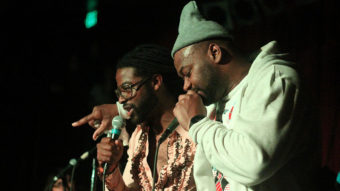
Adrian Younge (left) and Ghostface onstage at the Seattle stop of their tour last week. Erich Donaldson

Ghostface Killah is a compulsive storyteller. His fiction is painterly, and he delivers it in a headlong rush. On “Impossible,” from the 1997 album Wu-Tang Forever, he rhymed, “He pointed to the charm on his neck / With his last bit of energy left, told me rock it with respect / I opened it, seen the God holdin’ his kids / Photogenic, tears just burst out my wig.” He’s a romantic, , and never stoic.
The images in all his songs are this vivid, sometimes to the point of distraction. He describes scenes with such detail he might have a back story for each verse. He prefers to work with members and affiliates of the groundbreaking and influential Wu-Tang Clan, which he co-founded. “Not everybody can tell a really good story,” he says. “They veterans.” As is he. For 20 years he’s been playing unreliable narrators and characters who second-guess themselves. Yelling, going for broke whenever he’s in front of a microphone. Ol’ Dirty Bastard may have had no father to his style, but it’s Ghostface who’s still the same guy we met back in 1993.

His latest project contains all the preoccupations we already know him for — ziti, women, soul music, Wallys, campfire horror, injustice — but in some ways there’s even more going on than usual. Twelve Reasons To Die is also a collaboration with a film composer on a concept album that’s inspired a comic book and a theatrical stage show.
Ghostface Killah with Adrian Younge and his band, Venice Dawn, after their first performance together. Ghostface Killah and Adrian Younge’s new album, Twelve Reasons To Die, comes out April 16.

Born Dennis Coles on Staten Island, New York City, he can now, at the age of 42, look back on a career that’s seen him play an integral part in one of the most respected groups in hip-hop history and release equally successful solo work. He’s toured the world several times over, but he’s not done yet.

“I’m just, right now, glad to be a part of anything,” says Ghostface. “Yo, I been here for so long. You know what I mean? But I don’t feel old; I’m not going nowhere. I’m still talented. This is what I do. And I do it well.”

What he’s doing now is a concept album about an Italian gangster betrayed, murdered and resurrected as a black superhero bent on revenge.

This was not his idea. That came from Bob Perry. He’s worked in the music industry for decades, distributing records and doing A&R for hip-hop artists like Mobb Deep and the Alchemist, which is basically matchmaking rappers and producers. He’d always wanted to make a concept album, and he wanted to hear more live instrumentation in rap.

He scoured the Internet until he heard Adrian Younge, who had a studio full of antique instruments. “This is the guy I can make that — you know, my rock opera with.”
Composer and producer Adrian Younge has produced two new albums: one with William Hart of The Delfonics and another with rapper Ghostface Killah.

Perry called Younge and told him he wanted him to make an album with Ghostface. Younge says they were both thinking big. “We created this whole crime thriller thing that takes place in the late ’60s,” he says. “I don’t want to give away the story because it’s like a movie — we look at this like a real movie.”

And they figured — if the story they dreamed up is so visual, why not tell it that way, too? Perry took their idea to comic book writer Matt Rosenberg, who began work on a version of this saga in his medium. Younge and Perry sent him plot points, and Ghostface began fleshing out the role they’d cast him in.

“We just kind of gave him broad instructions,” says Perry. “Song 1 is about his rise to power. Song 2 is about being the man. Song 3 is about getting crossed, going to war, falling in love. And he took it from there.”

Ghostface says he had no problem working like that. “Just whatever you give me — it’s like a hit man. You know, it’s what I get paid for.”

He’s just being modest. Younge describes what Ghostface brought to the table: “He’s a kind of rapper that’s theatrical and cinematic. He’s very savvy in the type of production he chooses, and how he approaches the production.”

Ghostface has his methods. “Basically, whatever really sounds good to me. Beats to me is like women. You see a chick that’s like, ‘Oooh, man.’ I don’t know how everybody else does it, but that’s how I do it,” he says. “I got a good ear for music. If it feel good to me, then, a lot of times, it’s gonna feel good to you.”

When Younge sent Ghostface the music he wrote for their project, the rapper realized they had something in common. “We love old records. We got old souls,” he says. “And we love those kind of records.”

Ghostface has been incorporating the raw ’60s soul sound into his songs since before he had a record deal. “I had a lot of soul,” he says. “I rhymed over the words. I been rhyming over — in the ’80s, I rhymed over The Temptations. You know what I mean? Over it.”
The Wu-Tang Clan. Clockwise from left: Ol’ Dirty Bastard, the GZA, the RZA, Inspectah Deck, Masta Killa, Raekwon and Ghostface Killah. Center, from left, Method Man and U-God.

When the Wu-Tang Clan was in its infancy, when Ghost and his compatriots were rhyming in staircases, banging on the walls to make a beat — even on the group’s debut album — Ghostface hadn’t yet found his voice. “They was more nicer than I was,” he says. “I picked up from each, from Dirty, from Deck, to Rae, Tical — incorporated that into myself.”

His affinity for soul music became his signature. “I grew to be more nice,” he says. He asked the lead singer of The Delfonics, a group from the ’60s he listened to growing up, to perform his solo debut, 1996’s Ironman.

And on his fourth album, he went even further. He took an old Delfonics hit, “La La (Means I Love you),” and gave it the Temptations treatment.

“Ghostface literally rapped over the entire track. Not the instrumental, the entire track,” says Younge, talking about a song named “Holla.” “It’s different, but it works. I don’t know how he does it, but it always works.”

Ghostface, Younge and their band are touring Twelve Reasons to Die, in a production that acts out Ghostface’s detailed storytelling and the cinematic style of Younge, who has composed for films. It involves masks, long red robes and a giant book from which Ghostface reads one song. They deftly transition between the new high-concept tracks, Wu-Tang party rockers and Ghost’s best-loved work from a two-decade run — “Mighty Healthy,” “Daytona 500,” “4th Chamber,” “Run” — rearranging, reintroducing and knitting together soul music and hip-hop, in real time.

This is the part that Ghostface sounds most excited about. “I would always want to do a Ghostface show, like, to make it look like plays,” he says. “Each track is you just sliding in. Just make it theatrical — like a cinema.”

The stage show, like the album, tries to create something new. They’re pairing old lyrics with original music, throwing fresh verses on top of sounds made on 50-year old instruments. The point is to do something Ghostface has done in the past — push hip-hop forward.

Mosh Pit Math: Physicists Analyze Rowdy Crowd

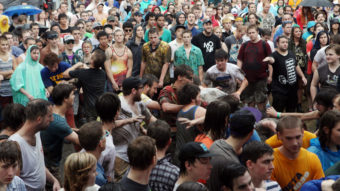
Fans in the mosh pit during the performance of Liturgy at the 2012 Pitchfork Music Festival in Union Park, Chicago, on July 14, 2012. Roger Kisby/Getty Images

Physics and heavy metal don’t seem to have a lot in common, but Matt Bierbaum and Jesse Silverberg have found a connection. Both are graduate students at Cornell University. They’re also metal heads who enjoy going to concerts and hurling themselves into mosh pits full of like-minded fans.

About five years ago Silverberg took his girlfriend to her first gig. “Usually I would jump in the mosh pit,” he says. “But this time I wanted her to be safe and have a good time, so we stayed out on the side and watched things from there.”

While he was watching, he realized that the motion of people in a mosh pit looks kind of like molecules moving in a gas.

“It was basically just this random mess of collisions, which is essentially how you want to think about the gas in the air that we breathe,” he says.

Physicists have worked out the basic rules that describe this kind of motion, so Bierbaum and Silverberg decided to look for the rules of motion in moshing. They went to concerts and studied videos from YouTube. Silverberg emphasizes that no tax dollars went toward buying concert tickets — the study is a labor of love.


Note: Video contains profanity


Using just a few variables, like how fast people moved and how dense the crowd was, Bierbaum and Silverberg created a mathematical model that they presented at this week’s March meeting of the American Physical Society. Using a mixture of simulated moshers and standing fans, they could reproduce mosh pits, circle pits and other common collective motions that take place at metal concerts. You can try some simulations for yourself in their mosh pit simulator below.

It’s not just the metal heads that obey these kinds of basic mathematical rules, says Andreas Bausch, a researcher at the Munich Technical University in Germany. Flocks of birds and schools of fish do similar things. So do car drivers. Now concertgoers can be added to the list, he told NPR in an email. “This is indeed cool stuff.”

The new mosh pit research could be interesting for another reason. In emergencies people panic, and the movement rules they follow change. Mosh pits might provide clues about the new rules.

“We hope that this will provide a lens into looking at other extreme situations such as riots and protests and escape panic,” Bierbaum says.

They plan to continue their research, while rocking on.


To play with the Mosh Pit Similator check the original post on NPR Music.


When punk met funk, deep in the heart of Texas

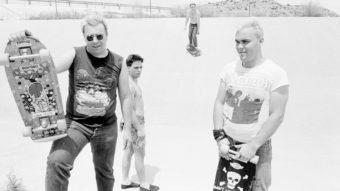
Big Boys in West Texas on the way to California in 1982. Randy "Biscuit" Turner is at the left, Chris Gates at the right, and Tim Kerr at the back. Bill Daniel/Courtesy of Light in the Attic Records
Big Boys in West Texas on the way to California in 1982. Randy “Biscuit” Turner is at the left, Chris Gates at the right, and Tim Kerr at the back. Bill Daniel/Courtesy of Light in the Attic Records

“To be a punk means freedom.” So said singer-guitarist Mark Perro of Brooklyn rock band The Men. His band came up in the local hardcore punk scene, but had recently started adding pedal steel and harmonica to their songs when he gave me that definition. For him, punk is not a genre of music, but a state of mind: In the wake of the Sex Pistols, regional punk scenes sprang up literally overnight in the U.S., each city hosting emancipated teens making their own mutant strain on three chords and a sneer. There was Black Flag, the Germs and X in Los Angeles; the Dead Kennedys in San Francisco; Husker Du and the Replacements in Minneapolis; and Bad Brains and Minor Threat in Washington, D.C. Noise and velocity defined most of these bands’ sound, generating a furious music danced to primarily in spasms and pogos.

Yet the funkiest and most fun strain of punk music in the U.S. resided deep in the heart of Texas, courtesy of the Big Boys. The band broke up in 1984, but its legacy lives on in 2013. Last week the Seattle-based Light in the Attic record label lovingly reissued the Big Boys’ ridiculously rare first album from 1981Industry Standard/ Where’s My Towel on vinyl, complete with silk-screened cover, photocopied inserts, sticker and more. And next month 540 Records will reissue the Big Boys’ 1982 EP Fun, Fun, Fun on vinyl. That title now names Austin’s annual music and comedy festival, Fun Fun Fun Fest, while skater-punk acts like Wavves, Harlem and FIDLAR take their cues from the Boys.
“They really inspired me and define everything that is DIY in my book,” Timmy Hefner, an Austinite who runs 540 Records and the music festival Chaos in Tejas, told me. “It’s one of the best Texas punk records ever and a record that totally changed my life when I was a young kid.”

Though Austin is known more for its brand of outlaw country music and putting its musical talent in psych wards (see Roky Erickson), the city’s underground punk scene was a fertile one at the dawn of Reaganomics, with bands like the Dicks, D.R.I. and Butthole Surfers popping up behind the Big Boys. The Big Boys — comprised of guitarist Tim Kerr, bassist Chris Gates, a handful of drummers and the outsized personality of frontman Randy “Biscuit” Turner — smashed the template for hardcore machismo that defined most scenes by being funky, irreverent, skate-obsessed and openly gay.

Listening back to the twenty-five minutes of Where’s My Towel/ Industry Standard, I’m struck by how the Big Boys wedded their love for funk, R&B, disco and soul to the speed and abruptness of punk. Opener “Security” is spasmodic yet it’s also spry, finding plenty of wiggle room in 53 seconds. Rather than the furious and forced bass and drum rhythms that propelled so much of punk rock, the band favored heavier syncopation from Kerr’s chopped James Brown riffs and Gates’ nimble bass. On “Spit,” they shout: “Watch your feet/ You look at us/ And you might miss the beat.” Live, they would cover Cameo, Kool and the Gang and Rick James. Their last album, 1984’s No Matter How Long the Line Is At the Cafeteria, There’s Always a Seat! featured turntable scratching, a sound rarely heard outside of early hip-hop. (Though yes, they also fathered funk metal.)


Big Boys shows were notoriously fun, and most touring punk bands found themselves under the band’s spell. Thumb through live pics of the band and you’ll see the husky Biscuit in drag, or else in shredded skate clothes. Sometimes dressed as a Daisy Dukes-wearing cowboy or in a wig and pink polyester. A Mexican wrestler or a mummy. Much like his bandmate Kerr, Biscuit had a career as a visual artist post-Big Boys (until his untimely death from untreated Hepatitis C in 2005), and during the band’s heyday, he was the visual focus of the band. When D.C.’s Minor Threat toured Austin, frontman Ian MacKaye was astonished their antics, as he recalled in the liner notes to the early ’90s CD reissues of the Big Boys’ discography: “Enormous men, decorated jump suits, a horn section, 200 friends onstage singing and dancing … The next year we came back to Austin and did it right — we opened for the Big Boys.”

Similarly intimidated was D.C.’s legendary hardcore punk band, Bad Brains, whose members, when they found out Biscuit was gay, responded with vitriol that shook much of the underground DIY culture in the early ’80s and was dissected via fanzines after. According to guitarist Kerr, who housed the band when they were playing in Austin and recounted the incident on his blog: “When they were headed out the door HR [Bad Brains’ singer] handed Beth a thick sealed envelope addressed to Biscuit. … There was a multi-paged letter/sermon/rant that ended with ‘…may you burn in hell, the Bad Brains.'”

It’s the type of malice that must have been all too common for a queer kid coming from small town Texas, a kid who found solace and acceptance in punk rock. Thankfully, Biscuit’s example paved the way for openly gay singers like Adam Lambert as well as Beth Ditto of The Gossip. Issues of self and self-reliance crop up often on Industry Standard, and when Biscuit shouts out the refrain to “Identity Crisis,” it’s with the sort of fury most punk rockers reserved for the establishment. In the music of the Big Boys, punk’s dance party of personal freedom can still be heard.


See Original Story

When Punk Met Funk, Deep In The Heart Of Texas

Site notifications
Update notification options
Subscribe to notifications