Southcentral

Navy holds Kodiak community forum on Gulf of Alaska training exercises

Gulf of Alaska. (Image from earthobservatory.nasa.gov)

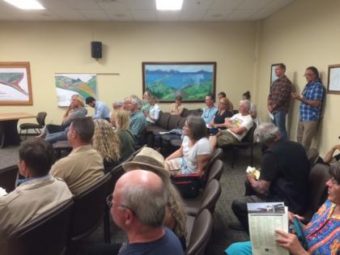
Navy representatives held a community forum in Kodiak Tuesday to address concerns about its training in the Gulf of Alaska, which they say begins Monday. They say many people believe this month’s training will include bombs, sonar, and exercises that will disturb commercial fishing, but say much of that is misinformation.

Chief of Plans for Alaskan Command, Captain Raymond Hesser, says while Environmental Impact Study documents approve the use of various pieces of weaponry, the Navy won’t actually be testing all of it during Northern Edge 15. He says this year won’t stand apart from past trainings in that way.

“So, ten days of the air-sea integration, that does not include any bombs or missiles, and it typically doesn’t. Okay. So those airplanes will be flying out just to coordinate and get used to operating in a maritime environment with Navy ships. And that’s the training objective,” Hesser says.

Hesser says the Navy’s exercises will not disrupt commercial fishing.

“Mitigations are establishing operating areas where exercise planners know to avoid fishing activity and other activity that we know would be of particular concern for a Navy ship doing its multi-mission stuff,” says Hesser. “So, again, I’ll tell ya, I can’t tell you exactly where the operating boxes are, but I will tell you that they’re not on the shelf.”

Fisheries biologist, Andrea Balla-Holden, says they will use sonar and that it’ll have a minimal affect on fish. She presented a graphic that outlines the range of fish hearing.

“There is no overlap in the frequency of the sonar used by the navy with the salmon, with the halibut, cod, snappers, and a variety of other great species, I didn’t put it all up there. And that’s just to try to indicate and to show you and convey that they don’t actually hear all of the sonar,” says Balla-Holden.

The graphic does show that herring can hear the sonar, but Balla-Holden says most fish cannot. She also says the sonar will have no affect on fish physically, while explosives could. While there will be no missiles or bombs, she says the explosions from naval gunfire will take place from the surface to five feet below it and its impact depends on different elements.

“The effects, which can include injury if you are close to the source, would be only occurring if you are very close to the source, but it is not a guarantee, it is not an absolute because it depends on the other factors. Smaller fish can be more affected than larger fish,” says Balla-Holden.

She says the explosions weaken as they continue down below the surface. The speakers at the community forum emphasized the training won’t be nearly as damaging as imagined.

And Hesser says they could have acted earlier to prevent misinformation.

“We never actually had questions about the exercise in the past and so we’ve never actually gone out before the exercise and done the public engagements like we’re doing right now,” says Hesser. “I think it’s a product of kind of the campaign that went against the exercise recently and a product of not doing the exercise for four years.”

Hesser says they’re doing their best to clarify matters now. They spoke in Cordova before visiting Kodiak for a second public forum and Hesser says the Navy will carry out its exercises between June 15 and 26.


NOAA investigates Steller sea lion deaths near Cordova

(L-R) Kate Savage (NOAA), Noah Meisenheimer (NOAA), Lt. Matthew Keiper (US Coast Guard), and Sadie Wright (NOAA) collect samples from a dead Steller sea lion near Cordova, Alaska. (Photo courtesy NOAA)

The National Oceanic and Atmospheric Administration is investigating the deaths of several Steller sea lions southwest of Cordova.

Julie Speegle, spokesperson for NOAA Fisheries, Alaska region, says 15 dead sea lions were discovered in the area on June 1.

“Three to five of them had wounds that our biologists could definitely say were human-caused wounds,” Speegle said. “So that indicates that these Steller sea lions had been deliberately killed.”

Killing sea lions violates the Marine Mammal Protection Act, which only allows limited exceptions for subsistence hunting by Alaska Natives

These particular animals were from the western stock of Steller sea lions, which are also listed under the Endangered Species Act.

NOAA law enforcement is looking for information from anyone with details about the event…and are offering an award up to $2,500 dollars for information leading to a conviction.

Mixed feelings on a new company’s plans to drill in Cook Inlet

A Texas-based company will begin drilling for oil in Cook Inlet next year using extended-reach oil wells.

BlueCrest Energy plans to drill from shore about six miles north of Anchor Point. Informational meetings were held in Homer and Anchor Point this week. The participants seemed split between hope for an economic jump start and worry for the project’s safety.

BlueCrest held three meetings in the three communities closest to the proposed site, Ninilchik, Anchor Point and Homer. BlueCrest inherited the Cosmopolitan Project from a long line of predecessors. Pennzoil, Arco, Conoco Phillips, Pioneer and Buccaneer all tried to reach the reserves in question. They all failed. When Buccaneer took its shot, BlueCrest already owned a 75 percent interest in the project and they decided to buy the other 25 percent after Buccaneer fell into huge amounts of debt.

Extended Reach Drilling (ERD) is directional drilling of very long, horizontal wells.

“We are not drilling offshore for oil. All of the oil development is from an onshore land rig.”

Larry Burgess, the Health, Safety and Environmental Manager for BlueCrest, says drilling from shore will leave very little risk of spills in the inlet.

Although onshore drilling was far more welcome than the prospect of offshore wells, Anchor Point and Homer residents still had concerns.

“[I am] Ken Lewandowski, I live in Cottonwood Subdivision which is in the backyard, the side yard of the Stariski plant that they plan on building.”

Lewandowski says there’s only one road in and out of his subdivision, where BlueCrest plans to drill.

“They literally tore up an ambulance coming down the hill in the winter time. Without having any access whatsoever to get out of our subdivision safely all year round and not having any kind of access to the facility leaves me to believe there’s a problem that’s going to happen in the future for sure.”

Lewandowski says living in that home was originally part of his retirement plan, but after learning about the Cosmopolitan Project, he’s looking for an exit strategy. He wants BlueCrest to compensate all four homeowners in the subdivision for the inconvenience.

“I spoke with this gentleman, Larry, a couple of minutes ago and he assured me that we’re going to sit down again and I’m looking forward to our next meeting.”

Other big concerns during the meeting included fire danger, spill prevention, noise, water use, and mode of transportation. Burgess was prepared with an answer for nearly every issue. But, no answer could stem worry over the risk of trucking oil. Burgess says there are only three real options to get the oil from the plant up to the Tesoro refinery in Nikiski. By truck, by ship, and by pipeline.

“If we have one barge running up and down Cook Inlet once or twice a week, that’s much less traffic with oil moving than if we’re running four or five trucks a day. On the other hand we’re looking at 400 barrels per truck as opposed to 50,000 barrels in a barge.”

BlueCrest would rather risk the 400 barrels on the road. A pipeline was the most popular option at both meetings. It’s the safest and most efficient mode of transport but it’s also expensive.

“More vehicles on the road, just by sheer probability is less safe than barging or a pipeline. That doesn’t mean it’s unsafe. It just means it’s less safe than the other options.”

BlueCrest plans to eventually produce about 17,000 barrels per day and Burgess says that’s nowhere near enough to justify a pipeline to Nikiski. Initially BlueCrest expects to have one or two trucks on the road each day. As production climbs the company plans to look at transportation alternatives.

Outside of safety concerns, the other big question on people’s minds was what benefits BlueCrest would bring to the Southern Peninsula.

Long-term Anchor Point residents Emmitt Trimble and Buzz Kyllonen were around to see the long procession of companies attempt the cosmopolitan project. Trimble says BlueCrest might be the people to get the job done.

“It’s going to be nice to see that income generated in this community when we don’t have a lot of economic growth or development here. It’s going to be nice to have somebody join the rest of us tax payers in paying those property tax bills.”

Kyllonen agrees with Trimble. But, he says they’ll keep an eye on BlueCrest.

“I think they’re on the right track and we’ll have to wait and see. But, I think they’ve done their homework and I’m optimistic.”

Burgess says BlueCrest needs feedback and he urges peninsula residents to share any comments and concerns they might have regarding this project. The company plans to start full scale construction in August.

Orthodox cathedral desecrated during vandalism spree in Kodiak

A 21-year-old man is under arrest for allegedly vandalizing one of Kodiak’s most historic buildings, the Holy Resurrection Russian Orthodox Cathedral, and many of its contents.

In a press release from the Kodiak Police Department, Arkimedes Garcia was arrested around 8:00 Wednesday night as he was exiting the church.

Northeastern side of the Holy Resurrection Church, a Russian Orthodox church in Kodiak, a city in the Kodiak Island Borough of the U.S. state of Alaska. Built in 1945, the church was added to the National Register of Historic Places on 12 December 1977. (Photo by NPS)

Thursday morning, Father Innocent Dresdow, the Dean of the Holy Resurrection Church, said many holy items were damaged.

“It’s clear from the pattern of destruction that this dear soul is deeply troubled and his anger and his rage appeared to be directed at, frankly God. And from the perspective of the Church, he knew exactly which things were holiest. And those were the things that were in absolute disarray.”

He said the most holy items have been removed from the church to an undisclosed location and are being re-blessed.

Father Innocent said Garcia broke several windows and made his way into the church’s Sanctuary behind the Nave where he not only did damaged items, but desecrated them as well.

“You can see in the hand crosses if you look carefully – they’re bent upward. All of the crosses that he just damaged are bent upward in the same pattern, including St. Herman’s Monastic Cross, which is the most priceless damage that was done last night. The tabernacle is where the reserve sacraments, the Holy Mysteries, body, blood of Christ are kept. Well, that was on the floor, with the Holy Mysteries and all the holy items that were on the alter were on the floor on both sides. He bled on the holy table, he bled on the back wall, he bled in the church in different places, and on the alter particularly is a major desecration.” “So he injured himself?” “He injured himself, yes.”

Father Innocent said that even though the church sustained physical damage in the attack, services will go on as planned.

“Scheduled services for tonight, at 6 p.m., the Akathist to St. Herman, will be held as scheduled. We have a clean up crew coming in at 1 p.m. People are welcome to join us from the community. They don’t have to be Orthodox if they want to come and help. We’re essentially trying to go over the floor, chairs, everything to make sure all, the minutest glass shards are out of the floor and items. We have lots of children here and we want to make sure nobody gets hurt.”

According to the Kodiak Police Department press release, Garcia emerged from the church “partially unclothed,” but did not explain further. Police Chief Ronda Wallace was unavailable for comment. Garcia was booked on four felony counts of burglary and criminal mischief.

Coastal communities rally to protest Naval activity in Gulf of Alaska

Protesters against military training exercises in Gulf of Alaska gather on Homer Spit. (Photo by Shady Grove Oliver/KBBI)

Several coastal communities, including Kodiak, Cordova, and Homer, have held both land-based and fishing boat flotilla protests over the last few weeks to voice their concerns about planned Navy and joint military training exercises in the Gulf of Alaska.

Dozens of local residents ignored the strong winds, grey skies, and drizzle to gather around the mariners’ memorial on the Homer spit.

Mavis Muller is standing in a group of people holding signs reading “Not in our fish basket,” “Whales don’t have earplugs,” and “Navy WTF.”

“We’re passionate about this fight for the protection and defense of habitat and our fisheries and cultures and lives and livelihoods that depend on the water. This affects all of us, this issue,” says Muller.

Jess Tenhoff is struggling with a large paper sign against the wind that reads Nurture, Not Navy.

“Well, I think the Navy could nurture,” says Tenhoff. “Personally, I would like it if the Navy would take the lead in nurturing, which it seems like they should do, considering that they make their living off the ocean. They should be the ones most concerned and I’m hoping that they are and that we just need to make clear to them that this needs to be really, carefully thought through.”

She’s referring to a series of planned training exercises in the Gulf of Alaska by the Navy. Last fall, the comment period closed on a draft Environmental Impact Statement or EIS for the next phase of the training starting in 2016. In the EIS, the Navy outlined the type of activities that could potentially have an effect on marine life. They included underwater explosions, simulated weapons fire, high ship and aircraft traffic, and sonar.

That’s caused a lot of concern for Gulf residents like Tenhoff who depend on fish stocks and the ocean for their livelihood and recreation.

“We need to be careful, we need to take care, we need to be conscious about our decisions concerning the resources that are ours as Alaskans to protect. It’s kind of our responsibility to get out there and do it,” says Tenhoff.

The Navy’s operations are related to the joint training called Northern Edge that brings together other branches of the military. It began in the early 90s and has roots in projects like Jack Frost and Brim Frost dating to the 1970s.

U.S. Air Force Captain Anastasia Wasem is the public affairs director for Northern Edge.

“We’re aware of the protests and we’ve even scheduled several public meetings to help alleviate the concerns of people in those areas,” says Wasem.

She says representatives from Alaskan Command and other organizations are traveling to Cordova and Kodiak to meet with residents and that they are sensitive to concerns.

“And if the public has concerns about the exercises, we certainly want them to be able to voice those concerns and be able to contact us. My office is always more than happy to speak with anybody about Northern Edge,” says Wasem.

Several protestors say they appreciate the ability to offer comments but are concerned they aren’t having any effect.

Back near the shore, Mavis Muller is looking out at the boats, some of which are carrying enormous handmade signs.

Muller, who painted the signs, says she knows all too well that protests for environmental protection and conservation often span years and have results that are hard to quantify. The victories she’s seen have been few and far between.

“It could be sort of like, oh really, 30 years later, we’re still saying the same thing or it could be that we are galvanizing a commitment. This fight is not going away. We are not naïve enough to think this fight is going to go away. It is never ending. This is a reminder to us that we are still fighting and we will continue to fight,” says Muller.

But all they’re asking for right now, says Muller, is that the military seriously consider its trainings in the Gulf of Alaska and not purposefully take part in activities that could harm this sensitive ecosystem.


Homer’s long-lived Coast Guard Cutter retires

Crew of the Roanoke Island. (Photo by Quinton Chandler/KBBI)

The Roanoke Island’s crew, their families, legislative representatives and coastguardsmen from sectors Anchorage and Seward came out to the Homer Elks Lodge for Roanoke Island’s decommissioning ceremony. Cmdr. Shawn Decker of Coast Guard Sector Anchorage presided over the ceremony. Decker said the Roanoke Island was first commissioned in Louisiana in February 1992 before she made the long transit to Homer.

“Over the course of the past 23 years she’s one of the longest tenured cutters to stay in the same home port her entire career. It’s very common for cutters to move around and to change home ports, but for the Roanoke Island she’s been here [in Homer] ever since she was commissioned and that is definitely not common,” says Decker.

Decker expounded on the duties carried out by the cutter and its crews over the years including: search and rescue missions, law enforcement operations, and community service projects.

“Over the past 23 years Roanoke Island has accumulated over 40,000 hours underway, they’ve completed over 1,000 law enforcement boardings, and they’ve executed over 100 search and rescue cases,” Decker says.

He called those stats a testament to the crews of the Roanoke Island, past and present. Lt. Michael Clell Thomas also spoke to the merits of the cutter. He is the ship’s commanding officer and in preparation for the decommissioning he was assigned the job of safeguarding the Roanoke Island’s history.

“It’s interesting how you get focused on yourself and your own crew and what you do with the cutter. You forget the legacy of that cutter and what the cutter has done with past crews. Reading through a lot of the history it’s kind of mind blowing to see all that has been accomplished,” Thomas says.

Thomas has also been consumed with preparations for the trip to the cutter’s new home. The crew will have to travel south to pass through the Panama Canal before heading to port in Baltimore, Maryland. The trip will be 7,000 nautical miles.

“We try to plan it as best we can before the trip but there are always some variables in there such as weather and delays with coming into a country and some of your port of calls that are always on my mind. And then safety from a C.O.’s perspective,” Thomas says.

Thomas and his crew are projecting the trip to take two months.

“That’s probably one of our biggest challenges. As a crew that operates a couple of weeks out at a time, doing a full two months is quite an evolution for us. The families are really what make this possible for us and without their help a two month deployment can be challenging,” Thomas says.

After the cutter makes it safely to Baltimore the Roanoke Island’s crew will fly back to Homer to meet their new vessel, the US Coast Guard Cutter Sapelo.

“The Sapelo is leaving next week from Puerto Rico and they’re probably going to cross somewhere with the Roanoke Island on the Panama Canal. The Sapelo is going to be here in the beginning of August,” Decker says.

Thomas says only one member of his crew will be transferred after the trek to Baltimore and the rest will be reunited aboard the Sapelo in August. The crew and the cutter are expected to be ready for full duty operations by September.


Site notifications
Update notification options
Subscribe to notifications