Juneau elections

Juneau’s new sales tax exemptions just rolled out. Here’s what you need to know.

Phil Gouvey checks out groceries at Foodland IGA on Wednesday, Nov. 19, 2025. (Photo by Clarise Larson/KTOO)

Before Thursday, when you would grab some groceries or pay your utility bill, Juneau’s city government taxed most residents at 5%. But now, that tax has dropped to zero percent for everyone, regardless of their income or age.

That’s because of a ballot measure that was approved by voters during this fall’s election to remove the local sales tax on essential food and residential utilities.

Phil Gouveia was buying groceries at Foodland IGA on Wednesday afternoon. He said he’s excited for the changes and to see some extra cash back in his pocket. 

“Yeah, it’s gonna help me. I’m 70 years old. I’m on a pension, so groceries keep going up, but my pension doesn’t,” he said. 

The exemptions officially take effect on Thursday, 30 days after the fall election results were certified. The proposition passed with nearly 70% of voter approval. 

Deputy City Manager Robert Barr said the roll out of the exemptions should be pretty hands-off for most residents. He said the city is working with businesses on implementing it, but it may take some time before all retailers are under the new system. 

“Our goal was to implement this in a way that was as easy for residents as possible, so most residents shouldn’t have to do much, if anything,” he said. 

The exemptions apply to the same food items that qualify under the Supplemental Nutrition Assistance Program, also known as SNAP or food stamps. That includes foods like fruits and vegetables, meat and dairy, bread and cereals — and cookies and ice cream. But it doesn’t cover hot food — like a rotisserie chicken — or meals from restaurants.

“What qualifies as food is largely groceries, things that you would buy from the grocery store and prepare at home, or things that are intended to be consumed off-site,” he said. 

The utilities exemptions apply to residential electricity, heating oil or propane, water and sewer and garbage and recycling. 

Alec Mesdag is the CEO of Alaska Electric Light & Power, or AEL&P, Juneau’s sole electricity provider. It serves more than 16,000 customers. Mesdag said the logistics of rolling out the exemptions are challenging and complex due to AEL&P’s large number of customers and having to verify which accounts are for residential use versus commercial. 

Despite that, he said the company is actively working with customers to ensure those who are eligible receive the exemption as soon as possible. 

“What we intend to do is go through our list and apply the exemption as broadly as possible, but excluding certain accounts that appear to us to be highly likely to be not eligible to receive the exemption,” he said.

Mesdag said AEL&P is sending out letters to customers to inform them which accounts have received the tax exemption and which have not.

While the exemptions are expected to put some extra cash back into residents’ wallets, it in turn means the city is expected to face a $6.4 million hole in its budget this fiscal year. And, each year moving forward, the city will face an estimated $12 million revenue loss from both the tax exemption on food and utilities and the separate cap on the city’s property tax rate that voters also passed.

City officials and the Juneau Assembly will be grappling with potential service cuts in the coming months.

Juneau Assembly kills ordinance to adopt local ranked choice voting system

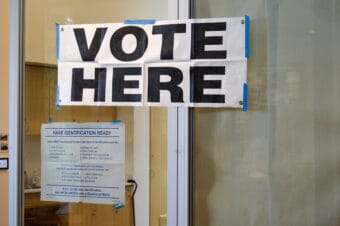
Signs for voting are posted outside the Mendenhall Valley Library on Election Day on Tuesday, Oct. 7, 2025. (Photo by Yvonne Krumrey/KTOO)

The Juneau Assembly officially killed a proposal to locally implement ranked choice voting on Monday night. The body unanimously voted to indefinitely table the ordinance to adopt a ranked-choice voting system for municipal elections beginning next year. 

The decision came after multiple people testified on the topic at the Assembly’s regular meeting, almost all against adopting the change. Roger Calloway said he doesn’t think the decision should be up to the Assembly.
“I’m here to testify against adopting this ordinance. I believe it’s wrong for you, the Assembly, to decide how we, the voters, get to cast our votes,” he said. 

Alaska already uses a ranked choice voting system for statewide elections. In local elections, Juneau voters choose one candidate in single-member races, like Assembly seats. With ranked choice voting, voters would have instead ranked candidates by preference.

Juneau’s recently retired city clerk, Beth McEwen, testified against the change. She said that while she supports ranked choice voting at the state level, she argued it’s unnecessary for Juneau and would confuse voters. 

“I think it was a good decision for state elections, not for local elections,” she said. “Local elections are nonpartisan. The state has a partisan system — and we have primaries and general elections at the state — we don’t have that at the local level.”

Assembly member Ella Adkison originally introduced the ordinance earlier this summer. She made the motion to table it indefinitely on Monday, which means the proposal is dead. A similar ordinance could still arise in the future under a new Assembly.

Adkison said it is not the right time to implement the change as the city faces more pressing issues like budget cuts following the results of the recent local election.

“We are going to have to cut services, and we are going to have to lay people off, and that is a thing we are going to work together as a community to get through,” she said. “But it’s going to be a really tough time for Juneau, and we’re going to have to spend a lot of time and energy as a community getting through that hard time.”

According to data from the state’s Division of Elections, Juneau voters favored ranked choice voting at the state level. Juneau overwhelmingly voted against a repeal effort on the ballot last election, which only very narrowly failed statewide. Advocates have already filed new initiatives in an attempt to repeal it in the 2026 state election.

Juneau Assembly will decide whether to adopt ranked choice voting Monday

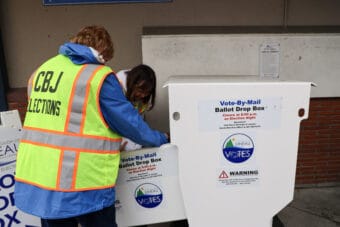
City election workers empty out the ballot box outside City Hall on Election Day on Tuesday, Oct. 7, 2025. (Photo by Clarise Larson/KTOO)

The Juneau Assembly is slated to decide on Monday night whether Juneau should adopt a ranked choice voting system for municipal elections beginning next year. 

Alaska already uses a ranked choice voting system for statewide elections. In local elections, Juneau voters currently choose one candidate in a single-seat race. With ranked choice voting, voters would instead rank candidates by preference.

If adopted on Monday, Juneau would become the first major city in Alaska to adopt ranked choice voting for municipal elections. But other cities across the U.S., including New York, San Francisco and Minneapolis, already use the system in local elections.

The Assembly was originally supposed to vote on the topic in August, but decided to delay the decision until after the fall local election. Assembly member Ella Adkison proposed the change. During a meeting earlier this summer, she said she thinks voters will support it. 

“It really is good for races where there are lots of candidates in one seat,” she said. “And I think Juneau, in general, likes having lots of candidates in races, because it means that the person that they feel represents them the most is the person who actually gets onto the Assembly.”

But not everyone agrees. During public testimony on the topic this summer, Juneau resident Angela Rodell questioned why the change is necessary. Rodell unsuccessfully ran for mayor in 2023 and led the Affordable Juneau Coalition in advocating for tax cuts this fall. 

“At a time when public trust in our local election process is being tested, this ordinance does not move us towards greater transparency, confidence or affordability,” she said. “Instead, it is the opposite. It proposes a fundamental change to our voting process without first answering a critical question, ‘What is the problem we’re trying to solve with this?’”

According to data from the state’s Division of Elections, Juneau voters previously appeared to favor ranked choice voting. Juneau overwhelmingly voted against a repeal effort on the ballot last election, which only very narrowly failed statewide. Advocates have already filed new initiatives in an attempt to repeal it in the 2026 state election.

Juneau residents have the chance to testify on the ordinance in person or online before the Assembly votes on Monday. People who want to testify online must notify the city clerk by 4 p.m. before the meeting. The meeting begins at 6 p.m. at Centennial Hall.

Newly-elected Juneau school board members officially begin terms

From left, Jenny Thomas, Melissa Cullum and Steve Whitney get sworn in as Juneau School Board Members at the Thunder Mountain Middle School library on Oct. 28, 2025. (Photo by Jamie Diep/KTOO)

The Juneau school board swore in three members and honored two outgoing members at a meeting Tuesday. 

In this fall’s municipal election, Steve Whitney was reelected to the board after being appointed to fill a seat vacated earlier this year. Jenny Thomas and Melissa Cullum were elected to the board for the first time.

The board honored outgoing members Emil Mackey and Deedie Sorensen. Mackey initially joined the board in 2015. In his outgoing remarks, he said he hopes to see an end to what he called an “attack on our public servants” nationwide. 

Sorensen worked as a teacher for the district for more than 35 years and was elected to the board in 2019. She ran unsuccessfully as a write-in candidate this fall.

Deedie Sorensen and Emil Mackey exit the Juneau School Board meeting at Thunder Mountain Middle School on Oct. 28, 2025. (Photo by Jamie Diep/KTOO)

Both Sorensen and Mackey survived a failed recall effort last year following the district’s school consolidation last year. Mackey commended Sorensen for attending meetings while undergoing cancer treatment during that time.

“She could have died during that process, and she did not miss a single meeting,” he said. “She would have chemo in the morning, and she would be on the Zoom call later that night.”

Sorensen thanked the public and her colleagues before leaving and said she plans to enjoy some time off.

“I got my all clear from my oncologist last week, and so, you know, so for the knowable future, things are looking really good,” she said.

Once the new members were sworn, the board immediately got to work on district business, including formally accepting Superintendent Frank Hauser’s resignation and listening to more than an hour of public comment about union contracts.

Two newcomers and one returning member elected to Juneau school board

School board candidates Melissa Cullum and Jenny Thomas smile as they wave signs in the Mendenhall Valley on Election Day on Tuesday, Oct. 7, 2025. (Photo by Clarise Larson/KTOO)

The Juneau school board will have two new board members and one returning member following the release of final election results Tuesday.

Steve Whitney and Melissa Cullum won three-year terms, and Jenny Thomas will serve a two-year term on the board.

The board appointed Whitney to fill a seat after Will Muldoon resigned earlier this year. He previously served on the board from 2016 to 2019. Whitney did not respond to a request for comment Wednesday.

Cullum is a homeschool parent and a former teacher. She said she’s looking forward to working with other board members.

“We’re in a good spot of transition, and I’m really kind of excited about moving us towards a more positive feeling or climate in our district,” she said.

Jenny Thomas will serve the remaining two years of Muldoon’s term. She said she’s excited to bring community engagement and new ideas to the board.

“Hoping to make the meetings a little less bureaucratic where it’s just reading reports and getting a little bit more into the like, the meat and potatoes of actually what’s going on,” she said.

Thomas was one of the leaders of an unsuccessful recall campaign against board members Emil Mackey and Deedie Sorenson after the school board closed and consolidated schools last year to fill a $9.7 million deficit. 

Sorenson filed to run as a write-in candidate two weeks before Election Day. The retired educator and current school board president said she’ll find other things to keep herself busy after she steps down.

“I’ve always been, you know, an advocate for public education. So, I mean, I don’t think that I’m going to take that hat off,” she said.

Jeremy “JJJ” Johnson also was not elected. He said in a text message that he’s proud to have received close to 20% of the vote, but he’s disappointed by the results of the ballot propositions and now plans to support his wife’s desire to leave Juneau.

“I can’t justify keeping her and the children here in a community that is steering towards some of the most challenging experiences a school system can face, just because I’m committed to the people I worked with, went to school with, and enjoyed casual time with,” he wrote.

Board members will be sworn in at the next school board meeting on Tuesday.

Final Juneau election results show seasonal sales tax fails, tax cut measures pass

Assembly District 2 candidate Nano Brooks smiles as he waves signs in the Mendenhall Valley on Election Day on Tuesday, Oct. 7, 2025. (Photo by Clarise Larson/KTOO)

Voters chose not to implement a new seasonal sales tax system in Juneau next year, but approved two measures that aim to reduce the tax burden on individual residents. That’s according to the final results for Juneau’s municipal election released on Tuesday.

 Meanwhile, voters elected a new face to the Juneau Assembly over a two-term incumbent. 

Nano Brooks unseats incumbent Wade Bryson for Assembly District 2

Three seats were up for grabs on the Juneau Assembly this year, but only one was contested. 

District 2 Assembly candidate Nano Brooks ousted longtime incumbent Wade Bryson from his seat on the Assembly. Bryson was seeking reelection for his third and final term on the Assembly. Brooks ultimately won by 391 more votes.

Assembly member Wade Bryson speaks during a committee meeting on Monday, Aug. 4, 2025. (Photo by Clarise Larson/KTOO)

This will be Brooks’ first time serving in public office after two previous Assembly runs, and he said he’s excited to bring new energy and ideas to the Assembly. He said he hopes his successful campaign running against an incumbent will inspire others to put their hat in the ring. 

“It doesn’t have to be what everyone would consider the status quo — that you get your two terms and you’re guaranteed a third,” he said. “I just showed that that’s not always the case. So maybe that’ll help other people get more engaged and give things a shot in the future.”

Bryson declined an interview following the final results. 

Incumbent Assembly members Greg Smith and Ella Adkison ran unopposed for their seats. Smith will now serve his third and final three-year term on the Assembly, while Adkison will serve her first full term. She was originally elected to the Assembly in 2023 to fill the remaining two years in the term of a member who resigned. 

Tax cuts pass, seasonal sales tax fails

Voters passed Propositions 1 and 2, which were both put on the ballot by an advocacy group called the Affordable Juneau Coalition.

Proposition 1 caps the rate the city uses to determine how much residents pay in property taxes each year. Results show that yes votes narrowly led by 157 votes. Proposition 2 exempts essential food and residential utilities from local sales tax. Votes in favor of the proposition led handily by nearly 4,000 votes. 

Angela Rodell, the treasurer of the Affordable Juneau Coalition, said the results show that Juneau voters aren’t satisfied with the status quo. 

“We are thrilled with the turnout and the response and the engagement,” she said. “Voters have overwhelmingly spoken to focus on affordability and must-haves in Juneau.”

The Juneau Assembly put Proposition 3 on the ballot, which sought to implement a new seasonal sales tax system next year. 

Cruise ship visitors walk past the Alaska Shirt Company in downtown Juneau on Thursday, Sept. 18, 2025. (Photo by Clarise Larson/KTOO)

Assembly members argued the change would have allowed the city to take advantage of the 1.7 million cruise passengers that come to town each summer, while giving year-round residents a break during the winter. It was also meant to recoup some of the city revenue lost if voters passed the other propositions. 

However, the proposition failed by 1,488 votes. 

“I think it’s pretty unfortunate that there wasn’t more support for a seasonal sales tax,” said Assembly member Christine Woll. “I don’t think that people have a clear understanding about the deep, deep cuts to city services that we’re going to have to make as a result of these results.”

Woll said the final results mean the city is now estimated to face upwards of a $12 million revenue shortfall this year — and every year moving forward. She said that’s not going to be an easy fix and will require some tough community conversations. 

“People have suggestions on particular projects they don’t like, which can save a few million here and there, but we have to make those cuts to our operations so that every year we’re spending $10 to $13 million less,” she said. “I am concerned about the public’s reaction when they see the level of cuts that we’re really talking about.”

Rodell challenged that, saying she thinks the outcome presents an opportunity to the Assembly to focus on needs versus wants. She argued that cutting services is not the only answer. 

“There are things that the city can focus on to grow the tax base and to generate additional revenue that doesn’t involve raising taxes on the backs of residents and working families,” she said. 

New faces elected to school board

Steve Whitney, Melissa Cullum and Jenny Thomas won the top spots in the race for the three open seats on the Juneau Board of Education. Thomas surpassed Jeremy “JJJ” Johnson by 132 votes.

School board candidates Melissa Cullum and Jenny Thomas smile as they wave signs in the Mendenhall Valley on Election Day on Tuesday, Oct. 7, 2025. (Photo by Clarise Larson/KTOO)

Write-in candidate and current board president Deedie Sorensen trailed behind all other candidates. 

Voter turnout 

In total, 10,263 registered voters had their ballots counted in this year’s municipal election – that’s just under 37% of registered voters in Juneau compared to last year’s 38%, which was the highest voter turnout of the last 10 years.

The Juneau Assembly will meet for its reorganization meeting to swear in new members on Monday, Oct. 27. New school board members will be sworn in at its next regular meeting on Tuesday, Oct. 28. 

Site notifications
Update notification options
Subscribe to notifications