Juneau elections

Juneau voters continue to favor affordability measures, oppose seasonal sales tax in updated results

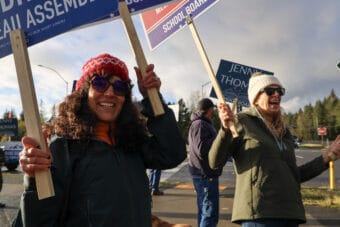
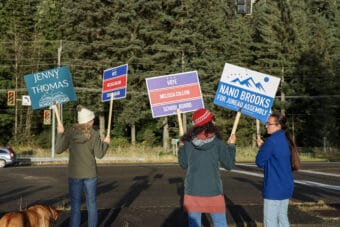
Candidates and residents wave election signs in the Mendenhall Valley on Election Day on Tuesday, Oct. 7, 2025. (Photo by Clarise Larson/KTOO)

The outcome of Juneau’s municipal election is beginning to take shape as preliminary results continue to roll in. The city clerk’s office released another batch of results that include ballots cast on Election Day on Friday evening. 

The results paint a similar picture compared to the first round results shared earlier this week. More voters appear to be in favor of Propositions 1 and 2, but oppose Proposition 3. 

Proposition 1 seeks to cap the rate the city uses to determine how much residents pay in property taxes each year. “Yes” votes narrowly outpace “no” votes by less than 200 votes. 

Proposition 2 would exempt essential food and residential utilities from local sales tax. Nearly 70% of voters are in favor of it passing so far. 

Proposition 3 would implement a new seasonal sales tax system next year to take advantage of cruise tourists. “No” votes lead by more than 1,500 votes. 

District 2 Juneau Assembly candidate Nano Brooks continues to grow his lead over incumbent Wade Bryson for his seat. Brooks now leads by more than 400 votes. 

Steve Whitney, Melissa Cullum and Jenny Thomas are now leading in the race for the three open seats on the Juneau Board of Education. Thomas surpasses Jeremy “JJJ” Johnson by 127 votes after trailing behind in previous results. 

Write-in candidate and current board president Deedie Sorensen continues to trail behind all other candidates. 

Voter turnout as of Friday’s results was just over 35%. The results shared are subject to change and more preliminary results will be shared in the coming weeks. The city will certify results on Oct. 21. 

Preliminary results show Juneau voters in favor of affordability measures, against seasonal tax

Assembly District 2 candidate Nano Brooks smiles as he waves signs in the Mendenhall Valley on Election Day on Tuesday, Oct. 7, 2025. (Photo by Clarise Larson/KTOO)

Preliminary results are in for Juneau’s 2025 municipal election. 

They show that most residents don’t want to implement a new seasonal sales tax system in Juneau next year, but are in favor of the two measures that aim to reduce the tax burden on individual residents.

According to the results shared by the city, 3,534 people voted no on Proposition 3 while 2,514 people voted yes — a 1,020-vote difference. 

Proponents say the change would take advantage of 1.7 million cruise passengers that come to town each summer, while giving year-round residents a break during the winter. Opponents say the system won’t actually save residents money in the long run. 

Meanwhile, early results show both Propositions 1 and 2 passing. Both were put on the ballot by an advocacy group called the Affordable Juneau Coalition.

Proposition 1 seeks to cap the rate the city uses to determine how much residents pay in property taxes each year. Results show yes votes are leading by less than 100 votes. 

Proposition 2 would exempt essential food and residential utilities from local sales tax. Votes in favor of the proposition led handily, with 4,173 people voting yes, while 1,867 people voting no.

District 2 Assembly candidate Nano Brooks narrowly outpaces incumbent Wade Bryson for his seat on the Assembly. Brooks is leading by a mere three votes. 

Incumbent Assembly members Greg Smith and Ella Adkison ran unopposed for their seats. Smith is seeking his third, three-year term on the Assembly, while Adkison is seeking her first full term. She was originally elected to the Assembly in 2023 to fill the remaining two years in the term of a member who resigned. 

Steve Whitney, Melissa Cullum and Jeremy “JJJ” Johnson are leading in the race for the three open seats on the Juneau Board of Education. Write-in candidate and current board president Deedie Sorensen trails behind all four candidates on the ballot by nearly 1,000 votes. 

Voter turnout as of Tuesday’s results was just under 22%. However, things could change significantly. The tally shared on Tuesday only includes ballots that were mailed in or dropped off before Election Day. That means there could be thousands of votes left to be counted. 

The results shared Tuesday night are subject to change —  more updated preliminary results will be shared by the city in the coming weeks. Results won’t be certified by election officials until Oct. 21. 
Find the latest election news at ktoo.org/elections.

Tax-focused ballot propositions drive many Juneau voters to the polls this Election Day

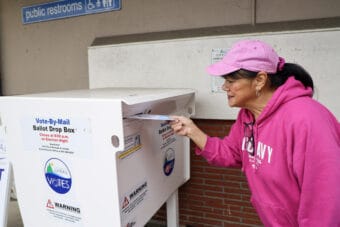
Elizabeth Ibias drops her ballot off in the City Hall ballot drop box on Election Day on Tuesday, Oct. 7, 2025. (Photo by Clarise Larson/KTOO)

Tuesday is municipal Election Day in Juneau, and voters will decide on three Assembly seats, three school board seats and three key local tax measures. Residents cast their ballots at vote centers and ballot drop boxes open across town. 

Election workers emptied out the ballot box outside City Hall on Tuesday morning as Jev Shelton went to cast his ballot. 

Shelton said he doesn’t think any of the propositions should pass, but took particular issue with Proposition 1. That measure seeks to cap the rate the city uses to determine how much residents pay in property taxes each year. 

“It just leads to a major step backward in this community, which is losing population, losing influence, and is needing to make itself a bit healthy and a bit more attractive than it’s doing,” he said. “That was not the way to do it.”

Another resident outside City Hall, Lawrence Siverly, said he wasn’t familiar with the candidates up for election. He came to vote on the ballot measures. He said he voted yes on Proposition 1 because his son is a homeowner here, and yes on Proposition 2, which would exempt essential food and residential utilities from local sales tax. 

Lawrence Siverly smiles after casting his municipal ballot at City Hall on Election Day on Tuesday, Oct. 7, 2025. (Photo by Clarise Larson/KTOO)

“Since I’m a senior, I already have benefits for food, but I think that should be available for everybody that lives here,” he said. 

But Siverly says he voted no on Proposition 3, which would implement a new seasonal sales tax system in Juneau next year. Proponents say the change would take advantage of the 1.7 million cruise passengers that come to town each summer, while giving year-round residents a break during the winter. Opponents say the system won’t actually save residents money in the long run. Siverly says he voted against it because he doesn’t want to pay a higher rate in the summer. 

Brian Fox walked outside the Mendenhall Valley Public Library after voting in person. Fox didn’t share how he voted, but said he wants to make things more livable in Juneau.

“I know that the cost of living here, and I’m acquainted with it very well, having lived here and in Fairbanks previously,” he said. “The cost of many things is sky high, some of it a little out of proportion.”

Election workers wait for voters at the City Hall on Election Day on Tuesday, Oct. 7, 2025. (Photo by Clarise Larson/KTOO)

Back at City Hall, LaRae Jones is the volunteer supervisor for the election this year. Next to a stack of  “I Voted Today!” stickers featuring the Alaska state flag, she fills up a candy basket.

Jones said this is the last evening people can vote.

“People are wonderful, we love to have them come vote in person,” she said. “I just encourage everyone to vote.” 

The preliminary results of the election will be released Tuesday night after ballot boxes and vote centers close at 8 p.m. The initial results will only include ballots that were mailed in or dropped off before Election Day. Official results won’t be certified by election officials until Oct. 21.

KTOO reporters Alix Soliman, Jamie Diep and Yvonne Krumrey contributed to this report. 

Find the latest local election coverage at ktoo.org/elections

Juneau high school students vote in annual mock elections. How will they stack up against final results?

a woman in a black shirt and blue scarf looks down in front of students in a classroom.
Juneau-Douglas High School: Yadaa.at Kalé teacher Amy Lloyd instructs a government class on Oct. 2, 2025. (Photo by Jamie Diep/KTOO)

Listen here:

Yaaḵoosgé Daakahídi High School teacher Electra Gardinier talked to students during a recent mock election in her fourth period U.S. Government class. She had spent the week explaining the different candidates and propositions. Now the students – most of whom are too young to vote – were casting their votes on sample ballots.

“So you have a ballot in front of you, and it looks like what I have in my hand, and on that ballot, it is asking us to vote on Proposition One, Two and Three,” Gardinier told the class. “We just talked about those propositions. It also asks you to vote for your Assembly member and school board members.”

Gardinier tallied up the votes in the school board race after class.

“For the last candidate, it looks like we would not be able to come to a consensus. Oh, no. Jeremy — J. J. J. So J. J. J., Steve Whitney and Jenny Thomas,” she said.

Students also approved all three ballot propositions in this year’s election. 

Gardinier said students that attend Yaaḵoosgé do so because they have been unsuccessful in some part of their education. She said that makes it really important for her to give her students a voice in this class.

“Sometimes that can mean that we have a population that already feels marginalized, academically, let alone how they’re feeling in other aspects of their life,” she said. “And so a lot of times, I fear that that creates this apathetic mentality of like, ‘nothing ever gets better for me. It doesn’t matter how I think. Nobody cares what my views are.’”

Gardinier said she wants students to feel engaged and heard, while also understanding what they are voting on.

“When I’m teaching, I try not to put anything above a sixth grade level. And it’s fascinating to me that a ballot is absolutely written at a level beyond that,” she said. “So I mean, I have kids who are not going to understand what they’re voting for, and that is something that I’m trying to combat.”

How did government students’ votes stack up over at Juneau-Douglas High School: Yadaa.at Kalé?

Eighty students voted in that mock election. They “elected” Jenny Thomas, Melissa Cullum and Steve Whitney to the school board.

For the Juneau Assembly, Nano Brooks eked out a narrow victory over Wade Bryson by one vote in the only contested race. 


As for the ballot propositions, the students approved the first two questions, but narrowly voted down the proposed seasonal sales tax. 

At least one student at JDHS will actually be able to vote this year. 

Samuel Lagerquist filled out his ballot ahead of Election Day. He said the structure of the class helped him learn more about the different candidates and ballot propositions. He said he also learned about how his peers are thinking.

“In this class, I was kind of presented with some different perspectives that I didn’t really think about, mainly concerning the first two ballot measures,” Lagerquist said. “It also offered a really good place to, like, kind of stay updated, and motivated me to stay updated into the actual news.”

Lagerquist said he feels it’s important to vote in a local election, even when statewide and national elections often see larger turnouts.

“The sales tax or ballot initiative ones are gonna have a more, like, day-to-day, actual, real effect on me. And so I think that, honestly, it’s probably more important than, like, your national elections, even though, you know, those are really important,” Lagerquist said.

While he doesn’t plan to be in the state for college, Lagerquist said he plans on voting absentee in next year’s Alaska election, when the governor and two congressional seats will be up for grabs.

Amy Lloyd teaches government at JDHS. She said the results for the mock election were a bit unexpected.

“I thought it was going to be 70/30 and it was more like 50/50 which shows me that they understand the value of their vote, and even if they didn’t say anything in the conversation, they voted how they wanted to vote,” Lloyd said. “So that was pretty cool.”

 She said it’s a big responsibility to teach students about the government. 

“We are living in America, we’ve got to understand the government,” she said. “It’s really exciting to teach a class that is so obviously in their best interest to know and learn and pay attention to.”

Real ballots in Juneau’s by-mail election must be returned by 8 p.m. Tuesday. Initial results are expected later in the evening.

Tuesday is the last day to vote in Juneau’s municipal election

A Juneau resident drops his ballot off in the City Hall ballot drop box on Friday, Oct. 3, 2025. (Clarise Larson/KTOO)

Juneau’s municipal Election Day is almost here — voters have until Tuesday night to cast their ballots. 

There are a handful of ways you can vote in the by-mail election. The city has ballot drop boxes in different locations all across town. Voters can also mail their ballots back or go to a vote center. 

This year’s ballot features three propositions, four candidates running for three open seats on the Assembly and four candidates running for three seats on the school board. One write-in candidate for school board is not featured on the ballot.   

Deputy City Clerk Andi Hirsh said as of Saturday, about 4,600 ballots had been returned.  

“Democracy only works when people participate,” Hirsh said. “This is your chance to really have a say in what our community looks like, and I think it’s really important for every person to be part of that.”

The ballot drop boxes are open until 8 p.m. Tuesday. They are located at City Hall, the AEL&P office in Lemon Creek, Douglas Library, the Mendenhall Valley Public Library and Statter Harbor boat launch. 

Ballots sent in by mail need to be postmarked on or before Election Day and a first-class stamp is required. Vote centers at City Hall and the Valley Library will be open from 7 a.m. to 8 p.m. on Tuesday for in-person voting.

Hirsh said the vote centers can get busy on Election Day and people might experience a wait time.

“We do tend to get both a lunch rush and an after work rush,” she said. “So, there tends to be a bit of a line.”

Ballots turned in on Election Day aren’t counted in the unofficial results released that night. They’ll be added to later unofficial result updates. Final results will be certified on Oct. 21.

Find the latest local election coverage at ktoo.org/elections.

Juneau voters weigh costs and benefits of removing tax on local food and utilities

Shoppers grab produce at Foodland IGA in downtown Juneau on Tuesday, April 29, 2025. (Photo by Clarise Larson/KTOO)

Juneau voters will decide in this fall’s municipal election whether to exempt essential food and residential utilities from local sales tax. Economists say that taxes on food hit low-income people the hardest. 

Whether you head to Costco, Foodland or Fred Meyer or any other grocery store in Juneau, you pay a 5% tax on most of the food you buy. And, when you go to pay your water or heating bill, you’re taxed the same on that, too. 

Right now, Juneau’s city government taxes food and utilities like just about everything else – at 5%. But, if voters choose to pass Proposition 2 on the local ballot this year, that tax would drop to zero percent for everyone, regardless of their income. 

Daniel Parks, the executive director of the Southeast Alaska Food Bank, said food insecurity is impacting more and more Juneauites every year. 

“On a local level, we’re facing the highest amount of demand that we’ve ever faced here,” he said. “More and more people that you would have once thought of as firmly in the middle class are sliding into food insecurity.”

Park said he thinks the proposition could have a positive impact. 

The proposed food exemptions would apply to items under the same definition as the Supplemental Nutrition Assistance Program, better known as SNAP or food stamps. It would also apply to residential electricity, heating oil or propane, water and sewer and garbage and recycling. Senior citizens are already able to apply for these exemptions.

Angela Rodell is the treasurer of the Affordable Juneau Coalition, a group of advocates who gathered enough signatures to put the question on the ballot. She says Juneau should have removed the tax a long time ago. 

“This is probably one of the most regressive tax things we have here in Juneau,” she said.  

She said the change would be immediately felt by residents and would make Juneau more affordable. 

 “I think when you start to feel like costs are coming back your way, when you feel like you have just a little bit of extra money, you feel better about participating in the community, participating with the nonprofits, supporting churches and trails and arts and all of those things,” she said.

Juneau Assembly member Neil Steininger is an economist, and he supports the concept.

“We don’t have the supply chains that can provide us lower-cost food, like a lot of areas down south do,” he said. “That really impacts your day-to-day living, because you got to eat every day.”

According to city estimates, the average person would save approximately $300 per year.   

But there’s a flip side to the change. The current 5% tax on food and utilities brings in quite a bit of revenue to the city — to the tune of a combined $9 to $11 million annually. 

“That is huge. That is a big number. Just to give some context,” said Assembly member Christine Woll. 

She said removing that tax would leave a serious hole in the city’s budget. 

“There is no way that we could exempt food and utilities without significant reduction to what the city provides its citizens,” she said. 

It’s unclear what services the Assembly might choose to cut. It would make those decisions after the election.

But, in hopes of offsetting those decisions before they come to fruition, the Assembly is asking voters to implement a new seasonal sales tax system to neutralize the estimated revenue loss. The proposed system is meant to take advantage of the summer tourists while also giving some winter relief to year-round residents.

“The seasonal sales tax basically will make up for that $9 to $12 million revenue loss by shifting the tax burden from residents to our summer visitors,” she said.

Rodell disagrees. She said a reduction in revenue will force the Assembly to pay closer attention to how it spends taxpayers’ money — something she doesn’t think they’ve been doing a good job at. 

“I’m a strong no on the seasonal sales tax because of the way it needs to go back to the drawing board,” she said. “They need to do a better job about defining how it’s going to help the residents of this community.”

The last day to vote in Juneau’s by-mail election is Tuesday, Oct. 7.

Find the latest local election coverage at ktoo.org/elections.

Site notifications
Update notification options
Subscribe to notifications