Juneau elections

Juneau may be getting a ‘new’ City Hall after all

The Michael J. Burns Building, which houses the Permanent Fund offices on 10th Street, on Monday, Feb. 24, 2025. (Photo by Clarise Larson/KTOO)

Juneau may be getting a ‘new’ City Hall after all – but this time voters won’t get to decide on whether to approve it. 

At a committee of the whole meeting on Monday, the Juneau Assembly moved forward with a plan to purchase and renovate two floors of the Michael J. Burns building, which houses the Alaska Permanent Fund Corporation downtown. 

If approved by the Assembly at its next regular meeting later this month, it would become the new location for City Hall. The cost to purchase the floors is $10.2 million. Renovation costs could add more than $7.5 million. 

At the meeting, City Manager Katie Koester told members the city estimates the move and renovations will be cheaper in the long run than maintaining the city’s current status quo.   

“Purchasing two floors of a box outside of the downtown core is not my dream situation. It’s not my legacy. It’s not anything like that,” she said. “I just think that it’s a very practical, fiscally responsible thing to do.” 

The current City Hall near Marine Park fits less than half of the city’s employees and needs millions of dollars in maintenance and repairs. The city rents other office space around town to house the rest of its staff. But city administrators say that’s unsustainable and expensive. They have advocated for years for a new space that would fit everyone. 

The city asked voters twice during recent municipal elections to approve bond debt to help pay for the construction of a brand new City Hall building. Voters said no both times. 

Now, the city has enough money set aside to purchase the floors in the Burns building, which means it won’t need to ask voters to approve any bond debt. The decision will instead go to the Assembly. 

Assembly member Alicia Hughes-Skandijs said she doesn’t like the plan, but she won’t object to it. 

“I share some people’s sense of, This isn’t what I wanted,’ but we do owe it to our community and to the folks who work for the city and for the community to come up with a solution,” she said. 

The Assembly asked for a more detailed estimate of what the renovations would cost. The Assembly is slated to take public testimony on the purchase of the floors and vote on it at its next regular meeting on Monday, Sept. 22. 

Sunday is the last day to register to vote in Juneau’s upcoming election

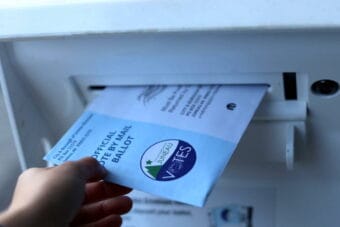
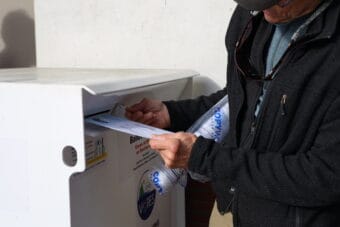
A municipal election ballot is placed in the drop box at the Douglas Library in September 2023. (Photo by Clarise Larson/KTOO)

Sunday is the last day to register to vote or update your mailing address for Juneau’s 2025 municipal election.

This year’s election features three ballot propositions, three open Assembly seats and three open school board seats. Ballots will be mailed to voters on Sept. 19 and vote centers for in-person voting will open on Sept. 22.
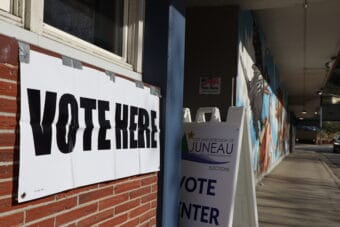
The last day to vote is Oct. 7. Final election results will be shared later that month. Go to the city’s election page for more information. 

Have questions for candidates? Submit your thoughts to the KTOO newsroom through the form at the bottom of ktoo.org/elections or below.


Ask KTOO your election questions

As we enter local election season, we’d like to hear from you: what would you like to hear from assembly and school board candidates as they compete for your votes? Send us your questions here and our reporters will answer them!

Name(Required)
Email(Required)
Please let us know what's on your mind. Have a question for us? Ask away.

What questions do you have for candidates as they compete for your votes this election? 

A sign hangs outside City Hall as the 2024 municipal election nears on Thursday, Sept. 26, 2024. (Clarise Larson/KTOO)

It’s municipal election season. That means the KTOO newsroom is busy building out its annual Municipal Candidate Guide. We pose six questions to each candidate and publish their answers in an easy to read – and compare – format. We hope you’ll look it over as you mull your votes in September and October.

KTOO’s local election coverage is part of our commitment to an informed and engaged electorate in our community. We’ll also cover this year’s local ballot measures and anything else election-related that arises.

And as the KTOO newsroom takes on its municipal election coverage, we want to hear from you. What questions do you have for candidates as they compete for your votes this election? On which issues would you like to hear their policy ideas? Submit your thoughts to us through the form at the bottom of ktoo.org/elections or below.

To hear from the candidates themselves, mark your calendar for Friday, Sept. 19. KTOO is teaming up with the League of Women Voters of Juneau to host and broadcast a live candidate forum. You can catch it live on 104.3 FM.

Bringing you the trusted information you need to vote with confidence is at the core of what we do at KTOO Public Media. Tune in!


Ask KTOO your election questions

As we enter local election season, we’d like to hear from you: what would you like to hear from assembly and school board candidates as they compete for your votes? Send us your questions here and our reporters will answer them!

Name(Required)
Email(Required)
Please let us know what's on your mind. Have a question for us? Ask away.

Juneau Assembly delays vote on ranked choice voting until after fall election

Assembly member Ella Adkison speaks during a committee meeting on Monday, Aug. 4, 2025. (Photo by Clarise Larson/KTOO)

The Juneau Assembly decided on Monday to delay voting on whether to adopt a ranked choice voting system for municipal elections beginning in 2026. 

Instead of voting on the ordinance at the Assembly’s next regular meeting later this month, members decided to push back the vote until November — after this fall’s Oct. 7 municipal election. They’ll still hold public testimony on the topic on Aug. 18.

Ranked choice allows voters to rank candidates by preference, instead of just choosing one. Alaska has used it for statewide elections since 2022, though there have been attempts to repeal it. 

Assembly member Ella Adkison proposed the local ordinance earlier this summer and advocated for its adoption at the meeting. She said the system aligns with Juneau’s values and it will encourage more people to run for local office.

“It really is good for races where there are lots of candidates in one seat,” she said, “I think Juneau, in general, likes having lots of candidates in races, because it means that the person that they feel represents them the most is the person who actually gets onto the Assembly.”

The topic received some pushback from residents at a meeting last week, as well as some support. A few testifiers questioned the need for the change, and argued that the decision on whether to adopt it should be up to voters — not the Assembly. 

It’s already too late for the system to be implemented for this October’s municipal election, but Assembly members worried that adopting it now might confuse voters anyway. Assembly member Alicia Hughes-Skandijs said she supports ranked choice voting, but wants to wait until there’s less going on. 

“My spidey senses feel like there is just a lot in motion, and there’s a lot on the ballot, and this just feels like too much change and is going to get lost in the noise — I wouldn’t want that,” she said. 

If the system is approved, Juneau would become the first major city in Alaska to adopt ranked choice voting for municipal elections.

Juneau could become first major Alaska city to adopt ranked choice voting for local elections

Voting booths sit on a table at the Mendenhall Valley Public Library on Tuesday, Oct. 1, 2025. (Photo by Clarise Larson/KTOO)

Monday was the first chance for residents to testify to the Juneau Assembly about whether to implement a ranked choice voting system for local elections. 

A spokesperson for the Alaska Division of Elections says it is not aware of any cities in Alaska that have adopted ranked choice voting for municipal elections. If approved, Juneau could become the first.

Alaska uses a ranked choice voting system for statewide elections. Voters approved it in 2020 and used it for the first time in 2022. The system allows voters to rank candidates by preference in open primaries, rather than partisan primaries. 

Supporters of the system say it helps reduce political polarization and fosters bipartisanship. Opposition predominantly comes from Alaska conservatives, who argue it makes voting unnecessarily complicated. Alaska is one of only two states that use ranked choice voting. Ten Republican-led states have banned it.

Assembly member Ella Adkison proposed an ordinance to adopt the system locally earlier this summer. She said the change will help build community consensus. 

But some testifiers at the meeting disagreed, like Angela Rodell. She unsuccessfully ran for mayor last election and questioned why the change is necessary.

“At a time when public trust in our local election process is being tested, this ordinance does not move us towards greater transparency, confidence or affordability,” she said. “Instead, it is the opposite. It proposes a fundamental change to our voting process without first answering a critical question, ‘What is the problem we’re trying to solve with this?’”

According to data from the state’s Division of Elections, Juneau voters appear to support ranked choice voting. The capital city overwhelmingly voted against an effort to repeal the statewide system last election, which only very narrowly failed statewide. Advocates are already attempting to repeal it in the 2026 state election.

Downtown resident Catherine Reardon said she thinks it makes sense for Juneau. 

“I think that it’s very appropriate, given the nonpartisan nature of our municipal government system,” she said. “I think it encourages candidates to work constructively together, although they are opponents, which is essential for a smooth operation of our local government.”

It’s too late for the system to be used in this October’s municipal election, but it could be implemented in time for next year. Residents will have another chance to testify on the proposed ordinance before the Assembly votes at its next regular meeting on Aug. 18. 

Bonds to upgrade Juneau’s schools and wastewater system rejected by Assembly

The Juneau Assembly at Centennial Hall on Monday, July 28, 2025. (Photo by Clarise Larson/KTOO)

The Juneau Assembly narrowly voted against putting two bond questions on this fall’s municipal ballot at a meeting on Monday. 

The bonds would have helped fund critical repairs and upgrades to Juneau’s schools and the city’s water and sewer systems. Officials say the updates are sorely needed. 

Assembly member Christine Woll said she wanted to wait to ask the question until a later election because of how crowded the ballot is already. She said she’s also worried about adding to the city’s debt at a time of potential budget uncertainty.

“We will need to fund these at some point in the near future, I would ask that we hold off until next year, given what we have on the ballot,” she said. 

Two citizen initiatives on the ballot seek to remove local sales tax on food and utilities and limit the city’s property tax rate. If passed by voters, both are projected to leave multimillion-dollar holes in the city’s budget. 

In preparation, the city recently notified local organizations that receive city grants – including KTOO – that it would be withholding a portion of their funding until the election due to “the potential of significant revenue loss” if the citizen initiatives pass.

Assembly member Maureen Hall said she wanted to put the school bond question on the ballot because of the potential for state assistance to pay down the debt. 

“We should take advantage of this opportunity,” she said. “I don’t think this is confusing to the voters. We all know what’s been happening to school funding lately.”

Despite voting down the school bond ordinance, the Assembly did move forward with a plan to fund the fencing and site preparation for a playground at Juneau’s Dzantik’i Heeni campus through general funds. It was originally intended to be funded through the bond measure. Members will still need to vote to approve that funding before that work can begin. 

Site notifications
Update notification options
Subscribe to notifications