Juneau elections

Miscommunication leads to hundreds of extra ballots sent to Juneau voters

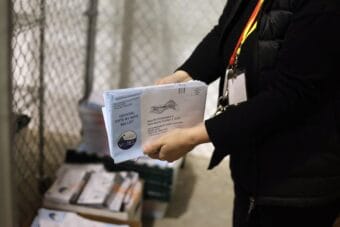
A city election worker handles envelopes at the City and Borough of Juneau Ballot Processing Center on Oct. 3, 2023. (Clarise Larson / for the Juneau Empire)

About 600 Juneau residents may have accidentally been sent two ballots for the upcoming municipal election. That’s due to a miscommunication between the city and the company that prints and mails the municipal ballots, city officials said. 

The Municipal Clerk’s Office, which runs municipal elections, announced the mistake Wednesday afternoon. Andi Hirsh, a deputy clerk for the City and Borough of Juneau, said the office became aware of the issue after people started calling in about it soon after ballots were sent out on Sept. 12.

“This won’t happen again. I’m not worried about this,” she said. “People are not going to be able to vote twice even though they got two ballots.”

Hirsh said the city believes the error happened after the company that prints and mails the city’s ballots, K&H Printers, didn’t discard the ones for voters who had updated their voter registration or submitted a questioned ballot in the State Primary Election in August.

Hirsh said that those who do receive two ballots should vote only one of them, and destroy the other. She said you can do that by simply ripping it up and disposing of it. 

And, despite the error, she said people won’t be able to vote twice. CBJ Elections has protocols in place to ensure only one ballot from a voter is accepted. 

“We have a bunch of processes in place to make sure that it’s secure. And a lot of those, I think people don’t necessarily see but I just want people to know that they’re there and they were in place before this, and they’ll stay in place after this,” she said.

Hirsch said people can call the clerk’s office with any questions or concerns about the ballots. She said the city plans to look further into what caused the issue after the election concludes. 

Voters have a few ways to return their ballots. The city has ballot drop boxes in different locations throughout the borough. Voters can also mail the ballot, or go to one of the two vote centers in town. Ballots must be postmarked on or before Election Day, which is Tuesday, Oct. 1. 

WATCH: Juneau Assembly candidates discuss local issues at 2024 League of Women Voters candidate forum

Juneau Assembly and mayoral candidates running in the Oct. 1 election answer questions about local issues during the 2024 League of Women Voters Assembly forum.

KTOO’s Clarise Larson and the Juneau Empire’s Mark Sabbatini moderate the live forum.

School board candidates will participate in a forum on Wednesday. Come in person to KTOO’s studio, watch live on KTOO 360TV or listen live on KTOO 104.3 FM and KAUK 91.7 FM starting at 7 p.m. Tuesday.
Find more elections coverage — including candidate profiles — at ktoo.org/elections

Juneau voters will decide whether to OK $10M bond for wastewater infrastructure improvements

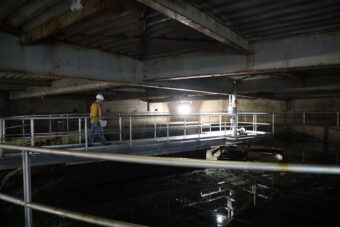
City and Borough of Juneau’s Utilities Superintendent Brian McGuire walks across a bridge in the wastewater clarifier building at the Juneau Douglas Wastewater Treatment Plant on Friday, Sept. 13, 2024. (Clarise Larson/KTOO)

Every time you wash your hands, take a bath or flush the toilet — your water and waste go somewhere. In Juneau, it goes to one of the sewage treatment plants run by the city.

Each day, the plants process nearly 3.3 million gallons of water. That equates to roughly 1.2 billion gallons every year. Denise Koch, the city’s director of Engineering and Public Works, said whether or not residents realize it, treatment plants play a critical role in the community. 

“Almost everybody in this town flushes the toilet every day and that water comes to one of our wastewater treatment plants,” she said. “These are critical services for both public health and for maintaining environmental standards.”

This election, the city is asking voters for $10 million to cover the cost of replacing the roof and structural supports for a building at the Juneau Douglas Wastewater Treatment Plant that houses its wastewater clarifiers. Utility staff say the building needs critical repairs, but some critics argue the city shouldn’t go into debt to pay for it.

The plant is located in Thane and services that area along with downtown and Douglas. It was constructed in 1973 — more than 50 years ago — and it hasn’t received any major upgrades since then. On the outside, rust cakes bits of the roof and piping along the wall. Inside, some of the ceilings and beams are so rusted you could break pieces off with your hands. And light from outside seeps through rusted holes in the ceiling. 

Brian McGuire is the utilities superintendent for the city. Last week, while walking through the building, he explained that wastewater clarifiers help ensure that the water treated at the plant meets environmental standards before it’s released into Gastineau Channel. 

“What’s here is the second to last step that the water goes through before it goes out to the Gastineau Channel,” he said. 

Clarifiers are large settling tanks that mechanically separate suspended solids from liquid water. The solids are dried and then shipped in containers to a landfill in Oregon.

“With water being such a part of what we do in this community, whether it’s fishing or whether it’s sailing, our community is really built around this,” he said. “And so I think this is a critical piece, this is the second to last piece that ensures that water is in the condition you want it to be when you’re out there fishing.”

McGuire said without the building undergoing these upgrades, there could big problems. If the building were to collapse, or something were to happen to the clarifiers, the city wouldn’t be able to meet environmental and public safety standards to discharge the water. It could also cause violations of the city’s wastewater permit.

But, while Koch and McGuire say the building is nearing the end of its designed lifespan and the need for replacement is time-sensitive, mayoral candidate Angela Rodell said she will be voting no. According to a poll conducted by KTOO, she was one of two Assembly candidates who said they would be voting against the measure. 

“We’ve raised taxes significantly over the last four to five years, and I’m concerned that we’re not addressing ongoing maintenance needs when they happen, but rather it seems to get to a crisis point,” she said. 

Koch said if the proposition doesn’t pass, the city is still committed to completing the project. But, because utilities are completely funded by ratepayers, the city may consider increasing rates to cover the cost of the project instead. 

“If the bond passes and we get revenue for this project, it enables us to use the funding that we get from the ratepayers to work on other projects before they get pushed back so far that they become more dire,” she said. 

The last time rates were increased was in July. They’ve gone up 2% each year since 2020.

The wastewater proposition is just one of three propositions on the ballot for this year’s municipal election. Ballots were sent to voters’ mailboxes last week. Election Day is Oct. 1.

Find more election coverage at ktoo.org/elections

Juneau’s public safety radio system hardly works. This election, Juneau voters are being asked to overhaul it for $12.7M.

Juneau Police Department Officer Terry Allen talks into a radio while on patrol duty in downtown Juneau on Monday, Sept. 9, 2024. (Clarise Larson/KTOO)

City officials say the radio system that police and firefighters in Juneau use is outdated. It was only designed for an eight-year lifespan and that expired a decade ago.

Though the system still operates, police officers like Terry Allen say it’s hardly reliable anymore. 

“It’s hit and miss,” he said during a patrol downtown last week. “You can be standing here and be clear as day, and then 15 feet away, you can’t hear anything but static.”

The city is asking voters for $12.7 million to spend on the project in this year’s local election. That money would be taken out as bond debt. It’s Proposition 1 on the ballot. But some critics say the city should have set aside money to pay for this a long time ago.

Allen has been a patrol officer with JPD for 24 years. He said having a working and reliable radio is crucial for his safety. Right now, the radios that officers and firefighters wear don’t work inside most buildings. And, they often hit dead zones near mountainsides and in patches scattered throughout the borough. 

Radio infrastructure used by the Juneau Police Department. (Juneau Police Department)

“If you’re in a situation where you need help and you can’t get back to your car, and you’re hoping somebody can get to you, waiting three minutes for dispatch to realize that you’re in trouble because they don’t even know you’re in trouble, and then trying to get somebody to you, that’s a long time,” he said. 

Capital City Fire/Rescue Chief Rich Etheridge said for emergencies like house fires or the recent glacial outburst flooding, not being able to communicate to crews inside buildings can be deadly. 

“I think it’s critical,” he said. “It’s the main component in every emergency situation in the community. Not being able to communicate with crews inside of a burning building, it puts us at a huge liability of hurting or killing someone.”

The system is also important for dispatchers like Meghan Kennedy-Brown. She’s been doing the job for more than 16 years. 

“It’s like a pet or a child — if you can’t make sure that they’re safe, you get very stressed out,” she said. “Because our job is to make sure they’re safe and make sure they have the tools they need, and it’s like taking one of our tools away.”

Now the decision of whether or not to replace it will come down to voters. The new project requires fixing or replacing communication towers at a cost of around $25 million in total. So voters are only being asked to pay for about half of it. The other half is being paid for with federal grants, previous city appropriations and some sales tax funding. 

According to the city, the mill rate isn’t expected to go up if the bond passes, because the city has the capacity to take on more debt right now. A portion of the mill rate is set aside for debt service and that money goes toward paying off bonds the city has taken on over the years.

According to a survey by KTOO, most candidates running for Assembly seats this election say they are in favor of the proposition passing. But several, like mayoral candidate Angela Rodell, said they don’t like the way the city wants to pay for it. She spoke about it at a public safety forum earlier this month.

“One of the things I’m very concerned about is why this bond issue is coming this year,” she said. “ Why it hasn’t come before now? To me, this is something that should have been taken care of a long time ago, and we need to focus on making sure that essential services are covered in current operating budgets.”

In light of a recent fatal shooting in Juneau involving police officers, people in the community have been calling for more transparency in the department. 

JPD’s current radio system doesn’t let them encrypt their communications – that’s when the signal gets cut off to the general public. But Police Chief Derek Bos said the new system would. 

“That doesn’t mean that everything would be encrypted, so that’s something we still would have to navigate as far as policies go, and when we would encrypt or when we wouldn’t, what that would look like,” Bos said. 

JPD doesn’t have anything in its policies about encryption. But, Bos said he’d like to get something on the books before the new system goes live. That would happen through a public process with the Assembly. 

“Encryption does have a significant value for law enforcement. A good example of that would be if we have an active shooter in a school,” he said. “We know nationally that the active shooters will listen to the scanners to see what the police are doing so that they can move away from the officers as we’re entering the school.”

The radio proposition is just one of three propositions on the ballot for this year’s municipal election. Ballots were sent to voters’ mailboxes on Thursday. Election Day is Oct. 1.

Local election ballots headed to Juneau voters’ mailboxes

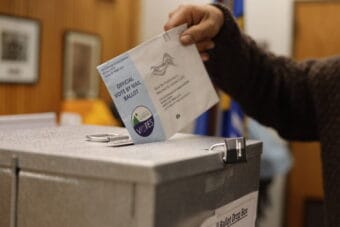
A municipal election ballot is placed in the drop box at the Douglas Library in September 2023. (Clarise Larson/for the Juneau Empire)

Ballots for Juneau’s local election are being mailed to registered voters Thursday. 

It marks the start of the City and Borough of Juneau’s municipal election this year, which features three ballot propositions, two recall questions, nine Assembly and six school board candidates.  

City Clerk Beth McEwen said people should start receiving their ballots in their mailboxes starting on Friday or this weekend.

“It’s a pretty long ballot. Take your time. Sit at your kitchen table and take as long as you need to research the stuff,” she said. 

Voters will have a handful of ways to return their ballots once they are filled out. The city has ballot drop boxes in different locations throughout the borough. Voters can also mail ballots back, or go to one of the two vote centers in town.

Ballots sent in by mail need to be postmarked on or before Election Day and a first-class stamp is required. 

This year, the city added a few more drop boxes. McEwen said that’s because it’s been a popular way for people in Juneau to return their ballots. 

“People were really appreciating and having an opportunity to drop things off and drop boxes. So we wanted to make that a little easier for folks,” she said.

The five available ballot drop boxes will open on Friday. They are located at City Hall, the Alaska Electric Light and Power Company office in Lemon Creek, Douglas Library, the Mendenhall Valley Public Library and the Statter Harbor Boat Launch parking area. 

The two vote centers will open on Monday, Sept. 16. They are at City Hall and the Valley Library. 

Election Day is Tuesday, Oct. 1. McEwen said she encourages people to not wait until then to vote. That’s because the vote center lines can be long, and ballots turned in on Election Day aren’t counted in the unofficial results released that night. 

Final results won’t be certified until Oct. 15.

Find more local election coverage at ktoo.org/elections.

Juneau Assembly candidates differ on natural disaster response, hiring strategies at public safety forum

Assembly candidate Neil Steininger speaks to the audience during a forum at the Alaska State Museum on Thursday, Sept. 5, 2024. (Clarise Larson/KTOO)

The candidates who win the three open seats on the Juneau Assembly this fall will make critical decisions about the safety of residents. From figuring out how to mitigate natural disasters to hiring enough first responders — not all candidates are on the same page on how to tackle these issues. 

Last week at the State Library and Museum, candidates participated in a public safety forum hosted by local first responders. The event focused on key health and safety issues that police, firefighters and dispatchers face in Juneau.

Issues like natural disasters, child care, staff shortages and wages were common themes. Assembly District 1 candidate Neil Steininger said the city needs to increase wages for first responders as the police department struggles to fill more than a dozen vacant jobs.  

“You don’t attract quality workers unless you are willing to pay what it costs to attract a quality worker,” he said. 

Steininger said getting those positions filled is critical. That’s as emergencies, like this year’s record-breaking glacier outburst flooding in Juneau, will likely continue to be looming problems. 

At the forum, while all candidates said they support mitigation efforts for future flooding being sought by the city, District 2 candidate Nano Brooks was more pressing. He said the city needs to take immediate action instead of waiting on movement from the state or federal government.

“We need to be building levees downstream on city-owned land. We need to be cutting diversion channels into unpopulated areas and be looking at what it takes to engineer stilted homes for construction of the future,” he said. 

Alongside candidates on the ballot, there is a proposition that asks voters whether to pass $12.7 million in bond debt to help cover the cost of replacing the radio system used by police and firefighters.

Police say the current system they use is outdated and its expected lifespan expired a decade ago. While all candidates present at the forum said they would be voting yes on the measure, some like mayoral candidate Angela Rodell, said she isn’t a fan of the way the city wants to pay for it. 

“One of the things I’m very concerned about is why this bond issue is coming this year,” she said. “Why it hasn’t come before now? To me, this is something that should have been taken care of a long time ago, and we need to focus on making sure that essential services are covered in current operating budgets.”

The lack of affordable housing and limited resources for people experiencing homelessness was also an issue brought up. District 2 candidate Emily Mesch said she wants the city to expand its collaboration with local social service providers. 

“I think CBJ has a leadership role, in terms of making sure that all of our social services providers are working well with one another, that when there are gaps, they can work together to fill them, and make sure that if there is a need, that it’s provided for,” she said. 

Seven out of nine Assembly candidates attended the forum. District 1 candidate Connor Ulmer and incumbent Mayor Beth Weldon did not attend. Five candidates are running for a District 2 seat, two are running for a District 1 seat and two are running for mayor.

But, more election forums are coming up. Ballots for Juneau’s by-mail election will be mailed to residents on Sept.12. Election Day is Oct. 1.

The Juneau League of Women Voters, KTOO and the Juneau Empire will co-host candidate forums on Sept. 17 and 18 at 7 p.m. 

Site notifications
Update notification options
Subscribe to notifications