Community

Social media becoming an information lifeline during natural disasters

The next time an earthquake or other disaster unleashes near you, Twitter, Google and Facebook might be useful places to turn. And not just you. Disaster-response agencies are plunging into social media.

They can develop better situational awareness by seeking out your online gripes and observations. Digital platforms also provide an avenue to give more frequent official updates and correct misinformation during a catastrophe.

Kaleb Urike has gone through the kind of disaster the Pacific Northwest is supposedly due for. I met him in Sendai, Japan and asked about a fateful day: March 11 last year.
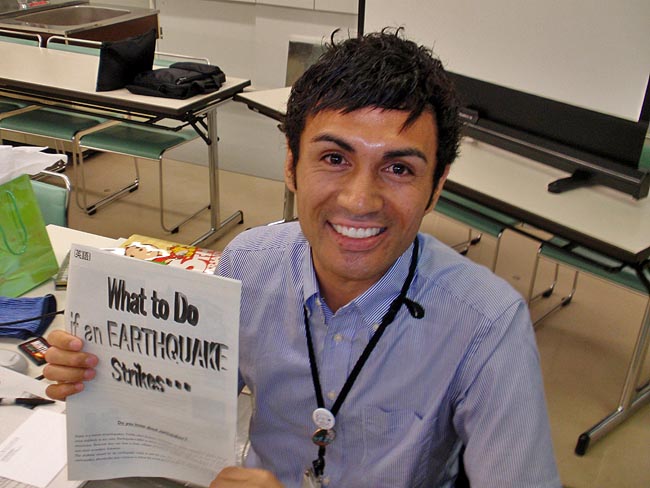
New Zealander Kaleb Urike used social media to let people know he survived last year's Japanese earthquake and tsunami. (Photo by Tom Banse)
New Zealander Kaleb Urike used social media to let people know he survived last year’s Japanese earthquake and tsunami. (Photo by Tom Banse)

Ironically, that day Urike was organizing a fundraiser for earthquake victims in his far away hometown of Christchurch, New Zealand when the tables turned. You remember the magnitude 9.0 quake that rocked northeast Japan.

“It lasted for five minutes,” Urike recalls.

“We had to evacuate and go outside. Then it just started snowing for 30 minutes. That’s all I remember, being cold.”

The recent university graduate was unhurt.  His next instinct was to locate other ex-pat workers in the city and confirm they were okay. But the electricity was out and would stay out for the next three days. Phone lines were inoperable or jammed.

Urike says in Sendai, cellular service and mobile data came back first.

“A lot of people could use their smartphones.  So they accessed Facebook and would update to say that they’re okay.”

Urike says he wasn’t a big fan of Facebook until this happened.

“I didn’t think actually it would be as useful as it was,” Urike says. “I would say after the earthquake everyone was on Facebook. I’m glad I do have a Facebook account, because I was going to close it down beforehand.”

Urike also made sure his survivor status was posted on Google Person Finder. Google activated this temporary internet database to help friends and relatives find missing people in the disaster zone.

This is a function traditionally performed by local government or the Red Cross, so what’s Google doing here? Ask Christiaan Adams. He’s a software developer with Google’s in-house crisis response team.

“In times of crisis, people will go to the tools that they know and use regularly,” Adams says. “In their daily lives, they use Google Search. They use Google Maps. These are the places they go for information.”

He says Google isn’t trying to be an alternative to official sources, rather to make those sources more effective.

“Technology is changing so quickly these days that it’s hard for anybody to keep up with the new ways of doing things and the best and latest ways of publishing data. So we try to work with many organizations to help them do that better and to get their information out.”

Adams says Google Person Finder accumulated more than 600,000 records pertaining to the Japanese earthquake and tsunami. That compares to 200,000 by the Japanese Red Cross. One difference is that the Red Cross verifies entries to its missing persons database while Google does not.

Government agencies have been slower to jump onto social media platforms than the private sector. Among recent converts are some Northwest wildfire incident commanders.

Kris Eriksen is a public information officer for the U.S. Forest Service. This summer, she says social media is allowing her to listen and respond from the fire command post in ways she never could before.

“We can sort of hear over-the-backyard-fence discussions among neighbors. We can join groups. We can hear discussion groups and blogs.”

“And,” Eriksen says, “we can get a sense or a pulse from the community and how it is feeling about our response efforts.”
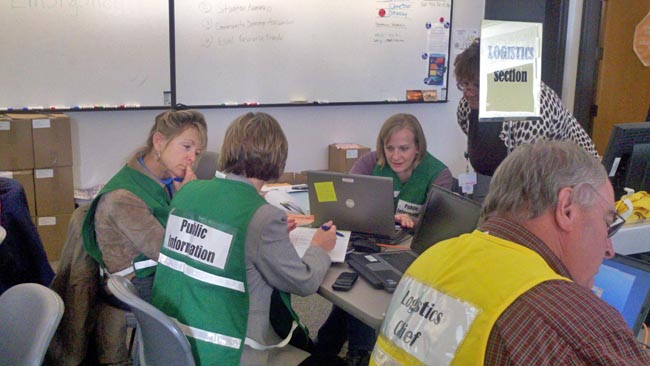
Several positions at the emergency operations center in Vancouver, Wash. are now tasked with engaging with social media during a natural disaster.
Several positions at the emergency operations center in Vancouver, Wash. are now tasked with engaging with social media during a natural disaster. (Photo courtesy of Cheryl Bledsoe, CRESA)

Change is also coming to county emergency operations centers. In a major disaster, the center in Vancouver, Washington now has several work stations dedicated to staying on top of Twitter, YouTube, public posts on Facebook and other social media sites. Emergency manager Cheryl Bledsoe says those channels can provide real-time intelligence from what is basically an army of citizen journalists.

“They’re seeing something on fire and taking pictures of it,” Bledsoe explains. “It gives us a much better picture in here of what the disaster looks like outside these four walls.”

Bledsoe has two computer monitors on her desk where she scans and sorts multiple incoming streams of internet chatter with practiced ease.

And yeah, Bledsoe knows you can’t believe everything you read on the internet.

“You do see fake information go into the social media streams, but it also gets corrected very quickly.”

During a big emergency, Bledsoe hopes Facebook and Twitter users collaborate to solve some problems themselves, without drawing on over-extended emergency responders.

But not everyone has a smartphone, plus there are people who don’t use social media at all. What about them?

“We still use emergency alert systems, which go out through radio and television broadcast,” Bledsoe says. “A lot of that is changing to where it is gathering in some new forms of technology. So even gaming systems, like the Xbox, are being looked at as a provider of emergency alerts.”

Of course, the Xbox, televisions and the internet require electricity, which may be out. So don’t throw away that battery powered radio just yet. It’s still part of the plan.

Something else to consider is that some divisions of federal and local government simply can’t afford to add another body right now to surf the web and reply to tweets during an emergency. Later this summer, the American Red Cross says it plans to start training so-called “digital volunteers.” In a future crisis, such volunteers could support an understaffed jurisdiction upon request.

—–

Correspondent Tom Banse’s reporting from Japan and Mountain View, CA for this story was supported by a disaster preparedness journalism fellowship awarded by the East-West Center.

Gastineau grave does not contain Chilkat man’s body

It turns out a grave site uncovered last month in Juneau does not contain the body of a Chilkat man who died in 1927.

The tribal administrator of the Douglas Indian Association now says it appears the grave site at Gastineau Community School actually belonged to an unidentified young woman.

The City and Borough of Juneau Engineering Department and the Sealaska Corp. had said last month that the remains discovered during construction outside the school belonged to Sam Goldstein of Klukwan. Chilkat representatives conducted a ceremony at the site the following day.

But an archaeologist now says the remains are those of a woman aged 20 to 25, and the headstone appears unrelated to the disinterred grave.

Goldstein’s remains are still missing.

Southeast Alaska shows population growth

Many communities in Southeast Alaska have seen population declines for a decade or more, but there appears to be a turnaround.

New estimates released by the Department of Labor and Workforce Development’s Research and Analysis Section show that all of Southeast saw growth at above the statewide average of 1.7 percent.

New state population estimates show Prince of Wales Island’s Hydaburg was the region’s fastest growing city of any size, adding 8 percent to its population. City Administrator Adrian LeCornu says he doesn’t know what caused it other than Hydaburg being an attractive place to live.

Thorne Bay, Klawock and Port Protection also are growing rapidly.

Former Rep. Heinze dies in Homer plane crash

Updated: 11:19 a.m.

The pilot of a plane in which former state Rep. Cheryll Heinze was killed – as well as four others in the Cessna 206 that crashed while landing on Beluga Lake in Homer – were taken to the hospital in Homer to be treated for injuries.

South Peninsula Hospital spokeswoman Derotha Ferraro says the five arrived at the hospital late Tuesday. Four were treated and released, but Heinze died early Wednesday morning while being prepared for transfer to an Anchorage hospital.

The National Transportation Safety Board says the Cessna 206 with five people aboard left Anchorage, stopped in Kenai and then continued to Homer. It crashed between 10:30 and 10:45 p.m.

The 65-year-old Heinze represented Anchorage as a Republican in the state House of Representatives from 2002 to 2003.


Emmonak Women’s Shelter receives emergency funding

In May, the Emmonak Women’s Shelter – one of only two shelters in western Alaska and the only shelter located in a native village – was on the verge of closing its doors. Plagued by budget shortfalls, its funding for the year was nearly gone before the summer even began. On July 2, After working with Senator Lisa Murkowski, the Bureau of Indian Affairs provided the shelter with $50,000 in emergency funding.

“We just received word from our Senator Murkowksi that $50,000 is going to be sent to the tribe and the tribe is going to write a check for that amount to the Emmonak Women’s Shelter,” said Lynn Hootch.

Hootch is the former shelter director who now works with the Yupik Women’s Coalition in Emmonak. Still involved with the shelter, Hootch says its monthly costs range from $10,000 to $13,000. That includes keeping advocates on the phone 24 hours a day, and housing women and children for weeks at a time. After fearing closure just months ago, Hootch says the $50,000 will now keep the shelter open and staffed for the rest of the summer.

“The Emmonak tribe will transfer the money to continue to keep our shelter open until hopefully, we receive the grant that we applied for, in September,” Hootch said.

That transfer is from the BIA Office of Indian Services, which will be making the emergency funds available to the Village of Emmonak. As a federally recognized tribe, OIS allocated the money under its Tribal Priority Allocation authority.  The tribe will then send the funds on to the shelter.

This isn’t the only new funding for the shelter. After the New York Times ran an article on the shelter’s seemingly imminent closure in May, word spread on Facebook, and pledges of support were followed by donations of money and in-demand items like diapers, clothes, and non-perishable food. Hootch says the Department of Public Safety even donated an ATV. In all, the shelter collected close to $30,000 in donation.

“We received almost close to $10,000 in checks and we found out this morning that we have close to $20,000 from PayPal.”

Serving about 500 women and children a year, the Emmonak Women’s Shelter has been open for 34 years. It operates under a grant from the U.S. Department of Justice’s Office of Violence Against Women.

Fourth of July festivities promise fun and games

Rain is in the forecast for the Fourth of July, but don’t let that dampen the fun. There is a ton of events and activities going on around downtown Juneau and on Douglas. With so many options, plan ahead because the parking goes fast.

Check out this video from Fourth of July in Douglas.


Here are some of the events going on for the holiday.

July 3

6:00 p.m. – Douglas Volunteer Fire District softball game at Savikko Park Field #4 followed by a watermelon eating contest.

8:00 p.m. – Midnight – Community dance at the JACC

11:59 p.m. – Fireworks on the Gastineau Channel

July 4

11:00 a.m. – Juneau Fourth of July Parade start

11:00 – 5:00 p.m. – Barefoot Bouncers Bouncy House at Savikko Park Field #3

12:00 – 6:00 p.m. – Deep Pit Beef Barbeque Dinner at Douglas Methodist Church

12:00 p.m. – Sand Castle Challenge at Sandy Beach

1:00 p.m. – Hotdog sale in front of Douglas Fire Hall

1:30 p.m. – Participants assemble for Douglas parade at Gastineau School.

2:00 p.m. – Douglas parade starts

3:00 p.m. – Field sports at Savikko Park Field #2

3:00 p.m. – Medieval fighting and dance at Savikko Park Field #3

3:30 p.m. – Super Dog Frisbee Contest at Savikko Park Field #3

4:00 p.m. – Make and Break Old-time Fireman’sHose Race at Douglas Fire Hall

4:00 – 9:00 p.m. – Dance, Music and other entertainment at Savikko Park Field #2

For more information check out the Douglas 4th of July Committee and the Juneau 4th of July website.

Site notifications
Update notification options
Subscribe to notifications