Community

Tongass Voices: Marian Call and Lisa Puananimōhala’ikalani Denny on bringing together Juneau’s music-makers

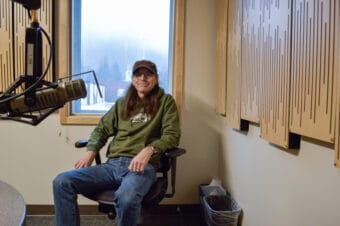
Marian Call and Lisa Puananimōhala’ikalani Denny are organizing the Juneau meeting of the Alaska Music Summit. Pictured in the KTOO studio on Jan. 24, 2025. (Photo by Yvonne Krumrey/KTOO)

This is Tongass Voices, a series from KTOO sharing weekly perspectives from the homelands of the Áak’w Kwáan and beyond.

Marian Call and Lisa Puananimōhala’ikalani Denny are organizing this week’s Alaska Music Summit in Juneau. It’s a chance for anyone who is a part of making music in the region to come together and swap ideas.

The Juneau summit is Saturday from 11 a.m. to 4 p.m. at Devil’s Club Brewing. Participants can register at alaskamusicsummit.com.

Listen:

This transcript has been lightly edited for clarity.

Marian Call: I’m Marian Call. I’m the Program Director of Music Alaska. 

Lisa Puananimōhala’ikalani Denny: I’m Lisa Puananimōhala’ikalani Denny. I am the project outreach coordinator for Music Alaska for the Juneau Music Summit. I also did a little volunteer coordination for our summit up in Anchorage.

The summit is a gathering of music-minded people across the state of Alaska. There are three of them: Fairbanks, Anchorage and Juneau. And it’s like a convention for people in every facet of the music industry to come together, to network, to share our perspectives and to connect with each other and level up together. 

Marian Call: The music summit was started about some years ago, but this is the seventh one, and we’re really excited to see every year, more and more people who are in different parts of music-making. Like people who do booking or people who are DJs, or people who make beats, or people who write new operas, or people who are teaching preschoolers, right? 

All these people serve different roles, but sometimes don’t have the chance to really talk to each other, even though all our fates are very connected. So the music summit makes space for this to happen, and it also gives us a chance to intentionally try to make our music ecosystem better, because it certainly nothing happens if we don’t try together to make it better. And when we do try to make it better, amazing things happen. 

We’ll also be talking about money, about what musicians earn, what they’re paid, how to make the money work. How to make it work well for the venue too. How to have a successful event when you’re trying to make sure that people are being compensated what they’re worth. 

Lisa Puananimōhala’ikalani Denny: We’ve reserved one small segment for to hear from the perspective of the bartenders, who are tend to be viewed as on the fringes of the scene, but they play such a crucial role in a lot of music events, especially like in downtown Juneau, where they’re helping run a lot of that show. 

Marian Call: I think that’ll be great. I think nobody ever asked the bartenders ‘Hey, which shows work?’, but I think they have specialized knowledge about that. 

Possibly the most important part is when we simply free the room up to everyone. Just talk to each other, right? Talk to someone you don’t know, talk to someone you haven’t talked to in a long time. So at lunch and afterwards and the next day at office hours, that’s really when it happens. 

We’re trying to kind of build bonds between the most distant corners of the music community, like if you’re as far apart as you can be in the music community, if you’re playing heavy metal

versus performing like 11th century chant. Or if you’re like teaching preschoolers versus performing with seniors in a community choir. 

No matter how far apart we are, all of our fates are tied together, and this is our opportunity, once a year, to try and make sure that people see that connection and value it. 

Lisa Puananimōhala’ikalani Denny: I am an independent musician in Alaska, and I wasn’t that before I came here. And Juneau is such a fun community to be an artist, a performer, a musician in, because we are so supportive. We’re so all about it. You want to try something? Do it. We’re going to support and applaud you. 

Juneau resident counts his blessings after California fire destroys home of 30 years

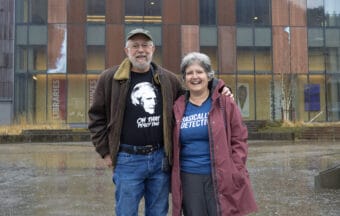
Juneau residents Drew Dembowski and Katy Giorgio pose outside Los Angeles International Airport on Jan. 12, 2025. (Photo courtesy of Katy Giorgio)

Everyone saw the images of homes burning throughout greater Los Angeles earlier this month in what has now been called one of the most destructive urban fires in United States history.

That included two Juneau residents, one of whom fled the Eaton Fire as it consumed the community he had lived in for decades.

On the night of Jan. 7, Juneau resident Drew Dembowski had just returned to his home of nearly 30 years. The idyllic brick ranch house sat at the base of the San Gabriel Mountains in Altadena.

Dembowski had just returned to California from Juneau the day before. He was there to finish getting his home ready to put on the market. A guest appearance with the Juneau Symphony in 2017 first brought Dembowski to Alaska. He fell in love with it, and kept coming back as principal bass. Then he fell in love with Katy Giorgio, the symphony’s principal trombone.

After spending his entire career as a studio musician in LA, he was finally ready to retire and live full time in Juneau with Giorgio.

“This was like my big move,” Dembowski said. “I lived here 68 years. It’s time for a change.”

But on that Tuesday, the Santa Ana winds had raged all day, putting the entire bone-dry LA region on edge. Back in Alaska, Giorgio was on edge too, watching coverage of the Palisades fire. As night fell, Dembowski sent her a screenshot from a fire tracking app. It showed a new flame icon in nearby Eaton Canyon.

“I knew immediately, when I saw that map,” Giorgio said. “I was like, ‘This is not good. I think we’re going to lose the house tonight.’”

With the flames rapidly approaching his neighborhood, Demobowski had just enough time to walk through his home to take pictures and grab a few essentials. In a video he captured just before getting in his car, embers sail through the air as the wind shakes trees and street signs. Small fires ignite in the brush across the street.

“I stuck around the house longer than I should have,” he admits.

By the next morning, it was gone.

“I just spent a year and a half and a half-million dollars remodeling the house to sell,” Dembowski said. “It was supposed to be listed in a couple of weeks, and now it’s just a pile of rubble.”

Giorgio caught a flight to LA the next day to help him sort through the aftermath.

Like many Southern California homeowners, Dembowski’s insurance of 28 years dropped his coverage a year ago. He could only find home insurance through a state plan offering the most basic coverage. And then there’s all the other things to think about in the aftermath of a disaster.

“Drew had one pair of pants, like in Los Angeles … that’s all he had,” Giorgio said. “But it was also, like, spending time calling the utility companies.”

They drove up to the house to take pictures and see what was left – a foundation of singed bricks and some surprisingly fire-resistant lawn furniture. The Eaton Fire destroyed more than 9,000 structures and left 17 people dead. The cause is still under investigation, but the community is forever changed.

“Altadena was such a beautiful place. It was an old area with lots of big trees and old houses. And it is just, it’s just gone,” Dembowski said.

The area was known for being the home of many artists and musicians, as well as a historic Black community.

“That’s what I cry about, is, of course, the house, and the things in the house, but it’s really like, that was such a beautiful area and, and I just don’t see it recovering in the same way,” Giorgio said.

It’s easy to count up the things that they lost in the fire – a collection of about 1,500 mountaineering guides Dembowski assembled over 40 years, his bikes and vinyl records, Giorgio’s orchids – but he’s quick to point out that he’s one of the lucky ones.

He already had a place to stay nearby and a home in Juneau to return to. And he was able to save his prized possession – an upright bass from 1790 that he’s owned for half a century.

“Had I lost that instrument, that would have changed my dynamic a lot,” he said. “It’s been my dance partner.”

Months of uncertainty lie ahead. Instead of listing his home on Zillow, he’ll file insurance claims. He knows he won’t recover the full value of his home, but he’s making peace with that. In a way, it’s a relief after struggling for so long to part with it.

“And you know, that’s taken care of now, not the way I would have chosen, but it’s – it’s given me the freedom to move forward and to get where I was hoping to get a little bit sooner,” Dembowski said.

In the end, he has his health, and his loved ones, and his bass.

“I’m counting my blessings,” he said.

Tongass Voices: Rich Mattson on uncovering stories from the pages of Juneau’s history

Rich Mattson, a researcher for Gastineau Channel Historical Society, looking through old newspapers at the Alaska State Archives on Jan. 21, 2025. (Photo by Yvonne Krumrey/KTOO).

This is Tongass Voices, a series from KTOO sharing weekly perspectives from the homelands of the Áak’w Kwáan and beyond.

Rich Mattson remembers playing in the ruins of Treadwell Mine as a kid in the 1950s, and he said that planted seeds of curiosity about Juneau’s past. 

Now, he researches history for Gastineau Channel Historical Society, and publishes daily “This Day in Juneau History” posts on juneauhistory.org. Mattson says he’s an amateur, but it has become almost like a part-time job in his retirement.

Listen:

This transcript has been lightly edited for clarity.

Rich Mattson: A popular bumper sticker in 1986 was “I survived the tsunami of 1986,” because there was a 7.7 magnitude earthquake in the Aleutian Islands on May 7, and it was feared that there would be a tsunami that would even reach into Juneau. 

So people went out to Auke Bay and lined the road to see the tsunami. Now, if there really would have been a tsunami, that would have been a pretty foolish thing to do. But as it turned out, it was only a two-inch wave, so bringing a rise to the bumper sticker, “I survived” that tsunami. 

I’m Rich Mattson. I just retired from DIPAC about 2018. And I’ve been following my passion for local history ever since. I grew up in Douglas. My dad came up as a fish biologist and with our family in 1957 and we ended up living down at the end of St. Anne’s Ave.

Well, growing up in that area, Treadwell was our playground, and Sandy Beach. There was an old timer here named Sim MacKinnon. He had made quite a collection of historic photographs, which, by the way, is in the State Library, fascinating to look at. 

And I just remember folks brought us down to a presentation he was giving. It was a Taku blustery night, and here’s all these pictures of old Treadwell. It just sort of set the scene. And that just hooked me as to be a lifelong student of Treadwell. So that really was what got me into local history.

I got a whole list of interesting stuff I found. And sometimes you find some goofy stuff. 

One of the first ones I came across, as a student of history, was, ‘Has anybody ever heard of  250-foot Johnson?’ Well, it turned out, Treadwell hired lots of Scandinavian workers, and there were lots of Johnsons. And so in the times there, most people had a handle of some kind that was assigned by their contemporaries. And this one, Charles Johnson, was working in the Treadwell Mine. 

Mr. Johnson was getting off his shift one afternoon, and he must have been sort of absent minded, and it doesn’t sound like they had a lot of safety railings around this thing, and he stepped off on the other side and promptly fell down the shaft. Well his friends were alarmed. They immediately went down on the hoist to recover his remains, and there they found him standing in the sump of water at the bottom in knee deep water, looking rather dazed. 

He had some bruises, no broken bones, and he’s a little bit in shock, understandably. Well, the newspaper reported that the next week, and they said he fell 250 foot down the Treadwell shaft. 

They said ‘ah, it was deeper than that.’ And they actually took a tape and measured that darn depth there. It wasn’t 250 feet, it was 256 feet! And from then on, Mr. Johnston was known thereafter as 256-Foot Johnson.

But for today, I actually went into my “This Day in History,” January 17. What was happening on that day? I think the one that was more interesting that I doubt very few people know, is the Goldstein ice skating rink. Well, the Goldstein building, as most people who are long timers around here know, is that big six story building at the corner of Second and Seward Street. 

Well, in 1939, that building got burned in a tremendous fire. It was probably the biggest fire in Juneau, certainly to that time, and even since then. The thing was just totally gutted.

But in those years when it was gutted, it was just a hollow shell. It was just the concrete walls, and because of the no roof, and it would rain and it would freeze, and presto! Juneau had an indoor, so to speak, ice skating rink. And so, Chief of Police [Ralston] was warning people that with the thawing weather that it was probably unsafe, so don’t go skating in the Goldstein ice skating rink until it freezes again. That was January 17 in 1940. So stuff like that.

Forest Service proposal to raise five kootéeyaa at Mendenhall Glacier met with questions of Indigenous agency

The Mendenhall Glacier Visitor Center on Oct. 19, 2024. (Photo by Clarise Larson/KTOO)

The U.S. Forest Service plans to raise five new totem poles – called kootéeyaa in Lingít – at the Mendenhall Glacier. 

At an open house on Wednesday, it was clear that the kootéeyaa are meant to honor and acknowledge the original people of the land. But some of those original people say they should be included in creating the plan.

Listen: 

The discussion got heated as soon as leaders from the Central Council of the Tlingit and Haida Indian Tribes of Alaska and the Forest Service unveiled the plan. They came with slideshows and maps, but soon the conversation among the two dozen attendees turned to how the kootéeyaa would represent the people and history of this place.

The proposal brought up conversations about stewardship, clan representation and belonging. Several tribal members said they’re upset about the lack of consultation in this process. 

Seikoonie Fran Houston was one of them. She’s the spokesperson for the Áak’w Ḵwáan – the Lingít people who originally lived in what’s now called Auke Bay.

“Sometimes I feel like I’m being stomped on,” she said. “We’re being stomped on.”

Houston asked where the plan for this project came from, and why her clan, the L’eeneidí, wasn’t consulted sooner.

Neilg̱áa Koogéi Taija Revels is the executive director of Goldbelt Heritage Foundation. She stood to defend the project, but also to acknowledge that this project has departed from the Lingít way of raising kootéeyaa.  

“I know this isn’t the way that we do things,” she said. “That we’re forced into a Western process where we have to get permission first before we can start talking to the clans about designs, how we’re going to do this properly.”

But Revels said this is also a chance to “correct the lie” that natural spaces like the glacier are inherently devoid of Indigenous people. 

“We were the natural landscape. We were the last frontier,” she said. “This gives us an opportunity, when visitors come to see the gorgeous lands that we are either guests on or stewards of, to see that Lingít people have always been in these places.”

Michael Downs, the district ranger for the U.S. Forest Service, was quick to say the plan isn’t even close to final.

“No big decisions have been made,” he said. “There’s plenty of time for these great discussions. I want you to all understand that.”

To address some of the frustration shared by tribal members, Downs said the Forest Service plans to have many meetings in the future about the kootéeyaa. 

“This is not like something’s going to happen tomorrow,” he said. “I mean, I’m just being honest there. They’re probably going to be about $250,000 a piece, and we don’t have no money right now.”

This co-management relationship between the tribe and the Forest Service is only a couple of years old. 

Lee Miller is Áak’w Ḵwáan, and he worked as a cultural ambassador at the glacier last year. That’s a new role: tribal members educate tourists on Lingít culture and its connections to the landscape. 

“Last year we saw fantastic changes and more to come,” Miller said. “This is our opportunity, folks. Put aside the bickering. Make this ours. Own it. It’s been a long time coming.”  

Miller said an opportunity for more Lingít representation at the glacier wasn’t imaginable a few years ago.

“What was out there? The glacier, the waterfall, the wildlife, and it’s still there. But we’re there,” he said. “We are finally there.”

Sa.áax’w Margaret Katzeek, who is Jilkaat Ḵwáan, came to the meeting with several of her nieces and nephews. She grew up here, and plans to raise her family here.

“I just think that it would be really important for them to be able to see something like this, wherever they are,” she said. “And know that they are part of this land as well, and that they belong here and that they are important and cared about and respected.”

She said kootéeyaa at the glacier would show future generations their reflections in the landscape. 

Tongass Voices: Librarian Melinda Sandkam on engaging all ages with Douglas Library’s I Spy display

Librarian Melinda Sandkam in front of the I Spy display at Douglas Library on Dec. 13, 2024. (Photo by Yvonne Krumrey/KTOO).

This is Tongass Voices, a series from KTOO sharing weekly perspectives from the homelands of the Áak’w Kwáan and beyond.

You may have noticed the eye-catching display of bits and bobbins: stuffed animals, beads and soccer balls at the Douglas Library. And that’s what it’s for — to be looked at. There is a list at the bottom that says things like “find 10 ladybugs.”

Librarian Melinda Sandkam created the I Spy-inspired collection nearly two years ago, and has been adding to it ever since. 

Listen:

This transcript has been lightly edited for clarity.

Melinda Sandkam: People are surprised by it. They come upon it when they’re waiting for something. You know, we can’t have food in the library, but you can enjoy snacks in the lobby. So often, people will be munching on a little snack out here, and they engage with the I Spy display, people will be coming into our meeting room to use it, and so they they discover the I Spy display, or the Friends of the Library books that are available, or the free magazines to pick up.

And so it’s just kind of in passing through. But I really do find that people get interested in finding that either looking for something on the list or they just spy something that they recognize.

I’m Melinda Sandkam, and I’m the outreach librarian with Juneau public libraries. So I was inspired by seeing I Spy displays in libraries and other locations.

When I completed my degree and was exploring neighborhoods in the Pacific Northwest to move, I visited over 150 libraries in Washington and Oregon, and so I saw I Spy. Sometimes they were in a smaller setting, like an aquarium or big glass case. So it’s just a great engagement in the library.

The I Spy display at Douglas Library on Dec. 13, 2024. (Photo by Yvonne Krumrey/KTOO).

But I also saw the display at the Alaska State Museum, and they have a board where things are attached or glued to and so those were inspirations to filling this case with something to engage the community.

The very first thing I did was put out an ask to all our staff, because we have some really creative librarians. And just, “did they have any miscellaneous things sitting around?” That was where we got our Elvis in the purple sequin suit, from a staff member. And then we just collected things.

Then I started looking in yard sales. And here in Juneau, there’s all the piles of free stuff. And so I always keep an eye out there. I just picked up two pine cones last night in someone’s bucket of free stuff.

But I’m also looking for literary things. So I recently found a Clifford, the Big Red Dog. I found another panda, and I knew I had pandas, so I just keep an eye out for things that will have the literary theme or that will make it two or three or multiple items.

I came from an education background. I was a preschool director most recently, before becoming a librarian, and so you see at that early age how people engage in different ways. Some engage kinesthetically and some engage through literature and some engage with a math background. Some engage very physically, like building things — manipulatives.

So this is definitely an engagement with the mind of looking for small and big that can be with. Like we have a very big Eeyore and a very small Eeyore. Those are some of the most difficult ones to find. Or you’ll say, three Poohs, but the Poohs are all different shapes and sizes, and so that can engage very young ones. There’s a lot of color. There is a lot of characters that they might know.

So it is just that color, shapes, sizes, themes, animals. We have a crocodile, we have frogs, we have ladybugs, dinosaurs and so those are all things that may engage many different people.

Tongass Voices: Juneau actor Roblin Gray Davis on clowning around

Roblin Gray Davis (right) clowning around with his brother W. Scott Davis. (Photo courtesy of Roblin Gray Davis)

This is Tongass Voices, a series from KTOO sharing weekly perspectives from the homelands of the Áak’w Kwáan and beyond.

Roblin Gray Davis is a professional actor, and he’s bringing one of his favorite ways to hone his skills to Juneau in a five week-long clowning course. 

He says clowning can break down the walls we put up, to see what’s behind. 

Listen:

This transcript has been lightly edited for clarity.

Roblin Gray Davis: I am Roblin Gray Davis, and I am a theater maker, a lifelong Alaskan artist. Been in Juneau for over 25 years now, I do believe.

Part of my interest in theater has been pursuing this idea of Mask Theater that comes out of the tradition of Jacques Lecoq, which was a school in Paris, that kind of was fundamental in maybe reopening the theater world, the contemporary theater world, to ask, you know, “how can we make this more lively and more topical and more interesting in general?”, and also, “how can we train actors and performers, designers, directors to maybe create original work?”

Though, I feel like I am still on my own personal journey in relationship to creating a red nose character. Sometimes the word clown is misinterpreted, perhaps because of all of the scary movies and all of the different forms that clown theater has taken in the United States, from birthday clowns to circus clowns to the scary movie clowns.

But this particular type of red nose clown theater work is coming out of actor training, so it’s really part of this world of mask theater, where we’re looking at putting on just “what’s the smallest mask we can put on our face?” And that is just a little nose. There’s something about how it changes the performer’s face in just enough of a way that the audience can see a character and not necessarily the actor. 

Play and laughter and kind of a liberating creativity is the heart of this work, finding how we are unique as individuals, and how our differences, our idiosyncrasies, are our strengths in a way, as artists, that’s what makes us interesting. 

If you can find that space as a creative artist, where you are hitting a nerve in your audience that elicits genuine laughter, then you are doing something miraculous, I would say. 

I mean acting is, I think, one of the most difficult art forms. I’m not a classical musician, so I’m sure it’s probably a little more difficult. But as far as you as an artist, needing to be the art form — right — we are as actors, we are the art. So in order to tell those stories and to perform lively and with authenticity and being compelling as a performer on stage, is difficult. It’s a difficult task. 

And so, I think as actors, we need to continually work on ourselves, to become more grounded, more present, more available to play, more in tune with our own creativity and those internal impulses we have.

All that stuff that I think makes a good performer or a strong performer. Someone who an audience goes, “it didn’t feel like they were acting at all. I felt that they were that character.” In order to do that art form, you have to be limber, you have to be strong, you have to be resilient, you have to be present. You have to be all of these things. 

And this particular work of the clown — clowning around — gets at all of those really important principles of performing.

Site notifications
Update notification options
Subscribe to notifications