Juneau Schools

City seeks proposals to fill space in Juneau’s closing schools

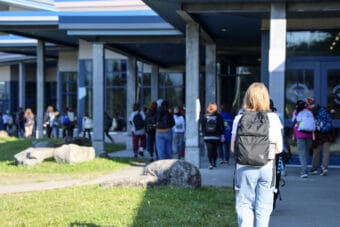
Students exit the Marie Drake building, which houses the Juneau School District’s alternative high school, Yaaḵoosgé Daakahídi, and Montessori Borealis, on Wednesday, April 24, 2024. (Clarise Larson/KTOO)

The Juneau School District’s plan to close schools and consolidate grades means some buildings will sit empty after the end of the school year. But the City and Borough of Juneau is seeking proposals from community organizations to fill that space. 

City Manager Katie Koester said that could mean using it for child care, housing or anything else that might benefit the community. 

“These are public facilities, and it’s quite a bit of square footage that’s available. The Assembly is really curious what public benefit these facilities could bring,” she said. 

The two buildings that will be open for proposals are Floyd Dryden Middle School in the Mendenhall Valley and the Marie Drake building downtown. Since voting to take over those buildings, the Juneau Assembly has openly discussed using one of them as a new home for City Hall.

Koester said that’s still an option, but the Assembly is currently leaning toward moving all City Hall employees to the building that houses the Alaska Permanent Fund Corporation instead. 

That plan still needs to be finalized and approved by the Assembly. 

“Those negotiations will take some time. So I don’t consider that like a final decision from the Assembly,” she said. “They definitely are leaning that way. But they also want to see what the other uses could be for Marie Drake and Floyd Dryden.”

Koester said the city will consider factors like how much the proposals for those buildings would cost the city — along with space and parking needs. She says those factors could also inform the Assembly’s decision on where it might move City Hall.

Interested organizations can submit proposals using a form on the city’s website. The deadline is May 20. 

The city will officially take over the buildings on July 1.

Juneau students stage walkout in protest of Dunleavy’s education veto

Juneau-Douglas High School: Yadaa.at Kalé student William Dapcevich holds a sign during a walkout to protest Gov. Mike Dunleavy’s education funding veto on Thursday, April 4, 2024. (Clarise Larson/KTOO)

Students from Juneau and across Alaska walked out of school on Thursday to protest Gov. Mike Dunleavy’s education funding veto last month

The bill would have raised state education funding significantly for the first time in years. But lawmakers came up one vote short of overriding the governor’s veto. 

Nearly 100 students from Juneau-Douglas High School: Yadaa.at Kalé left class to walk to the Alaska State Capitol.

JDHS senior Rachel Wood spoke into a megaphone, calling on the Governor and legislators who voted to sustain his veto to answer them. 

“We demand the 20 legislators who voted no to come out here and tell us why they did that. Where are you? Where are you? Where are you?” she said.

Juneau-Douglas High School: Yadaa.at Kalé Senior Rachel Wood speaks into a megaphone during a student walkout to protest Gov. Mike Dunleavy’s education funding veto on Thursday, April 4, 2024. (Clarise Larson/KTOO)

Students then flooded inside the Capitol to confront them. But Fairbanks Democratic Sen. Scott Kawasaki said they were nowhere to be found.

“I suspect they’re hiding in their offices right now,” he said.

Students eventually managed to speak to Rep. Julie Coulombe, R-Anchorage, according to the Alaska Beacon.

Amid the protest, JDHS Senior Carmen Farr held a sign that said “Remember Article VII Section 1.” That’s the section in the Alaska constitution that mandates that the Legislature fund public schools. 

“It’s the Legislature’s responsibility to maintain public school systems,” she said. “I think that the veto is kind of failing us there because we can see that it’s – everything’s kind of crumbling beneath us.”

The Juneau School District is facing a $10 million budget deficit next year. The bipartisan bill Dunleavy vetoed last month would have cut that in half, giving the district more than $5 million in additional state funding.

The district is relying on school closures and staff cuts to fill the budget gap. JDHS student Rain Bell said no matter what the Juneau School District did to fix the deficit, the quality of education was still going to decline without help from the state. 

“We’re still losing,” Bell said. “There are kids who aren’t going to be able to get the resources they need and aren’t going to be able to succeed.”

Juneau-Douglas High School: Yadaa.at Kalé student Ida Meyer holds a sign during a walkout to protest Gov. Mike Dunleavy’s education funding veto on Thursday, April 4, 2024. (Clarise Larson/KTOO)

Across town in the Mendenhall Valley, about 50 students walked out of Thunder Mountain High School.

The district’s school closure plan turns Thunder Mountain into a middle school and puts all ninth through twelfth graders at Juneau-Douglas High School: Yadaa.at Kalé.

Thunder Mountain freshman Harbor Whitton said increased state funding might have spared students from such drastic changes.

“It’s really heartbreaking, to be honest, because as a freshman here, I was planning to do my sports here, make friends here, graduate here like my friends and family have, and it’s just really upsetting because now we have to go to JD, the high schools are going to be combined, and it’s unfair, and we’re still going to be in debt,” she said. 

Students are already feeling the effects of budget cuts this year. The district has put limits on printing and other supplies, and senior Lauren Stichert said teachers are worried about their jobs.

“It’s important to keep schools open,” she said. “It’s important to have teachers keep their jobs. It’s important to have supplies – I mean, we’ve been limited to six sheets of paper this year because there’s no money.”

And Thunder Mountain freshman Dalnoi Keaton said she’s disappointed in state leaders.

“Personally, right now, I don’t want to raise my kids in a state that has really bad decisions that are being made. We need education funding. It’s just a must,” she said.

House lawmakers have set aside the equivalent of a $680-per-student increase in the latest draft of the state’s operating budget. But even if that passes and survives the governor’s veto pen, it’s another round of one-time funding for education.

Juneau School District announces principals and assistant principals for next year

Thunder Mountain High School principal Shawn Arnold, now principal of Thunder Mountain Middle School, smiles during a graduation ceremony in May 2023. (Clarise Larson / for the Juneau Empire)

The Juneau School District has named principals and assistant principals for its reorganized schools next year. The announcement comes after the school board reaffirmed its plan to close three buildings and combine the district’s two high schools.

Next year, sixth graders will stay at elementary schools, seventh and eighth graders will be at Thunder Mountain Middle School and ninth through 12th graders will be at Juneau-Douglas High School: Yadaa.at Kalé. 

School closures mean fewer principal and assistant principal positions across the district, but Superintendent Frank Hauser said they didn’t have to lay anyone off.

“We’ve got a great group of administrators that are going to continue to do great things in the Juneau School District, for the community, and I’m excited about the placements,” he said.

The new Thunder Mountain Middle School will be led by principal Shawn Arnold and assistant principal Laura Scholes. Arnold is the current principal at Thunder Mountain High School and Scholes is the assistant principal at Dzantik’i Heeni Middle School.

At Juneau-Douglas High School: Yadaa.at Kalé, Principal Paula Casperson will keep her role. She’ll be joined by assistant principals Kelly Stewart, from Thunder Mountain, and Luke Gunkel, currently the district’s activities and Community Schools coordinator.

Floyd Dryden Middle School Principal Kristy Germain has been named the district’s Director of Operations starting next year. She’ll oversee district maintenance, information technology, Community Schools and RALLY, the district’s child care program.

“We’re just really excited to have Principal Germain be part of the cabinet for next school year,” Hauser said. “Her leadership skills, organizational skills, the experience that she brings with her – she’s going to be a great asset.”

Current JDHS assistant principal Nate Creel will become principal of Kax̱dig̱oowu Héen Elementary, replacing Elizabeth Pisel-Davis, who’s retiring. And Dzantik’i Heeni Middle School Principal Molly Yerkes will become principal of the Tlingit Culture Language and Literacy program. Yerkes replaces Eldri Westmoreland, who is going on a leave of absence while she pursues a doctorate degree in Indigenous studies with a focus on education.

Dozens of Juneauites rallied for an override of Dunleavy’s education veto. It didn’t happen

Dozens of Juneau residents and educators lined the halls at the Alaska State Capitol on Monday, March 18, 2024. (Clarise Larson/KTOO)

Dozens of Juneau educators and residents flooded the Alaska Capitol Monday afternoon in hopes of convincing legislators to support an override to Gov. Mike Dunleavy’s veto of millions in state education funding.

They lined the hallway outside the Alaska House of Representatives chamber, chanting “Override! Override!”

The bipartisan bill Dunleavy vetoed last week would have raised state education funding significantly for the first time in years. But lawmakers came up one vote short of overriding it. 

Juneau Education Association president Chris Heidemann said he’s disappointed in the outcome.

“Super disappointed. You know, especially to miss it by one vote,” he said. “I know there was a lot of statements made that everybody in that room supports schools and supports kids, but that’s not what they’re showing people today.”

Last week, the Juneau School District adopted a budget for the next school year that relies on school closures and a reduction of staff to address a nearly $10 million budget deficit. 

It was built on the assumption that state education funding would not increase, but the bill that Dunleavy vetoed would have given the district more than $5 million in additional state funding.

Juneau Sen. Jesse Kiehl voted in favor of the override. The Democrat said not providing that additional funding to Juneau and other school districts across the state will have lasting impacts. 

“We’re gonna close charter schools, we’re going to have a lot of problems keeping open our neighborhood schools. This is a bad day for education in Alaska,” he said. 

The Juneau School District plans to eliminate nearly 50 staff positions next year to reduce costs and zero out its deficit. But district officials said that if the additional state funding comes through, it could save some if not all the jobs slated to be cut. 

In addition, they said more funding could also alleviate other cost-cutting measures, such as lowering the district’s pupil-to-teacher ratios next year, which will increase across all grade levels — likely meaning bigger classes. 

Juneau Rep. Sara Hannan said though she’s disappointed in the failure to override, the conversation about education funding in Alaska is far from over.

“Education is not resolved, and it will continue to be a prime piece of dialogue and work,” she said.

With the remaining time left in the session, lawmakers have the ability to pass a one-time funding boost for education — like they did last year — though that funding could also be subject to another veto by Dunleavy. 

Juneau School Board passes district budget with school closures, staff reduction

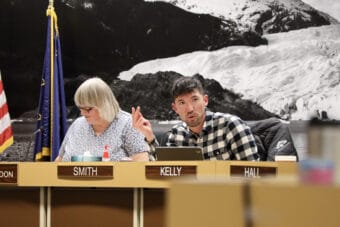
The Juneau School Board meets in the library of Juneau-Douglas High School: Yadaa.at Kalé on Thursday, March 14, 2024. (Clarise Larson/KTOO)

The Juneau School Board unanimously agreed Thursday night to adopt a budget for next school year that relies on school closures and a reduction of staff to address a nearly $10 million budget deficit.

The approved budget is built on the assumption that state education funding will not increase and the district’s student enrollment will decline. 

Just minutes after the meeting adjourned, the board learned that Gov. Mike Dunleavy had vetoed a bipartisan education bill that would have given the district more than $5 million in additional state funding.

After finding out the news, Juneau Superintendent Frank Hauser said though he was disappointed in the governor’s decision, the budget passed by the board wasn’t relying on those funds anyway. 

“We’re going to be moving forward. We have a balanced budget that was based on a BSA, of  $5,960, did not and include a BSA increase. I’m sad that we had to go there,” Hauser said. 

The $85 million budget passed on Thursday is largely based on a school closure plan that moves seventh and eighth grades to Thunder Mountain High School and all high schoolers to Juneau-Douglas High School: Yadaa.at Kalé.

The district will close three buildings: the district office, Floyd Dryden Middle School and the Marie Drake building, which houses the alternative high school and Montessori Borealis. 

The closures are just a piece in the district’s puzzle to reduce costs and zero out the $9.7 million budget deficit for next year, caused by dropping enrollment, an end to one-time state funding and state funding that hasn’t kept up with inflation. 

“There has not been a significant increase in the base student allocation since 2017. And when you look at the inflationary prices, I’ll just leave it at that,” Hauser said. 

The budget also relies on other cost-cutting measures like reducing the number of staff positions in the district and a loan for building maintenance and utilities from the city. 

The district’s pupil-to-teacher ratios next year will increase across all grade levels — which likely means bigger class sizes. 

The board also unanimously adopted a reduction in force plan, which will eliminate nearly 50 staff positions next year. The district hopes to do that through natural turnover, but it could resort to layoffs. The district has to send out layoff notices to teachers by May 15.

In public testimony, Juneau resident Melissa Cullum said the impacts of that will have a ripple effect for years to come. 

“You are going to have teachers leave because you are stretching them you are increasing the student count and minimizing the number of people in the buildings that can support these students,” she said. “You are going to have an exodus.”

The budget also doesn’t have much room for error, because it doesn’t put any money into savings. 

Some members, like Board Vice President Emil Mackey, saw the budget’s passing as a major milestone after a hasty race to balance it before important deadlines. 

“This is the first meeting and several months where I feel like it’s normal – and that’s a good feeling,” he said. “It tends to tell me that we’re on the backside of this headed downhill, rather than walking up that mountain. I really hope that stays the case.”

However, other members like David Noon cautioned the board and said the road ahead won’t be easy. 

“I think the next few months are going to be extremely difficult for students, for staff, for members of this community. So I’m not taking a whole lot of comfort right now,” he said. 

The bipartisan bill Dunleavy vetoed would have raised state education funding significantly for the first time in years. Several school districts across the state face multimillion-dollar deficits. Hauser has said an increase in funding would allow the district to revise its budget, potentially saving more staff positions. 

Hauser said he still has hope that an education funding increase will eventually come through, but his priority is to focus on moving the district forward with the changes that will come from the adopted budget. 

“I don’t think anyone can say that the Juneau School District hasn’t done its part,” he said. 

Juneau School Board decides to keep previously approved school closure plan

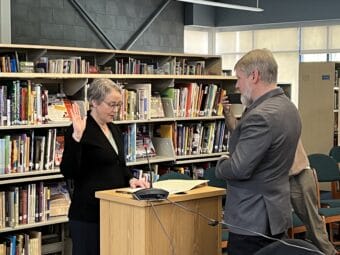
The Juneau School Board meets in the auditorium of Juneau-Douglas High School: Yadaa.at Kalé on Tuesday, March 12, 2024. (Clarise Larson/KTOO)

The Juneau School Board voted Tuesday night to stick with its previously adopted school closure plan. It puts seventh and eighth grades at Thunder Mountain High School’s campus and ninth through 12th grades at Juneau-Douglas High School: Yadaa.at Kalé. 

Last week, board member Amber Frommherz proposed that the board revisit that plan and look more deeply into a model that would keep two high schools open. She proposed putting eighth through 12th graders at the two high school campuses and closing the Marie Drake building and either Kax̱dig̱oowu Héen Elementary or Mendenhall River Community School.

On Tuesday night, Frommherz said her model would bring the district more state funding because the state’s funding formula gives more money to smaller schools. 

“There’s a configuration model out there that could bring in more revenue, that would save state funding,” she told the board. “That was my concern.”

Frommherz’s presentation focused on preserving state funding, not on cutting expenses. Board member Emil Mackey said it was important to consider the long-term savings that come with the approved model.

“Bringing more revenue isn’t the same as saving enough money, because shutting down the buildings saves us in maintenance, repair and utilities,” he said. “There’s a difference between chasing money from the state and balancing the budget on expenditures and revenue.”

High school principals outlined several scheduling challenges that would come with Frommherz’s model, including staggering lunchtimes for older and younger students and sharing amenities like gyms after school.

“The physical plan of JDHS is not really structured in a way to isolate based on the hallway configurations,” said Juneau-Douglas High School: Yadaa.at Kalé principal Paula Casperson.

Dozens of people spoke during the public comment period. Juneau Education Association President Chris Heidemann said revisiting the closure plan was creating even more uncertainty for teachers.

“In the last week, I’ve received several notices of resignation,” he said. “My members are starting to decide to leave on their own because of the continued uncertainty in this district around the budget.”

Floyd Dryden Middle School seventh grader Maisey Mar said she was looking forward to going to middle school with students from both Floyd Dryden and Dzantik’i Heeni Middle Schools next year.

“When I heard about the plan to combine the middle school at TM, I was excited about being able to go to school with my friends from both Floyd and DH, including my best friend since kindergarten who currently attends DH,” Mar said.

Others spoke in favor of Frommherz’s model and thanked her for looking into an option they say should have received more consideration from the beginning. Parent Margaret Katzeek said students can get more attention at smaller schools.

“I think about all of our youth who will fall through the cracks, educationally, physically, mentally,” she said.

But several teachers, like Juneau-Douglas High School: Yadaa.at Kalé math teacher Alexandra Razor, said the board should listen to principals about what it would mean for staff layoffs and course offerings.

“As a teacher of 24 years, I am frustrated right now,” she said. “I’m frustrated that people are questioning teachers and admin on our ability to work together, our ability to welcome students, our ability to create an equitable learning environment, and the idea that we’re going to start allowing students to fail and not graduate.”

After midnight, the board voted 5-2 to indefinitely postpone voting on the amendment, meaning the original closure plan still stands. Members Frommherz and Britteny Cioni-Haywood voted no. 

The board is set to approve next year’s budget at 5:30 p.m. Thursday at the Juneau-Douglas High School: Yadaa.at Kalé library.

Site notifications
Update notification options
Subscribe to notifications