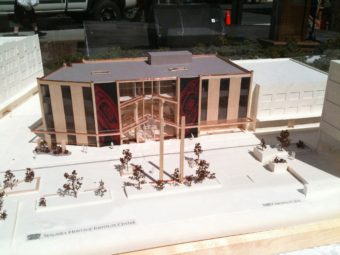
The proposed Mendenhall Valley library has its first funding toward planning, permitting and design.
The Friends of Juneau Public Libraries have raised a million dollars toward construction of the new library. The Assembly Monday night approved the initial $225,000 installment.
The Friends group operates the Amazing Bookstore in the Airport Shopping Center and uses proceeds from book sales to enhance library programs and services.
Paul Berans is president of the Friends of the Library Board of Directors.
“How many books does it take to make a million dollars when you sell them at 10 cents a book? Or, with inflation now, 25 cents a book,” he said.
In an executive proclamation, Mayor Merrill Sanford recognized the Friends of Public Libraries for exceptional volunteer effort and dedication. Berans says about 50 volunteers a week work at the Friends’ bookstore, for anywhere between two and a half hours to 20 hours a week.
Former CBJ Deputy Manager Donna Pierce has been hired to manage the new library project, to be built at Dimond Park next year.
Juneau voters in October approved the use of sales tax revenue for library construction. The total cost of the project is estimated at $14 million and includes state funds.
Oil taxes remain the legislature’s top issue this week, with six hearings scheduled on Gov. Sean Parnell’s bill to bring them down. But there’s also plenty else going on in Juneau, from consideration of education and home energy bills to visits from state dignitaries.
This week, the legislature may send its first passed bill of the session up to the governor’s office. And it could be an item that Parnell specifically asked for.
A bill to roll back regulations on cruise ships is scheduled to appear on the Senate floor on Monday. It easily passed the House last week, with all but one member of the Republican majority supporting it. The bill has received criticism from environmental groups, tribal organizations, and some members of the fishing industry because it would allow cruise ships to release their wastewater into mixing zones instead of having them meet water quality standards at the point of discharge.
A number of bills will get their first committee hearings this week. On Monday, an item creating a low-interest loan program for heating system upgrades will be introduced in House energy. It’s received support from members of both parties. On Tuesday, the House Health and Social Services committee will hear a bill that would require people receiving state public assistance or Alaska Native family assistance to undergo drug tests before receiving cash benefits. Urine tests would be “random and suspicion-based.”
The bill would also amend state code to prohibit undocumented immigrants from receiving benefits. Friday, a bill that would allow school districts to implement four-day school weeks will make its first appearance in the House education committee. The bill is sponsored by two Republicans and a Democrat, and the intent is to give rural schools with traveling athletes, and the like, more flexibility with their schedules.
Some of the state’s top legal and military officials will be visiting the Capitol this week. Both chambers will meet together on Wednesday for an address from Dana Fabe, the chief justice of the Alaska Supreme Court. On Thursday, high-ranking officers from the Air Force, National Guard, and Coast Guard will brief members of the House and Senate Armed Services committees.
Visitors from the Kennedy Center clap after watching a performance by students at Glacier Valley Elementary. (Photo by Heather Bryant/KTOO)
The John F. Kennedy Center for the Performing Arts is recognizing arts education efforts in Alaska’s Capital City.
The center today announced from Washington, DC that Juneau has joined its prestigious “Any Given Child” program, which promotes city-wide arts education for students in kindergarten through eighth grade.
Juneau is the 11th city admitted to the program since it started in 2009, joining much larger communities such as Sacramento, California, Portland, Oregon and Austin, Texas.
The goal of “Any Given Child” is to provide a quality arts background for all children. Kennedy Center experts will work with the Juneau Arts and Humanities Council to figure out the community’s needs and come up with affordable solutions.
Former JAHC president Annie Calkins wrote Juneau’s “Any Given Child” application.
“We wish to increase the equity across all of our schools. Some of our schools have excellent arts education happening at the elementary level and others do not have the same level of intensity or exposure and we want to make sure that across both of our middle schools there’s some equity as well,” Calkins says.
Kennedy Center Vice President for Education Darrell Ayers says the center is federally mandated to reach out to communities across the country. Any Given Child expands that reach by using chosen communities as examples for arts education.
Even though the Kennedy Center doesn’t provide any grant money, local funding can perk up after Any Given Child comes to town. Ayers says one funder gave Austin an additional $1 million.
“They see that the arts community has come together and people, rather than it being kind of a helter-skelter approach to arts education, everybody’s working now hand-in-hand,” Ayers says.
Visitors from the Kennedy Center watch a group of students perform a Tlingit dance at Glacier Valley Elementary. (Photo by Heather Bryant/KTOO)
In December, Ayers and a colleague came to the Capital City to fact-check Juneau’s application. Second-graders at Glacier Valley Elementary School performed a violin concert and Tlingit dance. The performance exemplifies what drew the Kennedy Center to Juneau in the first place.
The violinists are part of Juneau, Alaska Music Matters, or JAMM. Lorrie Heagy started JAMM in 2011. Now those students are continuing their music education in second grade. Heagy says nearly 300 students are in JAMM.
“Their listening skills have become so fine-tuned that by the first half of the year they could identify the first four strings. But by the end of their kindergarten year in the spring, they could come up to me and say ‘Ms. Heagy, my A-string is out of tune,'” Heagy says.
Ayers says next week, the other ten communities will meet at the Any Given Child Annual Exchange. Juneau representatives will join the cross-country brainstorming session in DC next year. Any Given Child planning in Juneau begins next month.
In the legislature, a bill that would increase funding for schools has been introduced.
A team of nine Democrats want to peg what’s called the “Base Student Allocation” to inflation. That allocation gives school $5,680 for every student they have enrolled, and it’s remained at the same level for the past three years.
The funding bill would increase that amount to nearly $6,000 to account for inflation over the past two years, and it would permanently tie the allocation to the consumer price index going forward.
Rep. Harriet Drummond served on the Anchorage School Board before being elected to the legislature, and she describes the bill as a way of responding to recent staffing cuts in the district.
“The school districts have been cutting for years. They’ve long since cut any fat if there ever was any. They’re now cutting certified staff,” Drummond says.
House Majority Leader Lance Pruitt is skeptical of the bill’s potential to get through the legislature. The Anchorage Republican is concerned the bill could give future legislators less flexibility with the budget in times when less revenue is coming in, and he says that changes to the education funding formula would probably have more success if the Democratic Minority took a bipartisan approach.
“The bill that’s out there is more of a political statement than truly addressing the issue. If there was really a desire to see this move forward and not just be an opportunity to talk to you guys, then you would probably see some Majority members’ names on there,” Pruitt says.
Pruitt says that it’s too early to tell whether there will be any increases to education funding, but thinks the governor’s plan to keep the base student allocation at the same level is a good starting point.
Dogs on a romp at the Mendenhall Glacier, where they should be on leash. Always pick up after your canine companions. Photo by Julia Carlisle.
Pick up your dog’s poop as soon as it’s dropped, or risk a fine.
After months of studying the problem, city officials Friday announced a zero-tolerance policy for dog waste and other dog-related problems in area parks.
CBJ Parks and Landscape Superintendent George Schaaf says the CBJ Dog Task Force looked at various solutions, including education, personal encouragement, and a media campaign, but the problems continue.
“And of course when the weather gets warmer, it becomes extremely obvious that there is a problem, especially in certain areas,” Schaaf says. “So at this point, having exhausted all our other options, we’re moving on to enforcement as a solution and we’re hopeful that we can avoid the need to actually close any parks to dogs if the problems still continue.”
Animal Control officers will no longer give warnings, but will issue citations immediately for anyone caught not cleaning up after their pets. Afterall, Schaaf says, dog waste is a public health issue, and the city has had pet laws on the books for years.
See that trash can at Fish Creek? The owner of this dog should have picked up that waste and put it in the can. The CBJ and USFS provide pick-up bags at most trail heads.
“It’s already required that you have a bag or another means of sanitary disposal with you whenever you’re in a leash law area and that includes most of the downtown business districts and other sites downtown, Schaff says. “And then it’s also illegal to allow your dog to relieve itself on any public or private property that doesn’t belong to you, without permission of the owner.
Those laws pertain throughout CBJ, whether on city, state or federal land, including Mendenhall Glacier and the Tongass National Forest. In the winter, the U.S. Forest Service helps maintain cross-country ski trails at the Mendenhall Glacier Campground. Complaints last week of piles of dog feces sent the campground manager to inspect, says Ed Grossman of the Forest Service.
“The campground manager went out there and picked up a couple gallons of the nasty stuff around the gate area,” Grossman says.
Like the city, the Forest Service provides plastic bags at trail heads for picking up dog waste. Grossman was a part of the city’s dog policy discussion last year. He says the Forest Service will take its cue from the city, hoping the new enforcement will work.
“There’s little doubt that we are just as disgusted as the other land managers at the fact that we provide bags and receptacles and have jointly gone out with public notices, we have signs,” Grossman says. “So we share the concerns across ownerships, and have turned to the Grateful Dogs group to help us. They’ve done clean up days, they’ve done educational notices as well, but the problem persists at everyone of our sites and on everyone of our trails.”
Leash laws are also on the books in downtown Juneau and many developed recreation areas throughout the borough, including the Mendenhall Glacier area.
Dogs must be on leash where noticed, and if they’re in an area where a leash is not required, they must be under competent voice control. Schaff says that means never having to apologize for your dog’s behavior.
Enforcement is the key and that may be difficult. Citizen complaints were the impetus for the CBJ Dog Task Force and the resulting zero-tolerance policy.
Schaaf says citizens should continue to report violators to Animal Control at 789-6997.
Kindergartners through fifth graders had a hand in the move to new classrooms on Friday, Jan. 19th. When school started on Wednesday — after a two day break for students — their classrooms were settled.
Auke Bay Elementary School students were in new classrooms for the first time Wednesday morning, after months of renovation.
While there’s more to do, the first phase of the work is complete. The move from old to new classrooms began on Friday with help from teachers, parents and other volunteers, and even the kids.
“You can look all around here and there’s lots of stuff that we moved,” said six and a half-year old Beck Schneider on Friday, standing in the middle of a new classroom at the west end of the building. Nothing was organized yet, but all the stuff, from pencils to desks, to books and files had been moved. And the children were proud of their work.
“We moved from a classroom that’s way over there that’s now empty,” Beck said.
That empty classroom will now be renovated. Phase two of the project gets underway this week, said Catherine Wilkins, the project manager for the CBJ Engineering Department.
“Fannies in seats on the 23rd of January. That’s been our target,” Wilkins said.
The three-phase renovation started in late May.
“In phase one, the west third of the building was basically torn down all the way to the foundations and completely replaced,” Wilkins said.
Much of that work was done after school started. And for kids like Beck, it was a great learning experience.
“Well, we saw lots of construction going, and when we were going out and in we saw lots of big trucks that had sand and lots of different material in them,” he said.
Beck’s mother, Leann Thomas, volunteered to help move and settle the new classroom. She attended Auke Bay School when she was a youngster.
“I went to school here during the years that it was sinking and we moved to Glacier Valley,” she said. “So I kind of feel like it’s fun that he’s in the year that it gets totally remodeled and he gets to move to the new part of the school.”
Auke Bay Elementary School was built in 1968 on pilings in glacial till and blue clay soils. While there has been subsidence over the years, in the current renovation heavy structural timbers have been replaced with steel and other stronger materials, Wilkins said.
Students in Paula Kalbrener’s first grade class helped move from their old to their new classroom then posed for the camera. From left to right: Amy Welling, Dominic Bailey, Beck Schneider and his mother Leann Thomas, Shaylen Montgomery, and Aaliyah Kato.
“The structural engineer made certain that this new structure is lighter. It weighs less than the old building. So we will not see additional subsidence,” she said.
When the project is complete in August, Auke Bay will look and feel like a brand new school. All mechanical and electrical systems, windows, doors, and interiors will be replaced; the school even has new water and sewer lines. A ground source heat pump will save the school district thousands of dollars in heating costs.
Beck’s first grade teacher, Paula Kalbrener, was glad to start Wednesday in a big new classroom. The old was “terribly drafty. The ceilings were all buckled and some of them had to be held up with a support to keep them from falling,” she said. “It was pretty crummy.”
Lori Hoover is in her sixth year as principal and has no complaints about being in a construction zone. Her office, the library and a classroom in the east wing won’t be finished until school starts next fall. She said the structural transformation is especially satisfying.
Construction sign.
“You know the old school is kind of on two and a half levels and they actually raised it, so now we’re just two complete levels instead of extra sets of stairs,” she said. “We had a lot of odd spaces, you know, from different remodels over the years that were somewhat dysfunctional and so all that’s been cleaned up so every space has a use.”
Juneau voters in 2010 approved $18.7 million in general obligation bonds for the Auke Bay Elementary School project. A year later, voters approved $1.4 million in bonds for the ground source heat pump. The state will reimburse the city and borough for 70 percent of construction costs through the School Construction Bond Debt Reimbursement Program.
Close
Update notification options
Subscribe to notifications
Subscribe
Get notifications about news related to the topics you care about. You can unsubscribe anytime.