Sports

JDHS tennis players compete in state tournament

High school tennis players from Juneau, Kodiak, Fairbanks and Anchorage will  compete for a statewide title this weekend.

Boys doubles during the Region 5 tournament last month, all JDHS players. Jon Scudder / Jasper MacNaughton defeated Sam Bibb / Ben Scudder 6-0, 6-1.

The Juneau Douglas High School tennis team is sending eight players to Anchorage for the tournament.

JDHS has had a tennis team for 11 years, and it’s still the only team in Southeast Alaska’s Region Five.

It started when Juneau’s Alaska Club was locally owned, had a full-blown tennis program and five courts.  Now it’s owned by an outside company, has three courts and no tennis pro.  But head coach Amy Skilbred and JDHS history teacher Kurt Dzinich, assistant coach, find little difficulty attracting kids to the sport.

“A lot of our team begins freshman or sophomore year, never having picked up a racquet before. And it’s really fun to see them develop over the four years they’re here and go on and play state their sophomore or junior year,”  Skilbred says.

In the recent Region Five tournament – which was just the Juneau team —  17-year-old Jasper MacNaughton finished “first place in men’s singles, men’s doubles, and mixed doubles and I’m a junior.  I guess that’s the first time that’s happened that a junior’s gotten first place in all three. So that’s pretty exciting for me.”

MacNaughton is one of 42 team members.   Tennis is sort of a family affair for the MacNaughton’s and four other families that have two kids on the team this fall.


F
inal roster for 2013 JDHS State Tennis Team:

Boys Singles: Jon Scudder

Girls Singles: Bailey Davenport

Boys Doubles: Ben Scudder, Sam Bibb

Girls Doubles: Sami Good, Kathe Tallmadge

Mixed Doubles: Emma Good, Jasper MacNaughton

Alternates: Johnny Connolly, Catherine Walsh

MacNaughton is competing this weekend in the state tournament in mixed doubles with partner Emma Good.  Her sister, Sami Good, is competing in girls’ doubles. Two other siblings, Jon and Ben Scudder are also playing in the championship games.

Sami Good is a freshman and has been playing tennis since about 4th grade.  She says her backhand is her most consistent shot, and knows every point counts.

“If you mess up, you can just do it again in the next point, so you just keep bettering every point,” she says.

She likes doubles better than singles because partners encourage and help each other.

Like her partner at state, senior Kathe Tallmadge. She has played all four years for JDHS and traveled to the state tournament last year.  But her first round draw turned out to be the state champion and Tallmadge says “it didn’t go very well.”

Tennis is her only sport.  She says her game has improved a lot this year and the highlight was a visit to the team by professional coach Mike Hinkle.

“It’s really good to  have an outside perspective on your playing because then he’s able to give you tips and directions on how to change your shots that some of the other coaches might not because they’ve seen you play so much,” she says.

Three of the five sibling twosomes on the team. Left to right (top person first) Jon Scudder/Ben Scudder; Sami Good/Emma Good; Reuben MacNaughton/Jasper MacNaughton. Photo courtesy Amy Skilbred.

Coach Hinkle will be working with individual players during the state tournament, another bonus for those who get to compete.

Fifteen-year-old Jon Scudder will play in boys singles this weekend.  He joined the team last year as cross training for soccer.  Now he’s hooked.

Sometimes, he says, it’s just fun to hit something as hard as you can.

“Like over and over again, kind of just take out whatever you want on the ball,” Scudder says.

Most JDHS team members come from other sports, and though cross-training is good, Coach Skilbred tells them the best way to get better at tennis is to play tennis.

JDHS has had as many as 60 kids participate on the no-cut team.

“I think it teaches you relying on yourself, some self-confidence, working with the team and others, helping newer players on the team so that you’re not just only concerned about yourself as a team member,” Skilbred says.  “And it’s a lifelong sport. You don’t need 21 other people to go play tennis; you can find one other person and go play.”

The Juneau players will compete Friday and Saturday in the seventh Alaska State High School Tennis Championship. Matches will be played at the East and North Alaska Clubs in Anchorage.

Volleys traded over Anchorage tennis court funding

Supporters of building the Northern Lights Recreation Center which would house six indoor tennis courts wore stickers with the words ‘Yes on Tennis’ scrawled across a green tennis ball at the regular meeting of the Anchorage Assembly Tuesday night.

There are certain rules of decorum you need to follow if you’re going to go to an assembly meeting. You need to sign up if you want to speak. You need to keep your comments short. And you need to put away all sporting gear, as Anchorage Assembly Chair Ernie Hall reminded the audience Tuesday night.

“I’m going to ask that all the individuals that brought tennis racquets this evening during the break to please have those removed.”

The place looked like a tennis training camp because the assembly was deciding whether to use state funding to build a new indoor tennis facility. The $10.5-million earmark has become a lightning rod because the city didn’t ask for it and many lawmakers thought the money was being used for other purposes.

If there is one thing everyone at the meeting could agree on, it’s this:

“Tennis is an incredible game that builds character.”
“It is a fun game.”
“Tennis is my favorite sport.”

Tennis keeps people active, it cuts down on obesity, and there are lots of benefits to having tennis courts that can be used year round by anyone, no matter what their income level. Dislike of tennis is not why the Anchorage Assembly is considering rejecting a state grant to build indoor courts near the Dempsey-Anderson Ice Arena. Instead, it’s a question of process, says Assembly Member Bill Starr.

“It wasn’t transparent enough, and it also wasn’t assembly directed.”

Every legislative session, cities across Alaska put together their wish lists for capital projects. The Anchorage Assembly didn’t have anything about indoor tennis courts in their request. The ask was instead made by Mayor Dan Sullivan, by the Alaska Tennis Association, and by the community council in the area.

Starr’s other problem with the funding is this: If you look at the state capital budget, the money was put in with a line that reads “Project 80s Deferred and Critical Maintenance.” Most of that funding is going toward repairs to older city buildings, like the skating rink. Starr thinks that legislators got hoodwinked when they approved a project that went beyond renovations.

“I also believe that some of the folks in Juneau — that’s what they thought they were approving. And so when you see that it’s diverging into a brand new $10.5 million standalone facility, that’s a challenge point for me.”

Mayor Sullivan doesn’t think it should be. He says rejecting the money on the basis of process would be punitive to the tennis players and community members who want the project to go ahead.

“It’s a minor point. It’s a technicality. And it’s kind of irrelevant, quite frankly, because the bottom line is the legislature intended for the Tennis Association to get money for a facility.”

So, who’s right? Did the legislature want the money to go toward tennis courts or not? I e-mailed all 60 legislators to see if they knew where the money was going when they voted on the capital budget. Of the 23 who got back to me before deadline, one said he was aware there was money for tennis courts in the budget, but he didn’t know the assembly wasn’t on board. A couple said they didn’t know about the tennis courts, but that they trusted the legislature’s finance committees to vet projects for worthiness. The rest said they simply had no idea it was in there.

Because capital budgets are expected to shrink over the next few years with a major tax cut on oil and declining production, the appropriation elicited harsh words from some. Sen. Lesil McGuire, an Anchorage Republican who is running against Mayor Sullivan in the Lieutenant Governor’s race, takes special issue with the funding.

“[Sullivan] came to me and asked if I would put it in and I said no! The whole Senate said no. So then he went to the house and got one member to agree to use a re-appropriation that was meant for much needed project 80s work in order to reclassify this,” wrote McGuire in an e-mail. 
”Essentially – the whole thing stinks”

But the members of the public who came out for the assembly meeting said the project should go through anyway. Nearly 50 people testified, and almost all of them were tennis players who said that Anchorage would benefit from having a public tennis facility that people could use year round without having to take on an expensive gym membership.

“The trouble is we live in a northern, rainy climate, and between the rain and our winter climate all those thousands of kids who are in the tennis programs don’t have any place to play in the winter,” testified Bill Bittner, a member of the U.S. Tennis Association and the Anchorage Park Foundation. Because they are no public indoor courts in Alaska, many made the point that low- and even middle-income players are shut out of the sport for most of the year. That could limit young players to compete and become higher-level athletes.

Robert Brewster one of the few opposed to the project. He owns the Alaska Club, a chain of fitness centers that offers the only indoor courts in Anchorage.

“This is not really a referendum on whether tennis is important or tennis is good for the community,” said Brewster. “The question is whether this particular facility is necessary.”

Brewster has offered to sell one of his facilities to the City of Anchorage. In his testimony, he argued that there is not enough demand to build new courts, and that as it is, the Alaska Club’s courts are in use just a fraction of the time that they’re open.

“There doesn’t seem to be any reason that there’s going to be a sudden flood of additional people playing tennis,” said Brewster. An audience member interrupted him to say that the low tennis participation was due to the Alaska Club’s high prices.

In the end, the Anchorage decided to put the issue on hold. They unanimously approved a measure allowing the city to accept $26.5 million in Project 80s money for upgrades to older buildings, but set aside the $10.5 million meant for the tennis courts. They’ll reconsider their position on the tennis courts at their October 22 meeting.

Daysha Eaton contributed reporting to this story.

Falcons fall to Crimson Bears in Glacier Bowl

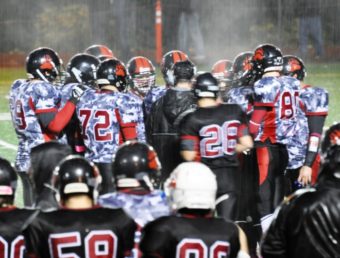
The Crimson Bears huddle just before half-time during Friday’s Glacier Bowl, which would more appropriately be call the Rain Bowl. It rained hard for all four quarters. Photo by Dick Isett.

The Juneau-Douglas Crimson Bears toppled the Thunder Mountain Falcons 57 to 0 Friday night.

It was the end of regular season play for  Juneau’s high school football teams.  Now that both teams are in the Southeast Conference, it’s the first time the game counts toward season standings.

The annual football game is called the Glacier Bowl — appropriate whether it’s played on TMHS field or Adair Kennedy, since both have a view of the Mendenhall Glacier.

The Bears easily took previous meetings and this year’s was no different.  At half time the score was Crimson Bears, 43, Falcons, 0.  The mercy rule went into effect at the top of the third quarter, allowing the clock to continue to run.

Though it was senior night for JDHS, coaches substituted a number of  junior varsity players through the end of the game.

The football season has ended for the Falcons, while the Crimson Bears go on the medium-schools playoffs.  Quarterfinals are Friday and Saturday for the Southeast and Northern Lights conferences.   Ketchikan plays North Pole on Saturday in the quarterfinals and Juneau has a bye.

In other high school sports, cross country championships were held over the weekend in Anchorage.

Thunder Mountain’s Maddie Hall came in third among Girls4A Varsity runners.


Runners save chicken from Gold Creek

JDHS cross country runner Nick Heidersdorf stands near the chicken. (Photo courtesy of Linda Mancuso)

Runners on the Juneau-Douglas High School cross country team rescued a chicken last night from Gold Creek at Cope Park.

Students spotted the chicken during practice and saw that it was stuck.

Runners Riley Moser and Madeline Handley worked together to get the chicken out.

“One kid lowered my daughter into the water down there in Gold Creek to save the chicken and yanked my daughter and the chicken back up,” says Catherine Reardon,  Handley’s mother.

The chicken is described as large and white with black around its neck and on its tail.

Another runner on the cross country team Soren Thompson took the chicken temporarily to his residence where his family has a coop.

JDHS cross country team is anxious to return the chicken to its owner. For more information on how to claim the chicken, call 463-5110.


High JDHS score prompts mercy rule

The JDHS Crimson Bears were sporting new jerseys at Saturday’s lop-side game against the Pemberton, B.C. Grizzlies.

A small school from British Columbia was scoreless against the Juneau-Douglas Crimson Bears, while the Thunder Mountain Falcons fell to the Kodiak Bears in weekend high school varsity football.

It was a total mismatch for the Crimson Bears and the Pemberton Grizzlies.  In the first half, Juneau scored ten touchdowns and a safety, for a score of 72 to 0.

At half time, Crimson Bears head coach Rich Sjoross said he planned to invoke the mercy rule at the beginning of the third quarter, allowing the game clock to continue to run even on plays when it would normally stop.

“Normally it doesn’t kick in until the end of the third quarter, but we’ll see if they want to just run it after half time, then it’d just be a running clock in the second half,” Sjoross said.

The Crimson Bears’ junior varsity team was playing in Ketchikan, so Sjoross couldn’t field less experienced players to make the game more competitive.

“I got 26 kids and 17 seniors. So when I sub a guy out, I put another senior in his spot.  I just have a veteran team,” he said.

Neither team scored in the second half.

JDHS is now a member of the small Southeast Conference with Ketchikan, Sitka, Thunder Mountain and North Pole.  The Crimson Bears were to have played Sitka on Saturday, but Sitka cancelled earlier this season.  Juneau has filled out the regular season schedule with a number of non-conference games, including Pemberton and two teams from the Lower 48.

Pemberton is a town of about 2,300 north of Whistler, B.C.  Pemberton’s secondary school enrollment is less than 400, and includes grades 8 through 12.

In Kodiak on Saturday, the Thunder Mountain Falcons battled the Bears, losing 60 to 15. It was a non-conference game.

TMHS has one win and one loss in Southeast Conference games and three non-conference losses.

JDHS has five wins, two of them conference games, and one loss for the season to Foss High School, from Tacoma, Wash.

TMHS and JDHS square off on Oct. 4.

Eaglecrest Day celebrates end of summer

 No termination dust has been seen yet in Juneau, but once  fall rains hit, winter seems close.

In recognition of the end of summer, Eaglecrest will celebrate the annual Discover Eaglecrest Day on Saturday.

The ski area is owned and operated by the City and Borough of Juneau.  Surveys indicate about a third of Juneau households have a skier or snowboarder that use Eaglecrest annually.

Eaglecrest Learning Center
Architect’s rendering of the proposed Eaglecrest Learning Center.

Unlike ski areas on a road system that get most of their revenue from daily ticket sales, the small Juneau area receives about 50 percent of winter revenue from season passes.  Eaglecrest Day is a time to buy passes, rent lockers, see plans for the new Eaglecrest Learning Center, enjoy fall mountain colors, ride a chairlift, hike or bike the trails.  This is the fifth year for the event.

For those who seldom visit the mountain, fall is a good time to come up.

There’s no snow on the road.” 

 Jeffra Clough is director of Sales, Marketing and the Snowsports School.

“If somebody is feeling a little bit intimidated by our road, they may be little less intimidated if they’re able to drive up it during the fall,” she says.

Never ridden a chairlift? Take a free ride up the Porcupine Chair.

“For some people that may be their first experience riding a chair lift and that might instill a desire to come back in the winter and learn how to ski or snowboard,” Clough says.

Mountain biking

Juneau Freewheelers’ Mountain Bike Tour of Eaglecrest begins Friday with a time trial. The start time is 6 p.m. at the Fish Creek bridge crossing by Treadwell Ditch. The two-mile version ends at the top of Porcupine Chair Lift.

The Hill Climb begins Saturday at 10:30 a.m., at the base of the mountain.

“They’ll start at the bottom  of Hooter and the riders that want to do a one-mile hill climb will ride to the bottom of the Black Bear chair,” Clough says. “Those that are really tough that want to do the two-mile hill climb will ride to the top of the Ptarmigan chair.”

Hooter to Black Bear is an elevation gain of about 460 feet.  The elevation gain to the top of Ptarmigan is about 1,400 feet.

The Mountain Bike Tour of Eaglecrest ends with the Criterium – a one or two-mile loop of the Eaglecrest parking lot.

The Zip Line is running for Eaglecrest Day, Discovery Southeast is holding the Decomposition Decathlon (you’ll want to enter the Fungus Cap Fling), and there’s a beer garden and BBQ.

Wishing for snow

At the top of every hour, between 11 a.m. and 3 p.m., Juneau Public Library’s Beth Wiegel will be reading winter stories to kids.

Beth Weigel, of the Juneau Public Library, will be reading stories about winter during Discover Eaglecrest Day. Children who bring their library card will be able to check out books.

Wiegel is also a ski instructor, who like  this reporter and Anna in the story “Anna’s Wish,”  is wishing for a snowy winter in Juneau’s mountains.

“‘Oh little snow horse, thought Anna, ‘I wish, I wish, I wish.’  Harder than she had ever wished for anything, Anna wished for snow.  Like tiny stars her wishes floated up into the sky and froze, then slowly they began to fall back down to earth.”  (From “Anna’s Wish” by Bruno Hachler, illustrated by Friederike Rave.)

Discover Eaglecrest Day is Saturday, from 10:30 a.m. to  3 p.m.

Site notifications
Update notification options
Subscribe to notifications