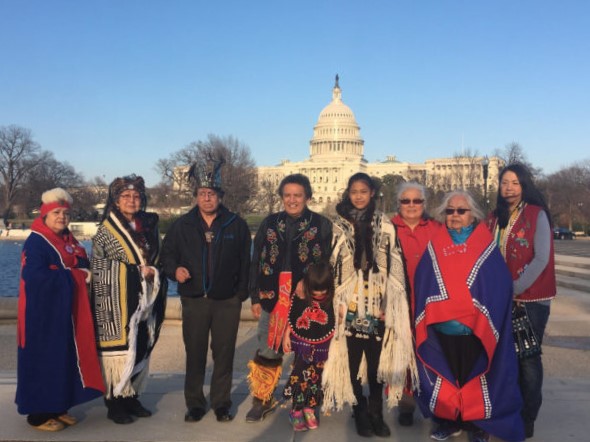
Tlingit people from around Southeast Alaska have returned from a trip to the Smithsonian Institution. Elders examined hundreds of Tlingit artifacts in the Smithsonian’s collection, providing context for their own research and for museum staff.

The trip to Washington D.C. was part of the Recovering Voices program, a Smithsonian initiative aimed at preserving indigenous languages and cultures.
Virginia Oliver of Wrangell was among those who examined hundreds of Tlingit artifacts in the National Museum of the American Indian’s collection. From bentwood boxes to blankets and daggers, Oliver and the elders studied their history.
“When they opened up the doors, I have to tell you the feeling was really heavy,” she recalled. “It was so much spirit in there where all of our ancestors have been stored for however long since they were collected.”
Every participant prioritized 100 items out of thousands of pieces. Oliver selected 80 items from Wrangell, 10 from Etolin Island and 10 from her hometown Kake.
“They had the first 15 items that all of the participants had chosen right out on the tables and you could walk right in there and look at them,” Oliver said. “We got together and started a prayer to say hello to our ancestors and to let them know we were there and speaking Tlingit. We did a song, a potlatch song, an opening welcome for them.”
Information about several items’ history was limited to the collector, the year it was collected and sometimes a location. There was no way to know how old items actually were and sometimes even what they were used for. As part of the program, Smithsonian staff hope participants are able to provide more information.

“They had a weaver come in. She is a teacher in Juneau, a Chilkat naaxein weaver,” Oliver explained.
The weaver was examining one blanket in particular and noticed that it looked familiar.
“She took a picture out of her camera and showed it to us. It looked like the exact same blanket. This blanket that they had the picture of was on a grave house,” Oliver said. “And, if you looked at this blanket, you could see at the top of the blanket where it had been tacked on to the grave house and how part of it had been probably folded under so it wasn’t weathered. So it was very interesting. They were wondering where that blanket had went and it was in the Smithsonian institute.”
Other items that were mislabeled were also corrected.
Oliver, who teaches a Tlingit culture and language class in Wrangell’s middle and high schools, was able to share her experience with her students by live streaming through a virtual-reality camera.
“We would link up, and they would look at some of the artifacts,” Oliver added.
Hours of footage were taken and will also be converted into two-dimensional video and shared with schools in Hoonah, Angoon and Juneau.
Oliver will not only share what she gleaned from the experience with her students, but will give six presentations to the public.