Listen to this story:
The U.S. Army Corps of Engineers announced Thursday that it will pay the full cost to extend and repair Juneau’s temporary river levee meant to protect almost all Mendenhall Valley neighborhoods from glacial outburst floods in the near-term. And it will expedite its process to choose a long-term solution that will protect the entire Valley.
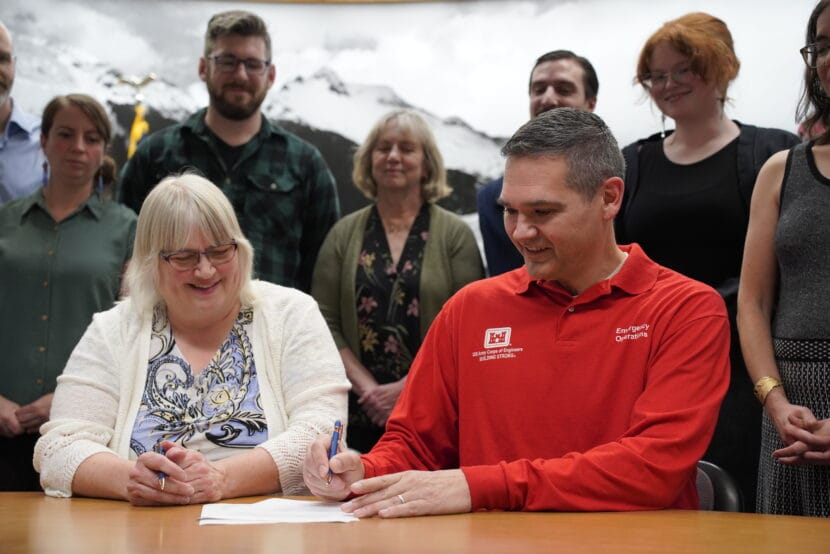
The existing temporary levee is made of HESCO barriers — steel and mesh baskets filled with sand. It protected hundreds of homes from flooding by a slim margin during the record-breaking glacial outburst flood in August. At a special Juneau Assembly meeting Thursday, members signed an agreement accepting assistance from the Army Corps to enhance the temporary levee.
After signing the agreement, Mayor Beth Weldon referenced a quip Assembly member Ella Adkison made moments before.
“The Army Corps is going to do phase two and pay for it. So we truly appreciate the assistance, and as Miss Atkison says, there’s no take-backs,” Weldon said.
The agreement expands the levee both upstream and downstream, protecting many more homes and businesses along Mendenhall River. Phase 2 will go from Back Loop Bridge to just before Juneau International Airport. The city estimates the expansion will cost around $19 million to build. The agreement means the city will no longer have to debate controversial ways to pay for construction.
Daryl Downing, program manager at the Seattle District of the Army Corps, says the agency will cover HESCO design and installation, as well as armoring the banks.
“What is not covered is going to be any sort of outreach the City and Borough of Juneau will need to do to secure rights of entry or any permitting requirements for these efforts,” Downing said. “Once the Corps installs these measures, they get turned over to the City and Borough of Juneau for operations and maintenance, and then removal as well.”
The Army Corps will also help repair the existing stretch of the flood barrier, which leaked and slumped during the flood this summer — sustaining about a million dollars in damage — and build it higher for the next flood.
The agency aims to complete that work by July 15, 2026. For reference, the glacial outburst flood has struck during the first two weeks of August in each of the past three years.
None of this funding will retroactively cover the cost to build Phase 1 of the levee — which is estimated at around $6 million. The Assembly passed a controversial funding scheme called a local improvement district, or LID, earlier this year to split 40% of the cost among more than 400 homeowners in the flood zone.
At Thursday’s meeting, the Assembly voted not to close out the Phase 1 LID. The only Assembly member who objected was Nano Brooks. He asked if it would be possible to use some funds from the recently reappropriated $5 million that was pulled from the Capital Civic Center to reduce the residents’ portion.
City Manager Katie Koester said that money could be used to care for future repairs and maintenance of the HESCO barriers.
“In the end, it’s really your decision how much you want to use taxpayer dollars versus property owner dollars,” Koester said.
Long-term solution in sight
The Army Corps made another major announcement Thursday. It aims to finish its technical report, recommend a long-term flood solution, and design it by the end of May 2026. That’s several years faster than the process agency staff outlined at a public meeting in July.
John Rajek is the chief of the geotechnical and engineering services branch at the Alaska District of the Army Corps.
“We plan on developing a preliminary design of the preferred flood control alternative, we’re going to prepare a planning-level cost estimate that’s going to help everybody understand the financial implications and basically help make informed decisions on the path forward,” Rajek said. “And then the third element is, we’re going to complete a draft environmental assessment of that alternative.”
Those options are a dam, a permanent levee, a bypass channel along the river, a tunnel to drain Suicide Basin or relocating buildings from the flood zone.
Rajek says that in December, the Army Corps will hold a charette — a major planning meeting with federal and local agencies — to discuss the options and pick one.
Anonymous sources engaged in the agency’s process told KTOO that a tunnel through Bullard Mountain to drain Suicide Basin looks like the preferred option at this point, but Army Corps staff refused to comment.
The Army Corps is seeking public comment on the long-term solution, which closes at the end of next month. The public affairs office requests comments to be submitted to public.affairs3@usace.army.mil.