Listen to this story:
Juneau is mulling over how to prepare for next year’s glacial outburst flood.
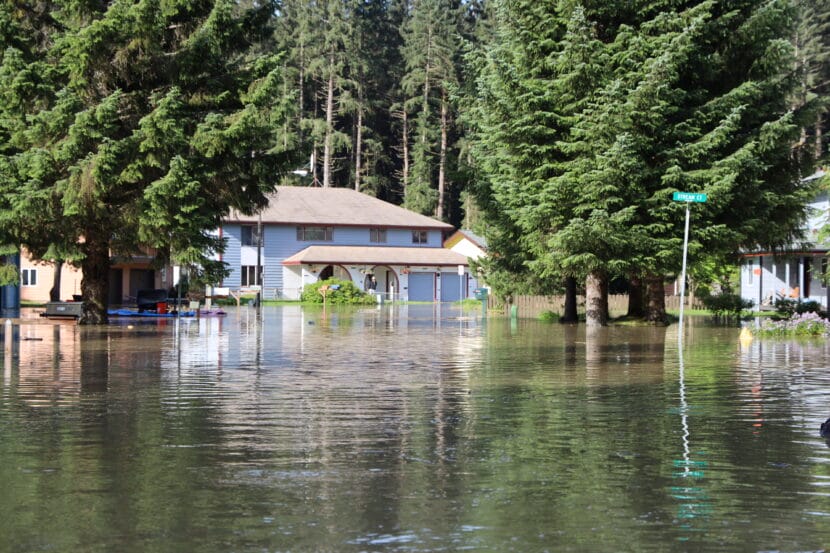
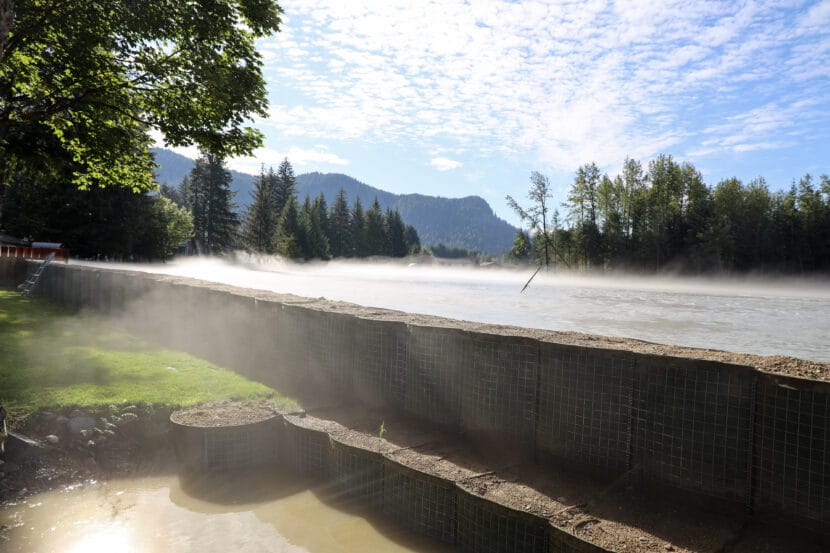
The city’s temporary levee protected most Mendenhall Valley neighborhoods from a record-breaking flood this summer, but it needs repairs and, potentially, some upgrades. Now, the U.S. government shutdown could complicate the city’s decision-making process.
City staff presented major questions about ways to protect Valley neighborhoods from flooding to Juneau Assembly members during a committee meeting Monday. The four largest questions are how high to build the levee for next year, whether to expand it, whether to sponsor a buyout program for those left unprotected and how to pay for those projects.
In an interview, Deputy City Manager Robert Barr said the answers to some of those questions will depend on federal information and funding that might be delayed by the U.S. government shutdown.
“That’s what we’ll be working on over the next week, is figuring out kind of who’s still at the table, who still can be at the table, and trying to kind of keep things moving as best as we can,” Barr said.
How high should the levee be?
Barr said the model that projected how the city’s levee would perform during the flood wasn’t entirely correct.
“We certainly saw things in real life this summer that the model did not predict,” Barr said at Monday’s meeting. “And we got a little bit lucky with the height of the HESCOs and where things landed.”
The levee leaked, flooding a couple dozen homes. The city’s memo to Assembly members said floodwater also flowed over the top of the levee in some areas.
So, how high should they build it? Experts won’t be able to forecast the height of the next glacial outburst flood until it’s underway. But record-breaking floods have grown over the past three years. It reached 15 feet in 2023, then 16 feet in 2024. The flood this August made the record at 16.65 feet.
Barr said the city won’t be able to make an educated guess about how high to build the levee until researchers publish the data from this year’s flood. That data will include the volume of Suicide Basin, the speed of the torrent and how the river channel has changed.
Aaron Jacobs is the senior service hydrologist at the National Weather Service in Juneau and a member of Juneau’s flood science team. He said the agency is exempt from the federal furloughs that began Wednesday because its work is deemed essential for public safety.
“The Weather Service work is going to go on,” Jacobs said. “So our analysis and our work of looking at the data and forecasting the events and stuff like that, that’s still going to go forward.”
The flood science team is made up of federal workers at the National Weather Service and the U.S. Geological Survey and scientists at the University of Alaska Southeast.
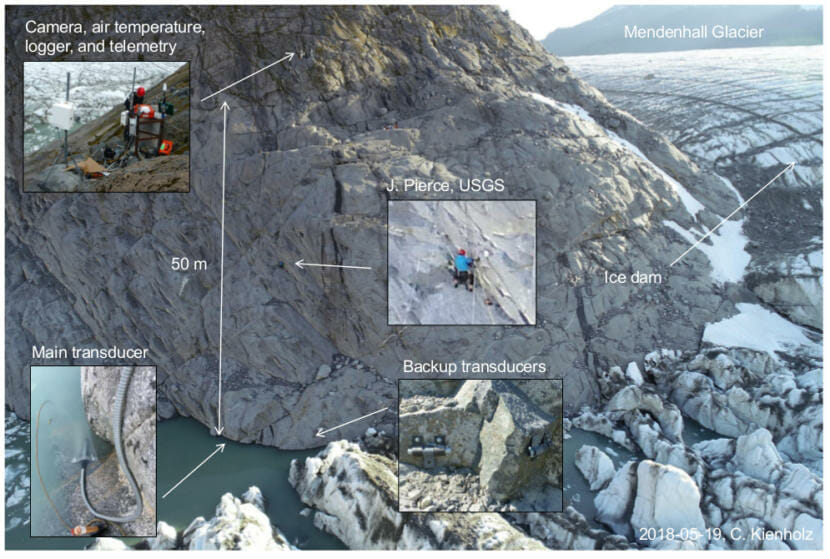
Jason Amundson, a glaciologist at UAS, said the university’s flood researchers haven’t been affected by the shutdown. But he said one of his colleagues at USGS went up to Suicide Basin on Tuesday to maintain the monitoring equipment before the agency’s staff were furloughed the next day.
“He was able to get up and make sure the cameras were up and running and should be hopefully good to go through the winter,” Amundson said.
He said he thinks the team will be able to get data to city decision-makers without delays, but that could depend on how long the shutdown lasts.
How to fund levee upkeep?
The second big question is how to pay for the levee’s ongoing maintenance. The stacked baskets of sand, called HESCO barriers, sustained an estimated $1 million in damage during the August flood.
Earlier this year, the city used what’s called a local improvement district, or LID, to split the cost of building the barriers 60/40 with landowners in the flood zone. It was controversial.
Barr said it might not be the best way to pay for upkeep.
“LIDs aren’t really a mechanism to care for ongoing costs,” he said. “LIDs are a great mechanism to pay for big one-time upfront capital expenditures. That’s what they’re designed for.”
The other options are to pay for upkeep with general city funds or to establish a service area, a designation that allows the city to offer specific services in that area. It means the city could charge landowners in the flood zone an additional tax. It would need a majority vote from registered city voters within service area bounds.
Barr said one drawback is that the landowners wouldn’t know in advance how much they’d have to pay in additional taxes each year.
Expand the temporary levee?
The third major question is whether to extend the temporary levee to protect more properties. A proposed Phase 2 of the HESCO project would expand the levee both upstream and downstream, so it would stretch from Back Loop Bridge to just before Juneau International Airport.
Phase 2 is estimated to cost roughly $19 million. That’s more than double the expected cost of the existing barrier, which hasn’t been finalized yet. Barr said it would be much more expensive because the riverbanks would need more boulders to armor against erosion.
“There’s a much, much larger number of properties that aren’t already sufficiently armored,” he said.
City staff said Monday that getting help paying for an expansion through the Federal Emergency Management Agency, the U.S. Army Corps of Engineers or an act of Congress ahead of the next flood will depend on how long the shutdown lasts and what funding is still available when it ends. Either way, if the city decides to go forward with Phase 2, the Assembly will probably need to find a way to pay for at least some of it — perhaps through another LID or a service area.
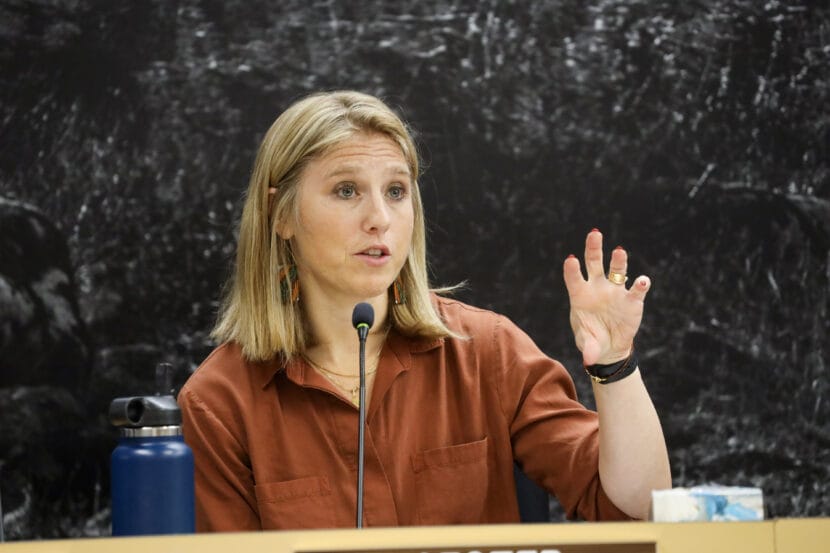
But there’s another potential project that could expand flood protection. City Manager Katie Koester said the Army Corps is talking about a solution that could come sooner than its original seven-to-10-year timeline.
Koester said Army Corps staff are working on a recommendation for what that solution would be and construction could start as early as the end of 2027. But she said moving that quickly would restrict the opportunity for public feedback, and the project still depends on continued federal funding.
City staff said they don’t know where that plan stands now amid the shutdown, but if it moves forward, it could influence how much of Phase 2 the city decides to build.
A spokesperson at the Army Corps said agency staff were still working as of Wednesday. The spokesperson said it’s too early to comment on how quickly an expedited enduring solution could come.
Sponsor a View Drive buyout?
Finally, the fourth major question is whether to sponsor a federal buyout program for View Drive, the street that’s been hit hardest by flooding and is left unprotected by the city’s levee. A buyout would pay residents to leave, demolish their homes and transform the land into a park.
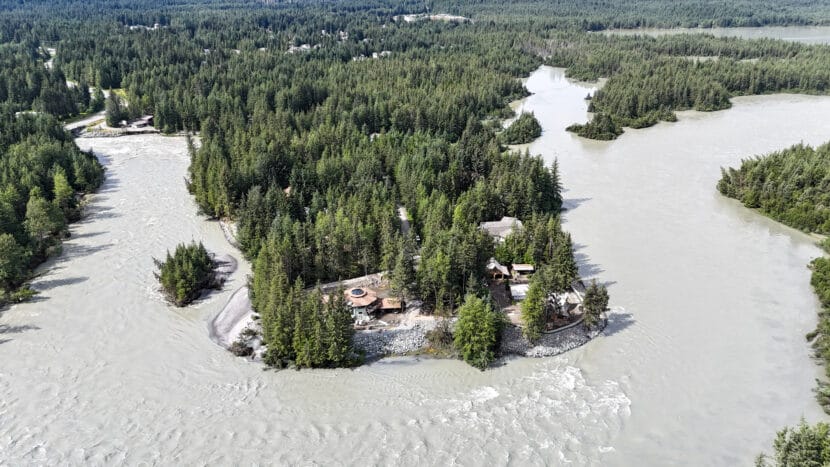
If all 18 eligible properties participated, it would cost around $25 million. If the Juneau Assembly votes to sponsor it, the city would have to pay around $6 million. Federal staff working on this project at the National Resources Conservation District have been furloughed due to the shutdown and were unable to respond to a request for comment.
The city plans to hold a special Assembly meeting to discuss these questions in detail on Oct. 30. City staff said final decisions won’t be made until December.
Update: This story has been updated to clarify a statement made by a city official and include a statement from the U.S. Army Corps of Engineers.