The criminal justice system can be intimidating for English-as-a-second-language speakers.
The stakes are high, the hearings take hours, and it can be hard to understand what’s going on.
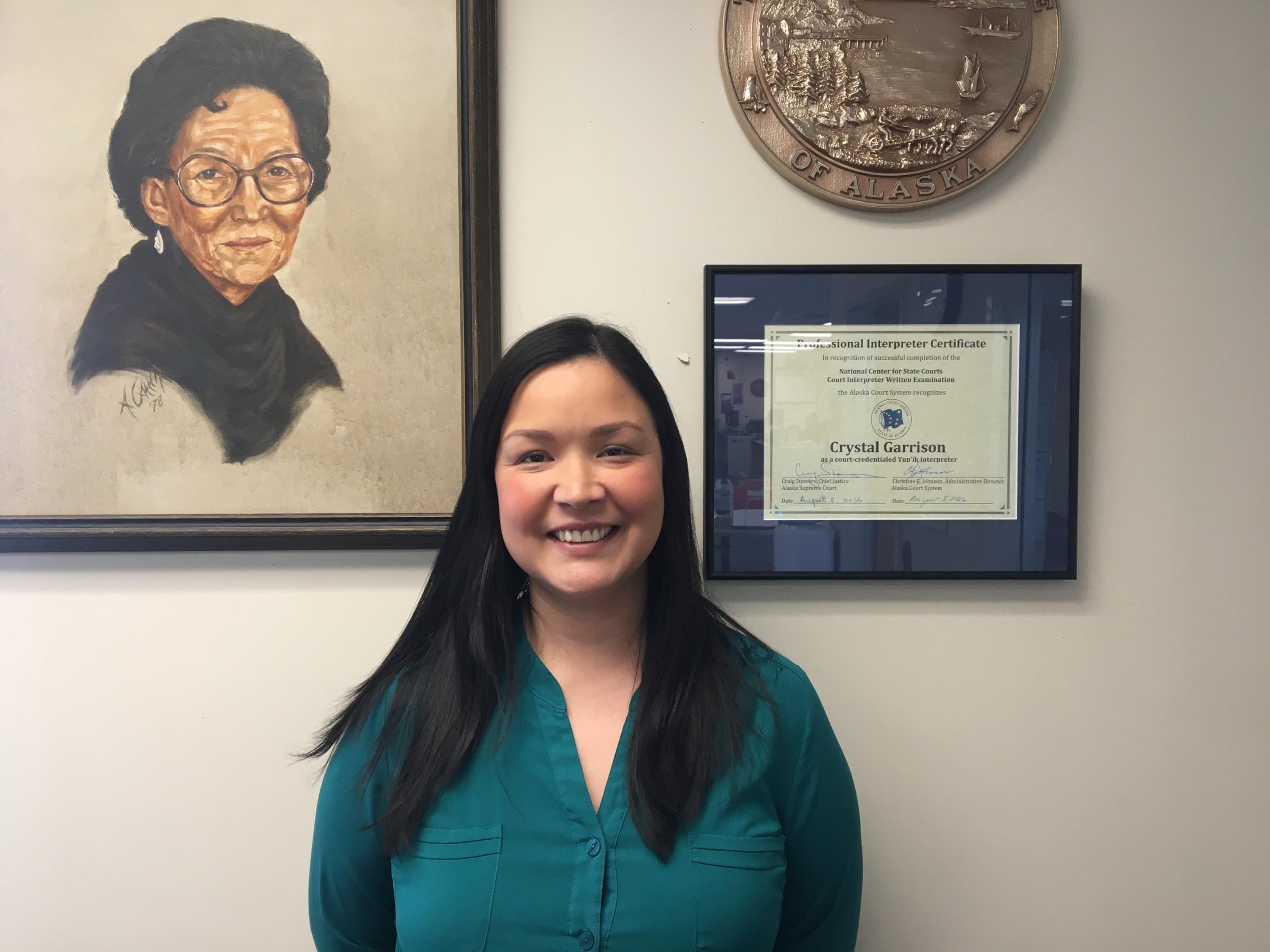
Crystal Garrison became the Alaska Court System’s first certified Yup’ik interpreter in 2016, and just received a prestigious award for her work.
Crystal Garrison’s boss called her into her office two weeks ago.
“She had her boss on the phone on speaker phone and they asked me to shut the door,” Garrison said with a laugh. “I kinda got wide-eyed and wondered, ‘what did I do now?’”
The Alaska Bar Association awards the Judge Nora Guinn Award annually to professionals who’ve devoted their careers to helping rural, Native residents navigate the legal system.
They’ve chosen to recognize Garrison for her work as a Yup’ik interpreter in the Yukon-Kuskokwim Delta.
Bethel’s in-court clerks supervisor Garrison has worked at the court for almost two decades.
She’s a fan of Judge Nora Guinn, who was the first woman and the first Native person to serve as an Alaska District Court judge.
Garrison has a painting of her on the wall next to her desk, hanging above her pictures of her children and a printed-out picture of Beyonce.
“I was speechless,” Garrison said. “I haven’t done this for the accolades, I’ve done it to help Yup’ik people in our region.”
Garrison grew up in Eek, where she spoke Yup’ik and English at home.
She didn’t interact with the criminal justice system when she was growing up, and when she started working at Bethel’s courthouse, parts of the system surprised her.
Garrison was alarmed by her region’s crime rate, and she was struck by how alienating the criminal justice system was to many of the Yup’ik speakers who were trapped in it.
“Some people in the smaller villages don’t even travel much outside their smaller villages,” Garrison said. “If they get in trouble and they have to deal with the justice system? What a different world that is altogether for them.”
Language barriers are a big part of that culture shock.
“It’s confusing even if you speak English as your first language,” Garrison said.
Many of the terms and phrases used in court aren’t used anywhere else, and a number of key terms are Latin.
“Very often, people are brought before the court and people don’t realize that they are not fully comprehending what is happening,” said David Case, assistant public defender in Bethel who’s known Garrison for years.
They might misunderstand the role of the judge, the role of the prosecutor, or the charges they’re facing.
Bethel’s courthouse has often struggled to find Yup’ik interpreters, Case said, and has sometimes been forced to improvise.
“I’ve seen the court say, ‘hey, you’re in the back there. Would you like to interpret?'”
In some cases, residents have been asked to translate for relatives who are testifying.
And while a number of Y-K Delta community members speak Yup’ik fluently, working with untrained interpreters can create some serious problems.
Garrison remembers clerking for one trial a few years into her career.
“The person that was having the interpreting done for them said something, and the person interpreting basically told him to answer in a different way,” she said. “That was kind of what was alarming to me. I told the judge to stop; that interpretation is not accurate.”
Garrison decided to become an interpreter herself.
In 2016, she passed the National Center for State Courts’ written examination, where she was quizzed on court terminology and ethical standards.
She scored a 93 on that test.
The center didn’t have a test for Yup’ik proficiency, so Garrison’s language skills were assessed through a series of classes at the University of Alaska Fairbanks’ Kuskokwim Campus.
Garrison said interpreting work is challenging.
Certain ideas are differently articulated in Yup’ik and English, like the concept of a no-contest plea.
Garrison has to take the time to deconstruct them.
Case describes Garrison as a consistent, and often lone voice for the fair treatment of non-English speaking people in the Y-K Delta.
Yup’ik interpreting is getting better at Bethel’s courthouse, Garrison said.
She’s seen a decrease in family members interpreting for one another, and an increase in credentialed interpreters.
It will be an important moment for her; she says her husband is actually a relative of Guinn’s.
When Garrison won the award, they called her husband’s grandfather, Guinn’s last surviving sibling, right away.
“He kind of got emotional,” Garrison said. “He said, ‘I’m so happy for Crystal for carrying on something my sister worked so hard to do all her life.'”