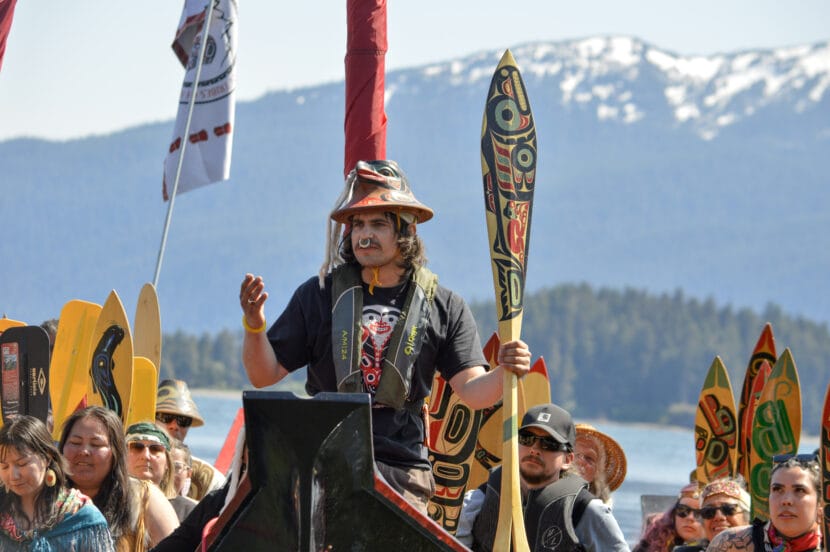
Ḵaayák’w Brandon Gomez introduces the Wave Dancer yaakw and asks permission to come ashore at Auke Recreation Area on June 2, 2026. (Photo by Yvonne Krumrey/KTOO)
One was different from the others, though it looked exactly the same.
Ḵaayák’w Brandon Gomez from Deishú introduced the yaakw at the landing on Tuesday.
“This is the Wave Dancer. It’s a 31 foot and a half dugout canoe made out of strips, and so it’s made to the same specs as a dugout canoe,” he said to those standing on shore. “So that this art form, this way of our life will not be forgotten, and that’s so our grandchildren and their grandchildren’s can participate on journeys, and they too can learn to be boat builders and to wear their culture with so much pride.”
The Wave Dancer is the first of its kind. It was made from smaller pieces of wood – or strips – instead of one tall tree, but to the same specifications as a traditional dugout canoe.
“It’s backwards from making a dugout,” said Gudaxh Jai Reid.
He helped build and sail the Wave Dancer. He said they finished it just about a month before they set sail.
“A dugout, it starts as a log, and it’s all removing the wood,” he said. “And a strip canoe is the complete opposite. You start with nothing, and you build up. It’s a pretty neat process.”
Carvers made the yaakw in Juneau, then brought it to Haines to sail in for Celebration.
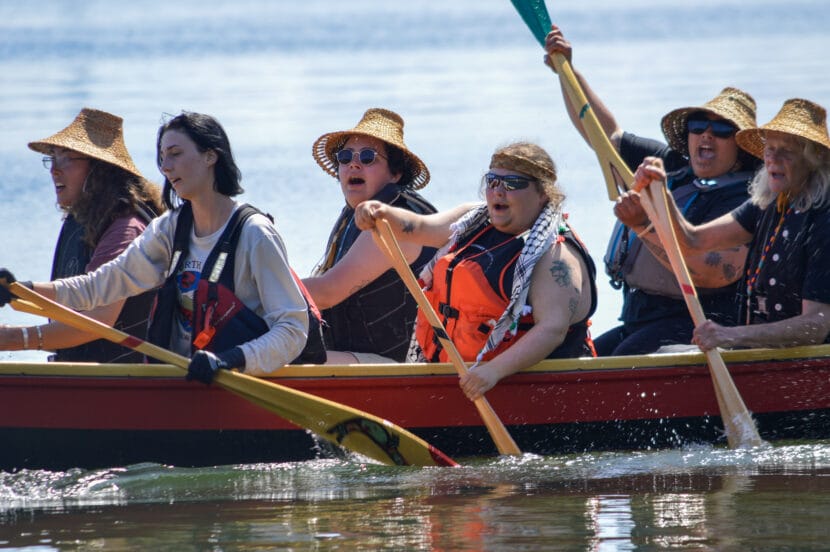
Reid said the journey was remarkable, and the yaakw held up.
“It was beautiful,” he said. “I feel some of my fellow boat builders say every canoe is an experiment, and this one was our biggest experiment yet, and it handled just fine. We know what we want to do different, and we know what we want to keep, and I’m excited to make a bunch more.”
The strip canoe allows carvers to move away from using old growth trees to keep traditional boat building alive. It’s the brain child of Master Carver Wayne Price.
“That’s the future, and we can’t get the stand talls anymore to make a dugout, we can build one out of strips,” he said. “It still has the same expectation as a dugout, so that’s pretty cool.”
He came up with the idea more than a decade ago while he was helping build Shuká Hít, the Sealaska Heritage Institute’s clan house.
“I was adzing away, and I didn’t have nothing to do, so I dreamed up a strip canoe,” Price said. “And I worked really hard, and got it lofted, made one that was half inch thick, and every time we come up on a wave, they get blown sideways in the headwind, so I said it’s too light. So I said we should try to make one that is the same dimensions as a dugout, inch and a half on the bottom, an inch on the sides.”
Paddlers aboard the Wave Dancer, a traditional canoe built using new methods for carvers, sailing to Auke Recreation Area. June 2, 2026. (Photo by Yvonne Krumrey/KTOO)
He said this invention was born of necessity — with old growth trees becoming harder and harder to harvest. He said carver Kevin Jones spent two years putting the boat together.
The yaakw’s journey for Celebration was its first ever, Price said.
“We were going into this, and we didn’t know nothing, we didn’t know, because it was first one ever built, but we got it, put it in the water,” he said. “We did the sea trials coming down, we all had our sails up in five foot seas. We were clocked at seven knots, and there’s no water came in the boat. The strip canoe performed exactly like a dugout.”
And now that it arrived back in Juneau, these carvers and paddlers headed to downtown Juneau for Celebration.
Celebration officially starts Wednesday, with a Grand Entrance parade into Centennial Hall downtown. Over the coming days, there will be numerous events and ceremonies dedicated to honor and uplift Alaska Native culture.
Celebration events will broadcast live statewide on KTOO 360TV and stream on Sealaska Heritage Institute’s YouTube channel and ktoo.org/tv. You can also watch live on KTOO’s Roku and AppleTV apps.
Disclosure: KTOO’s production department is contracted to provide television and streaming services during Celebration 2026. It operates independently from the news department.
Correction: An earlier version of this story misstated the type of tree used in carving dugout canoes.
Sign up for The Signal
Top Alaska stories delivered to your inbox every week
Close
Update notification options
Subscribe to notifications
Subscribe
Get notifications about news related to the topics you care about. You can unsubscribe anytime.