Adelyn Baxter

Digital Content Director, KTOO

"I help inform KTOO listeners, viewers and readers by finding creative ways to bring our content to our audience wherever they are."

With a slowdown in Juneau COVID-19 cases, Bartlett prepares to resume elective surgeries

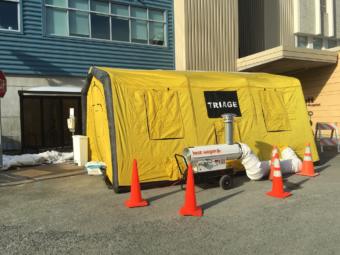
A triage tent sits outside the emergency department entrance to Bartlett Regional Hospital on March 13. (Photo courtesy of Katie Bausler)

Bartlett Regional Hospital is not currently treating any patients for COVID-19.

Chief Operating Officer Billy Gardner said efforts to slow the spread of coronavirus in Juneau appear to be paying off.

“We’re seeing the line — the curve — flatten, as they say, in Juneau. So that’s very positive,” Gardner said.

Juneau’s last positive case of COVID-19 was identified on April 21, but city data traces the onset of symptoms for that individual to April 15. The city and borough has seen 27 confirmed cases since March. According to city data, 22 of those people have now recovered.

All visitors to the hospital are still being screened on arrival. Gardner said they’re only allowing patients’ visitors in limited cases, like mothers in labor and parents of minors.

But he said people should not avoid going to the emergency room if they need immediate medical attention.

Starting next week, hospitals around the state are allowed to resume most elective surgeries. Gardner said Bartlett is busy getting ready to begin offering services like cancer screenings once again.

“We detect up to nine cases of breast cancer a month on average,” he said. “So we need to get that service back up and running at full speed as soon as possible.”

Earlier this month, the hospital reported an expected revenue shortfall of $4 million for the month due to the suspension of elective surgeries.

Correction: A previous version of this story incorrectly stated that Juneau’s last positive case of COVID-19 was identified on April 15. In fact, the patient’s positive test was reported to the city on April 21.


Newscast — Monday, April 27, 2020

In this newscast:

  • The Juneau International Airport may have given up millions in federals relief funding,
  • recognizing scams and frauds circulated by those looking to make money off of the pandemic,
  • Pelican and Tenakee Springs will see ferry service again after all,
  • and the Girl Scouts of Alaska expect to receive a federal loan to help makeup lost cookie sales.

City considers options as businesses decide whether to reopen

The Franklin Street Barbers was open for business in downtown Juneau on Friday; its one of several types of businesses the state says can be open now. (Photo by Rashah McChesney/KTOO)

Starting Friday, the state says some businesses that have been shuttered for a month can reopen.

But the City and Borough of Juneau is asking business owners to wait a little longer for local leaders to discuss the pros and cons.

The new state health mandate lists several types of non-essential businesses that can now choose to reopen as long as they follow rules meant to keep people safe.

But Juneau is asking local business owners to hold off. Mayor Beth Weldon says the city Assembly will discuss the state’s guidelines Monday.

“We are going to look at the mandates a little bit more in detail and see if indeed we are comfortable with all of them,” Weldon said on Friday. “For the businesses trying to reopen, they seem to have pretty strict regulations in place. So that’s comforting.”

The city won’t prevent anyone from opening up in the meantime. But Weldon said they would like to hear from the community before the Assembly decides whether to set some rules of its own.

For some business owners, there was confusion about how to safely open.

The state’s board of barbers and hairdressers met remotely for several hours Friday morning, answering dozens of questions about everything from where customers should wait to how to properly sanitize a space. Some owners questioned if they could be sued if someone caught COVID-19 in their shops.

Calls to Juneau area barber shops and hair salons revealed several were open and accepting customers one at a time. But, some remained closed.

Jo Betts owns Little Mermaid Beauty Salon in Douglas. On Friday, she was in her shop cleaning and getting ready to reopen, but not just yet.

She said she felt it was too soon.

Juneau has had 27 confirmed cases of COVID-19 so far. Eighteen have recovered. The hospital has been able to relax testing criteria and can now test up to 40 people a day.

After doing her own research and seeing what national authorities are saying, Betts decided to wait until May 1 to reopen.

“Everyone I have made the appointment with has said “absolutely, I agree,” … and they’ve also been very good about saying they were very proud of me for waiting to open until I felt comfortable to open,” Betts said.

She actually closed her salon a week before the health mandate closing personal care services was issued in March. She also had multiple people ask her to make house calls, but she told them no.

When she does reopen, she’s asking customers to wait in their cars until she comes to get them. She will sanitize between each appointment and wear a mask.

She’s already fully booked a week out from May 1, and that’s just her regulars.

“My hair color people are my first priority because they are the most desperate, but (I’m) trying to get my own local clientele in first before I start taking people that I don’t know,” she said.

Assembly member Rob Edwardson said he still has reservations about the state’s ability to assess the risk that reopening businesses and relaxing restrictions could mean for public health.

On Monday when the Juneau Assembly meets again, it could decide to reintroduce some of the local restrictions from the city’s hunker down order.

“I definitely think that it’s a possibility to go back to that, I don’t know how much support there is on the Assembly,” Edwardson said. “I definitely think that it’s a possibility that the Assembly would go with the governor’s list with no modifications, but I kind of feel like what we’re going to end up with will be some place in between.”

Either way, Edwardson said he hopes Juneau residents will continue doing what they’ve been doing — washing their hands frequently, social distancing and wearing a mask when appropriate.

The Assembly will discuss the mandate during Monday’s regular meeting at 7 p.m. Before that, Alaska Chief Medical Officer Dr. Anne Zink will answer questions from the Assembly starting at 6 p.m.

Both meetings will be aired on Facebook Live and on Zoom.

Correctional officers in Alaska ask for help to avoid bringing COVID-19 home with them

Corrections officers wait outside of a cell during a weekly inspection at the Lemon Creek Correction Center on June 18, 2016 in Juneau, Alaska. (Photo by Rashah McChesney/KTOO)
Corrections officers wait outside of a cell during a weekly inspection at the Lemon Creek Correctional Center in Juneau on June 18, 2016. (Photo by Rashah McChesney/KTOO)

Correctional officers are worried about bringing COVID-19 home to their families.

Last week, the union that represents correctional officers in Alaska reached out to the state’s Department of Corrections asking for help securing temporary housing for officers.

Randy McLellan is the president of the Alaska Correctional Officers Association, or ACOA. He works at Hiland Mountain Correctional Center in Eagle River and said social distancing is just not possible in correctional settings.

“It’s not going to take long, once (the coronavirus) gets into one of these facilities, to spread like wildfire,” McLellan said. “It’s just the nature of the community inside the walls.”

As of last week, seven staff members had tested positive for COVID-19 at Lemon Creek Correctional Center in Juneau. Nearly half of the staff had been tested at that point.

Meanwhile, five inmates have been tested so far. All of the tests came back negative.

ACOA also reached out to community partners in search of temporary housing. McLellan said the Juneau School District offered space in a middle school.

A school district spokesperson said it was considering allowing officers to use Dzantik’i Heeni Middle School’s locker rooms and gym for temporary housing. All Juneau schools have been closed since March.

But McLellan said when the union informed DOC about the plan, they were told that the state had already found temporary housing.

As of Wednesday, he said the union has not been told where or when it will be ready.

Corrections spokesperson Sarah Gallagher did not provide details about the housing when asked Wednesday.

She wrote in an email that the housing is available to any staff who have tested positive for COVID-19 or who have been identified as a close contact of someone who has, but no one has taken advantage of it yet.

McLellan is frustrated with the slow response to something that he said should have been addressed weeks ago.

“(Officers are) scared to death to take it home. We’ve had several officers stay at hotels waiting for test results already, outside of Juneau,” he said.


Juneau Assembly approves $200,000 in renter relief

A woman crosses Marine Way in front of Juneau City Hall on Sept. 25, 2017. (Photo by Jeremy Hsieh/KTOO)

Some assistance is on its way for Juneau residents struggling to pay rent amid the coronavirus outbreak.

The Juneau Assembly approved an emergency appropriation Monday night setting aside $200,000 from the city’s affordable housing fund as relief for residents who have been laid off or are unable to work due to COVID-19.

The resolution passed by an 8-1 vote. Assembly member Loren Jones voted against it, saying he feels it does too little and is “a bad piece of legislation.”

“We’re arguing over $200,000 for people and human beings in rent assistance, and we’re putting up barriers,” Jones said.

Several other Assembly members said they were disappointed it had taken so long for the Assembly to pass some form of rental assistance, especially given how quickly it approved $3 million in emergency funding for local small businesses.

“I’m not happy about the message this sends in Juneau, especially (to) individuals who really need assistance at this time,” said Assembly member Carole Triem. “There’s no right answer on any of this, there’s no certainty on any of this, but we do need to do something to help the people who really need it.”

The resolution creates an emergency rental assistance program. Funds will be distributed through the Juneau Community Foundation to the Alaska Housing Development Corp., a nonprofit that runs several low-income housing complexes and an existing rental assistance program.

Applicants will need to demonstrate that they are within a certain income bracket and prove that they are unable to pay rent as a result of COVID-19 impacts.

AHDC Executive Director Tamara Rowcroft said Thursday the details are still being worked out by the city, and it will take about a week before they can start accepting applications from renters.


Corrections commissioner says early release for Alaska prisoners ‘is not on the table’

Nine men attended David A. Boxley's four-day formline design class. (photo by Scott Burton/KTOO)
Prisoners at Lemon Creek Correctional Center in Juneau attend a formline design class in 2015. (photo by Scott Burton/KTOO)

States across the country are working to reduce crowding in jails and prisons in response to COVID-19. Solutions run the gamut from keeping low-level offenders out to releasing some prisoners early.

In Alaska, the court system issued two court orders last month aimed at reducing the number of people in state custody.

But despite an outbreak among staff at Juneau’s correctional facility, Gov. Mike Dunleavy and the head of the state’s Department of Corrections say early release of prisoners is not an option.

In Washington state, Gov. Jay Inslee signed an executive order this week approving early release for about 1,000 nonviolent offenders.

California and North Carolina have also released thousands of prisoners early as states work to limit the spread of COVID-19.

But in Oregon, Gov. Kate Brown announced this week that she will not release inmates to reduce crowding in state correctional facilities.

Earlier this year, Alaska’s Department of Corrections was struggling with overcrowding. Facilities statewide were 97% full as the department worked on a now-abandoned plan to send inmates out of state.

But in a press conference on Wednesday, Corrections Commissioner Nancy Dahlstrom said crowding is less of a problem now. She said state facilities are now at 89% capacity.

“I have a little bit more room than I’ve had in the last few months,” Dahlstrom told reporters. “We’ve been able to have smaller numbers of folks in most of the units. I have room to isolate people when I need to.”

Last month, the ACLU of Alaska sent a letter to state leaders asking them to consider ways to reduce the risk of spreading COVID-19 inside state institutions.

They suggested releasing inmates at higher risk of serious medical complications from contracting coronavirus.

Dahlstrom said that she read the letter and is open to suggestions for how to protect inmates.

But early release “is not on the table,” she said.

“Should the courts decide to make some decisions, I will honor that,” she said. “But I am not looking at that currently.”

Dunleavy followed up to Dahlstrom’s response at the press conference.

“I think we all want to be safe, and not just safe from this virus but safe from individuals that may do us harm,” Dunleavy said.

The Alaska Court System issued two court orders last month that are meant to reduce the number of people in custody.

In an interview earlier in the week, DOC Director of Institutions Sidney Wood said orders issued by the Alaska Court System, along with efforts at police departments to arrest fewer people, have helped bring down the overall inmate population.

“So some folks that normally would have come in and stayed with us are now being remanded and released, according to that bail schedule set by the court,” Wood said.

At Lemon Creek Correctional Center, where multiple staff members have tested positive for COVID-19, there are about 30 fewer inmates there than there were a month ago.

One of them is Jeremy Simile. He and other inmates are confined to their dorms for most of the day in order to reduce social contact among the population.

After hearing about other states that have released inmates early, he took a poll of the other men in his dorm, also known as a “mod.”

“Of the 15, nine are within a year, 11 are nonviolent offenders,” Simile said on Wednesday. “So if they followed the guidelines that other states have followed and push people to parole board — or people that were within a year of their release date, if they push them out the door — that would leave five people in my mod.”

Simile said he has about five years left on his sentence, so he doesn’t expect to be let out early.

But he said having fewer people living in close proximity to him would at least give him some peace of mind.


Site notifications
Update notification options
Subscribe to notifications