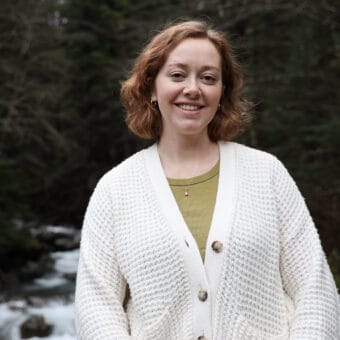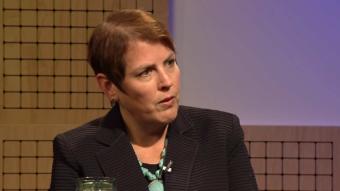
Angela Rodell appearing on KTOO’s Capitol Views in 2016. (KTOO file)
Former Alaska Permanent Fund Corporation CEO Angela Rodell is running for Juneau mayor.
Monday at 4:30 p.m. was the deadline to get on the ballot for Juneau’s Oct. 1 municipal election. Rodell is running against current Mayor Beth Weldon.
Rodell filed her paperwork with the Juneau Clerk’s office around 3 p.m. She says her leadership experience and background in finance can help Juneau overcome economic challenges.
“It feels like we have a lot of big issues right now, and taxes have continued to increase, the valuations — they’re just up and up and up,” she said.
Rodell has lived in Juneau for over a decade. She led the Permanent Fund Corporation from 2015 to 2021, when the fund’s board of trustees voted to remove her from the role.
She also served on the Juneau Airport Board for six years and was previously a revenue commissioner for the state. She’s currently the chair of Launch Alaska, a nonprofit tech company based in Anchorage.
“It was time to get off the bench, as they say, and get back. And I just really want to help move this community forward,” she said.
Weldon is in her second term as Juneau’s mayor. She’s a retired division chief with Capital City Fire/Rescue and owns Glacier Auto Parts.
Aside from the mayor’s race, two other Juneau Assembly seats and three school board seats are on the ballot. All seats are for three-year terms. Five candidates had filed to run in District 2 as of Monday afternoon, and at least one had filed in District 1. Candidates must live in the district they’re running to represent.
In District 1, former Alaska Office of Budget Management Director Neil Steininger and Connor Ulmer were listed as candidates as of 5 p.m. Monday. In District 2, Emily Mesch, Nathaniel “Nano” Brooks, Maureen Hall, Dorene Lorenz and Mary Marks had all been certified.
At least four people filed to run for school board. Current board members Elizabeth “Ebett” Siddon and Will Muldoon filed to run again. Jenny Thomas, Amber Frommherz, Michelle Stuart Morgan and Jeff Redmond also filed to run.
More last-minute candidates may be added as the clerk’s office works to certify them on the city website. Candidates have until Friday to withdraw their names if they no longer wish to run.
Write-in candidates have until Sept. 24 to file their candidacy with the clerk’s office. They won’t appear on the ballot, but they will show up on the city’s online candidate list.
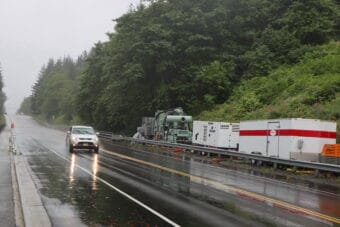
A car drives over Lawson Creek bridge on Douglas Highway on Monday, July 15, 2024. (Clarise Larson/KTOO)
Anyone driving along Douglas Highway this summer has likely noticed heavy equipment by the side of the road at Lawson Creek Bridge.
It’s part of stage three of the Alaska Department of Transportation’s Douglas Highway project. Most of the project has involved sidewalk improvements and road resurfacing up to this point, but what’s happening at Lawson Creek is different.
DOT spokesman Sam Dapcevich said the bridge is undergoing a process called metalization.
“They spray this liquid on there, but it’s not a paint,” he said. “It actually causes a chemical reaction that coats the steel of the bridge in a zinc-like coating, and it greatly extends the life of the bridge steel.”
Lawson Creek Bridge was originally built in 1935 and widened in the mid-70s.
A drone shot of Lawson Creek Bridge as it undergoes metalization in summer 2024. (Photo courtesy of Sam Dapcevich/Alaska Department of Transportation)
Dapcevich said the bridge has eight steel beams underneath it that are each 300 feet long. The work crew is doing 100-foot increments at a time, blasting away the old paint and then coating the beams with zinc.
“Basically, it’s like a sacrificial layer. It will corrode instead of the bridge corroding,” Dapcevich said.
The work shouldn’t affect traffic on the highway at all, but Dapcevich said they’ve gotten some complaints about noise when work runs late. The crew is permitted to work as late as 10 p.m., but he said they’re trying to keep it to daytime hours. They’ve also moved a generator that caused some noise complaints.
The work is expected to last until the end of September.
Details about the project can be found at douglashwy.com.
Correction: This story previously misstated the number of steel beams beneath Lawson Creek Bridge.
Join KTOO in celebrating a half-century of broadcasting during May’s First Friday!
First, tune in Friday, May 3 from 2 to 4 p.m. on KTOO 104.3 and 91.7 FM or online for a special edition of Juneau Afternoon featuring live music from local artists and guests from KTOO’s past and present.
Afterward, join us for an open house at our 360 Egan Drive studio starting at 4 p.m. Enjoy light refreshments, tour the studios and see photos and items from KTOO’s 50-year history on display. RSVP to the Facebook event here.
We’re celebrating our milestone all year with stories, interviews and events. If you have memories you’d like to share, submit them here. Stay tuned for more on upcoming celebrations!
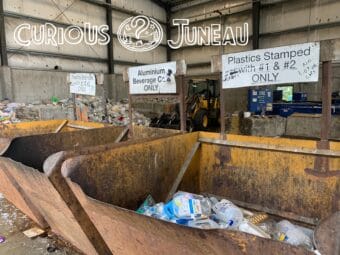
Signs tell Juneau residents where to deposit their recyclables at the city Recycling Center in Lemon Creek. (Photo by Adelyn Baxter/KTOO)
Editor’s Note: After we finished this story, a power outage forced the city’s recycling center to close for repairs. The city’s public works department says the recycling facility is full right now and won’t be able to receive any new materials for at least a few days.
It’s a nearly universal experience in Juneau.
It’s Saturday. You pull up to the city recycling center in Lemon Creek and methodically separate the Number 1 and 2 plastics, tin, glass, aluminum and cardboard you’ve used over the past week into their separate piles. Then you get back in your car to finish your weekend errands, which probably include Costco.
Do you have a Curious Juneau question? Submit it at the bottom of the page.
But do you ever stop to wonder what happens to all of that material after you drop it off?
Over the years, several Curious Juneau listeners have asked where Juneau’s recycling ends up. A few even wonder if it’s really getting reused, or if some of it ends up in a landfill.
And what about contamination – can incorrectly separating recyclables cause Juneau’s shipments to be rejected?
“Our stuff is considered the gold standard,” said Juneau Recycleworks Operations Manager Stuart Ashton. “They will actually take it and if they’ve got a tour coming up, they’ll bring that stuff out and for observation because it’s so good. It’s that good.”
Where does it all go?
Ashton is talking about the staff of a big recycling facility in Tacoma, Washington. That’s the short answer. Your recycling goes to Tacoma.
Separated recycling gets condensed into cubes by a baler, then it’s shipped by barge to Waste Management’s JMK Fibers recycling facility.
They process about 180,000 tons of material per year. Ashton said Juneau makes up about 1,400 tons of that.
Jackie Lang with Waste Management’s Northwest region said while there’s always room for improvement, Juneau’s reputation for good recycling outshines many of the other communities they serve.
“They are pretty darn good at it,” Lang said. “We see that in the material that we receive from Juneau. We see that residents and businesses are working hard to put the right material in the right container.”
In Tacoma, industrial-scale machines sort Juneau’s recycling before it gets shipped to end markets.
“Plastics sorted at this particular recycling facility end up in fleece-type clothing and backpacks,” Lang said. “Some plastics are made into rigid plastic products like plastic buckets or maybe laundry baskets or storage bins. Tin cans are recycled into rebar, aluminum cans become new aluminum cans. And cardboard boxes become new boxes, water bottles become new water bottles.”
Does recycling make a difference?
National headlines in recent years have bemoaned the unsavory realities of recycling, like the fact that only a tiny portion of what gets put in recycling bins worldwide actually ends up being reused.
Lang said the commodity market for recycled materials fluctuates constantly based on global supply and demand. She acknowledged that the market had dipped in recent months, but said that Waste Management has recently invested millions into improving equipment at its Tacoma facility to make sure more of what they receive does get recycled.
“Recyclables that arrive at our recycling center are sorted and shipped to manufacturers who are waiting for that material,” she said. “So the demand is reliable and steady for the products that we recycle every day.”
More and more, headlines and studies warn us about the threat of microplastics in our environment, even here in Alaska.
Recycling has long been touted as the way to avoid plastics pollution. But a recent report from the Center for Climate Integrity investigates how the oil and plastics industries used recycling as a public relations tool for decades, despite privately acknowledging that recycling often costs more than producing new plastics.
The report accuses corporations of suppressing this information, leading to the rise in global plastic pollution.
How can Juneau resident be better recyclers?
Back in Juneau, there’s still the question of what to do with those pesky items that don’t have a proper bin.
Juneau’s curbside recycling program is done through Alaska Waste, which accepts plastics 1 through 7.
Ashton says the city’s recycling facility only accepts #1 and #2 plastics. He noted that #5 has become more valuable on the market, but it’s not as simple as suddenly deciding to accept it.
“It really is more about sustainable practices,” he said. “Trying to retrain an entire population of 30,000 people, you can only take number one and two plastics for two decades and then switch. If it gets more expensive, we have to stop it in a couple of years.”
Another thing to keep in mind is that if the plastic caps and lids don’t have a recycling stamp with a 1 or 2 on them, they’re not allowed. And plastic bags? They’re never recyclable, although Fred Meyer sometimes collects used bags.
Nearly all of the recycling collected curbside and at the city facility eventually leaves town. But not all of it. Waste Management actually grinds up glass at the dump. Ashton says the landfill uses it in place of gravel.
“It is our best reuse material in this town, from my perspective,” Ashton said.
So where could Juneauites improve their recycling habits? Ashton says the curbside recycling program sees the most contamination. That’s probably because there’s less oversight — and less social pressure to get it right.
Curious Juneau
Are you curious about Juneau, its history, places and people? Or if you just like to ask questions, then ask away!
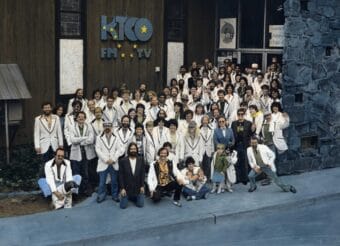
KTOO staff and volunteers pose outside the station’s former location on 4th Street in Juneau circa 1985. The story goes that longtime staffer Jeff Brown bought suit jackets for everyone on discount. (KTOO archives)
Editor’s note: For our 50th anniversary we decided to step back and highlight a few of the people who helped get us started. Engagement Editor Adelyn Baxter spoke to founders and other people who had a role in making KTOO what it is today.
Juneau’s locally owned, listener-supported public radio station is 50 years old this week. A lot has changed after five decades on the air — KTOO now boasts three radio stations, a television channel, a website and a staff of more than 20 people.
But like most community radio stations, it had humble beginnings.
“You’re listening to KTOO, stereo FM radio for Juneau, Alaska,” says John Corso, one of the founders of KTOO, during a radio spot that ran in early 1974. “KTOO is owned by the people who listen to it, and operated by the people who own it. You’re a listener right now. You can become an owner by joining Capital Community Broadcasting. And you can become an operator by volunteering your time.”
The spot ends on an irreverent note that’s characteristic of the station’s early days.
“If you’d like to know more about owning and operating, keep listening. If you’d like to know more about listening, see an audiologist.”
Fifty years later, in the KTOO archives, former general manager Bill Legere examined dusty boxes of photos and documents. He pulled out a booklet called “How to KTOO,” written by Elaine Mitchell.
A KTOO volunteer assists a young volunteer in the radio booth at Juneau-Douglas High School: Yadaa.at Kalé in the 1970s. (KTOO archives)
Mitchell was a champion of Alaska radio. She died years ago, but she went on from KTOO to help found the Alaska Public Radio Network, which still connects dozens of rural and urban stations today. Legere called her “the founding mother of KTOO.”
“There’s this line in here that says, ‘You’ll never need more than $10,000 a year to run the radio station,’” he said. “So, sort of quaint in that regard, but it was the blueprint for how to start a public radio station.”
KTOO wasn’t the first public radio station in Alaska, but it was one of them. To understand its scrappy beginnings, we need to go back to the early 70s, when Juneau had just two AM commercial radio stations.
KTOO volunteers inside a recording booth in the station’s 4th Street location circa 1985. (KTOO archives)
As Dennis Harris recalls, neither one was locally owned. He and other staff at one of the stations got fired abruptly one day — which wasn’t unusual. They often got hired back. But it was tedious. And this time, his colleague, Mitchell, had an idea.
“Elaine had bought this book called ‘How to Start a Community Radio Station,’ where they recommend that you build a 10-watt station because it was cheap,” Harris said. “And she passed it around to us, and we talked about it. And we had a meeting. And we decided to start a nonprofit corporation.”
Harris, Mitchell and a small group of determined volunteers began to get the word out that they were starting a community-focused radio station.
“We were able to raise the money necessary to build the station in about two months, just from donations,” Harris said.
In the early 70s, public radio was in its infancy across the country. The Public Broadcasting Act of 1967 created the Corporation for Public Broadcasting, which distributes federal money to public media stations across the country as a portion of their funding. NPR was incorporated in 1971, along with 88 founding member stations.
Meanwhile, national community radio trailblazer Lorenzo Milam wrote “Sex and Broadcasting: A Handbook on Starting a Radio Station for the Community” – the same book that inspired Mitchell and scores of other stations around the country.
It took more than a year to get the equipment and FCC license necessary to get on the air. They found space for two radio booths in Juneau-Douglas High School: Yadaa.at Kalé’s auditorium. They were tiny, but they worked.
Longtime KTOO staffer Jeff Brown inside the radio booth at Juneau-Douglas High School: Yadaa.at Kalé in the early 70s. (KTOO archive)
“Having a locally owned, locally controlled radio station was part of the big impetus,” Harris said. “And the other was to have a place where we could have an open microphone where the community could come and say anything they wanted, as long as they didn’t libel or slander anybody.”
The first official broadcast was sometime around midnight between Jan. 26 and 27, 1974 — or maybe earlier, depending on who you ask. It was a bit chaotic (you can hear more about it in this Juneau Afternoon conversation), according to the remaining founders. But either way, Frederick Hoskinson’s voice was the first to go out over the airwaves.
“I was hired as the first coordinator of volunteers, which we only had that one position,” Hoskinson said. “Everyone else was a volunteer.”
There were more than 100 volunteers in the early days. They didn’t broadcast all day long — Hoskinson said they would start around 12:30 p.m. People could host shows on just about any topic and played any kind of music they wanted. He remembers a Saturday program hosted by middle school students aimed at kids their own age.
“There was no way that we can be everything to everybody all at the same time,” he said. “We tried to be everything to everybody at various different times.”
Part of the station’s early focus revolved around legislative coverage. Mitchell and Harris hosted a legislative digest that aired in the evenings and was available to public radio stations statewide.
Betsy Brenneman came to work at the station in 1977 from KYUK in Bethel.
“It was a real hub for the community. I mean, there were people coming in and out of the station,” she said. “People would just come in and hang out and talk.”
KTOO volunteers and staff outside the station’s second location on Main Street downtown circa 1979. (KTOO archives)
KTOO later moved to two other buildings downtown before finding its current home at 360 Egan Drive in 1996. A television station — now called 360TV — went on air in ‘78. The TV station was led by Sharon Gaiptman and Brenneman was the news director.
“(We) just found a lot of people who came together and made things happen that, in some ways, if you look back — ‘Oh, how did we do that?’ You know? But, we did it,” she said.
Legere didn’t arrive at KTOO until the 80s, and took the helm in 1991, but he said the same spirit that started the station persisted even then.
“KTOO started in a time when there was no one to say ‘no.’ You could do anything you wanted, as long as you could figure out how to do it,” Legere said.
There are more people than we could ever hope to mention in this story who helped build KTOO and kept it going for half a century.
Today, as in 1974, KTOO remains locally owned and operated.
KTOO’s Tasha Elizarde and Bostin Christopher contributed to this story.
If you have a memory you’d like to share for KTOO’s 50th anniversary, you can find out how to submit it here.
Correction: A previous version of this story misidentified what year Betsy Brenneman arrived at KTOO and her role at the station.
Emma and Dylan Jobsis pose with their newborn baby, Cosmo, and the rocking boat they received to celebrate Bartlett Regional Hospital’s first baby of the year. (Photo courtesy of Bartlett Regional Hospital)
Juneau welcomed its first baby of 2024 over the weekend.
Weighing in at 10 pounds and 2 ounces, Cosmo Jobsis was born Saturday at Bartlett Regional Hospital to local residents Emma and Dylan Jobsis.
Cosmo is 21 and 1/4 inches long and joins an excited big brother named Cade, according to a hospital press release.
In keeping with tradition, Cosmo’s family received a wooden rocking boat handmade from Sitka spruce by Bartlett’s Dr. Lindy Jones and his wife, Colleen. It was filled with gifts for the newborn. The Joneses have made the rocking boats to welcome the first baby of the year born at Bartlett for years.
Cosmo is the seventh baby to receive one.
Close
Update notification options
Subscribe to notifications
Subscribe
Get notifications about news related to the topics you care about. You can unsubscribe anytime.