
Adelyn Baxter

Digital Content Director, KTOO

"I help inform KTOO listeners, viewers and readers by finding creative ways to bring our content to our audience wherever they are."

AEL&P parent company and Canadian Hydro One call off merger

Hydro One's logo on a tower at its headquarters in Toronto on May 20, 2015. Hydro One says it's Canada's largest electricity transmission and distribution service provider.
Hydro One’s logo on a tower at its headquarters in Toronto on May 20, 2015. Hydro One says it’s Canada’s largest electricity transmission and distribution service provider. (Public domain photo by Raysonho @ Open Grid Scheduler / Grid Engine)

The proposed merger between the parent company of Juneau’s power utility and a Canadian power company is dead. That’s according to Hydro One and Avista, who announced Wednesday they had terminated the deal.

Alaska Electric Light & Power was bought by Avista Corp. in 2014. The Spokane-based parent company opened merger talks with Toronto-based Hydro One in 2017.

But the merger needed approval in every state where Avista does business. Alaska’s regulators had approved the deal, but utility regulators in Idaho and Washington rejected the merger.

Both states cited fears over political meddling in Hydro One, which is 47-percent owned by the province of Ontario. Populist premier Doug Ford forced Hydro One’s CEO to resign and replaced its board of directors weeks after being elected in June.

In a joint statement, Avista and Hydro One said their boards independently decided terminating the deal would be best course of action for the companies and their shareholders.

AEL&P President Connie Hulbert wrote in a statement that the outcome of the proposed merger will not affect the Juneau utility, which serves 17,000 homes and businesses including Hecla’s Greens Creek Mine.

“It will continue to be business as usual for AEL&P,” she wrote.

Some in Juneau had raised concerns over the prospect of a foreign business owning the 125-year-old company.

Renewable Juneau, an advocacy group, released a statement applauding regulators for scuttling the merger. Andy Romanoff, who is on the nonprofit’s board of directors, wrote that the proposed merger was not in the public interest.

“Idaho and Washington regulators found, for various reasons, that the proposed merger between Canada’s Hydro One and Avista Corporation was not in the public’s best interest. We understand that finding as it is consistent with issues raised in Alaska,” Romanoff wrote. “A concern of note was the prospect of foreign control of the merged corporations and its possible implications for Juneau’s local power utility, AEL&P.”

Hydro One will pay Avista a $103 million termination fee as required by the merger agreement, the statement said.

In an email, Avista spokesperson Casey Fielder said Avista is not actively seeking any other mergers.

CoastAlaska’s Jacob Resneck contributed to this report. 

There will be blood: Permanent donation center opens in Juneau

Donated blood at the new Blood Bank of Alaska donation center in Juneau. (Photo by Adelyn Baxter/KTOO)

A new Blood Bank of Alaska location celebrated its grand opening Thursday in Juneau.

The region has been served by mobile blood donation drives in the past, but this is the first permanent facility in years.

Donors can call or make an appointment online. I decided to stop by last week during the soft opening to donate a pint of blood.

Even though I’d donated dozens of times before, I still had to look away when the needle went in.

“I just don’t watch it,” said Wesley Dahlgren, director of collections and recruitment for the Blood Bank of Alaska.

He was nice enough to sit down for an interview while I donated.

Dahlgren is based in Anchorage but was in town for the soft opening last week to help get the new facility up and running.

“Juneau’s a large population base, and it’s the state capital,” Dahlgren explained when I asked what prompted them to open the new donation center. “We are Alaska’s blood center, so getting the state capital involved is kind of paramount.”

The Blood Bank of Alaska collects, processes and distributes blood throughout the state. They also have donation centers in Anchorage, Fairbanks and Wasilla.

Bartlett Regional Hospital doesn’t have a contract with them, but a few other hospitals in Southeast do.

I asked Dahlgren what would happen to my blood after we finished. He explained it would be sent back to Anchorage via Alaska Airlines.

“It will get processed, and the components in your blood will basically be broken down. Then that blood will be shipped as needed throughout the state,” he said.

It takes up to two days for blood to be screened before it can go out into the supply network.

Once there, it has a shelf life of about 40 days.

A donor can only give blood every two months. That’s why blood centers always need a fresh supply.

I’m Type O-positive — the most common blood type. Even though Type O-negative is the universal donor, Dahlgren said Type O-positive is the most transfused type of blood.

“It’s about 30 to 40 percent of the population, but only 38 percent of the population is eligible to donate. So we always need O-positive,” he said.

Dahlgren said hospitals in remote towns like Bethel, Nome or Utqiaġvik keep a supply of Type O-negative on the shelf since they can’t store large quantities.

But donation centers need donors of all other blood types, too.

Dahlgren said only about 2 to 3 percent of Alaskans donate blood. That’s a lot less than the number of hospital patients who need it.

After about seven minutes, the machine beeped like I’d just leveled up in an ’80s arcade game.

That meant I was all done. A tech bandaged my arm and put my blood bag in a freezer.

Dahlgren thanked me and invited me to stick around for a few minutes and have a snack.

“You know, a lot’s changed in blood banking in the last few years, but cookies have not changed,” he said.

The hours for the Juneau donation center in the Jordan Creek Center are currently Monday through Friday, 9 a.m. to 5 p.m.

Assembly appoints Hughes-Skandijs to replace Kiehl

Alicia Hughes-Skandijs. The Juneau Assembly appointed her to fill a vacant Assembly seat on Monday. (Photo courtesy Alicia Hughes-Skandijs)

Incoming state Sen. Jesse Kiehl resigned his seat on the Juneau Assembly Monday night as required by law.

Kiehl won the election to represent Juneau, Gustavus and the northern Lynn Canal in the Alaska Senate in November. He takes his new office Tuesday.

Upon handing over his letter of resignation, Kiehl thanked his colleagues on the Assembly and city staff saying it had been a singular privilege to serve the community.

“These seats, we occupy for a time — but they’re not ours. And I can honestly say, that everybody I have had the privilege of serving with understands that,” Kiehl said.

Mayor Beth Weldon thanked Kiehl for his seven years of service to the city.

Incoming state Sen. Jesse Kiehl thanks city staff after resigning from the Juneau Assembly on Jan. 14, 2019.
Incoming state Sen. Jesse Kiehl thanks city staff after resigning from the Juneau Assembly on Monday. (Photo by Adelyn Baxter/KTOO)

In his place, the remaining members unanimously appointed Alicia Hughes-Skandijs to Kiehl’s District 1 seat. She will serve until the next municipal election in October.

Hughes-Skandijs is a 12-year Juneau resident. She first arrived to study at the University of Alaska Southeast and now works as a grants administrator for the state.

She was chosen from among seven applicants for the position.

After being sworn in, she said she’s excited to serve and looks forward to learning the ropes.

“As an appointed member, I’m kind of at this point just focusing on keeping the Assembly fully filled and working on the goals they already have set,” Hughes-Skandijs said. “But affordable housing and child care are personally two things that I know that are city goals that I’m excited to work on.”

Hughes-Skandijs said she is open to the possibility of running in October’s election to serve out the remaining year of the seat’s three-year term.

Immediately after her appointment, the full Assembly went into executive session to discuss recent litigation and contract negotiations.

Juneau’s new lawmakers are ready to take on the Legislature

Juneua's legislative delegation (from left to right), Jesse Kiehl, Sara Hannan and Andi Story. (Photos by KTOO staff)
Juneua’s legislative delegation (from left to right): Jesse Kiehl, Sara Hannan and Andi Story. (Photos by KTOO)

The 2019 Alaska legislative session begins Tuesday, and for all three of Juneau’s lawmakers it will be the first day of a new job.

Right out of the gate, incoming Sen. Jesse Kiehl and Reps. Sara Hannan and Andi Story will face an unorganized Alaska House of Representatives as lawmakers continue to figure out what a majority there will look like.

All three of Juneau’s legislators are Democrats. Kiehl will join the Senate minority.

But for Hannan and Story in the House, the majority that ends up coming together may not fall along party lines.

Story said that may be for the best.

“We’re going to have to find a way to organize and work together, where we’re focused more on getting the work done and not so much on what party you’re from. So I’d like to think we’ve all realized that,” Story said.

They’ll also work with a brand new administration.

Gov. Mike Dunleavy’s proposed budget includes a $1.6 billion deficit, signaling major cuts to come.

Hannan said she does not think the state can cut much further without impacting critical services. She’s also not a fan of privatizing government services like prisons.

“The biggest draws on the budget are in services that we have to continue to serve: education, health and social services, prisons. Those are very expensive services to deliver, and in no scenario do we get rid of them,” Hannan said.

All three lawmakers said a sustainable state spending plan will be their number one priority.

Kiehl said he views the Legislature’s controversial decision to draw from Alaska Permanent Fund earnings last session as the best path forward right now.

“We are at a juncture where the state has started to make a transition away from oil paying for absolutely everything. In the long run, for us to have an Alaska that people wanna live in, we’re going to need to use some of those earnings. I think we also need to protect the dividend,” Kiehl said.

Kiehl is taking over the helm from his former boss Dennis Egan. He also worked for Egan’s predecessor, Kim Elton.

He said he plans to merge what he learned from their legislative styles for his tenure in the Senate.

“No matter how strongly you feel about an issue, in the end you do have to work with your colleagues. So it’s important not to make anybody the demon, not to make anybody the boogeyman,” he said. “Working with people just collegially, and making friends wherever you can, I think is good for our region.”

Kiehl will serve on the Senate Judiciary Committee.

Neither Hannan nor Story know their committee assignments yet. Both have backgrounds in education and also mentioned an interest in serving on the House Labor & Commerce Committee. That will ultimately be up to House leadership — whoever that ends up being.

Police union holds town hall to discuss crime, staffing shortages

A Juneau Police Department cruiser closes the inbound lanes of Egan Drive after a truck rollover on July 25th, 2016. (Photo by Mikko Wilson / KTOO)

Juneau’s law enforcement union held a public meeting Thursday night to hear from the community and share information about increasing crime rates in Juneau.

The union began contract negotiations with the city on Thursday and hopes to leverage public safety concerns to address pay and staffing shortages.

About 60 residents attended the town hall, and about a dozen spoke to the union representatives from the Juneau Police Department and Alaska State Troopers about their experience with crime in the capital.

One of them was Evanne Katasse-Roberts, a resident of Switzer Village in Lemon Creek.

She talked about the frustration she and her family have felt watching a series of suspected drug dealers cycle through their neighborhood.

She said she’s seen the amount of discarded needles and more drug activity around her home spike in the last few years.

She estimates she calls the police two or three times a week, and while she says they’re responsive, the problem doesn’t go away.

“I want to know what I can do to help our police officers, our state troopers, to get ahold of this epidemic,” Katasse-Roberts said. “It’s ridiculous, everything that myself and my family have endured and witnessed in my neighborhood.”

Juneau Police Sgt. Sterling Salisbury, the chapter president for the Public Safety Employees Association, said that’s a common refrain.

“We have seen an uptick in crime over the past three years and don’t feel, as a union, that our city is approaching it with a theory of ‘we need more police officers on the street,’” Salisbury said after the meeting.

In a presentation, the union representatives said JPD has lost 17 officers to other agencies since 2010.

They said the losses, coupled with problems attracting new officers, have led to continued vacancies in the department.

That means they have as few as three officers on duty at a given time.

“I’ve been a cop for almost 12 years and I’ve never seen it to where we were fully staffed,” Salisbury said.

In July, the Juneau Assembly approved a 2 percent raise for police personnel and retention bonuses for sworn officers hoping to address the hiring shortages.

But Salisbury said it’s not enough.

He said they need more than a dozen additional officers — on top of the positions they’re already allotted — to address the number of calls coming in.

“The problem that we have with that is we can’t hire enough people to even fill those positions. So in one respect we’re very appreciative, but we still need the help in getting more people in the door,” Salisbury said.

Both JPD officers and state troopers point to retirement benefits as a major factor hurting retention.

While Salisbury acknowledges that a return to a pension-style retirement plan would need to happen at the state level, they can advocate for better wages.

“In this day and age when people don’t want to be cops, and that’s what we’re going to have to turn to, is trying to be a competitive agency where people want to come and work,” Salisbury said.

Police Chief Ed Mercer attended the meeting but did not speak.

He’s scheduled to present an update on crime at a Juneau Assembly committee meeting on Monday.

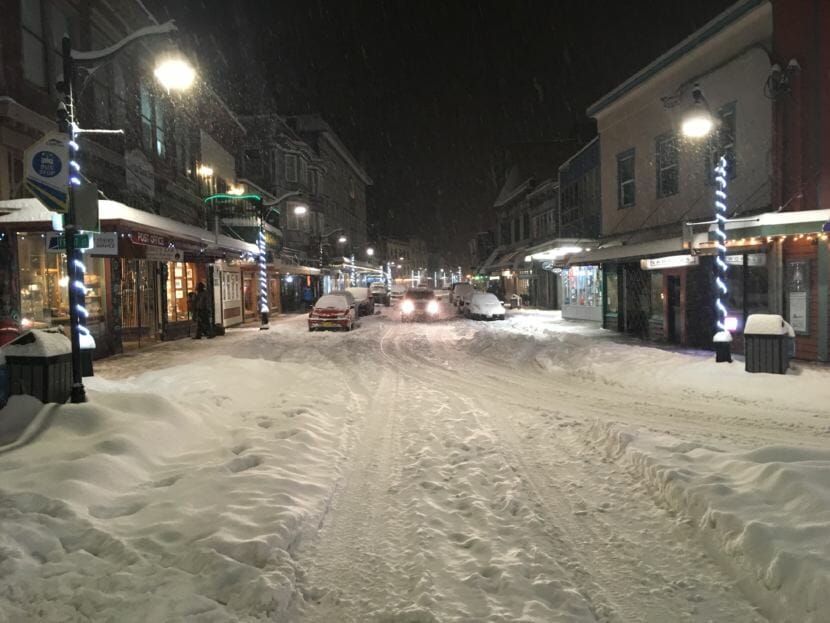
Snow continues in Juneau, weekend outlook uncertain

Snow clogs the streets of downtown Juneau during a snowstorm on Jan. 10, 2019.
Snow clogs the streets of downtown Juneau during a snowstorm on Jan. 10, 2019. (Photo by Ryan Cunningham/KTOO)

School was canceled for the first time in more than seven years Friday as snow continued to fall on the Juneau area.

Snowfall totals as of 9 a.m. were 10.9 inches at the airport, 13 inches in Auke Bay and 14.5 inches in West Juneau, according to National Weather Service forecaster Jake Byrd.

Snow is expected to continue until later Friday afternoon, although it may turn to rain in some places.

A Winter Weather Warning remains in effect until 4 p.m. Byrd said a developing band offshore could bring several more inches of snow.

“We could see just maybe two more inches, but if that bands ends up going directly into Juneau, I wouldn’t be surprised if we saw maybe even another 5 inches,” Byrd said.

He said there is also potential for the snow to turn into rain Saturday. If that does happen, it probably won’t have too much of a melting effect.

“If we do stay cold like we are right now and the wind doesn’t pick up, we’re probably going to see more snow tomorrow,” Byrd said.

While this much snow isn’t unusual for the area, Byrd said the last comparable storm occurred in March 2017 when 16.9 inches were recorded in 24 hours at the Weather Service office.

The 9.7 inches of snow that fell at the airport Thursday broke the single same-day accumulation record of 6.1 inches, set on Jan. 10, 2009.

KTOO’s Matt Miller contributed to this report. 

Site notifications
Update notification options
Subscribe to notifications