In this 2015 photo, Gastineau Humane Society Director of Animal Control and Protection Ben Peyerk pets a cat named Gouda. The animal shelter announced this week it will change its name to Juneau Animal Rescue. (Photo by Elizabeth Jenkins/KTOO)
As of Tuesday, Gastineau Humane Society has changed its name to Juneau Animal Rescue.
This year marks 56 years for the organization. They’re also getting a new logo. Director Samantha Blankenship said the change was prompted by a desire to make more people aware of their role in the community.
“We’re trying to look forward into our next 60 years of service, so we’re looking to develop new supporters as well as embracing our longtime supporters,” Blankenship said. “We wanted an identity that was more closely aligned with our city and our mission of promoting animal welfare and the prevention of animal cruelty and suffering.”
She said they also receive several calls a week from people looking for Gastineau Human Services, a nonprofit that provides transitional housing and support to formerly incarcerated and homeless individuals.
In addition to pet adoption, Juneau Animal Rescue provides services like doggy daycare, grooming and animal vaccinations. The City and Borough of Juneau contracts the organization to provide animal control and protection.
But Blankenship said most of the organization’s funding comes from donations.
“With the old name of Gastineau Humane Society, a lot of people were under the misconception that we did get funding from larger humane societies, and that’s not true. We’re a private, nonprofit entity and we’re not affiliated with any larger organization,” she said.
Blankenship said the shelter adopted out 343 animals last year. She said in recent years they’ve seen more owners giving up their pets. They’re not sure why, but they hope to keep expanding services in the coming years.
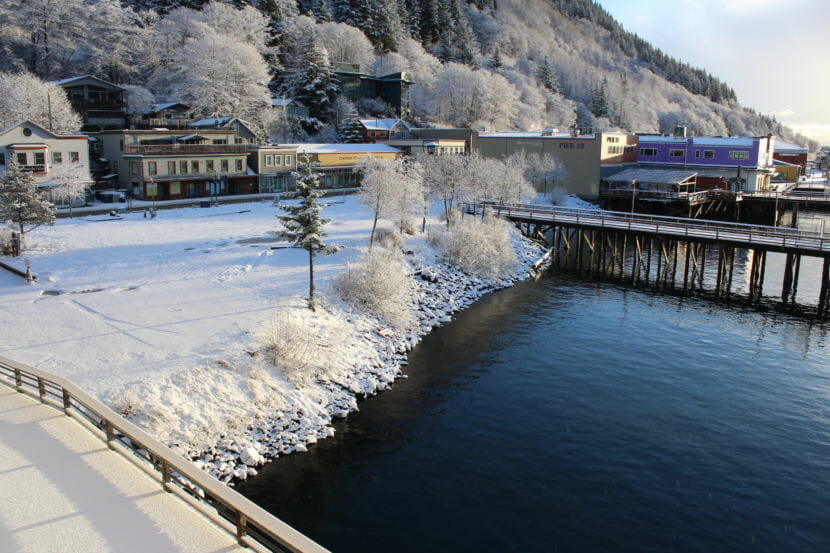
The Archipelago Lot sits between the downtown library and Pier 49 on South Franklin Street. The proposed land exchange would see the tidelands decked over to create a pedestrian plaza and bus staging area. (Photo by Adelyn Baxter/KTOO)
The city hopes a proposed land exchange with the owner of a waterfront property on South Franklin Street will help mitigate the impact of continued growth in the number of cruise ship passengers visiting Juneau each year.
But a recent ruling in the lawsuit brought by the cruise ship industry may complicate how the city pays for the project.
According to City Manager Rorie Watt, the costs are big for waterfront development in Juneau.
“That’s what it would cost to provide these services, that we would not do but for the need to serve those ships and their growing footprint,” Watt explained at a committee meeting in November.
Juneau expects 1.3 million cruise ship passengers to visit in 2019 — that’s about 1,500 more passengers per day compared to this past year.
“In terms of elbow room, for that number of people, you need a lot of space,” Watt said at the meeting.
That’s why a public-private partnership between the city and former Juneau Empire owner Morris Communications is being billed as an opportunity to address summertime crowding along the cruise ship docks.
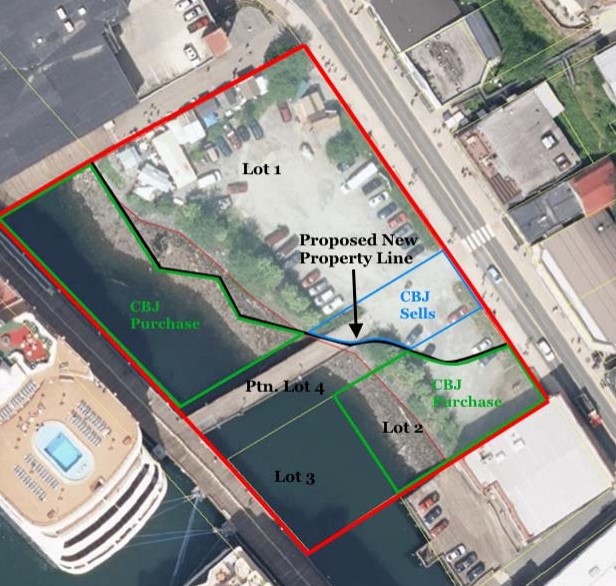
Morris owns the vacant lot known as the Archipelago Lot used by seasonal food stands next to the downtown library. The proposed deal would see the city buy the tidelands between the lot and the Seawalk and a parcel just south next door to Pier 49.
In return, Morris would get a section of city property along South Franklin Street.
This visual concept of the Archipelago Lot shows the proposed new subdivision line and properties to be sold and purchased by Morris Communications and CBJ. (Image courtesy of the City and Borough of Juneau)
The city wants to deck over the tidelands to create more space for pedestrian traffic and bus staging. Estimates put the total cost at $23 million with a two-year construction period.
Allen Grinalds, Morris’ real estate director, said the company could have decided to develop its lot independently but wanted to explore a partnership because of the potential benefits to both parties.
“I think the idea, though, is through cooperation and communication between the two developments, we can do something that’s really impactful,” Grinalds said.
Morris plans to build a mix of retail, food and beverage options on their lot with an open concept to allow foot traffic to flow easily from the street to the Seawalk. They will put off construction on the lot for a full year while the city builds its deck.
But before the city can move forward, it has to figure out where the funding for the project will come from. The plan has been to use a combination of local funds and tax revenue collected from cruise ships and passengers.
Watt said the ruling was relatively clear, but now the city needs to figure out exactly how to apply the ruling in a way that allows them to to continue providing needed services for tourists.
“In my mind, it’s a bit of a mechanical problem: How do we fund these services that everybody needs?” Watt said this week. “Nobody’s saying, ‘Don’t do these things that have made us a successful port that we are.’”
Another part of the proposed deal includes an optional “right to object” clause. That would give Morris the ability to block any addition on the city’s portion of the land that directly competes with their businesses.
In exchange, the city would pay almost $200,000 less for the land.
Grinalds said Morris just wants to protect their business interests.
“The takeaway from that is simply that, anything that’s going to be good for the city is probably good for the development, and we’ll probably be the biggest cheerleader for that,” Grinalds said.
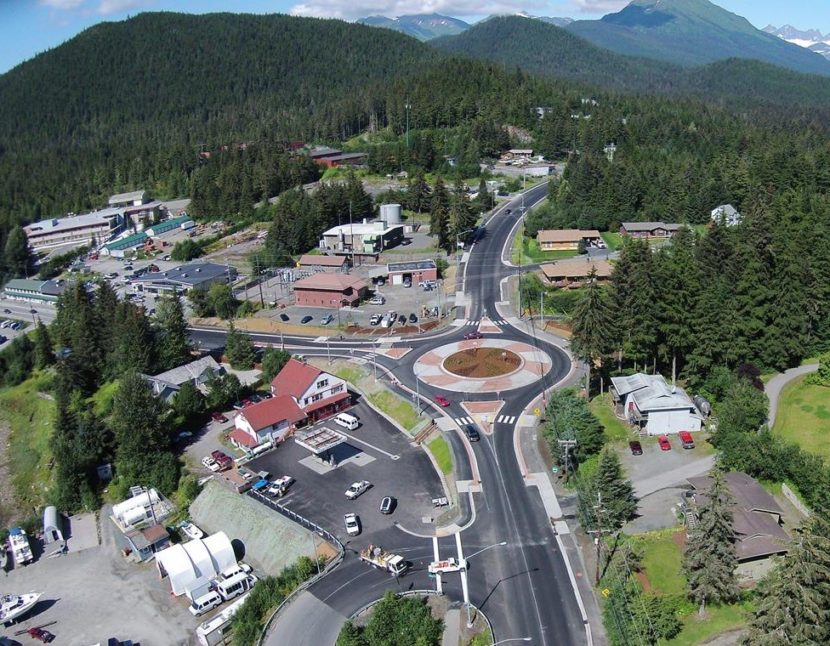
The Auke Bay roundabout. (Photo courtesy Alaska DOTPF/Miller Construction)
The city has been working with a steering committee to figure out how to turn the quiet neighborhood overlooking Statter Harbor into a pedestrian-friendly hub for recreation and business.
Last week, the city invited residents and business owners to weigh in on new zoning districts meant to help realize that vision. The City and Borough of Juneau has been working on a development plan for Auke Bay for several years, but many neighbors have reservations about the current proposal.
Right now, Auke Bay’s town center basically consists of private homes, an elementary school, a harbor and a mixed-use building with restaurants and retail shops. There are at least five different types of zoning districts at play here.
“Our hope is to create some cohesion in this Auke Bay center where there currently seems to be a little bit of a hodgepodge of zoning,” said Allison Eddins, who works for CBJ’s Community Development Department and is a lead planner on the project.
On a map of Auke Bay’s main commercial area, she pointed out two lots right in the center where residential complexes have been proposed.
Construction is already underway on the Auke Bay Station condos, where up to 50 condos are planned. The second complex is still in the proposal stage and would be smaller, with about 32 units.
“Development’s coming to Auke Bay, whether we have a new zoning district and an overlay district or not,” Eddins said.
Many residents at last week’s meeting voiced concerns over how new zoning rules would affect views of the bay.
Pat Kemp, one of the partners behind Auke Bay Station, echoed those concerns.
“Currently, the zoning requirements allow buildings taller than ours to be built which would block our view, and one of the assets of living in Auke Bay is viewing the harbor and the boats and so forth,” Kemp said.
The Auke Bay Area Plan specifically highlights protecting views as one of the ways to promote growth in the area.
Other recommendations in the plan include rear parking and encouraging multi-story buildings with commercial and office space below and residential above.
It’s also one of the reasons why the committee is proposing creating two new zoning districts in Auke Bay.
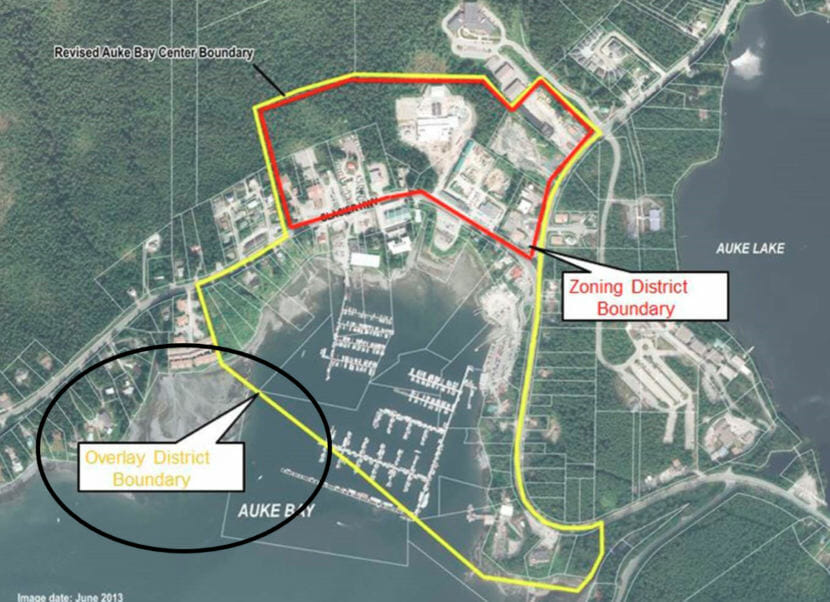
The proposed zoning districts for Auke Bay, as presented at a community meeting on Dec. 6, 2018. (Image courtesy of the City and Borough of Juneau)
Eddins said the two new districts are meant to encourage the development of a compact, mixed-use neighborhood and incentivize design standards for buildings.
But some residents felt the proposals ask too much of property owners.
“There’s always room for improvement, don’t get me wrong. But requiring somebody to do something with their property the way that they are doing is kind of an overreach,” said Sean Goertzen, an Auke Bay resident.
He said he’s been following the committee’s work on the area plan. He doesn’t live in the town center that would be most affected by the proposals, but he’s still concerned. And he’s not alone.
“A lot of the residents around there really don’t want this to happen,” Goertzen said. “I think it’s a very difficult plan to implement, especially with all the existing buildings that are already there.”
Goertzen’s main issue is mixing residential with high-density commercial zoning. He worries it may lead to more crime in the area.
Other residents like Karla Allwine are more optimistic. She said she’d love to see Auke Bay look more like towns along the Oregon coast and thinks the proposals are a step in that direction.
Still, parking remains a concern. Allwine suggests the city set aside land for public parking.
“They’re going to experience an increased tax base from all of this … and a park-and-ride in that area would do a lot to offset the parking issues downtown,” Allwine said.
Eddins is quick to remind residents that this is just an initial step in a long-term planning process. There will be more opportunity for public input.
At the earliest, the proposal may come before the Planning Commission by late spring.
The Auke Bay Implementation Committee meets again Dec. 20 to discuss the proposed zoning plan.
David Glenn Waits. (Photo courtesy of Juneau Police Department)
Update (Dec. 7, 2:30 p.m.) — Adelyn Baxter, KTOO
In an updated release, the Juneau Police Department identified the suspect in Thursday’s robbery as Juneau resident David Glenn Waits, 54.
Police say Waits allegedly presented a Wells Fargo teller with a note demanding $50 and $100 bills. He appeared intoxicated and became more agitated as he continued to demand the money.
The employees gave Waits one $100 bill after growing concerned he might harm someone, and he left the building. When police searched him later, the bill was not found.
Waits was taken to Lemon Creek Correctional Center on one felony count of coercion.
Original story
Juneau police detained one person after an attempted bank robbery at the downtown Juneau Wells Fargo Thursday afternoon.
According to a Juneau Police Department release, Wells Fargo employees contacted police around 2:40 p.m. to report that a person came into the bank and passed a note to a teller demanding money. He became more aggressive when the teller did not immediately comply, but did not directly threaten anyone at the bank.
Police say there were no reports that the man was armed. He left the building with an undisclosed amount of money. The release says when officers responded, bank staff gave them the note he used and described a suspect about five feet tall “with a medium build, shaggy ear length hair, wearing a black coat with a blue fleece jacket.”
An officer located a person matching the suspect’s description in the Downtown Transit Center and detained them for questioning, according to the release.
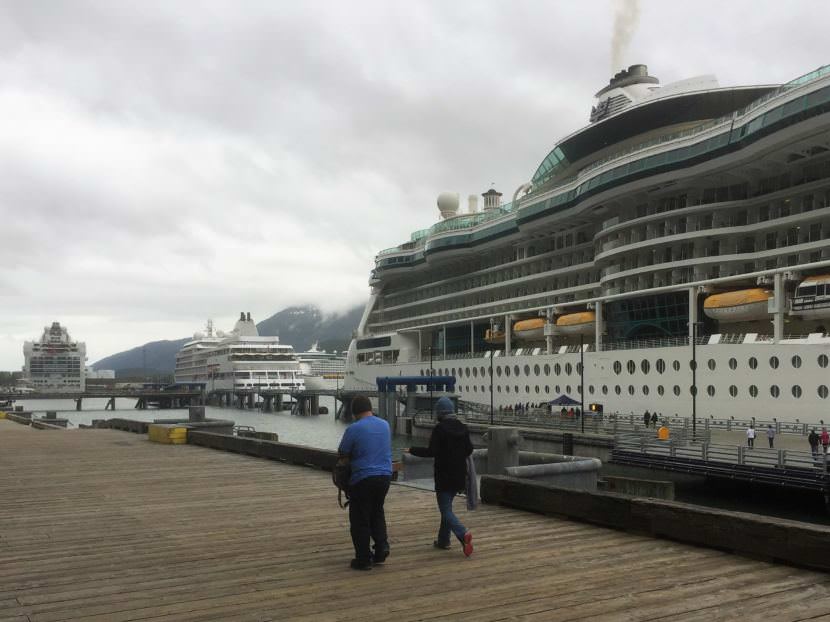
Passengers walk a downtown Juneau dock where three cruise ships are tied up in June 2017. (Photo by Ed Schoenfeld/CoastAlaska News)
Locals with ideas for how the city should spend marine passenger fees have until Jan. 2 to submit proposals.
The $5-per-passenger head tax has been around since 1999, when Juneau voters passed a proposition meant to offset the cruise industry’s impact on local resources.
Proceeds have funded things like seasonal crossing guards, better signs and public facilities near the cruise docks.
City Manager Rorie Watt said the city looks forward to getting more clarity on the matter.
“The litigation really is around whether it can only be a service to the vessel or fees can be used to provide a service to vessels and passengers,” Watt said. “And kind of embedded in there is (the) distance from the ship and how reasonable it is for us to provide services to cruise ship passengers from the ship.”
The outcome of the lawsuit could endanger millions in annual revenue from the marine passenger fee and the $3 port development fee passengers also pay.
About 1.3 million cruise ship passengers are expected in Juneau next year. The city estimates they’ll generate about $6 million in marine passenger fees.
Watt said he’s not sure when the judge’s ruling will come.
“We had oral arguments in the middle of September, and he advised us that it would be a while and that the case was complicated. So we’re just waiting patiently,” Watt said.
Project proposals can be submitted to the city manager’s office. Watt will compile a list by Jan. 15, and the public will have 30 days to comment.
The Assembly Finance Committee will review all comments and proposals before forwarding the recommendations to the Assembly for consideration as they work on the next year’s budget.
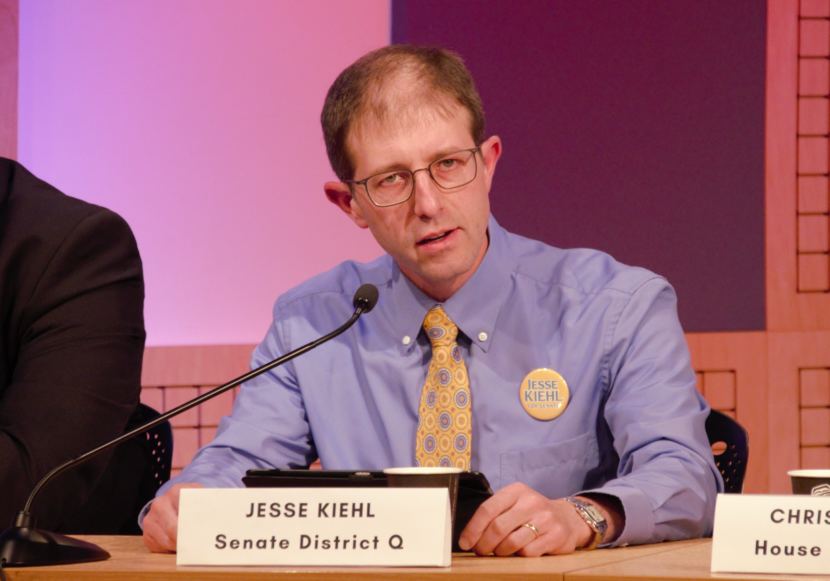
Democratic Senate District Q candidate Jesse Kiehl answers a question during a League of Women Voters of Juneau candidate forum for Juneau-area legislative candidates @360 on Oct. 9, 2018. (Photo by Jeremy Hsieh/KTOO)
The Juneau Assembly is now accepting applications for a short-term replacement for Assembly member Jesse Kiehl’s soon-to-be-vacant District 1 seat.
Kiehl won the November election to replace retiring state Sen. Dennis Egan in the Alaska Senate. That means he will resign his seat on the Assembly before taking office in January.
Kiehl was re-elected to a third three-year term last year. Whoever is chosen to replace him will serve until next October’s municipal election, when the seat will be placed on the ballot. The winner of that race will then finish out the final year of Kiehl’s term.
Residents interested in applying for Kiehl’s Assembly seat must live in District 1 — that means downtown Juneau, Douglas, North Douglas, Lemon Creek or the area around the airport.
Areawide Assembly candidate Kate Troll watches 2013 municipal election results come in at Juneau’s Election Central. (Photo by Casey Kelly/KTOO)
The city began accepting letters of interest and declaration of candidacy forms Friday. Applicants have until Wednesday, Jan. 2 to submit their forms. After that, public interviews will be conducted by the Assembly Human Resources Committee, chaired by Rob Edwardson.
Edwardson said the first public interview will take place Thursday, Jan. 10.
The Assembly will vote on the committee’s recommendation.
According to the city clerk’s office, they have received one application so far from Kate Troll. Troll served one term as the areawide Assembly member from 2013 to 2016. She was defeated by former Assembly member Norton Gregory when she ran for re-election in 2016.