Alaska Beacon is part of States Newsroom, a network of news bureaus supported by grants and a coalition of donors as a 501c(3) public charity. Alaska Beacon maintains editorial independence. Contact Editor Claire Stremple for questions: info@alaskabeacon.com. Follow Alaska Beacon on Facebook, Bluesky and Twitter.

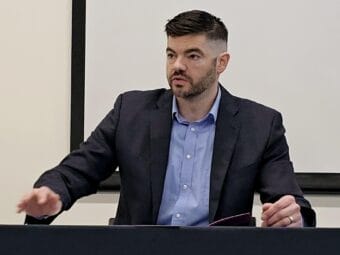
Former U.S. District Court Judge Joshua Kindred speaks at his Dec. 4, 2019, Senate Judiciary Committee confirmation hearing in Washington, D.C. (U.S. Senate Judiciary Committee video screenshot)
The Alaska Bar Association’s board of governors is considering whether to recommend the disbarment of former federal judge Joshua Kindred and will vote on the issue next month.
Kindred, appointed by President Donald Trump to the U.S. District Court of Alaska, resigned in 2024 after investigators found that he had a “sexualized relationship” with a clerk who became a prosecutor and lied about it to a senior judge and investigators, and maintained a hostile workplace for law clerks.
Kindred’s Alaska law license is listed as “inactive” in the ABA database; disbarring him would mean that he is unable to practice law in the state.
A final decision on disbarment would come from the Alaska Supreme Court, which makes the final decisions on attorney discipline in the state, said Annette Blair, legal secretary of the discipline section for the bar association.
No current or former federal judge has ever been disbarred in Alaska.
According to documents made available ahead of the bar association’s August meeting, someone filed a complaint against Kindred in January, requesting a discipline hearing.
Kindred did not attend that hearing, which took place in June.
“Based on the uncontested facts, the (area hearing) committee agrees with, and adopts, the legal analysis set out in the petition as well as in the memorandum that disbarment is the appropriate sanction for Mr. Kindred’s misconduct,” the hearing report states.
In a footnote, the committee recommended that Kindred be given a path to restoring his law license after at least five years of disbarment.
“We enter our decision not with any joy. It is our collective hope Mr. Kindred can recover emotionally, financially and physically notwithstanding the hardships Mr. Kindred confronts,” a footnote states.
The bar association’s board of governors is scheduled to meet Aug. 21 by Zoom, with the vote on action against Kindred expected in the afternoon.
If the board approves disbarment, that recommendation will be sent to the Alaska Supreme Court for final action, to be taken at an as-yet-unscheduled date.
Sen. Forrest Dunbar, D-Anchorage, speaks in favor of Senate Bill 39, the payday loans bill, on Tuesday, April 15, 2025. (Photo by James Brooks/Alaska Beacon)
Anchorage Democratic Sen. Forrest Dunbar will be able to attend the Aug. 2 special session of the Alaska Legislature, he said late Tuesday in a post on Facebook.
Dunbar, a member of the National Guard, is deployed to Poland on active-duty service but received a federal waiver that will allow him to return to Alaska for legislative work.
Dunbar’s attendance is critical for lawmakers who hope to override Gov. Mike Dunleavy’s decision to veto millions of dollars in public school funding from this year’s state operating budget. Despite his attendance, the outcome remains uncertain, and Dunleavy has the option of canceling the session.
That formula is subject to the state’s annual budget process, and Dunleavy chose to only partially fund it, causing a wave of cuts to services at public schools across the state. Dunleavy had said he would not agree to the full funding increase without the Legislature adopting other policies he’s proposed.
Many legislators hoped to override that second veto in January, when the regular legislative session reconvenes, but Dunleavy called a special session for Aug. 2, forcing an early vote.
Writing on Facebook, Dunbar noted that he had previously requested to be excused from the Legislature during his National Guard service, “however, the Legislature obviously does not control the actions of the governor.”
Dunbar said he began seeking a formal waiver that would allow him to use his personal leave, pay for his own plane ticket, and return to the state for the special session.
“I am pleased to report that the commanding general to whom our unit now reports has indeed granted that request,” Dunbar wrote. “I plan to return to Alaska for the start of the special session, and I will be voting yes to override, so that our students have the funds they need to avoid catastrophic cuts to their schools.”
For weeks, it hadn’t been clear whether Dunbar would be able to obtain the rare dispensation needed to return to Alaska.
“In general, a service member on federal Title 10 mobilization orders is required to complete the full term of their deployment,” said Dana Rosso, a spokesperson for the Alaska National Guard, by email. “Any early release or temporary return would require approval through Department of Defense and U.S. Army channels and is only considered under exceptional circumstances — such as serious medical or family emergencies — while taking mission requirements and federal law into account.”
Rosso said there was no way for a state official — such as the governor or adjutant general — to issue the waiver.
“Any early release or temporary return would require approval through Department of Defense channels, typically at the Secretary of the Army or Secretary of Defense level,” he said. “These waivers are rare and only considered under extraordinary circumstances, such as serious medical issues, family emergencies, or extreme humanitarian situations.”
Dunbar’s chief of staff, Arielle Wiggin, said by email that it wasn’t clear until recently whether the commanding general of the U.S. Army’s V Corps — Lt. Gen. Charles Costanza — would grant the waiver.
Even with Dunbar’s attendance, it isn’t clear whether the governor’s budget veto will be overridden or sustained.
In a closed-door meeting shortly after issuing a proclamation that called the session, Dunleavy asked members of the House’s Republican minority caucus to stay away from the first five days of the special session, the period when the Alaska Constitution requires any override vote to take place.
The date of the special session also coincides with the National Conference of State Legislatures, which several lawmakers were expected to attend.
Other legislators were scheduled to work or attend family events during the period.
Since the governor’s announcement, many have said they will be canceling their plans in order to attend the special session. Sen. James Kaufman, R-Anchorage, will return from a trip to Vietnam, he said, and vote in favor of the override.
Some Republicans aligned with Dunleavy on the issue, including Reps. Jamie Allard, R-Eagle River, and Kevin McCabe, R-Big Lake, have said they will follow his wishes and stay away.
Of the 46 legislators who voted this spring to override the governor’s veto of the education funding formula, all but a handful have committed to supporting a budget veto override as well.
Rep. Dan Saddler, R-Eagle River, said he will attend the special session but declined to say how he would vote on the budget issue. House Minority Leader Mia Costello, R-Anchorage, said she has not made up her mind.
Republican Reps. Julie Coulombe and David Nelson of Anchorage, and Bill Elam of Nikiski, could not be reached by phone on Wednesday.
The governor’s legislative director is keeping close track of the number of potential “yes” and “no” votes for a veto override, and it is possible that the governor could cancel the special session.
After Dunbar’s announcement, Alaska Democratic Party chair Eric Croft issued a statement calling the timing of the Dunleavy-called special session “one of Dunleavy’s many dirty tricks.”
“There is nothing Dunleavy won’t try to further his anti-education political agenda, including taking advantage of a legislator’s active commitment to the military. We’re grateful for Senator Dunbar’s service to our country’s security and Alaska. If not for his dedication to his constituency, we may have seen our persistent efforts to fund education fail yet again,” Croft said.
Asked about Croft’s comments, Dunleavy spokesperson Jeff Turner reiterated a statement that Dunleavy made on July 2, when he declared that the special session would be devoted to education reform and an executive order creating the new Alaska Department of Agriculture.
“Enacting a few necessary reforms to our public education system can elevate those children struggling in Alaska’s school system,” Dunleavy said at the time. “As elected officials we must do all we can to put the next generation on the path to a successful and prosperous future, and that starts with a solid public education.”
A copy of the Alaska Constitution is seen on Thursday, July 28, 2022. (Photo by James Brooks/Alaska Beacon)
Former state Rep. David Eastman has won his lawsuit against Gov. Mike Dunleavy and the state of Alaska, successfully challenging the governor’s decision to allow a bill to become law last year.
In the suit, Eastman — a Republican from Wasilla — challenged the constitutionality of Senate Bill 189, citing a clause of the Alaska Constitution that requires lawmakers to limit bills to a single subject.
In the final hours of the 2024 legislative session, lawmakers combined several other bills into SB 189. Dunleavy and the executive branch had no role in the crafting of the bill, but because the governor allowed the bill to become law without his signature, the suit named him as a defendant.
On Tuesday, Juneau Superior Court Judge Larry Woolford signed an order declaring that the bill “was passed by the 33rd Alaska Legislature in violation of Article II, Section 13 of the Alaska Constitution and is therefore void.”
Woolford’s order also awards Eastman $20,250 in costs and attorney fees. Eastman was represented in the suit by attorney Joe Geldhof.
The legal victory has limited immediate impact because lawmakers this year re-passed all the bills that were combined into Senate Bill 189. Woolford’s order “does not address and has no effect on subsequent legislation repealing and reenacting the provisions of SB 189.”
Its biggest impact may be to constrain current and future legislators, preventing them from repeating the kinds of legislative logrolling that have become commonplace in the final days of each two-year legislative cycle.
Because bills die at the end of the legislative cycle and few bills pass both House and Senate, it has become common for lawmakers to make last-hours amendments that combine bills in an effort to speed them across the legislative finish line.
“We are pleased to have resolved the Eastman v. Dunleavy case, which challenged a bill on the grounds of violating the single subject rule,” Attorney General Treg Taylor said by email on Tuesday.
“Following the filing of the lawsuit, the Department of Law sought to provide the Legislature with an opportunity to rectify this by breaking the bill into separate pieces of legislation. Fortunately, the Legislature successfully completed their work prior to the conclusion of the case, avoiding confusion on the laws enacted,” Taylor said.
Fishing boats line the docks in Kodiak’s St. Paul Harbor on Oct. 2, 2022. (Photo by Yereth Rosen/Alaska Beacon)
Gov. Mike Dunleavy has canceled a broadly supported bill proposed by a legislative task force and intended to help commercial fishers in Alaska.
The governor issued his veto of Senate Bill 156 on Wednesday, marking his seventh veto of a policy bill this year.
Legislators will have an opportunity to call for an override vote on most of those vetoes when they meet Aug. 2 for a special legislative session.
SB 156, which was inspired by policies drafted by a joint House-Senate task force intended to evaluate the state’s commercial fishing industry, would transfer $3.69 million from a defunct state loan fund to the state-owned Alaska Commercial Fishing and Agriculture Bank, which provides loans to fishers.
In his veto message, the governor said that “in a year of limited revenues and competing needs, committing scarce public dollars to subsidize a private lender is not prudent. Until long-term fiscal policy is put into place, the state must preserve its limited resources.”
Sen. Jesse Kiehl, D-Juneau, was the lead sponsor of SB 156.
In posts on social media, Kiehl called the veto “a weird move” because the bill was based on work he did with the governor, it passed through the Capitol by a combined 59-1 vote, and he said the governor’s office declined meetings to discuss it after the Legislature passed the bill.
Nesbett Courthouse in downtown Anchorage on Oct. 7, 2024. (Yereth Rosen/Alaska Beacon)
A group that advocates in favor of Alaska’s nonpartisan judicial system has filed a lawsuit against Gov. Mike Dunleavy, alleging that he illegally appointed a member to the board that nominates candidates for the state’s judicial vacancies.
The suit, filed Wednesday in Anchorage Superior Court by Alaskans for Fair Courts, claims Dunleavy violated the constitution and state law when he picked John W. Wood — also named as a defendant — for a public seat on the Alaska Judicial Council.
Under the state constitution, the council consists of three non-attorneys picked by the governor and three attorneys selected by the Alaska Bar Association. In addition, whoever holds the office of chief justice of the Alaska Supreme Court sits as the council’s chair.
The council accepts applications for judicial vacancies, vets those applicants for merit using nonpartisan metrics, then submits a list of nominees to the governor for final selection.
Wood was picked for a non-attorney seat on the board but is a former attorney, making him ineligible to serve, the suit alleges. In addition, the suit says Wood is ineligible because he held a “position of profit” with the state when appointed in May.
State records show Wood has served as a state contractor, receiving more than $132,000 this year. The most recent payment is listed as June 6.
Alaskans for Fair Courts also claims that Wood is ineligible because he has not been confirmed by the Legislature.
Wood was appointed during this year’s legislative session, but after lawmakers had voted on confirmations for the year, the suit claims, meaning that Wood’s appointment should not be considered a recess appointment subject to confirmation next year.
“If the governor were to appoint a (judge) nominee selected by a judicial council that is not properly constituted … the resulting legal deficiency … could subject actions taken by the new judge to challenge by litigants,” the suit claims.
It asks that the Anchorage Superior Court issue an order declaring that Wood is ineligible, and that his appointment is void.
In a written statement, Attorney General Treg Taylor said the state hasn’t yet been served with the lawsuit and can’t comment on the merits.
About the timing issue, Taylor said, “The Governor has the ability to appoint three members to the Judicial Council, and the Alaska Bar Association appoints the other three members to provide a 50/50 balance on the Council. The Council then nominates judges for the Governor’s selection with any ties on the Council being broken by the Chief Justice. It is important that the Council have this balanced perspective as it moves forward with its work. Having to wait almost a full year before seating a Governor’s appointee, as the Alaskans for Fair Courts argues, upsets that balance and doesn’t seem so fair.”
Dunleavy has seemingly violated the state constitution’s judicial nomination process before.
In 2019, he failed to appoint a judge under the timeline required by the constitution, which was part of the basis of a failed attempt to recall him from office. In 2021, he called for the council to add a nominee in addition to the three it had forwarded to him for a seat on the Supreme Court. The constitution does not allow governors to appoint someone from outside of the council’s list of nominees. He ultimately did by the constitutional deadline in that instance.
The 30 students entering the WWAMI program this year pose for a group photo during orientation at the University of Alaska Anchorage campus. The 30 students represent the biggest cohort in Alaska’s WWAMI program, which enables prospective physicians to start their medical educations at UAA and complete their degrees at the University of Washington School of Medicine in Seattle. New Alaska WWAMI classes begin their programs in July of each year. (Photo provided by the University of Washington)
A record 30 students have started their medical education this month in a special multistate collaborative program, the University of Alaska Anchorage and University of Washington announced.
The 30 students this month entered the WWAMI program, named after the first letters of the states that participate through universities: Washington, Wyoming, Alaska, Montana and Idaho. The program allows students to begin their medical education at universities in their home states — at UAA, in the case of Alaska — and complete their work toward medical degrees at the University of Washington School of Medicine in Seattle.
The WWAMI program offers Alaska’s only in-state education toward a medical degree. There is no medical school in Alaska. Students in the program typically spend their first 18 months taking classes and doing training work at UAA before moving onto studies at University of Washington. There are other options, including an option to complete the entire program in Alaska.
The milestone of 30 Alaska students starting their WWAMI education marks a turnaround in fortunes for the program.
In 2019, Gov. Mike Dunleavy proposed entirely eliminating state funding for the Alaska portion of the WWAMI partnership. At the time, he characterized WWAMI as a waste of state money.
Three years later, Dunleavy took the opposite position. He proposed expanding WWAMI funding so that the program could expand from 20 students from each cohort year, which was the enrollment at the time, to 30 per cohort year.
The Legislature in 2023 approved a funding increase that allowed 25 students to start the WWAMI program last year and 30 this year.
The WWAMI program’s history dates back to 1971, when nine students enrolled in preliminary courses at the University of Alaska Fairbanks arranged in partnership with the University of Washington. They then completed their education in Seattle. Montana and Idaho entered the program in 1972, and Wyoming entered it in 1996, according to a history compiled by UAA. Alaska WWAMI relocated from UAF to UAA in 1989.
This article has been updated to include that there is an option to complete the program inside Alaska.
Close
Update notification options
Subscribe to notifications
Subscribe
Get notifications about news related to the topics you care about. You can unsubscribe anytime.