Annie Bartholomew, KTOO

Health care ordeal inspires Playboy Spaceman’s latest releases

Juneau songwriter George Kuhar performs with Playboy Spaceman at the Rockwell Ballroom on July 9, 2016. The band was playing at its album release party for "And His Father." (Photo by Annie Bartholomew/KTOO)
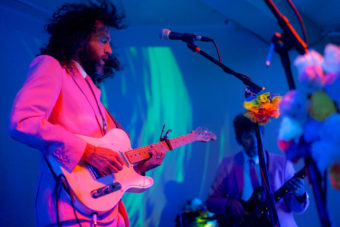
Juneau songwriter George Kuhar performs with Playboy Spaceman at the Rockwell Ballroom on July 9, 2016. The band was playing at its album release party for “And His Father.” (Photo by Annie Bartholomew/KTOO)

Kidney failure, Obamacare, and sounds of hospital rooms all inspired Playboy Spaceman’s latest releases.

Playboy Spaceman’s latest recordings veer away from the guitar solos of their past, entering the ethereal. The song “Get Me Out of Here” teases with electronics reminiscent of medical devices. Songwriter and front man George Kuhar’s vocals are hazy and echo, grounded only by gritty drum machine fills.

He says song was recorded while  visiting a kidney specialist last year.

“It was a solo journey and I had some health concerns. I spent a few days in Seattle doing some blood work, tests and things.”

The lyrics came to him throughout the day. That night, he finished it from his Travelodge hotel room where he laid the electronic beats and vocals that would become its framework.

The song closes out their new EP, which complements Playboy Spaceman’s second full-length album that went live for download last week. Kuhar named the album “And His Father,” in honor of dad who passed away unexpectedly this spring.

The album was recorded at Peabody’s Monster, a South Franklin cooperative music space, where many of Juneau’s rock musicians can be heard practicing at night.

“It definitely has the feeling of a place where a lot of music has been played,” says Kuhar. “There’s cigarette stains in the carpet, posters all over the place and other profanities. ”

Band members Bridget Kuhar, Jason Messing, Nick Wagner and Simon Taylor all took a week off to record in their rehearsal space. But Kuhar says, the vocals just sounded wrong, “I wanted to be like a samurai and be like, swoosh swoosh — you know and done, let’s put it out there. I had to learn how to sing all over again.”

Keyboard player Bridget Kuhar donated a kidney to her now husband George Kuhar who she collaborates with in the band Playboy Spaceman. (Photo by Annie Bartholomew/KTOO)

Kuhar’s experiences with the health care industry are a central theme on the album and inform his songwriting. In 2008 he received a kidney transplant from his now wife and collaborator Bridget, who plays keyboards in the band. Because of the Affordable Care Act, Kuhar was able to treat his pre-existing conditions, allowing him to take time off from his job at the hospital to finish the album.

He says he was inspired by the human perseverance he observed working in surgical services at Bartlett Regional Hospital, patients making hard decisions to overcome their medical issues, and how things become complicated with the business of medicine.

“I have a lot of frustration with the way money plays into health care. Profiting off someone’s ailment,” says Kuhar. “That part’s hard to swallow. And how we do we make that right? I don’t know.”

For now, Playboy Spaceman is taking their music north. They’re playing at the 49th State Brewing Co.’s locations in Anchorage on Friday and Healy on Saturday.

Slideshow: Juneau gathers to grieve Orlando mass shooting

More than 150 people gathered in Marine Park Monday afternoon for a vigil service for those affected by the mass shooting at an Orlando gay nightclub. The event was  hosted by the Southeast Alaska Gay and Lesbian Alliance (SEAGLA) and led by Pride Commitee members Jenny Jahn, James Hoagland and Aldersgate United Methodist Church pastor Susan Boegli.

Names of confirmed victims from the Pulse Orlando nightclub shooting were read aloud followed by bell chimes. The ceremony ended in prayer with candle lighting and song.
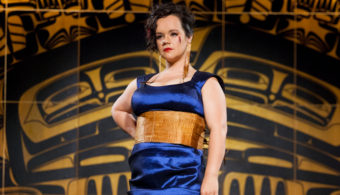
 

Slideshow: Native fashion takes the runway at Celebration 2016

Celebration’s first Native Fashion Show was standing room only in the Walter Soboleff Center clan house. Eighteen Alaska Native designers contributed 40 different ensembles, including clothing, jewelry, accessories and body art.

Looks included traditional wear, nouveau fashion, skin sewing and body designs featuring the painting of Tlingit Athabascan artist Crystal Worl. There was also special recognition category honoring Haida designer Dorothy Grant whose tuxedo was worn by The Revenant actor Duane E. Howard at the Oscars in February.

The event was emceed by Lance Xh’unei Twitchell and the soundtrack was provided by Celeste Worl. Hair and makeup was by Brendan Sullivan and Heather Sincic with lighting by Nimmy Philips.

Click on any photo to view the full slideshow.

High fashion, ‘Indigenized’ at Celebration

Lily Hope and Deanne Lampe attach silver cones to Chilkat fringe for their piece in the Sealaska Heritage Institute Native Fashion Show. (Photo by Annie Bartholomew/KTOO)

At a kitchen table in a Douglas home, Lily Hope arranges buttons into a basketry pattern on a silky blue dress. Her auntie Deanna Lampe cuts fibers of cedar and wool spun together. They’re two of the 17 Alaska Native artists whose pieces willl be showcased at a Sealaska Heritage Institute‘s Native Fashion Show Friday, a first for Celebration.

Designer Lily Hope creates a wave basketry design in buttons on a silky blue dress for Celebration's Native Fashion Show. (Photo by Annie Bartholomew/KTOO)
Designer Lily Hope creates a wave basketry design in buttons on a silky blue dress for Celebration’s Native Fashion Show. (Photo by Annie Bartholomew/KTOO)

“We’ve always been sewers,” said Lampe.

“Beadmakers and earring makers,” said Hope. “I think I’ve been sewing buttons since I was 9. That’s the hazard of having a family that makes art.” 

The duo is busy crafting three ensembles for Celebration’s first Native Fashion Show. The looks range from business casual to show-stopping red carpet glamour — all  incorporating elements of traditional regalia including formline, Chilkat weaving and beadwork.

But as mall retailers adopt Native designs, the cultures that created them  haven’t been treated with respect. From clothing chains like Urban Outfitters using the Navajo name and patterns without permission, to the rise of costume headdresses at music festivals. Hope said the misuse of and appropriation of Native design is one reason they’re participating in the fashion show.

“I would say that’s part of the motivation for making these pieces, is to create an authentic fashion show from indigenous peoples using indigenous designs and materials,” Hope said. “To say, ‘Hey this is how you’re supposed to do it. This is the honorable way to do it.’ And do it right and make it pop, and make them go, ‘Oh, I want that.'”

“And the way they’re doing it, they’re not really respecting the tribe or the culture,” Lampe said. “They’re just remaking something they’ve seen on TV from the ‘40s which is pretty much what a lot of that stuff was,  that stuff that they had in black and white movies. That was just kinda gross. But –”

Hope finishes the thought.

“–They didn’t know any better back then, and it seems like they don’t know any better now.”

Their pieces include aspects of traditional dress, but they can’t exactly imagine their ancestors wearing them. Lily and her aunt think about it a moment, laugh, and say one piece especially would be over the top for them.

But, “I think our ancestors would be like, ‘Hey, look at that! They’ve taken the modern fashion and indigenized it.’ I bet they’d be like, ‘That’s pretty cool,’” Hope said.

Model Maka Monture wears Crystal Worl's painting at the Village Vogue Fashion Show in Anchorage. (Photo courtesy of Crystal Worl)
Model Maka Monture wears Crystal Worl’s painting at the Village Vogue Fashion Show in Anchorage. (Photo courtesy Crystal Worl)

Crystal Worl is one of the designers and an organizer behind the fashion show. She said she was inspired by similar shows at the Sante Fe Indian Market.

“It’s actually influenced a lot of artists, a lot of young people to get into fashion, whether it be through jewelry, through textile,” Worl said. “They’re very fashion forward and it brings a lot of attention to the concept that indigenous people identify themselves the way they have always done it. With regalia, but now we’re doing it to new mediums and they’re applying it in different ways. This whole fresh interpretation of what it is to be indigenous.”

Worl said appropriation of Native American designs isn’t just an American thing.

“And I’ve seen it all over the world. In Mexico, in France, in Thailand and China,” Worl said. “For some reason, it’s really hot in in China to be hipster and wear knockoff moccasins, wearing these weird looking totem poles on shirts. It’s so weird.”

Worl said there are respectful ways for non-Native people to incorporate elements of Native fashion into their wardrobe.

“People should care, and it’s not to say, ‘No you can’t do this, that’s not what it’s about. It’s to teach people that, there is a cool hip way of rocking indigenous design and here’s how you do it,” she said. “If you’re really into Northwest Coast formline design, the best way to study it or learn about it or wear that design is to learn or study from an indigenous community. Or to buy from an indigenous artist who made it for the purpose of sale. Because I don’t know of any indigenous artist who would make a headdress to sell it for someone to wear at a rave or party, like, that’s weird to me.”

For her part, Worl will be painting models with her adaption to Tlingit body art. It combines formline, Athabascan floral patterns and contemporary shapes from nature, like leaves and herring eggs.

“Formline is about the flow, where the eye moves, the movement between thick and thin lines,” she said. “Where things connect and how they flow and the balance of positive and negative space. Just that technique is helping me apply it to the body. Basically building a design that architecturally fits the human body.”

Worl, Hope and Lampe will watch their models take the catwalk in the Walter Soboleff Center Friday evening. The Native Fashion Show is at 6 p.m. in the Walter Soboleff Buliding. Live television coverage of the show will air on 360 North.

Live television coverage of Celebration on 360 North and 360north.org begins at 6 p.m. Wednesday. Celebration coverage continues from 9 a.m. to 10 p.m. through Saturday. For more Celebration news coverage, go to ktoo.org/celebration.

Vega String Quartet kicks off Jazz & Classics brown bag concerts

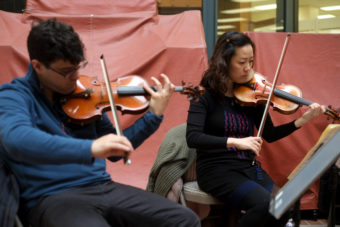
Vega String Quartet members Domenic Salerni and Jessica Shuang Wu play violin at the State Office Building Atrium during a Brown Bag Concert as part of the Juneau Jazz & Classics Festival on Monday, Mar. 9. (Photo by Annie Bartholomew/KTOO)
Vega String Quartet members Domenic Salerni and Jessica Shuang Wu play violin at the State Office Building Atrium during a Brown Bag Concert as part of the Juneau Jazz & Classics Festival on Monday. (Photo by Annie Bartholomew/KTOO)

The Atlanta-based Vega String Quartet kicked off the Juneau Jazz & Classics Festival‘s Brown Bag Concert series Monday. The 30th annual festival runs through May 21 in venues all over town.

Nearly 200 Juneau students attended the free performance in the State Office Building atrium, including eight classes from Harbor View, Glacier Valley, Montessori Borealis and Riverbend elementary schools. The quartet has a residency at Emory University and shared a program of classical and contemporary string arrangements.

The Vega String Quartet performed for nearly 200 school children at the State Office Building Atrium, Monday, May 9. (Photo by Annie Bartholomew/KTOO)

Here’s their performance of part of Vivaldi’s “The Four Seasons.”

See the entire Juneau Jazz & Classics Festival schedule at jazzandclassics.org.

The quartet’s concert was sponsored by Hecla Greens Creek and Princess Tours, which bused more then 150 students to the State Office Building.

Full Disclosure: Annie Bartholomew is a member of the Juneau Jazz & Classics Board of Directors.

Devon Kasler of High Tide Tattoo debuts Anger Machine EP

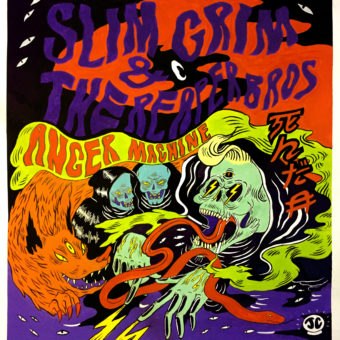
Juneau artist Devon Kasler’s premier EP Anger Machine is an even dose of teenage angst and fantasy. With his band Slim Grim & The Reaper Bros, Kasler evokes a familiar feeling of secretly listening to Black Sabbath or Danzig or Queens of the Stone Age, whatever your poison was. But for Kasler, it wasn’t just a phase. The blood, skulls and gore of musical past carry over to his day job as a tattoo artist at High Tide Tattoo.

His music is sinister, full of ghastly hooks, and it’s loud, as if Alice Cooper came of age in the early 2000s. The release is the result of a partnership between Kasler and high-school-friend-turned-producer Cole Paramore who mixed the EP and contributed percussion over the tracks Kasler recorded alone in his bedroom, many in a single take. 

You can hear collaboration on the single “Skeletal Ghoul,” which opens with brooding guitars that remain rooted in Paramore’s drumming, growing louder until it concludes with a ripping guitar solo from Kasler. Somehow, you can just guess this guy’s pedal board is bigger than yours.

The album artwork was created by fellow High Tide Tattoo employee Jolene Chup who goes by the handle Fakewitch, releasing her own series of visual art last September.

Get these bad boy vibes on Bandcamp or see the six-track EP performed live tonight at the Taqueria when Kasler debuts his new line of patches, T-shirts and lighters inspired by his collection of music. 

Site notifications
Update notification options
Subscribe to notifications