I keep tabs on what’s happening in Juneau’s classrooms for the families they serve and the people who work in them. My goal is to shine a light on both stories of success and the cracks that need to be filled, because I believe a good education is the basis of a strong community.
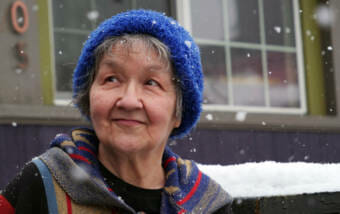
Ernestine Hayes is seen in Juneau, Alaska, this winter. (Photo by Pat Race)
The Rasmuson Foundation named Juneau writer Ernestine Hayes its 2021 Distinguished Artist on Friday.
The achievement represents a lifetime of creative excellence and outstanding contribution to Alaska’s arts and culture.
Emotions ran high as people gathered on Zoom for a virtual ceremony. Hayes was selected by a panel of Alaska artists and art experts who help the foundation choose from a group of nominees each year.
Hayes held back tears as she talked about being marginalized as a young girl in territorial Alaska.
Ernestine Hayes held back tears as she talked about being marginalized as a young girl in territorial Alaska. (Photo by Bridget Dowd via Zoom)
“This life pattern continued throughout my childhood, throughout my years in California and throughout my life after I returned,” Hayes said. “I came to accept exclusion as a feature of my life path.”
In her writing, Hayes explores the complexities of Indigenous identity. In one of her books, “Blonde Indian: An Alaska Native Memoir,” Hayes shares her personal journey of feeling alienated from Alaska Native and Euro-American communities.
She said the Rasmuson Foundation award overwhelmed her.
“You have given me a gift that fulfills the deep need that I’ve lived with since I was that marginalized little girl,” Hayes said. “I feel your acceptance. I feel accepted. Gunalchéesh! Gunalchéesh!”
The Rasmuson Foundation named Juneau writer Ernestine Hayes its 2021 Distinguished Artist Friday (Photo by Bridget Dowd via Zoom)
The Distinguished Artist award includes a $40,000 prize, which Hayes said is much needed, as her home burned down three years ago. She said it’s been a long, challenging time full of unexpected costs and difficult decisions to repair the home.
“I’ve now gone all in with all my savings, all my retirement, all my energy and all the hope I could still muster,” Hayes said. “As you can imagine, I can’t describe the relief your generosity has brought to my worries.”
The celebration featured a performance by X’unei Lance Twitchell, a video by Pat Race and remarks from Joy Harjo, the first Native American United States Poet Laureate.
Joy Harjo, the first Native American United States Poet Laureate spoke during a ceremony to honor Juneau writer, Ernestine Hayes. (Photo by Bridget Dowd via Zoom)
In the video, Hayes said any recognition she receives does not belong to her alone, but to Tlingit people.
Rasmuson Foundation board member, Adam Gibbons also spoke during the ceremony. He said Hayes is known for her modesty, but called her a “living, breathing, storytelling treasure.”
“We are grateful for your challenging us, for causing us to question our values, for pushing us to know and consider our stories and our history,” Gibbons said.
The Rasmuson Foundation will also be announcing the 2021 recipients for individual artist awards, project awards and fellowships in the next few months.
Aiden McCurley is in in a specialized program for students with autism at Riverbend Elementary School. (Photo courtesy of Alyssa Cadiente-Laiti Blattner)
After a year unlike any other, teachers, students and parents across the country are hoping for a less surprising school year this fall. But before starting anew, some families are looking for ways to make up for this year’s challenges.
In Juneau, the school district is offering an expanded summer school program.
The Juneau School District has offered summer school in the past. High school students were able to participate in credit recovery, special needs students could sign up for an extended school year and there were a few programs for elementary students.
But Ted Wilson, the district’s director of teaching and learning support, said in recent years, the summer school program hasn’t been nearly as big as they’re expecting it to be in the coming months.
Ted Wilson, the district’s director of teaching and learning support, says in recent years, the summer school program hasn’t been nearly as big as they’re expecting it to be in the coming months. (Photo courtesy of Ted Wilson)
“Once it’s all said and done, practically every school and program in the district will have hosted some aspect of summer school,” Wilson said. “We’ll have more capacity for both our special ed students and our general education students than we might have other summers.”
Several sessions will be offered at different schools across all grade levels throughout June and July.
At the elementary level, teachers have identified students that could benefit from a little extra time and invited them to participate in summer programs. Middle school sessions are open to any sixth, seventh or eighth grader who wants to apply.
High Schools are offering more sessions than they typically do, prioritizing students who need to complete credits first, and admitting other students as space allows.
Most programs will focus on language arts, math and science, but some art, and P.E. options are available as well.

Wilson said the district is using funds from The American Rescue Plan Act (ARPA) to make those sessions possible.
“[ARPA] is 100% funding the middle school and it’s funding about half of the elementary school effort,” he said. “It’s helping with the high school effort, although the high schools often provide a lot of what they’re going to be doing.”
The Juneau School District expects to see about $5.2 million in ARPA funds, and Wilson said according to soft estimates, the district will spending $200,000 to $250,000 on summer school programs this year. That will be combined with a few other available grants. The district is also setting aside money for summer school in 2022.
Ivette Perez has a 10-year-old son at Mendenhall River Community School. As a single mom, she said it was hard to keep her son on track this year.
Ivette Perez hugs her 10-year-old son, Ivan. (Photo courtesy of Ivette Perez)
“[I was] trying to juggle between, ‘okay, you need to do homework, but at the same time I need to be on meetings or interviews or conferences,'” Perez said. “So, for me, it was really hard trying to make a schedule and sit down with him for four, five, or six hours a day.”
Perez said her son fell behind in math and will be using the June and July summer sessions to catch up.
“He was doing okay [before the pandemic],” she said. “He was like on a regular level I would say, not like really really smart, but this past year, when they stayed home, that’s when he completely dropped, like he kind of forgot everything or it was completely different not having a teacher in front of him to explain things.”
Ivan Perez is in fourth grade at Mendenhall River Community School. (Photo courtesy of Ivette Perez)
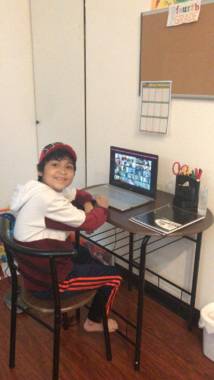
Another Juneau mom, Alyssa Cadiente-Laiti Blattner, has a six-year-old in a specialized program for students with autism at Riverbend Elementary School. She said while most students attended school virtually, her son Aiden was unable to.
“Aiden doesn’t like using the computer and he won’t engage,” Blattner said. “We’ve tried doing Zoom before and he didn’t want to be on the computer. He’d run away from it.”
Aiden also lost a lot of his service hours where he’d get speech therapy or time with a special education teacher. The extended school year will help him catch up on those hours. Blattner said she’s hoping the next year will be better for both his education and his social interaction.
“He’s not able to tolerate wearing a mask as long as his peers in general education are, so Aiden has actually spent the majority of his time at school in his specialized classroom,” she said. “I don’t think he’s been in his general education classroom at all. So that is concerning because he hasn’t had that social interaction with his peers.”
For parents who still have questions about summer school or who might have missed communication from their schools, Wilson recommends contacting the school’s office directly. Recruitment for summer school is still underway, but some elementary programs are already at capacity.
Alyssa Cadiente-Laiti Blattner and her son Aiden. (Photo courtesy of Alyssa Cadiente-Laiti Blattner)
Alaska Fashion Week kicks off Thursday night in Juneau and event organizers hope it’s just the first in an annual tradition.
The event, which runs Thursday through Sunday, is made up of a string of activities. It starts with a film screening, then a city tour, a whiskey tasting and — of course —a runway show and after-party. But it’s not all about dressing up and checking out the latest trends.
Cordova Pleasants owns Resolute Boutique in Juneau and is heading up Alaska Fashion Week. She says her mission is to educate people about fast fashion and sustainability.

“Fast fashion is actually an incredibly polluting industry. So it’s really important to shop with consideration in mind,” Pleasants said. “You know, where are your clothes made? What are they made of? We want to focus on natural materials and stay away from the polyesters and synthetic materials because they don’t biodegrade as well as something like cotton, or hemp, or even linen.”
The past year also put a strain on the fashion industry, in part because so many people waited out the pandemic at home in their sweatpants.
“Everybody was sitting at home and not buying fashion, which put a lot of retailers throughout the U.S. out of business,” she said. “A lot of my colleagues and my friends closed their boutiques all over the country. I feel really lucky to have Juneau’s support to have been able to keep mine.”
Shattuck Way behind Juneau’s city hall will be shut down for the runway show on Saturday, which features about 20 designers. Half of them are national brands and the other half are Alaskan and indigenous designers.
“These collections have been created specifically for Alaska Fashion Week. So we’re just over the moon to see them come down the runway,” Pleasants said.
And after more than a year of fashion hibernation, Pleasants says it’s a great opportunity to just dress up.
“Dress to the nines even if you’re just going to the grocery store. It doesn’t matter. This is about celebrating fashion in Alaska and maybe pulling out maybe your grandmother’s pieces or anything you have that’s passed down, pulling out those special pieces and this is your excuse to wear them,” she said.
More information about the event schedule and featured designers can be found on the Alaska Fashion Week website.
More than 2,300 Juneau residents weighed in on the City and Borough of Juneau’s COVID-19 vaccine survey. The form was intended to get a better sense of resident attitudes and concerns about getting the shot.
CBJ advertised the survey on social media, through the mail and on flyers throughout the city. It was distributed both online through SurveyMonkey and as a hard copy at several public buildings.
Christine Carpenter led the effort to develop the survey. She said about 84% of respondents had already received a COVID-19 vaccine.
“We know that that’s not an accurate depiction of what’s happening across Juneau because we also have the numbers about the percentage of the population that has been vaccinated,” she said.
At the time the survey closed, about 60% of Juneau’s eligible population had gotten at least one dose. Even though the data doesn’t necessarily represent Juneau as a whole, Carpenter said the comments people wrote were useful.
“There were lots of questions about ‘how do you know the vaccine is safe?’ or ‘what’s the FDA process like? I’m concerned that it’s not FDA approved,'” Carpenter said. “There were also a lot of questions about the long-term side effects of the vaccine as well as the short-term side effects.”
CBJ plans to use those responses to develop a communications plan to answer frequently asked questions and address common concerns. Of the respondents who had not gotten a vaccine, 61% of them said they didn’t want to get one, and 52% of those said nothing would change their minds. But Carpenter said the most surprising results weren’t necessarily numbers.
“We learned that people who have not received the vaccine are really spread out across all parts of Juneau,” she said. “There’s not really a whole lot of adequate indicators about who is vaccinated and who is unvaccinated because I think for the most part they’re spread out across all walks of life.”
The full report with more details on the survey results is available on CBJ’s website.
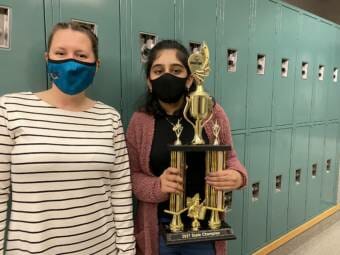
Spelling bee champion, Ishita Khiani (right) poses with her trophy at Dzantik’i Heeni Middle School on Thursday, April 29, 2021. Electra Gardinier (left) is a spelling bee proctor and teacher at DHMS. (Photo by Bridget Dowd/KTOO)
A 12-year-old Juneau student is the new Alaska State Spelling Bee champion and after the state bee was canceled last year, this was a much-needed win.
Dzantik’i Heeni Middle School hosted its own spelling bee during the first week of March to determine who it would send to the statewide bee. This year, seventh grade student, Ishita Khiani spelled all 25 words correctly. Electra Gardinier is a teacher at DHMS. She’s also Ishita’s spelling bee proctor.
“It actually went on into another round and again she got all words correct so she remained the top speller,” Gardinier said.
Normally, the statewide bee would be held in person in Anchorage, but due to COVID-19, this year’s competition looked a little different.
“We’re doing it on an online system,” Ishita said. “We just have to listen to a recording of someone saying the word and there’s information like the origin and the definition, as well as a sentence that has the word in it and then we just have to write in a text box what we think the word’s spelling is.”
Ishita took on the challenge in late March and received an email saying she was again the top speller.
“We didn’t expect actually to win,” Ishita said. “I thought that maybe I just won the school spelling bee and I was so excited when I actually saw that I won the state.”
She will represent Alaska in three nationwide, online preliminary rounds this summer. If she makes the top 10, she’ll head to Orlando, Florida where the final competition will be broadcast on ESPN. But whether she gets there or not, Ishita wants to continue entering spelling bees.
“I really have a passion for language arts,” she said. “I really like writing essays and learning about new words to spell and adjectives to use. I feel like it’s really good to have an open vocabulary and it can make you sound more professional when you get older.”
But according to Gardinier, Ishita is already so far ahead and with the challenges this year brought on, Gardinier said it’s a nice change of pace.
“It was a real glimmer of hope for us to know that one of our students is progressing so far and has taken the challenges of online learning and pushed herself even further than we could possibly imagine,” Gardinier said.
Ishita plans to go over the provided study sheets and take online spelling tests to prepare for her next challenge.
A raven sits next to a millimeter wave, high-capacity wireless backhaul on top of the Marine Park pavilion in downtown Juneau in 2019. (Photo by Jeremy Hsieh/KTOO)
Juneau and Douglas residents started reporting internet outages around 1 p.m. on Thursday.
About an hour later, Alaska Communications posted an update on its Twitter account, saying it was experiencing phone, internet and data outages and that its top priority was to restore service as quickly as possible.
OUTAGE: We are currently experiencing a voice, internet and data outage affecting businesses and consumers in Southeast Alaska. This is our top priority and we are working to restore service as quickly as possible. (1/2)
Around the same time SnowCloud Services, a local internet provider, announced that a statewide outage was causing disruption in its service.
There is currently a statewide outage that is causing a disruption of service. We are actively working with our upstream providers to resolve the situation.
Several GCI customers reported still having a connection.
The phone line issue also affected the Juneau Police Department. For a short period of time, people needing to call 9-1-1 would’ve been unable to do so. City officials later said 9-1-1 was operational again, but that JPD phone lines were still down.
The city’s COVID-19 hotline was also unavailable for the afternoon, due to the phone problems.
Later in the day, Alaska Communications said on Twitter that the issue was related to an underwater fiber optic cable. Service was restored early on Friday morning.
UPDATE 3:20 a.m.: We’ve restored internet, voice and most data services in Southeast Alaska. We rerouted traffic onto other fiber optic cables. We are continuing work to repair one of our subsea cables. If your internet service isn’t yet working, please reboot your modem. (1/2)
This story has been updated. A previous version of this story said that the outage started on Wednesday and that service was restored on Thursday. It started on Thursday and was restored on Friday morning at 3:20 a.m. The story has been corrected.
Close
Update notification options
Subscribe to notifications
Subscribe
Get notifications about news related to the topics you care about. You can unsubscribe anytime.