Bridget Dowd

Local News Reporter

I keep tabs on what’s happening in Juneau’s classrooms for the families they serve and the people who work in them. My goal is to shine a light on both stories of success and the cracks that need to be filled, because I believe a good education is the basis of a strong community.

Juneau Assembly drops property taxes to the lowest rate since 2013

property tax bills
The Juneau Assembly passed a new budget earlier this week, dropping property taxes to the lowest rate since 2013. (Photo illustration by Jeremy Hsieh/KTOO)

The Juneau Assembly passed a new budget earlier this week, which will take effect in July. The plan includes money to expand child care services and funds the Capital Improvement Plan, among other things.

In addition, Juneau homeowners will pay the lowest property taxes since 2013.

The city uses two primary unrestricted funding sources to pay for its services: sales tax and property tax. In Alaska, property tax rates are recalculated each year after all property values have been assessed. The rate is calculated in “mills.”

The mill rate for the next budget year has been lowered from 10.66 mills to 10.56. If you move the decimal point one to the left you get a percentage of property values.

“So 10.56 mills is 1.056% of property value,” said city finance director Jeff Rogers. “So if you own a $100,000 house you would pay $1,056 a year in property tax.”

Juneau’s rate remained the same at 10.66 for the last six years, but at the end of last year’s budget cycle, some members said the rate would have to increase soon to pay for child care.

“[The assembly] wanted to establish a durable funding source for child care,” Rogers said. “So as the manager started to prepare the budget for next year, he incorporated that and proposed to increase the mill rate from 10.66 to 10.86.”

But Juneau’s property values went up more than expected this year.

“So increased property values means that you could potentially have a lower mill rate and still receive more in property tax,” Rogers said.

If the rate had stayed the same, instead of decreasing, that would’ve meant $540,000 more for the city. On a smaller scale, if you own a $500,000 home, you save $50 for the year.

The assembly’s initial budget assumed Juneau would continue to lose money without sales tax from tourism, but now late summer cruises are on the horizon. Assembly member Michelle Bonnet Hale said online sales tax is another thing to consider.

“Every quarter we bring in more vendors to pay online sales tax,” she said. “If people in Juneau, who are shopping online, are paying that sales tax, then in my mind, people in Juneau should have some drop in their property taxes.” 

Hale started pushing for a lower rate last year because she didn’t want the city to raise more money than necessary.

“We’re not in the business of making money,” she said. “What we’re in the business of is making enough revenue to support the government services that we decide we need and at a certain point, it’s not our job to keep sort of buffering the savings account.” 

Hale was outnumbered as recently as last month, but Juneau Mayor Beth Weldon and assembly member Maria Gladziszewski changed their votes on Monday.

“I’m just very pleased that we did this,” Hale said. “I think it really sends a strong message to the community and a strong message to the taxpayers in Juneau that we listen to them and we really work hard at balancing the budget correctly.”

Juneau Assembly turns down $2 million donation from Norwegian Cruise Line

Juneau’s cruise ship docks were empty last year after sailings were suspended due to the coronavirus pandemic. In May, the Norwegian Cruise Line company announced it would donate a total of $10 million to Alaska port communities. (Jennifer Pemberton / KTOO)

The City and Borough of Juneau Assembly turned down a $2 million donation from the Norwegian Cruise Line company during its regular meeting Monday night. 

Some assembly members were concerned about what the public would think of the city taking the money.

In May, Norwegian announced it would donate a total of $10 million to Alaska port communities. That included Ketchikan, Juneau, Hoonah, Sitka, Skagway and Seward. The funds were intended to support small businesses and those most impacted by the lack of cruise passengers last year.

The company has purchased an empty waterfront lot downtown, where it wants to build a dock. 

Carole Triem is one of six assembly members who voted against taking the donation. She said the proposed dock factored heavily in her decision.

“The whole process from start to finish requires decision-making from the assembly,” Triem said. “I just think that to accept money from NCL, even though it’s totally separate from the decisions we’d be making about this development project just is not a good look for us.”

Triem said even though she has faith in everyone involved, just the appearance of impropriety is enough to lose the public’s trust.

During the meeting, assembly member Wade Bryson disagreed with that argument.

“The opposition to the dock is still going to be there,” Bryson said. “The pro-tourism groups are still going to be there. Taking that $2 million changes not one number on either side of that equation.”

Bryson added that the path for Norwegian getting its dock is already in city code and charted out. 

“Yes, I would agree that we have to make a couple of decisions along the way, but they’re not going to be able to come up with some strategy or technique that’s going to help them circumvent the Juneau process,” Bryson said. “It would be foolish and fiscally irresponsible to reject this money that is going to go, at our decision, to helping our community.”

Ultimately, the motion failed by a six to three vote and the assembly asked City Manager Rorie Watt to go back to Norwegian, suggesting the company donate directly to an organization like the Juneau Community Foundation, instead of the city itself.
Research team looks at potential landslide hazard in Juneau, plans to track landscape changes

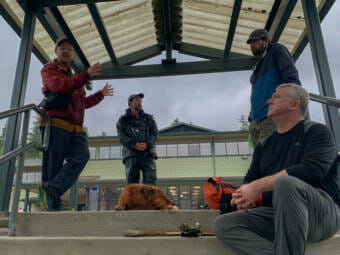
Geologist Bretwood Higman (left) talks about a potential landslide hazard above Lemon Creek, during a press event on Thursday, June 10 in the parking lot of Dzantik'i Heeni Middle School. He is joined by CBJ Emergency Programs Manager, Tom Mattice (far right) and other researchers from CBJ and the National Weather Service in Juneau.
Geologist Bretwood “Hig” Higman (left) speaks during a press event on Thursday, June 10 in the parking lot of Dzantik’i Heeni Middle School. He is joined by CBJ Emergency Programs Manager, Tom Mattice (far right) and other researchers from CBJ and the National Weather Service in Juneau. (Photo by Lyndsey Brollini/KTOO)

A section of land along the Lemon Creek side of Thunder Mountain in Juneau has been identified as a potential landslide hazard.

A group of researchers and emergency management experts hiked into the area to assess the risk Thursday morning.

Juneau Emergency Programs Manager Tom Mattice and his team gathered in the parking lot of Dzantik’i Heeni Middle School to share their findings. For starters, Mattice said there’s no immediate danger.

“But I think it’s just important to recognize we’ve found some obvious signs and we have some ways to start to track those,” Mattice said.

The team examining cracks in the landscape — places where the mountain has sagged — and they plan to measure those over time. 

“We want to know how active the concern is,” Mattice said. “If we went up and looked at those cracks in the mountainside this year and they were six inches apart and we came back six months later and they were six feet apart, we would know that we had a really active concern.”

CBJ Emergency Programs Manager, Tom Mattice speaks during a press event on Thursday, June 10 in the parking lot of Dzantik'i Heeni Middle School.
CBJ Emergency Programs Manager, Tom Mattice speaks during a press event on Thursday, June 10 in the parking lot of Dzantik’i Heeni Middle School. (Photo by Lyndsey Brollini/KTOO)

The team used a combination of Light Detection and Ranging, or “LiDAR” data and pictures of the landscape to identify the area as a hazard. Mattice said he’s hoping the general public will also help them keep an eye on it through what he called ‘citizen science.’

“People that are looking at these things, people that are hiking in the mountains and paying attention. If they see obvious gaping cracks opening up in places, maybe they’ll bring them to our attention,” Mattice said.

Geologist Bretwood “Hig” Higman is a part of the research team. He owns a small nonprofit called Ground Truth Alaska, which aims to educate others on Alaska’s natural resource issues.

Last year, Higman helped identify an area of land that could potentially crash into Barry Arm of Prince William Sound, northeast of Whittier Alaska.

“One of the things that jumped out when we were looking at that is it’s a super obvious instability,” Higman said. “It’s something that any geologist could’ve identified. You don’t need much expertise, and yet, even though thousands of people visit that area, nobody had noticed it.”

Higman said that was a red flag and a sign that maybe researchers needed to spend a little more time looking for the obvious, which prompted him to identify other sites like this one. 

Unfortunately, even with careful tracking, an extreme rain event or earthquake could cause an unpredicted landslide at any time.

“What I would say after my walk today is that if it’s been raining for the last two weeks and it’s an earthquake longer than 20 seconds and you live at the bottom of a mountain, you should probably go somewhere else,” Mattice said.

And even if they get a pretty good idea of when the slide is coming, Higman said there’s no way to prevent it from happening.

Geologist Bretwood Higman (left) speaks during a press event on Thursday, June 10 in the parking lot of Dzantik'i Heeni Middle School.
Geologist Bretwood Higman (left) speaks during a press event on Thursday, June 10 in the parking lot of Dzantik’i Heeni Middle School. (Photo by Lyndsey Brollini/KTOO)

“Sometimes people say ‘can we just go and like if we know it’s gonna fall anyway can we let it loose right now so at least we know when it’s gonna happen or maybe we can do it in little pieces?’ There isn’t really a way to do that.”

That means with the exception of being 100% evacuated, there’s no way to prevent damage or loss.

Juneau school board temporarily reduces graduation requirements to help students catch up

Maya Araujo, left and Jade Araujo pose for graduation photos outside Juneau-Douglas High School: Yadaa.at Kale on May 18, 2020.
Maya Araujo, left and Jade Araujo pose for graduation photos outside Juneau-Douglas High School: Yadaa.at Kale on May 18, 2020. The twins were the first of about 130 JD seniors to walk the stage over three days of individual graduation ceremonies that school officials arranged to avoid large gatherings because of the COVID-19 pandemic. (Photo by Jeremy Hsieh/KTOO)

The Juneau School District Board of Education passed a slight change to graduation requirements Tuesday night.

The next three graduating classes will have to earn half a credit less than the classes before them in order to graduate.
JSD Superintendent Bridget Weiss said students will still have to complete core academic credits like English and math, but this change will give them some wiggle room.

“What we’re hoping is that this just relieves a little bit of the pressure for those students who lost some credits throughout the pandemic and provides a little bit of space in their schedule to make up those core academic credits,” Weiss said.

After the classes of 2022, ’23 and ’24 finish high school, the graduation requirements will return to where they were pre-COVID. 

“We also are very proud of our graduation requirements,” Weiss said. “We have a pretty high standard when you look at it comparatively and the board really did not want to sacrifice that high standard.”

Juneau schools have long surpassed state standards on graduation requirements and even with the change, Juneau students will still be meeting those.

During Tuesday’s meeting, board member Emil Mackey said he was torn in both directions.

“On one hand, I hate that we’re weakening our standards,” he said. “But at the same time too, this has been a remarkable time and we have to realize that the pandemic has created a new reality and time marches on.”

‘Not one size fits all’: University of Alaska looks for ways to retain more Alaska Native students

UAS campus
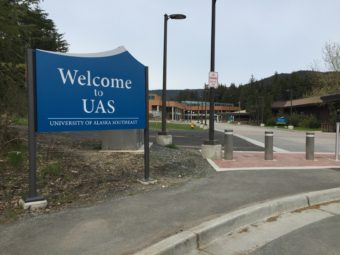
The UAS campus in Juneau. (Photo by Lisa Phu/KTOO)

The University of Alaska is launching a system-wide program geared toward retaining more Alaska Native students at the school and increasing the number of Alaska Native staff members.

The school recently found that Alaska Native students are enrolling, but they don’t always stay.

Sarah Peele, whose Haida name is Tukshaak’éi, is a student at University of Alaska Southeast. She transferred from the Fairbanks campus, where she said the professors didn’t make her feel welcome.

Sarah Peele, whose Haida name is Tukshaak’éi, is a student at University of Alaska Southeast.
Sarah Peele, whose Haida name is Tukshaak’éi, is a student at University of Alaska Southeast. (Photo courtesy of Sarah Peele)

“They were all white,” Peele said. “They were not originally from Alaska. They were from Lower 48 or a different country and they had little to no knowledge of whose land they were on and they did not care when I brought that up in our classrooms.”

While being interviewed over Zoom, Peele was bouncing a seven-month-old boy on her lap. She said that’s another thing about her culture that her professors don’t always understand. 

“A lot of Alaska Native students are not traditional students, meaning they’re not right out of high school, they’re not single, a lot of them have kids,” Peele said.

Her experience at the Juneau campus has been an improvement, but she said there could be a reason for that.

“I’ve primarily switched  to Alaska Native Studies and Languages, so all of my professors are Alaska Native and I’ve kind of retreated into this little safe space,” she said.

In the past, Peele was often the only Alaska Native student in her classes, and more often, the only Alaska Native woman in her classes. She said that was intimidating, and experiences like that could be contributing to the lack of retention among students like her. That’s part of the reason why she decided to help get the Alaska Native Success Initiative off the ground at UAS.

UAS Chancellor Karen Carey. (Photo courtesy of the University of Alaska Southeast)

“I’m thankful that the chancellor and a couple other non-Alaska Native people who were on that committee were open to change and open to recognizing how they’re comfortable in their whiteness,” Peele said.

Alaska Natives represent about 20% of the UAS student population, but only about 7% of its faculty and staff. UAS Chancellor Karen Carey says she wants those numbers to be closer together. That would mean hiring more Alaska Native staff.

“You know, just in terms of looking at things like hiring practices,” Carey said. “Are we really making sure that we are getting the most diverse pool of candidates that we can?”

This week the Board of Regents will be hearing the three campuses present their plans for accomplishing those goals. 

Ronalda Cadiente Brown is the Associate Vice Chancellor for Alaska Native Programs at UAS.
Ronalda Cadiente Brown is the Associate Vice Chancellor for Alaska Native Programs at UAS. (Photo courtesy of Ronalda Cadiente Brown)

“We’ll also be doing some training for all of our faculty and staff because if you’re coming here from say Chicago or Kansas or Texas and you’re moving here to work, you may not know anything about the Alaska Native populations,” Carey said.

Ronalda Cadiente Brown is the Associate Vice Chancellor for Alaska Native Programs at UAS. She played a big part in coming up with the plan they’ll present to the board. 

“There’s not one size that fits all for any Alaska Native student,” Cadiente Brown said. “The course of study, what they bring to the university setting, the demands on them from the goals and desires that they have and the levels of support. There are so many variables that we hope by this work that we do our best to improve the system so that we have basically an answer of support for anyone and everyone that needs it.”

Once the campus plans are approved, changes could come as soon as the fall semester. 

Site notifications
Update notification options
Subscribe to notifications