Chloe Pleznac

KTOO

Empire reporter breaks down how Juneau voted in statewide election

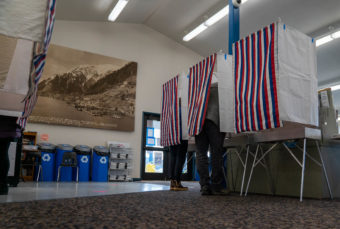
Voters gather at the Lynn Canal polling location, Auke Bay Ferry Terminal, Juneau Alaska, Nov. 8th 2022. (Photo by Paige Sparks/KTOO)

Alaskans are still waiting for the final outcome of races after the recent general election. But there’s no doubt about who Juneau voters picked as their winners.

KTOO’s Chloe Pleznac spoke to Juneau Empire reporter Mark Sabbatini about his recent article breaking down how capital city voters differed from the rest of the state.

The following transcript has been lightly edited for clarity. In the audio of this interview, Klukwan is misidentified as Klawock.

Chloe Pleznac: So we won’t know final statewide election results until the 29th. But in Juneau, do we have a pretty good idea which statewide candidates came out on top among local voters?

Mark Sabbatini: We do. It’s fairly clear at this point that Mary Peltola was the dominant choice among Juneau voters. She’s got 48% statewide, which means she’s gonna need to probably rely on ranked choice voting. But here in Juneau, she’s got 75% of first choice votes among District 4 — downtown and Douglas voters — and 62% of those voting in District 3, which would be the Valley and some of the outlying communities like Skagway, Haines, Klukwan and so on.

Chloe Pleznac: So Walker did better than Dunleavy here. But he also did far better relative to Gara than he did elsewhere. What do you make of that?

Mark Sabbatini: Well, again, it shows that Juneau as a whole tends to vote more liberally than the state as a whole, because Dunleavy’s the one candidate statewide who’s got an outright majority of first choice votes as of now. He’s got 51%. His two main opponents, Bill Walker and Les Gara, combined are at 44%. So that’s the statewide numbers. But you look in Juneau, and in the Valley, which is the most conservative area in District 3 — he trails Walker there, basically 38% for Walker to 35% for Dunleavy. Gara is about 11 points behind that at 24%. But then you look downtown and Douglas in District 4, the governor is actually in third place, and he trails by a lot. Walker has 46% of District 4 voters. He’s trailed by Gara at 28%, and Dunleavy at 25%. So he was certainly not popular where the governor’s mansion is actually located.

Chloe Pleznac: There was some redistricting this election cycle. Did we see that influence vote counts?

Mark Sabbatini: Well, the redistricting process that both redefined the numbers for Juneau’s two districts also added some communities to the new District 3, which was largely the Mendenhall Valley area. They now also have Skagway, Haines, Klukwan and the outlying Northern Panhandle communities. And what we saw was while that district is still more conservative than the district that encompasses downtown, Douglas and the Lemon Creek area, those outlying communities generally did vote considerably more liberally than the Mendenhall Valley areas did. I believe it was out in Klukwan you had Murkowski get 80% of the vote in that precinct, whereas she and Kelly Tshibaka are essentially tied 43 to 43% statewide. And in the Mendenhall Valley district, Murkowski is still ahead, but it’s more of a 55 to 30% split rather than the 80% she got in some of the most favorable Northern Panhandle communities. 

The other thing that was interesting is, and you see this both in the outlying communities and in Juneau, it isn’t always consistent. Up in Haines, there’s two precincts and they’re fairly split actually, one considerably more liberal than the other. So generally, adding those communities to District 4 made the numbers more liberal than in the past, but it’s not consistent across the board.

Chloe Pleznac: Alaskans seem to agree en masse against a constitutional convention, with about 70% of statewide voters voting against holding one. How did Juneau residents vote on this issue?

Mark Sabbatini: Well, Juneau residents both in District 3 and District 4 were decidedly more against the convention than people statewide. As you noted, the statewide numbers were about 70% to 30%. In the District 3, or Mendenhall Valley and Northern Panhandle communities, it got rejected by a 75% to 25% margin. District for downtown, Douglas and Lemon Creek, it was a landslide rejection. Numbers were like 86% against and 14% in favor.

Chloe Pleznac: What about local elections? Two seats ran unopposed. Sen. Jesse Kiehl and District 4 Rep. Andi Story both gained another term in office, but incumbent Rep. Sara Hannan from District 3 ran against undeclared opponent, Darrel Harmon. Was that a close race? 

Mark Sabbatini: That was definitely not a close race. Sara got about 80% of the vote, Darrel got about 20. And he admits he really wasn’t much of an active campaigner. He made very little efforts during the initial last stage of the campaign. Towards the end he put out some fliers and had a website, but he admitted he was simply on there to give people something to check off on the ballot if they didn’t want to vote for the incumbent. 

Chloe Pleznac: Thank you for taking the time, Mark. 

Mark Sabbatini: Thank you for having me.


Juneau Empire reports dozens of people transferred out of Lemon Creek Correctional Center during repairs

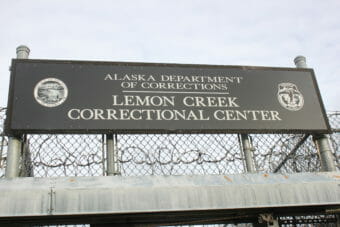
Lemon Creek Correctional Center
Lemon Creek Correctional Center in Juneau. (Photo by Lisa Phu/KTOO)

Around 50 people have been transferred out of Lemon Creek Correctional Center in Juneau over the past several months. That’s about 20% of the incarcerated population. The Department of Corrections says people have been moved while the prison is repaired after recent rain events caused instability in parts of the facility.

The Juneau Empire reported on the transfer. Editor Ben Hohenstatt shared information the Empire got from DOC, but said there was still a lot to this story that remains unclear.

Listen:

The following transcript has been lightly edited for clarity.

Chloe Pleznac: So what do we know about the state of the building or the nature of the damage?

Ben Hohenstatt: We know very little ourselves at this moment. Again, citing security concerns, DOC spoke in very broad terms about the nature of repair work happening at sites at the facility. They said both aging infrastructure and extreme wet weather had contributed to a need for repairs to the building.

Chloe Pleznac: Talk me through the transfer of incarcerated individuals. Who’s being moved and why?

Ben Hohenstatt: Again, at this point, that’s largely unclear, it seems that it’s to accommodate this repair work. At this point, what we know is that 45 to 50 people were transferred amid renovations and repair work to the prison. We know that about half of that population was female.

Chloe Pleznac: Do we know where in the state they’re being moved?

Ben Hohenstatt: We were told multiple facilities in Southcentral Alaska was the destination. DOC generally stated that where inmates are taken to, and specific identity of inmates generally [is] not shared to protect both staff and the incarcerated individuals.

Chloe Pleznac: Is there any specific data surrounding the situation that stuck out to you?

Ben Hohenstatt: I was surprised that it was approximately 20% of the population. That’s a significant group of people in a community of a little over 30,000. Fifty people is a lot of people, even over the course of several months. So it was somewhat surprising that the transfer had happened at that scope, and apparently with relative speed and not a ton of information making its way to the public.

Chloe Pleznac: Do we know how many people are being moved are sentenced? And how many are still awaiting trial? Is there any statistics on that?

Ben Hohenstatt: That is not something I know, at this time. I know that we’re not done reporting on this. And we had several questions in and we’ve reached out to some folks who we believe may have been transferred. So hopefully, we’re able to get greater clarity into that.

Chloe Pleznac: So how is this affecting the lives of the incarcerated people being moved? I imagine that their access to visitation is now impaired if they’re being shifted to new correctional centers. Getting to Juneau is hard enough, coming from the outside. I’m just kind of curious how this is impacting their ability to reach people.

Ben Hohenstatt: Right. That is something I would be interested in knowing more about, in the coming days, coming weeks as we’re able to talk to folks. Based on what we know now, DOC says that the overwhelming majority of incarcerated people prefer to communicate remotely with family and legal counsel. And they should continue to be able to do that at other facilities. They’re someplace different. And if they had been relying on non-technology to communicate with their legal representation or families for visitation, I’d have to imagine that would be impacted.

Chloe Pleznac: Do we have any idea when these repairs will be finished?

Ben Hohenstatt: We had been told that they are working with the Department of Transportation and Public Facilities on the repairs, and that there is not yet a timeline for when the repairs will be done.

Chloe Pleznac: So to be clear, Lemon Creek Correctional Center is not closing down. It is simply redistributing individuals to safer locations while construction is completed.

Ben Hohenstatt: That’s what we were told.

Site notifications
Update notification options
Subscribe to notifications