Chloe Pleznac

KTOO

Newscast – Wednesday, April 17, 2024

In this newscast:

  • Wrangell’s Nolan Center hosted a screening of Blue Ticket on Monday. It’s a film of a play that KTOO documented back in 2019. The play’s author, Maureen Longworth, documented how gay men in Juneau were exiled from the city in the 1960s.
  • The Alaska Native Birthworkers Community is a collective of Indigenous midwives and doulas who work with Indigenous mothers during pregnancy, birth and pregnancy loss. They aim to make the birth experience easier for mothers, including those living in rural Alaska.

Garden Talk: Why silverweed is ‘a beloved plant all throughout the Pacific Northwest’

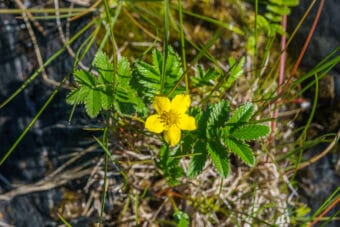
Silverweed in bloom. (Courtesy of Khalil English)

For this week’s Garden Talk, KTOO’s Chloe Pleznac spoke with Khalil English about his research on silverweed, a seemingly inconspicuous plant with deep roots in Pacific Northwest history. English spoke about silverweed’s importance as a food source across the North — and about where it grows in Juneau.
Listen:

This transcript has been lightly edited for clarity and length.

Khalil English: Silverweed first came into my life, I believe, through a book that I got from Professor Daniel Monteith called Haa Atxaayí Haa Kusteeyíx Sitee. It means, “Our food is our Lingít way of life.” And there are some plant foods in there that I had never heard of before, and one of them was tséit or silverweed. And that kind of just grew into something huge. I looked into some of the Lingít uses and how it’s harvested here, and then found, oh my gosh, it’s a beloved plant all throughout the Pacific Northwest and even circumboreal. It’s all around the North, and even in Europe, in Scotland, and Norway, etc. People have loved silverweed. So it ended up becoming a little bit of a self-history search, as well. 

Chloe Pleznac: Can you tell me a little bit more about what some of those traditional uses are and how this plant fits into the history of all the indigenous cultures along the Pacific Northwest Coast? And even the circumpolar north, as you were saying.

Khalil English: A lot of the information that I have been able to learn comes from the Kwakwa̱ka̱ʼwakw, which are just the northern tip of Vancouver Island and a little bit on the mainland. And that’s where the temperate rainforest, it’s just non-stop, summer and winter rain. So we have these huge estuarine river systems, and people would bioengineer the salt marsh. So according to sources from the Kwakwa̱ka̱ʼwakw, there was not a single patch of saltmarsh that wasn’t owned and tended by someone. So it was a very intensively managed crop. There was a lot of food that people got from it. It was very important ceremonially, there was actually a taboo, at least in this area, for not eating the silverweed until, I think it was at least, around December, which has a little bit to do with getting the roots to taste sweeter. And then as far as Scotland, there’s sadly not as much information, but there is still a lot of love. In some of the few stories I could find. There was a little Gaelic phrase that I learned that I’ll share that kind of highlights some of the feelings around it. And it’s, brisgean beannaichte an Earraich, seachdamh aran a’ Ghàidheil. It means “blessed silverweed of spring, seventh bread of Gales.” And so along with millet and rye and wheat, silverweed was very important. And so people, when they were given their allotments for fishing, etc, silverweed patches were a part of that, at least in Scotland. And then when the potato famine happened, people actually returned to eating silverweed.

Chloe Pleznac: Do you know why it kind of has become a little disenfranchised? Why is it not known as well as these other food sources? 

Khalil English: I think it depends on where we’re looking. So, for silverweed in the British Isles, from what I’ve garnered, it’s the fact that it was mostly a food that poor people ate. That’s why it wasn’t recorded so much. When we’re looking at the Pacific Northwest, then we’re dealing with a little bit more of that kind of direct intention to remove people from their food and remove people from the land. So of course, where silverweed grows, is the easiest land to develop. It’s the easiest land to put cows on. And so people were removed from their silverweed fields. There’s quite a few disheartening stories of people kind of giving up on those fields and walking away.

Chloe Pleznac: Where can people in Juneau typically find silverweed and respectfully harvest it? 

Khalil English: Silverweed is abundant. There are actually quite a few subspecies of silverweed. So Pacific silverweed is what I’ve mostly been focusing on. They have the biggest roots and they’re going to be mostly along the oceanside. But even for folks in interior Alaska, or I don’t know, in Utah, there is still silverweed. It prefers more salty grounds. So for us, that’s right on the oceanside, could be at the edge of some lake, down further South. More direct places in Juneau might be Fish Creek. The Mendenhall Wetlands would be the most ideal spot, but of course, I don’t know how safe it is to eat anything out of there given the airport and the waste management system. But pretty much anywhere. Like Sandy Beach, all the edges are covered in silverweed. Any beach, right under that beach rye, that really grayish blue grass that is very thick? Silverweed is right there.

Chloe Pleznac: What time of year is the best time to keep an eye out for this? You were saying culturally, there’s a bit of connection at different times of the year for harvesting, perhaps?

Khalil English: For our area, what I’ve read is mostly people would harvest in the spring. And then what I’ve read for down in Vancouver, people mostly harvested in the fall. But I think it’s a little interchangeable. What they’re going for is once the plant starts growing actively, once you can see anything above ground, the roots are very, very astringent. They become really bitter. There’s a lot of tannins. So, when you harvest either at the very beginning of spring or in the fall, those tannins have reduced a lot. Then when you dry them and store them cold, the tannin content is further reduced. So, in wintertime, you got to kind of familiarize yourself with habitat, and then you can go and look for their dried leaves. They persist pretty well and are easy to recognize. And then you just dig in. 

One last thing I’ll share, and this was a little more of my focus, is something I’ve loved about silverweed, is it really highlights the relationship that people can and have for many thousands of years had with the earth. I think, too often when we’re talking about environmental topics, it becomes really depressing, and we kind of demonize ourselves. But, to me, this really highlights like, oh, we have a place we also are attending the earth as well. And by tending these wild systems, they can become more productive. We can take advantage of it and so can the rest of the wildlife. But in today’s world, of course, it’s a little harder to go out and say start bioengineering our salt marsh here. So, people can bring them into their gardens. They’re very adaptable.

Garden Talk: It’s time to get your garden — and yourself — ready for the growing season

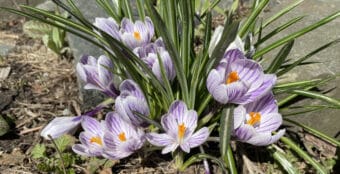
Flowers bloom in the Rainbow Foods garden in Downtown Juneau on April 3, 2024. (Photo by Chloe Pleznac/KTOO)

With the spring equinox behind us and a stretch of sunny, warm days over the last few weeks, it feels like spring has arrived full-force in Juneau. Trees are budding, birds are singing, and things are starting to stir in the earth. 

Master Gardener Ed Buyarski says it’s time to start doing the garden prep that will set you up for success later in the season.

“It’s a time for cleanup in the garden, if we didn’t do cleanup last fall,” he said. “Getting all the old cabbage and broccoli plants out of there, and other slimy stuff. Removing slug habitat is a good start. Greenhouse clean up, tidying up. And, if folks are like me — we had a greenhouse collapse this winter — getting that new greenhouse on order or rebuilt.”

Buyarski also suggests that gardeners should get their own bodies ready for the physicality of the growing season. 

“One thing for me that I have found helpful as I have become rather mature is getting in ‘garden shape,” he said. “That’s doing some stretching exercises each day. Getting the shoulders exercised, stretching out the back and the legs and all of the rest of that.”

And as far as our recent weather? Buyarski says to pay attention to warmer days for opportunities to start the growing season off on a good foot.  

“A gradual warm up is good. That’s what we want. Waking up soil microorganisms if we’re mixing in some compost and some organic fertilizers and making sure to have your garden beds covered with clear plastic right now so the soil can warm up,” he said.. “We’re trying to encourage everything to grow better, whether the clear plastic is directly on the soil, or we have hoops with clear plastic over them, little mini greenhouses — all of that will help.”

If you have questions or ideas for future Garden Talk features, please email chloe.pleznac@ktoo.org or leave a message at (907) 463-6492.

Juneau writer Vera Starbard weighs in on Writers Guild strike

Juneau-based writer Vera Starbard poses on her deck overlooking the Gastineau Channel with the banners she printed to show support for the Writers Guild of America strike. (Photo courtesy of Vera Starbard)

Alaska writer Vera Starbard recently hung banners from the deck of her Douglas home in support of the nationwide writers’ strike.

Starbard, a member of the Writers Guild of America union, has written for the PBS Kids show “Molly of Denali” and the recently canceled ABC drama “Alaska Daily.” 

Starbard is Lingít and Athabascan and has also written plays for Perseverance Theatre. 

KTOO’s Chloe Pleznac spoke with Starbard about the banners and what she and the writers picketing in Los Angeles and New York City hope to achieve. 

This interview has been edited for length and clarity.

Chloe Pleznac: So how long have you been part of the Writers Guild of America union, and do you feel that it’s helped you as a writer?

Vera Starbard: I only was eligible this time last year, and only about seven, eight months ago have been sort of officially a card carrying member of the WGA. And immediately there were benefits — there were things that I never thought I’d get as a writer. Being a freelance creative writer, you just don’t expect to ever get things like retirement funds, health care — these things just aren’t something you expect or plan for, even. As a writer, you kind of have to make do. But with WGA, they require that our employers pay for that, that they kind of make all these benefits that are more typical of office jobs, and we’re allowed them. So already, I mean immediately, I was getting things that I think most, you know, salaried workers or full-time workers sort of expect, but we haven’t been able to expect. So that’s been great.

Chloe Pleznac: You recently posted on social media about two banners you’ve placed on the porch of your Douglas home. One reads “#WGAstrong” and the other “Alaska supports writers.” Why did you decide to put those signs up?

Vera Starbard: Part of it honestly, because I’m watching all my friends, co-workers, colleagues in New York and LA — and even some other locations like New Mexico and Atlanta — picketing. Really sort of literally shutting down productions, which is the fastest way to sort of make the studio’s willing to make any sort of negotiations with us, really. And I was feeling very — like I can’t do my part. I’m up here, there’s no studios or anything shooting up here. But we do have 1.5 million cruise ship passengers passing by my house, which just happens to be on their route into the docks, so let’s let them know. Let’s sort of raise awareness for all these people who are coming up here that – for one, I’ve always found Alaska to be extremely supportive of my writing and other writers and artists in general, and especially Juneau – but also get them aware. Maybe it’s, it’s just cryptic enough on the “WGA strong” that I might look it up and see what that’s all about.

Chloe Pleznac: So what do you hope the strike achieves?

Vera Starbard: Ultimately, all we want is fair pay, fair benefits, and the ability to have a career out of this. Right now, what writers are facing is you might do one show, work for 10 weeks, and that might be your whole career. It’s very, very difficult, in the best of circumstances, to make a living as a TV writer or just a creative writer in general. But what’s happening with the studios right now is they’re shortening the hours, they’re implementing policies and processes that are pushing newer writers out, pushing diverse writers out, to be honest. I don’t believe I would be where I am, if the door hadn’t opened just a little bit wider for me to get in by an awful lot of people who’d come before me sort of opening that door. And what studios are trying to do in not being willing to negotiate on fair pay, is shutting that door right back again. And it makes me pretty worried for the future of Native writers being able to enter the industry at all, much less make a living at it. So yeah, ultimately, fair pay. And just to be able to have a middle class income, as a writer.

Chloe Pleznac: Are you feeling any professional impacts from the strike? 

Vera Starbard: Oh, sure. Immediately had to set aside some projects that I’m working on, timestamp them, and I can’t touch them until the studios that I’m in contract with on them will negotiate fairly with us. So immediately, I had to sort of plan for the summer of what I was going to be working on, and that’s done. And that means my main source of income is done, also. So there’s definitely that immediately felt. But it’s also something every single writer who voted for this, which was 98% of us, said, you know, “We would rather strike down and feel that temporary pain of no income so that we can have this career, so we can have a career for the future”. 

Chloe Pleznac: So Hollywood can feel very far away from Alaska. But are there ways Alaskans could be affected by the strike that we might not expect?

Vera Starbard: Yeah, I think what viewers will definitely notice, what sort of the most typical consumers — of which I’m one — is, you’ll start to see delays for shows that are coming out. But up here, I think what people will really see is there’s just a loss of authenticity. If you don’t have people who are really from Alaska, who really know what they’re talking about writing on these shows, and there are Alaskans writing on these shows about Alaska. Definitely not all of them. And I think we can all name the ones that clearly have no influence from actual Alaskans. But you know, there are some out there, and they’ll start to see that.

Chloe Pleznac: So do we know how long this strike is going to go on for? Has there been any headway that’s been made? I’m not sure if that’s something you’re privy to or able to disclose, but I’m just curious.

Vera Starbard: The WGA definitely keeps us informed. It’s tens of thousands of writers and only a few are on the negotiating committee, so of course we’re not literally in the room, but they do keep us informed. And unfortunately, what we know is, the studios are still just not even willing to talk. That’s where they’re at. The very, very fair proposals that the writers put out there, they weren’t even willing to discuss and negotiate on them. They just said, “We reject it, we’re not going to talk about it.” So right now, it’s in the studio’s hands — they’re not talking. That means, yeah, it’s probably going to be a long strike. And I think that’s sort of in the expectation, is that it will be. The big thing right now is both the directors’ union, and the actors’ union are up for their contract negotiations as well. So in a matter of weeks and months, there’s going to be some movement from them. And they’ve been extremely supportive of the writers. Really, the whole – sort of everyone below executive level has been very supportive of the writers, because we’re all kind of in the same boat, we’re all getting affected by the same low pay and unfair contracts … I believe it’ll be through at least June and July. But that’s just my personal, my personal guess. And that’s because of what’s about to happen with the directors’ and actors’ unions, that everybody’s been so supportive and ready to sort of join the fight and have been joining the fight. We’ve had so many actors and directors striking and picketing with us. So it’s a good, it’s a good indication of what’s about to happen. But it’s also about to get kind of messy.

Chloe Pleznac: I really appreciate you taking the time to talk with me.

Vera Starbard: Yeah no, gunalchéesh. Thanks for having me.

Vera Starbard is on KTOO’s Board of Directors. 

Gold Medal basketball tournament returns to Juneau after pandemic hiatus

U.S. Rep. Mary Peltola put up the ceremonial jump ball for Kake’s Rich Austin (15) and Hoonah’s Albert Hinchman (22) during their Masters Bracket game in the Juneau Lions Club 74th Annual Gold Medal Basketball Tournament, Sunday, March 19, at the Juneau-Douglas High School: Yadaa.at Kalé gymnasium. (Klas Stolpe/For the Juneau Empire)

The Gold Medal Basketball Tournament was a familiar favorite for Southeast Alaska athletes for decades, until the COVID-19 pandemic hit the pause button. Last week, players took to the court at Juneau-Douglas High School: Yadaa.at Kalé for the first time in four years. 

Reporter Klas Stolpe covered part of the tournament for the Juneau Empire. He spoke with KTOO’s Chloe Pleznac about some of the highlights and history of this beloved event.

This interview has been edited for length and clarity.

Chloe Pleznac: Thank you so much for joining me today to talk about the Gold Medal basketball tournament last week. I wanted to start off just by asking how many teams participated in the tournament and where were they from?

Klas Stolpe: Well, they have four brackets and there’s a B bracket, a C bracket, Masters bracket and women’s bracket. And so you have eight teams in the B bracket, eight teams in the C bracket and six teams apiece in the Masters and women’s bracket. And they come from all over Southeast. You got Angoon, Haines, Hoonah, Hydaburg, Juneau, Kake, Metlakatla and Yakutat and Hydaburg. Usually don’t get a Juneau team in, usually if someone drops out at the last minute. And in this instance, I think Wrangell backed out of their entries, just couldn’t find enough players. 

Chloe Pleznac: So how did it go over the week who came out on top?

Klas Stolpe: Well, in the B bracket, which is kind of the more elite players. The entry from Juneau won this this bracket, then they defeated perennial power Hydaburg, and it was awesome, awesome tournament games in the beat all year long, all tournament long, I should say. And Juneau won 86 to 62 in the championship game. The C bracket which is 32 years and older, again, the FilCom Juneau team defeated Klukwanw 79 to 49. And the Masters bracket which is 42 years and older, Hoonah defeated the Juneau team 64 to 43. And in the women’s bracket, Prince of Wales defeated Yakutat 79 to 38. And of course, there’s interesting stories in every bracket, which makes the tournament a lot of fun if you’re a media person. 

Cassie Williams is congratulated by her mother Ann after winning the Women’s Bracket championship and Most Valuable Player honors, Saturday, March 25, during the Gold Medal Basketball Tournament at Juneau-Douglas High School: Yadaa.at Kalé. (Klas Stolpe/For the Juneau Empire)

Chloe Pleznac: Well, that’s awesome. Was there any cultural significance that you noticed while covering this event?

Klas Stolpe: It’s funny because in Southeast Alaska, culturally, basketball has always and probably will always be just huge. I myself, you know, grew up in Petersburg, Alaska, before the internet age and before cell phones, and I still have lifelong friends that I’ve met across Southeast through basketball. Its course is really big in rural Alaska and the small communities and larger ones. They always share common courts when they play. Originally this tournament started in 1947. A Boy Scout executive for Southeast Alaska, his name was Dell Hanks, he had traveled all around Southeast on his missions, and he noticed how big basketball was. And he was talking to the Juneau Lions Club and they got this idea to start this tournament. So that said, it slowly gathered, it steamrolled over the years into this major tournament. And while it originally started with community pride, and gathering and seeing opponents and old friends again and again, and establishing and strengthening relationships. You usually at these tournaments, will have a couple of special activities during the week there. You know, there’ll be a Native dance group, a local cheerleading group. There’s usually a welcoming blanket dance where the names of every tribe are pronounced out and people in the stands will come down and of course, we always have frybread that’s passed out and the lobby is filled with vendors and the stands with fans and, of course, there’s some thick skinned referees. So yeah, it becomes a huge fun event.

Chloe Pleznac: Was there anything that surprised you covering this?

Klas Stolpe: Cassie Williams, she was the MVP of the women’s bracket. And she remembered when I interviewed her, she remembered traveling to the tournament as a kid and watching her mom and play and win a women’s championship. And now it’s 20 years later, and two of her mom’s teammates were on this year’s team. And her mom was in the stands watching Cassie win a championship so that was cool. Wow. And and then, in Juneau, do you notice FilCom a guy named Alex Heumann dreamed of winning a gold medal championship with his youth and high school teammate Larry Cooper. Plus he was playing for a family member who had passed and so they won a championship together. And Metlakatla’s Willie Hayward, who is just an icon in Southeast basketball, he was playing with his son. And Hydaburg’s Matt Carle – who was another icon and now he’s, he’s moved to Juneau – he was playing with his son Jaren on the Hydaburg team. You get all these little. I mean, it’s just families gathering, and very good competition. Hydaburg, Vinnie Edenshaw, I mean, he’s the smallest player on the court. But he was the tournaments, leading scorer. And there’s a great game well, Hydaburg defeated Angoon in a double elimination game was double overtime. And Hydaburg trailed by two points with .03 seconds remaining in the game, and the aforementioned Edenshaw on the line. So everyone thinks he’s going to tie this game up. But he misses the first free throw, so he had to miss the second, and the ball bounced back out and was tipped in the air by his teammate, George Peratrovich. And it tied the game and ascended into the second overtime and Hydaburg advanced. So that was pretty cool.

Chloe Pleznac: Wow, that is pretty cool. Thank you for telling that story. And thank you so much for taking the time to speak with me. I really appreciate it.

Site notifications
Update notification options
Subscribe to notifications