Chloe Pleznac

KTOO

Garden Talk: What it means to harvest plants respectfully

SawmillCreek060118
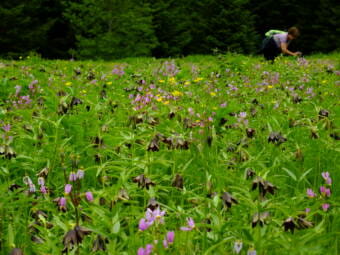
A meadow off Sawmill Creek near Berners Bay. (Photo by Matt Miller/KTOO)

As part of the Kayaani Sisters Council, Naomi Michalsen helped develop a free guide for people who want to learn about how to sustainably and respectfully gather local plants. For this week’s Garden Talk, Michalsen shared some reflections on the practice of respectful harvesting.

“I didn’t really grow up talking about respectful harvesting. We didn’t say, ‘Hey, let’s go out and harvest respectfully!’” she said. “In today’s world, it seems like things are changing so quickly, that it is how we’re talking, and it is how we’re going out.”

She said that starts with building an understanding of the history and culture of the Indigenous people who have stewarded the land where you want to gather plants.

“Starting with our young kids, to kind of start with that idea that before we even go out to harvest — who are the people that live in the land that we’re harvesting? Build a deeper understanding and connection to the people on whose lands you are harvesting,” she said.

Michalsen said people should also feel spiritually prepared before they go out.

“Some people say a blessing or a song — a prayer. They might meditate, they might talk or sing to the plant. They might announce to the ancestors that they’re there,” she said. “Some people even said that their grandmother told stories the night before about the plant that they were going to harvest, and they would dream about this plant.”

Michalsen also emphasized that language  is a powerful vessel for expressing gratitude and respect. She explained that learning and using the traditional names of plants is a great way to practice. 

“I have a friend in Juneau, George Holly, he’s been working with a lot of the young children, and they’re creating songs around the plants and the environment around them. So it’s okay to create songs as well,” she said.

And she said it’s important to acknowledge one’s teachers.

“For example, Holly Churchill was one of my teachers when I learned how to gather cedar bark. So I always acknowledge that. Rita Blumenstein was one of my teachers around the plants, and so I acknowledge her as one of my teachers,” she said. “So, always acknowledging the people of the land, people that were your teachers — and I always would even gather for them as well, especially when they became older.”

A free, printable version of the Respectful Harvesting Guidelines is available on the University of Alaska Fairbanks website. Come back next week for more from this conversation. 

Correction: An earlier version of this post misspelled Michalsen’s last name.

Garden Talk: Juneau’s Jensen-Olson Arboretum celebrates Public Gardens Day and Primula Day

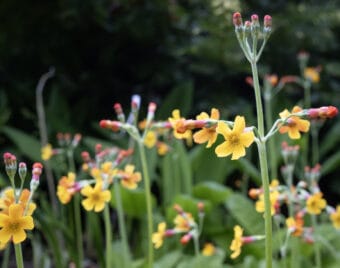
Primula chugensis. (Jensen-Olson Arboretum)

Green things have been sprouting up all over Juneau in the past month and a half. Along with the warmer weather comes a burst of color and life at the Jensen-Olson Arboretum. 

Ginger Hudson, the arboretum’s manager, recently spoke with KTOO’s Garden Talk about what the arboretum has planned for Memorial Day weekend.

On Saturday, the arboretum will celebrate both National Public Gardens Day and their own Primula Day. There will be a plant sale starting at 10 a.m. and a guided tour of the garden with members of the American Primrose Society beginning at 11 a.m. 

Primula auricula, sometimes called bear’s ears primrose. (Jensen-Olson Arboretum)

Hudson says Public Gardens Day is a recognition of gardens across the country, which she says are like “plant museums” where visitors can explore unique collections. “It’s important to preserve these lands that are unique or special or have special plant collections. Some may have plants on them that are not found anywhere else in the world. And just to let folks know, ‘Look, this is another place you can come and relax or get ideas for your own garden.’” Hudson said. 

The arboretum’s Primula Day is dedicated to the genus Primula, or primroses. Husdon says the arboretum cares for more than 170 varieties, including some that are considered threatened.

“We’re really excited about that because they grow really well here,” she said.

Primula denticulata (purple balls) and Primula elatior (pale yellow mass). (Jensen-Olson Arboretum)

Hudson said that Caroline Jensen, who donated the arboretum property, loved primroses.

“The previous manager developed her collection into a larger collection for the accreditation acknowledgment — that puts us on the national and international stage. So we collect seeds and plants from all over when we can,” she said. 

Visitors can buy their own Primulas from the arboretum during the plant sale. But for people who can’t grow them at home, Hudson says the gardens at the arboretum remain an accessible resource for everyone to enjoy and appreciate nature’s beauty.

“That’s why we have public gardens! If you don’t have a garden at home but you like gardens, well, you need to just come in and hang out here!” she said. 

Primula ‘Lady Greer.’ (Jensen-Olson Arboretum)

The Jensen-Olson Arboretum is currently open to the public from 9 a.m. to 5 p.m., Wednesday through Sunday. Admission is free, although donations are always welcome. You can find a full list of the arboretum’s future events online at friendsjoarboretum.org/events.

Garden Talk: Jensen-Olson Arboretum previews upcoming events for Alaska Native Plant Month

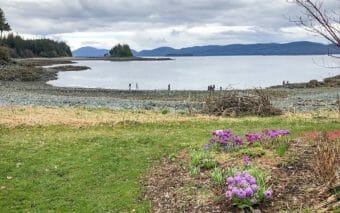
The view from Jensen-Olson Arboretum in Juneau. (Photo courtesy of the Jensen-Olson Arboretum).

Spring is in bloom at Juneau’s Jensen-Olson Arboretum.

Ginger Hudson manages the arboretum, a city-owned garden located out the road just pass the Shrine of St. Therese. She spoke with KTOO’s Garden Talk about spring planting and upcoming events at the arboretum for Alaska Native Plant Month.
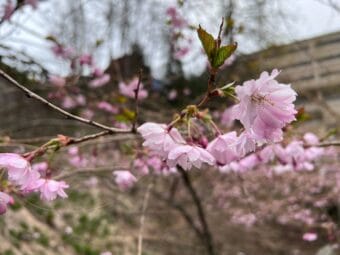
“In the Lower 48, Native Plant Month is in April,” Hudson said. “And as everybody knows, our gardens are still waking up.”

Alaska Native Plant Month takes place in May and was established last year to recognize the importance of native species and encourage Alaskans to plant them in their gardens.

On Sunday, the arboretum will host a free native plant walk at 11 a.m. that anyone can join.

The arboretum is home to a nationally-accredited primrose collection. There are more than 170 varieties of primroses on the property today. Hudson says they’re in prime bloom at the moment, so now is the time to see them.

“If you can make it out earlier, the primroses are in prime spectacular color right now,” she said. “But they do bloom from April until frost. There is always some kind of primula growing.”

You can also stop by next Saturday for Public Gardens Day and Primula Day, when the garden will hold a plant sale and host tours.

Hudson also shared recommendations for native plants to grow in local gardens, including flowering and fruit-producing varieties.

Find a full list of future events online at friendsjoarboretum.org/events.

Garden Talk: Good pruning technique can help your trees and bushes reach their potential

A cherry tree in blossom by the stairs behind Fireweed Place in Juneau on April 24, 2024. Buyarski says the cherry trees downtown are “severely, really thick,” and that pruning would help a lot. (Will Mader/KTOO)

If you’ve taken a walk outside in Juneau lately, you’ve probably noticed the smell of growing things. Maybe you’ve also noticed the budding and blooming trees and bushes.

Master Gardener Ed Buyarski says proper pruning techniques can help your trees reach their full potential. He says to start with some basic rules.

“First, take out any deadwood. The deadwood doesn’t do the tree any good,” he said. “This winter, with some of the heavy snow we had, there’s been a lot of broken branches. So trim those off neat and clean.”

He says that for apple and cherry trees, the goal is to create a “slightly open center,” without branches rubbing each other.

“We want to open the tree enough so the sun gets through to the flowers and the fruit and the leaves,” he said. “They even talk about, well, “A robin should be able to fly through your tree without hitting its wings.”

He also says that it’s important not to prune too much in the spring because that will only lead to more pruning.

“So you don’t want to take too much off. They say 20% maybe, at most,” he said. “If you stimulate too much new growth, that means you have to do more pruning. It’s kind of a vicious circle, this time of year.”

He says that’s not true for pruning later in the year, though.

“There’s actually a time from mid-June to mid-July for pruning, which is going to slow down the growth,” he said. “Because most of the energy in the tree is up in the branches and trunk.”

Buyarski says not to leave stubs, not to seal your pruning cuts with paint or anything rubbery, and not to fill cracks in the trunk.

“That is not beneficial,” he said. “But cleaning tools in between, especially moving from tree to tree, if you have a little container with some 10% bleach solution, you can dip your pruning tools into that or paint them with it so that you’re not transferring diseases from one tree to another.”

Buyarski also emphasized the importance of using clean and sharp tools, fertilizing the trees, and reducing competition from weeds and grass around the roots.

Garden Talk: Transplanting starts and seeding potatoes

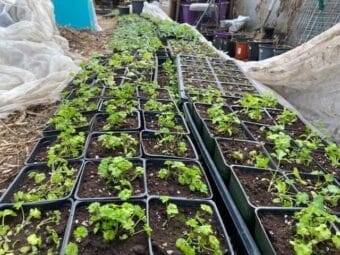
Parsley and flower starts in the process of being hardened off on April 22, 2024. (Photo courtesy of Christina Castellanos/Snowshoe Hollow Farm)

With all of this spring sunshine warming the earth, Master Gardener Ed Buyarski says it’s time to think about starting seeds and transplanting. But before you put your seedlings in the ground, you’ll have to get them ready.

“Hardening them off is slowly getting them used to outdoor conditions,” he said.

Buyarski says it’s best to start taking your seedlings outside when it’s cloudy – or at least put them in the shade.

“And only doing this for a short time like an hour the first day and then two hours tomorrow and then three or four hours the next day,” he said. “You’re gradually getting them used to longer time periods outdoors.”

Once you’re ready to put them in the ground, Buyarski says you can use a horticultural fabric like Reemay or Agribon to help your transplants prosper.

“It provides a little bit of shade, a little bit of frost protection, and holds a few degrees of heat,” he said. “But the rainwater can still go through, the air goes through, some light goes through.”

And as far as seed potatoes go? It may not be as simple as grabbing your winter root cellar rejects, unless you grew those yourself.

“I do not recommend using regular eating potatoes from the grocery store for that purpose,” he said. “Eating potatoes do not have the same inspections for diseases and stuff.”

Buyarski said that if you don’t have your own, you should try to buy certified seed potatoes instead.

Site notifications
Update notification options
Subscribe to notifications