Clarise Larson

City Government Reporter, KTOO

"My mission is to hold Juneau’s elected officials accountable for their actions and how their decisions impact the lives of the people they represent. It’s rooted in the belief that an informed public has the power to make positive change."

When Clarise isn't working, you can find her skijoring with her dog, Bloon, or climbing up walls at the Rock Dump.

Telephone Hill tenants file lawsuit as city plans next steps for redevelopment project

A sign leans against a tree in the Telephone Hill neighborhood on Tuesday, Nov. 4, 2025. (Photo by Clarise Larson/KTOO)

Tenants living in Juneau’s historic Telephone Hill neighborhood had until last weekend to move out.

But some didn’t, and three of them are now suing the city to reverse the evictions. At the same time, city officials are discussing the next steps for the downtown neighborhood’s redevelopment into new, denser housing.

The city’s Nov. 1 eviction date for Telephone Hill tenants has come and gone, and now, the city is laying out the plan for what lies ahead for the neighborhood.

“It is really the only piece of property that is large enough to be able to support maximum density housing and really move the needle on housing in Juneau,” City Manager Katie Koester said at a Juneau Assembly committee meeting Monday night.

She and Assembly members discussed what’s next for the controversial redevelopment project.

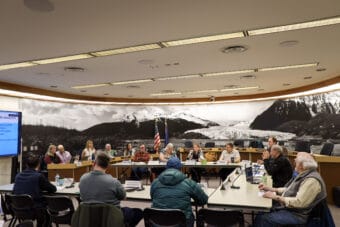
City Manager Katie Koester speaks during a Juneau Assembly committee of the whole meeting on Monday, Nov. 4, 2025. (Photo by Clarise Larson/KTOO)

The discussion came just days after three tenants living on Telephone Hill filed a joint civil lawsuit against the city on Halloween, seeking to reverse the evictions. City leaders did not mention the lawsuit at the meeting.

The plaintiffs claim the city improperly evicted people on the hill, illegally phased the redevelopment and that the project fails to comply with federal and state historic preservation acts.

Joe Karson is one of the plaintiffs. He’s 80 years old and, as of Tuesday, hadn’t moved out of his apartment on the hill.

“They came and told me today that I have to be out by eight o’clock tomorrow morning, and I won’t be,” Karson said.

He says he plans to fight the evictions and demolition as long as possible. He pointed out that the city doesn’t have a developer lined up yet.

“The idea is that at some point, someone will build something — that’s their idea of a project? What on earth is that?” he said.

City Attorney Emily Wright says the city’s law department is reviewing the lawsuit and plans to file a response shortly. She says the city believes it has no merit.

All of the residents of Telephone Hill were renters and had been since the state took ownership of the neighborhood in the 1980s. The state transferred ownership to the city in 2023. Last year, the Assembly voted to redevelop the neighborhood to build denser housing on prime downtown real estate to ease Juneau’s housing crunch.

The city wants to find a developer willing to build four mid-rise apartments, which could create an estimated 155 new housing units. But, right now, there’s no developer signed onto the project.

“This is a unique gem that a community doesn’t get an opportunity very often to have property so centrally located with utilities with infrastructure in their community,” Koester said.

Trees outline the Telephone Hill neighborhood in downtown Juneau on Monday, June 9, 2025. (Photo by Clarise Larson/KTOO)

According to a 2024 assessment, Juneau is in immediate need of at least 400 new housing units.

The project has come with a lot of pushback from local advocates. That’s in part due to the history of the hill — it was home to Alaska’s first commercial telephone service, and many of its houses were a part of the original Juneau townsite in the late 1800s. All seven structures are slated for demolition this winter.

This past spring, the Assembly approved spending $5.5 million to tear them down and prepare the land for new buildings. The Assembly chose to front that cost in order to attract developers and tack on some affordable housing requirements.

Koester said the city plans to select a developer early next year so that construction can begin in 2027.

At Monday’s meeting, she spoke to an audience filled with advocates against the plan. She said that the decision to redevelop the neighborhood is not an easy one, but added it has the potential to dramatically move the needle on the city’s lack of housing availability and affordability.

“Telephone Hill really does represent some of the most developable property, well-located in our community, and it’s been really hard to struggle with those decisions,” Koester said.

According to Wright, as of Tuesday tenants are still occupying three residences on Telephone Hill. The city plans to take legal action against those tenants on Wednesday.

Haines and Skagway both oppose Cascade Point ferry terminal. Juneau hasn’t taken a stance.

This is a concept design drawing of a new ferry terminal facility in Juneau at Cascade Point. (Alaska Department of Transportation and Public Facilities)

The Juneau Assembly doesn’t plan to take a stance on whether it’s in favor of the state’s proposed Cascade Point Ferry Terminal north of Juneau. That’s despite Haines and Skagway openly opposing the project.

The new ferry terminal would be located beyond where the road ends in Juneau on land owned by Goldbelt Incorporated, a local Alaska Native Corporation. The project is slated to cost tens of millions of dollars. 

Juneau already has a ferry terminal in Auke Bay. The new terminal would be about 30 miles north of the Auke Bay terminal. The state has been pushing for the new terminal for several years, saying it would benefit travelers by reducing operating costs and travel time between Juneau, Haines and Skagway. 

But in an interview, Juneau Mayor Beth Weldon said that the Assembly has other priorities to focus on right now. 

“I don’t think we ever took a stance on it because we just had other, more pressing issues, like the flood,” she said. “We’ve been dealing with that for three years now, and now we’re dealing with budget cuts and everything else, so I don’t see it coming back on our plate for quite some time.”

Multiple Assembly members declined to share where they stood on the topic. Member Paul Kelly said he is “not yet convinced that this is the best solution to help Juneau and other communities in Southeast Alaska improve our interconnectivity.”

The state department of transportation has already signed a $28 million contract for the project’s first phase in July and construction could begin next summer. 

An economic analysis released earlier this month by the department weighed the financial merits. Overall, it portrayed it as having more pros than cons. That’s despite its high price tag and criticism from regional officials and members of the Alaska Marine Highway Oversight Board.

The analysis concluded the project would allow for flexible travel in the region and would play a key role in bringing a proposed new gold mine in Juneau to fruition. Canadian mining company Grande Portage wants to develop an off-site ore terminal at the new ferry dock in partnership with Goldbelt. 

The state began soliciting public comment on the first phase of the project last week. The comment period runs through Nov. 28.

Telephone Hill tenants must vacate homes by Saturday ahead of demolition plans

This is a preliminary concept drawing of what the Telephone Hill neighborhood redevelopment could look like. (Courtesy/City and Borough of Juneau)

Renters living in Juneau’s Telephone Hill neighborhood have until Saturday to vacate their homes before the city evicts them.  

That will clear the way for the city’s plan to demolish the houses in December and redevelop the area to build newer, denser housing there in response to the city’s housing crunch.

The evictions were originally slated for Oct. 1, but the city postponed them until this Saturday due to a legal hiccup. The evictions come after outcry by local advocates, who asked the city to halt them until it produces a clearer redevelopment plan. Right now, a developer has not signed on to the project. 

Advocates collected more than 800 signatures opposing the redevelopment plan ahead of the Juneau Assembly meeting on Monday. There, more than a dozen people testified in hopes of persuading members to reverse course and save the historic downtown neighborhood. However, no action was taken on the topic. 

The Juneau Assembly is slated to discuss the project and next steps for the redevelopment at a committee meeting on Monday at 6 p.m. The discussion will include the timeline for demolition and finding a developer, and will address several other questions about the project brought forth by advocates. 

Debate over Alaska’s ranked choice voting continues at Juneau Chamber of Commerce luncheon

Rebecca Braun speaks in favor of ranked-choice voting at a Juneau Chamber of Commerce Luncheon on Thursday, Oct. 30, 2025. (Photo by Clarise Larson/KTOO)

Though Alaskans approved ranked choice voting nearly five years ago, the debate about whether it actually benefits voters persists. At a Juneau Chamber of Commerce Luncheon on Thursday, two speakers shared what they think of the system. 

Alaska uses a ranked choice voting system for statewide elections. Voters approved it in 2020 and used it for the first time in 2022, though there have been attempts to repeal it. The system allows voters to rank candidates by preference. 

Rebecca Braun is on the board of Alaskans for Better Elections and spoke in favor of the system. Braun argued that ranked choice voting encourages voter participation and reduces political polarization.

“It might not be perfect, but I think that it’s better,” she said. “I don’t think there’s any voting system that like has no distortions. Mathematicians study this, and there’s almost nothing where you have 100% perfect outcomes. But this seems like to me a better system.”

Alaska is one of only two states that use ranked choice voting. Ten Republican-led states have banned it. Murray Walsh spoke against the system at the forum. He’s a retired land use consultant and is a part of a statewide campaign to repeal ranked choice voting.

Walsh argued it makes voting unnecessarily complicated and unfairly gives Democrats an advantage. The Alaska Republican Party has consistently opposed ranked choice voting. 

“Anytime you take something that people do understand and make it more complicated so that they don’t understand it, and then you’re alienating the voter,” he said. 

According to data from the state’s Division of Elections, Juneau voters appear to support ranked choice voting. The capital city overwhelmingly voted against an effort to repeal the statewide system last year, which only very narrowly failed statewide

Though the discussion on Thursday centered around ranked choice voting in state elections, the City and Borough of Juneau could soon be the first major Alaska city to adopt the system. Larger cities in the U.S. like New York, San Francisco and Minneapolis already use ranked choice voting in local elections.

Earlier this summer, Juneau Assembly member Ella Adkison proposed an ordinance to adopt the system locally. She said the change will help build community consensus. The Assembly chose to delay voting on the ordinance until after this fall’s local election. Members are expected to take the topic back up in the coming weeks. 

Correction: A previous version of this story used the wrong title for Rebecca Braun. 

Newscast – Wednesday, Oct. 29, 2025

In this newscast:

  • Federal subsidies for rural air travel will continue through at least mid-November despite the government shutdown. That’s according to a notice from the Transportation Department telling air carriers that it’s found enough funding to continue paying Essential Air Service subsidies through Nov. 18.
  • The state’s plan to build a new ferry terminal north of Juneau has sparked calls for more information about the project … and, what justifies it. The state recently released an economic analysis to that effect. But, at least so far, the report hasn’t done much to ease concerns – particularly among members of a key oversight board.
  • The University of Alaska Anchorage kicked off its new school psychology master’s program this fall to address a shortage in school psychologists. But the program has so far failed to get approval from the state Board of Education over concerns about social justice advocacy. That could make it harder for students to get jobs after they graduate.
  • John Boyle, commissioner of the Alaska Department of Natural Resources, abruptly resigned his position on Friday. Gov. Mike Dunleavy announced the appointment of his deputy, John Crowther, as acting head of the agency that regulates Alaska’s agriculture, mining, oil and gas.

Newscast – Tuesday, Oct. 28, 2025

In this newscast:

  • Juneau plans to expand its temporary levee along the Mendenhall River, in part by using money originally intended for a new arts and culture center.
  • A project meant to bring more than 70 units of new workforce housing to downtown Juneau is dead before it could even break ground. The developer blames the city for stopping it. The city says the project was a risk to public safety.
  • The Juneau Assembly approved merit and cost-of-living pay bumps to Juneau’s city manager and city attorney Monday night.
  • It’s been almost three weeks since a storm caused major flooding and erosion damage to infrastructure in Kotzebue and other Northwest Arctic communities. And that was before the remnants of Typhoon Halong made their way through the region.
Site notifications
Update notification options
Subscribe to notifications