David is currently part of the 360TV team working on major digital and content projects. Formerly he worked in the newsroom as Digital Director overseeing digital platforms.
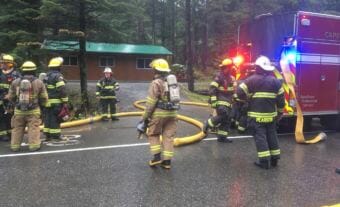
Emergency personnel and vehicles at the scene of a house fire on North Douglas Highway on Tuesday. (Photo by Matt Miller/KTOO)
Firefighters put out a north Douglas house fire Tuesday afternoon. Emergency personnel and vehicles blocked North Douglas Highway while fighting the fire a little more than half a mile north of the Douglas Bridge.
The occupants of the home were away when the fire started. Firefighters tried to revive two dogs found inside the house, but the animals did not survive.
The fire was out by around 4 p.m. and the highway was re-opened. The cause and origin of the fire were still undetermined.
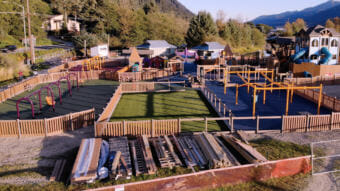
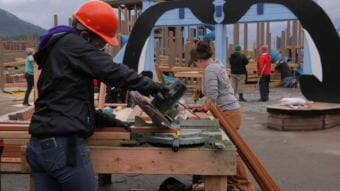
The community build portion of construction for the new Project Playground began on Wednesday and continues through Sunday. The project is still seeking volunteers with different levels of experience (including kids over 10) and also needs to borrow tools including drills, speed squares, carpenters squares, tape measures, and 4-foot levels.
Listen to Jacob Steinberg’s audio postcard from the construction site, featuring Mike Goldstein, Joyce Levine, Norton Gregory and Sherri McDonald.
The construction of Project Playground continues until the end of the day Sunday. To volunteer or for more information, go to the project web site.
House District 33 represents Skagway, Haines, Klukwan, Excursion Inlet, Gustavus, downtown Juneau and Douglas.
Dimond and his family have deep roots in Alaska. Juneau residents may recognize the family name from Dimond Courthouse, Dimond Park and other locations around the city.
After high school, he found college wasn’t for him and tried a few different jobs — but nothing really clicked until he started working in construction.
“I started doing it on and off and it fit,” he said. “It was a comfortable fit for my personality type and who I am.”
“Everybody saw it as our identity was being stripped away and everything was being taken away from us,” Dimond said.
He doesn’t feel the same way about the merger now, but at the time, his frustration prompted him to get involved. He was elected to a position in the local union, which led to part-time work as an instructor and eventually his current job as an organizer.
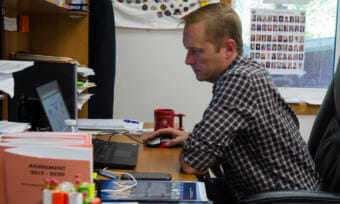
As one of just two employees in Juneau, he does a little bit of everything — he coordinates with state and local governments, checks compliance with union requirements and shares information with members.
He also spends time visiting job sites; sometimes to look into tips or complaints, sometimes just to stay connected to workers.
He said advocating for those workers is part of his run.
“I’ve seen some movement in the last two years to better support workers and their rights,” he said. “I think we can do better. So, I decided this was the year to do it – kind of put my money where my mouth is.”
Dimond also hopes to shift the atmosphere in the Legislature. He said he’s seen a lot of dysfunction in the legislative process. As an independent, he wants to bring more compromise and collaboration to the process.
As a father, he’s also concerned about education. He feels school funding has stagnated and views education beyond the traditional core subjects as critical.
“If we’re not educating our children, we’re not building a very strong future for ourselves,” he said. “I’d like to see more vo-tech classes and art classes, those type of classes that keep kids engaged. They’re expensive classes but they’re vital to helping create well-rounded adults.”
To pay for government, Dimond supports looking closely at agency budgets to find more targeted cuts and efficiencies.
“It does have some negative impacts on lower income folks,” he said. “For that portion of it I would like to see if there’s a way that we could address that maybe there wouldn’t be an impact to those communities and those people that really heavily depend on the permanent fund. But then there’s plenty of other people in this state that don’t need that income.”
Dimond thinks making ends meet might also require some tough decisions on new revenue.
“I’m also not entirely opposed to an income tax,” he said, adding that Alaska residents “enjoy road systems and our ferry system, airports and schools. All of those things need funding, and if we want to have a society that functions well and is inviting to investment dollars from startup businesses and outside corporations, then we need to make sure that we have a top-notch running state. We all have to have skin in this game.”
Dimond supports the Juneau access road and believes that it should complement a strong ferry system.
He likes the plan developed by the Southeast Conference to turn the ferry system into a publicly owned corporation. But he believes that the state will likely have a continuing role in subsidizing its operations.
Dimond, an independent, won’t be on a ballot in the on Aug. 21 primary election. He’ll face off in November against whoever wins the Democratic primary.
For more candidate profiles and election information, visit ktoo.org/elections.
Today, ALE&P celebrated their 125th anniversary with festivities including tours of the historic Gold Creek Hydro Plant.
The plant was built in 1896, but it’s been expanded several times since then. Today, the hydropower it generates supplies just a small fraction of Juneau’s power.
Diesel generators were added in the ’50s and ’60s, but were taken out of regular usage in 1973 when the Snettisham Hydroelectric Project came online. Today, the generators still supply crucial backup power. AEL&P briefly switches to diesel during maintenance operations a few times a year, according to Vice President and generation engineer Christy Yearous.
Click on an image below to enter the 360° view – the click or tap and drag to look around inside the plant.
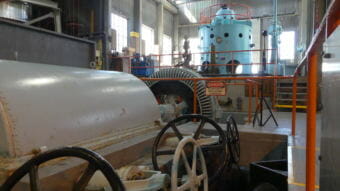
The smaller hydroelectric generator recessed into the floor is an older model, the others are more recent additions. The valves with hand wheels on them (recessed into the floor) control the flow of water, and thus how much power it generates. They are still operated by hand to start the generator and adjust its output.
Here are some of the five diesel generators that can provide power in an emergency or during routine maintenance. The diesel generators have to be turned on every couple of months for testing and maintenance. In an emergency they can provide power directly to the federal building (which houses FEMA) without going over the public power grid.
This is the control center for the plant. All of Juneau’s power was once coordinated from here, using the telephone in the booth that still sits in the corner (although it now holds a newer phone). Now, that coordination is computerized from a different location. The computer on the desk monitors key functions of the plant, including water supply and power output.
Just before Brotherhood Bridge, the Mendenhall River takes a short detour. It loops east for a few hundred yards and then doubles back. It’s called an oxbow, a U-shaped departure from the river’s trajectory.
But it might not have this shape for long. The extra water in the river from flooding cut through the oxbow Thursday.
Tom Mattice is the city’s emergency program manager. He said this spot on the river has been eroding for years.
“It went from a trickle of water to 100 yards wide in about an hour,” he said. “And as that continued to widen, the trees on the banks continued to fall into the hole, and as they would block the hole, the water would go to the outsides around the trees and continue to erode the bank further and further.”
Water flows through the new gap in the oxbow on Mendenhall River. (Photo by David Purdy/KTOO)
The river hasn’t completely changed course yet — there’s still water flowing around the old route. But Mattice thinks that will change over time, possibly during future flooding. Exactly what those changes will look like or when they happen is hard to predict.
But he said anyone with property along the river should count on erosion.
“If you don’t stabilize your banks, your banks are going to change,” he said. “And so, this area will have probably more change than some other areas, but everywhere on the river has change.”
Water flows through the new gap in the oxbow on Mendenhall River on Thursday. (Photo by David Purdy/KTOO)
Mattice said the river is probably changing faster than it has in the past because 11- and 12-foot floods are more common now.
“If you have one 100-year flood in an area, then the trees grow back,” he said, “and the next time that event occurs the trees are 99 years old protecting that bank. When you have a 100-year flood back to back to back to back to back, the trees and vegetation can’t keep up. So in general, due to this accelerated change on the Mendenhall, due to a lot of high water events, the river banks are probably less stable than they are traditionally.”
He said sooner or later property owners along the river will have to stabilize their banks, or see them worn away by the river’s natural tendency to change course over time.
Close
Update notification options
Subscribe to notifications
Subscribe
Get notifications about news related to the topics you care about. You can unsubscribe anytime.