Heather Bryant

Below-average temps seen in Alaska cities

Alaska’s three largest cities saw below-normal temperatures in July.

The National Weather Service says the average monthly temperature for Fairbanks was 60.8 degrees, 1.7 degrees below average. In Anchorage, it was 55.5 degrees, 3.3 degrees below average. In Juneau the average monthly temperature was 54.9 degrees, down 2 degrees from average.

It was also wet. Meteorologist Dan Peterson says Anchorage, for example, got 2.14 inches of rain last month. That’s 1.96 inches above average.

Peterson says he’d love to say the weather’s going to change but that doesn’t appear to be the case. He says there might be a couple nicer days here and there, before it’s back to the same pattern that’s played out this summer.

The track of the jet stream is blamed for the wet, cool conditions.

AK crime stats: jump in assaults against police

Statistics gathered by Alaska State Troopers show the state has seen an increase in assaults against law enforcement.
The head of the state patrol says officers are dealing with more aggressive behavior from suspects.

Col. Keith Mallard says law enforcement officials take every possible step to capture individuals without violence. But sometimes the behavior of a suspect puts the police officer’s life or other people’s lives in danger.

Federal Bureau of Investigation statistics show an upward trend in the number of assaults against officers in Alaska, while nationally, the numbers have decreased.

In Alaska in 2010, the most recent statistics available, 386 officers were assaulted. That’s an increase over the 315 officer assaults in 2009 and 287 in 2008.

Mars Rover Pulls Off High-Wire Landing

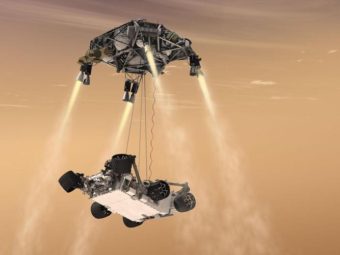
An artist’s rendering shows a rocket-powered descent stage lowering the one-ton Curiosity rover to the Mars surface. (NASA/JPL-Caltech)

The best place to stand in the entire solar system at 1:14 a.m. ET Monday was about 150 million miles away, at the bottom of Gale Crater near the equator of the Red Planet.

Looking west around mid-afternoon local time, a Martian bystander would have seen a rocket-powered alien spacecraft approach and then hover about 60 feet over the rock-strewn plain between the crater walls and the towering slopes of nearby Mount Sharp.

A gangly vehicle, about the size of a small car on Earth, descended from the spacecraft on nylon cords amid blowing crimson dust. As soon as this machine touched the soil with its six wheels, its delivery craft abruptly disconnected the cables and, with the last of its fuel, safely careened away from its passenger. NASA’s new Mars rover, Curiosity, had landed.

Fourteen minutes later, news of these strange happenings reached the people on Earth who were responsible:

“Touchdown confirmed!”

With those words, the mission control team at the space agency’s Jet Propulsion Laboratory in Pasadena, Calif., erupted in cheers, applause and hugs. And as the first pictures began to arrive from their nuclear-powered explorer, the celebrations grew louder and continued well into a televised news conference an hour later.

Curiosity's shadow on the surface of Mars, just minutes after the rover landed on the surface of the planet.

NASA/JPL-CaltechCuriosity’s shadow on the surface of Mars, just minutes after the rover landed on the surface of the planet.

“Needless to say there’s a lot of excitement in this room,” said the laboratory’s director, Charles Elachi.

When it comes to visitors like the $2.5-billion Curiosity rover, Mars has been a reclusive, get-off-of-my-lawn host. Of 13 previous attempts to land space probes on the Red Planet over the past four decades, nearly half failed or immediately lost contact.

Those odds were enough to make for a tense scene at mission control in the days and hours leading up the landing. “You can’t believe the tension and uncertainty here at JPL,” NPR science correspondent Joe Palca reported from the laboratory. “The anxiety just couldn’t be denied.”

The novel use of the rocket-powered “sky crane” to lower the one-ton robot to the Martian surface only added to the drama.

“I was on the edge of my seat,” former astronaut and NASA Administrator Charlie Bolden Jr. told NASA TV moments after the landing.

With the suspenseful landing behind them, mission controllers quickly turned their attention to Curiosity’s coming months of work on the Martian surface. The rover is expected to spend two years exploring Gale Crater and the three-mile-high mountain within it.

“Tomorrow,” JPL’s Elachi said, “we’re going to start exploring Mars.”

NASA TV has been streaming video of the overnight events at the Jet Propulsion Laboratory and plans to carry the next scheduled news conference at Noon ET.

For more details on this historic event, check out NPR’s ongoing coverage here.

Health commish responds to abortion reg concern

Alaska’s health commissioner says his department didn’t intend to restrict the definition of a medically necessary abortion in proposed regulations for abortion payment conditions.

Commissioner Bill Streur was responding to Sen. Hollis French, who said the agency is seeking to reinstate criteria overturned by the Alaska Supreme Court.

The court held the state must fund medically necessary abortions if it funds medically necessary services for others with financial needs.  A legal opinion requested by French said phrasing used in the proposal is narrower than current law, and “reasonably likely” to be found unconstitutional.

While French asked Streur withdraw the proposal, Streur said the department would determine, after reviewing all public comment, whether to make language changes.

Streur said a court would ultimately decide constitutionality if the adopted regulation were challenged.

Fishing boat sinks near Sitka AK; crew rescued

The Coast Guard says a 50-foot fishing vessel capsized and sank while pulling in loaded salmon nets but another nearby boat rescued all five of the stricken vessel’s crew members.
Lt. Ryan Erickson says the Evening Star sank early Thursday about 40 miles northwest of Sitka, Alaska.

The boat went down in Slocum Arm in 300 feet of water with about 1,000 gallons of diesel fuel aboard. The fishing vessel Chickamene came to the rescue and took the Evening Star’s crew to Sitka.

Erickson says the Coast Guard is working with the vessel owner to deal with pollution and salvage the boat if possible.

Inspectors saw a sheen in the area Thursday afternoon, prompting the Alaska Fish and Game Department to announce an emergency closure of an active salmon fishery.

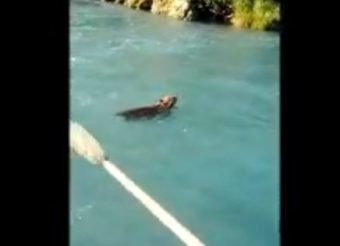
Video: Men floating Alaska river save drowning bear

Three Alaska men are being credited with saving a brown bear from drowning.

Dustin Klepacki was floating the Kenai River with his father and friend last weekend when they came upon the bear cub drowning in a whirlpool.

They tried to bump the bear out of the whirlpool, but the water caught their boat and they turned in circles as the bear became more frantic.

Finally, the current brought the boat up against the bear, and Dustin’s father, Mike Polocz, was able to nudge the bear to slower-moving water. The bear swam to shore. Polocz writes that the cub let out one more cry for mom on shore and the men heard her coming back for the cub.

Another friend, Charlie Mettiale , filmed the rescue on his iPhone, complete with the bear’s cries.


Site notifications
Update notification options
Subscribe to notifications