Heather Bryant

New greenhouse project is in the works at Lemon Creek Correctional Center

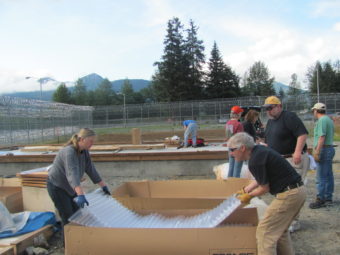
The Juneau Rotary Club is building a greenhouse at Lemon Creek Correctional Center. So far the foundation has been laid at the east end of the campus.

A city attorney, master brewer, architect, a reporter and several gardening enthusiasts are part of the Rotary work crew at Lemon Creek Correctional Center. The project was chosen by the Juneau rotary club as a way for volunteers to give back to the community.

Rotarian Sharon Gaiptman came up with the idea in 2010. When a prisoner told her that flowers lining the runway in a fashion show were the first things he’d seen grow since being locked up. The annual event called “Success Inside and Out” is aimed at preparing prisoners for the outside. Gaiptmen says her Rotary colleagues liked the idea.

Construction began three weeks ago on a rainy day when the cement foundation was laid. Gaiptman says it’s rewarding to see so many volunteers committed to the project.

“I am so happy to be here. I don’t care, it’s beautiful and it’s sunny today. But it wouldn’t matter if it were raining again, it’s happening as you can see,” Gaipman said.

Sandy Williams, Wayne Jensen, Denny DeWitt and Clark Gruening are the main project crew.

Gruening expects the greenhouse will enable some of the inmates to learn something about horticulture, agriculture, greenhouses.

Rotarian Denny DeWitt jumped on board as the community service director for the project. Dewitt says the greenhouse will be less obvious to the community than past projects.

“It’s the kind of project that is not gonna be on Egan, not everyone is gonna see it. But that’s not the important part. The important part is it’s gonna do some constructive things for folks that are in our community,” Dewitt said.

DeWitt has coordinated with prison superintendent Scott Wellard. The prison actually had a greenhouse in front of the facility for twenty years, but it was destroyed by high winds.

The new greenhouse will be maintained by prisoners and will grow edible produce and possibly flowers. DeWitt says it’s likely some of the vegetables may be used to feed the prisoners.

As for the materials, it all came in a greenhouse kit that contained plastic siding, wood, aluminum doors, and tools like riveters and nails. The kit was paid for by fund-raising efforts done throughout the year like the Rotary rose sale and wine auction. The total cost of the greenhouse is around $13,000. Architect Wayne Jensen is supervising the construction.

He has used his expertise on many previous projects for the rotary club, including the picnic shelter in Cope Park, another picnic shelter in Auke Bay, and the wetlands viewing deck off Egan drive. Jensen says he’s constantly looking for what to do next for his community.

“Once there’s an opportunity to do some more projects, you always want to take advantage of it,” Jensen said.

Rotarian Mary Lou Gerbi, who is also a gardner in her spare time, says she believes the project may help prisoners.

“This is a unique community so I truly believe there is the possibility of reform and maybe finding yourself, finding a different self. Maybe nurturing yourself through nature,” Gerbi said.

Rotary volunteers will work on the greenhouse until it’s completed. Jensen says it could take anywhere between 2 to 20 Saturdays.

Mat-Su officials ponder ferry’s fate

Officials in the Matanuska-Susitna Borough are trying to figure out what to do with their $80 million ferry.
The commuter ferry Susitna was completed earlier this year, but remains docked in Ketchikan since there are no places for it to land in either the borough or Anchorage.

The borough assembly in July learned that it’s costing taxpayers almost $67,000 a month to keep it in Ketchikan.

Borough assembly members are considering whether to sell it or just beach it, and will discuss it again at the Aug. 9 meeting.

Mary Louise Rasmuson dies at 101

Mary Louise Rasmuson. (Photo courtesy of the Rasmuson Foundation)

Mary Louise Rasmuson, one of Alaska’s most well-known women, died in her home yesterday in Anchorage. She was 101.

Rasmuson was a fixture in Alaska arts and history as one of the state’s most generous supporters of arts, education, history, culture and science.

She championed the effort to establish the Anchorage Museum of Art and History in 1968.

Before coming to Alaska, Rasmuson was an assistant principal in Pittsburgh, PA. She left that position to become a member of the Women’s Army Corp when the U.S. joined World War II. She eventually became the fifth commandant of the WAC in 1957.

According to the Rasmuson Foundation, military historians credit her with major achievements including increasing the WAC’s strength, insisting on effectiveness in command, working with Congress to amend laws that deprived women of service credit and benefits, and expanding the range of military opportunities open to women.

Many point to Rasmuson as a champion for women. She served in the military for 20 years. She received a Legion of Merit award with two oak leaf clusters for her work integrating black women into the WAC. She was also awarded the Women’s Army Auxiliary Corps Service Medal, the American Campaign Medal, World War II Victory Medal, Occupation Medal and National Defense Medal. At an event honoring her, former U.S. Secretary of Defense William Perry said, “When you hear about women seizing new opportunities to serve, remember that they march behind Colonel Rasmuson.”

Mary Louise Rasmuson. (Photo courtesy of the Rasmuson Foundation)

Rasmuson moved to Alaska in 1962 after marrying Elmer Rasmuson, then chairman of National Bank of Alaska.

She was active in a number of organizations in Alaska. In 2009, she was inducted into the Alaska Women’s Hall of Fame.

According to the Rasmuson Foundation, Mrs. Rasmuson remained active with many organizations and most recently had been serving as honorary chair and patron of the Veterans’ Memorial Project.  She has also served on the national board of American Cancer Society, U.S. Army Alaska Citizen’s Advisory Committee, and led the Anchorage March of Dimes Campaign. She was affiliated with Zonta, American Association of University Women, Alaska Native Sisterhood, Veterans of Foreign Wars, Virginia Mason Board of Governors, Palm Springs Desert Museum and Seattle Art Museum, amongst many others. She was a lifetime member of Association of U.S. Army and the National Association for the Advancement of Colored People.

The family has invited everyone to the funeral mass, Sept. 1o at Our Lady of Guadalupe Church.

In lieu of flowers, the family requests that memorial gifts be made to Anchorage Museum at Rasmuson Center, 625 C Street, Anchorage, AK, 99501.

Gas taxes will be part of getting new pipelines

The Parnell Administration is beginning to consider what needs to be done with the state’s tax on gas production.   Currently it is coupled with the oil tax regime,  but legislators were told today that it’s time to begin planning  a new system  to encourage gas line development  for in-state use – as well as for export.
Gas exploration companies and the Parnell Administration are anticipating an alignment of interests this Fall that could make is easier to deliver natural gas from the North Slope to  South Central and the Railbelt.   Part of that alignment will be the development of a gas tax regime that reflects what Deputy Natural Resources Commissioner Joe Balash told the In-State Gas Caucus is a effort for the state to – quote – “recalibrate its thinking.”  He says a gas pipeline project from the North Slope was originally based on sending gas to the lower-48.  The focus now is on exporting liquefied gas to Pacific markets.

The original construct of AGIA had within it upstream inducements that were made available for that first open season, but because there were no firm transportation commitments resolved there,  those particular inducements are no longer statutorily available.   So we recognize the need to adjust a few things relative to those kinds of inducements for an LNG-focused project.

Natural Resources Commissioner Dan Sullivan says there has been no specific element of a new tax regime yet considered – saying staff is looking at broad principles while considering the options as a project comes together.  He told legislators that oil and gas companies,  along with the state and Trans-Canada pipeline company are still coming up with details for an export  project with results expected in September.  Balash said legislators should have a new plan to consider during next year’s session.

When January rolls around, I think there’s a reasonable expectation that the governor’s going to keep oil tax legislation on the front burner and there will be some means of addressing natural gas – be it commercialization or in-state use or both.  Exactly how or what we do as an administration will be determined in that time frame.  It’s premature to say with any degree of specificity what that will look like.

The Caucus also got updates from the Alaska Gasline Development corporation on its plans for a smaller gas line to Fairbanks, the Railbelt and South Central.   CEO Dan Fauske said the project is behind schedule for holding  an open season next year because lawmakers did not provide sufficient funding for all the work leading up to the offering.  However, he said  planning work is still continuing and new budgets are now being prepared that will fit in with expectations of more commercial alignment this fall.

Jökulhlaup at Lake No Lake causing rise in Taku River

Forecasters with the National Weather Service in Juneau have detected a rise in the Taku River as well as dropping water temperatures caused by flooding from a jökulhlaup at Lake No Lake.
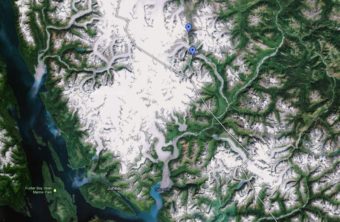
Lake No Lake is located in British Columbia.

View Taku River Jökulhlaup in a larger map

Observers noted the changing levels and temperatures on Sunday afternoon.

Richard Lam with the Juneau office says they are expecting the river to peak at approximately 43 feet on Tuesday afternoon. That depth is a minor flood stage for the river.

“After it gets to the peak it will drop off rapidly as with most events,” Lam said. “We’ll have a rapid increase in water level and a rapid decrease once the peak is reached.”

The weather service hasn’t issued any advisories yet. Lam says they don’t know yet how much water to expect and are waiting for more information.

An update from the National Weather Service office in Juneau will be issued around 4 p.m. today.

“Over the last 24 years, the water flow has been about 48,000 cubic feet per second. Right now it’s 51,000 cubic feet per second and is expected to increase as the water level goes up,” Lam said.

When the water levels peak, the flow from Lake No Lake will be at approximately 90,000 cubic feet per second, according to Lam.

“The main impact of this right now looks like the water will be colder than normal, so if you happen to get into the water there will be a high risk of hypothermia,” Lam said.

Lam said that people might also see debris such as ice chunks and tree trunks on the river.

Earlier this summer, a jökulhlaup happened at Tulsequah Lake on June 5 and at Suicide Basin on the Mendenhall Glacier.

This is an going story. Check back here for updates.

Related:
Glacial dam on Mendenhall Glacier bursts, prompts flood watch
Flood advisory for Mendenhall Lake and Mendenhall River cancelled


Juneau’s Governor’s Picnic an annual affair

“We’re serving up some good food and good fellowship here in Juneau.”

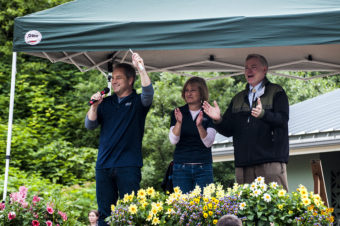
That’s how Gov. Sean Parnell characterized the fourth annual Juneau Governor’s picnic in Juneau on Friday.

He and First Lady Sandy Parnell started the evening handing out paper plates. Lt. gov. Mead Treadwell and ten commissioners and several deputy commissioners also served food at the Juneau event.

“I think it’s a great way for the community to see their government serve them and to be able to meet their commissioners and the governor and myself,” Mrs. Parnell said. “It’s nice way for us to be able to serve you.”

The capital city governor’s picnic is one of a series of four in Alaska’s major urban centers. This year a rural Alaska picnic was added in Glennallen, which the governor called the first of the “traveling” picnics.

“We held a traveling picnic in Glennallen and we’re going to do one traveling picnic a year in a different rural community,” he said.

The governor’s website asks communities to sign up for a picnic.

The last two for the year will be held in August in Anchorage and the Mat-Su.

About 2,000 people attended the Juneau picnic, according to Cathie Roemmich, director of the Juneau Chamber of Commerce, which helped organize the event.

As the line for food got shorter, the Parnell’s slipped out of the serving line and mingled with the crowd.

The governor said it’s not all picnic; Alaskans often have hard questions for him.

“Oh, all the time,” he said. “That’s part of the beauty of being out here like this.”


Site notifications
Update notification options
Subscribe to notifications