"I strive to tell stories that highlight the triumphs, struggles and resilience of students from all backgrounds as they navigate a constantly changing world."
In their free time, Jamie’s probably playing their oboe or exploring the outdoors.
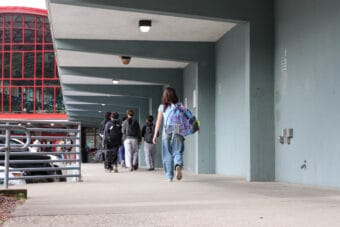
Students exit school buses outside Juneau-Douglas High School: Yadaa.at Kalé on Aug. 15, 2025. (Photo by Jamie Diep/KTOO)
The Juneau School District started off the school year with more than 90 open positions.
Of those, close to half are certified staff – positions that require a license like teachers, counselors and speech therapists. There were also openings for paraeducators, school nurses and administrative assistants.
According to staffing reports presented at a board meeting earlier this week, a quarter of the district’s paraeducator positions remain unfilled. Paraeducators are also known as teacher aides or assistants. This includes special education paraeducators, literacy paraeducators and those for various KinderReady programs.
Superintendent Frank Hauser said the shortage means the district has to make tough decisions like moving employees to different buildings in order to meet the special education needs of students.
“Those are difficult conversations [we] have to have with staff saying, ‘we need to potentially have you move from one building that you’ve been at for a couple of years to another building,’ Hauser said. “But in those decisions, the focus is always on making sure, are we meeting the needs of the students?”
The district is also filling 18 certified positions with employees from third party contractors, with three more waiting to be confirmed as of Aug. 14.
Hauser said that’s to bridge the gap in services while the district makes permanent hires. He says some contractors are working virtually, but the contracted teachers are qualified for the position.
“A lot of our third party services are experienced, qualified teachers that work for a, you know, a third party contractor and provide these services,” he said. “Many of them have extensive knowledge on a specific area of need.”
Hauser says long term substitute teachers also aren’t included in the vacancy data. The district is currently hiring several teachers from the Phillipines, an increasingly common practice in the state.
This comes as the school district continues to negotiate new contracts with its teacher and support staff unions. The school board is expected to vote on ratifying a contract for school administrators at its next meeting on Sept. 9.
The school board is also considering how to spend more than $1.5 million in state funding that was restored by the state Legislature after the governor’s veto. The school board’s priority list of things to add to the budget includes more staff positions and universal free breakfast.
Egan Library at the University of Alaska Southeast in Juneau on April 16, 2025. (Photo by Jamie Diep/KTOO)
The University of Alaska Southeast has received a grant to train school administrators at local school districts.
A $100,000 grant from the Alaska Department of Education and Early Development will pay for student tuition in the new training program.
Bryan Zadalis, a spokesperson for DEED, said the state Department of Labor and Workforce Development gave DEED money from a federal grant to pilot an educator apprenticeship program. Part of that money went toward the $100,000 grant to UAS.
UAS Dean of Education Carlee Simon said the Principal Apprenticeship Program will work with districts around the state to train future administrators while they’re working in schools.
“We’re hearing a lot of feedback through the superintendents that they have a strong teacher who really needs to serve in a leadership role, and they need to have kind of this on the job training because they don’t have the time or the ability to totally step away from their leadership, or their teaching experience,” she said.
This comes as Alaskan school districts struggle to retain teachers and principals. Data from Regional Educational Lab Northwest, an education research lab that looks into evidence-based methods to improve learning outcomes in the Pacific Northwest and Alaska, shows that principals had an 18% turnover rate in Alaska in 2021.
According to a University of Alaska report to the state Legislature, from 2012 to 2021, teacher turnover rates statewide consistently surpassed the national average.
The grant will cover the cost of tuition for students. Simon said it’s a step in keeping both good teachers and administrators in school districts.
“We know that retention of strong teachers is linked to strong leaders, and so we’re excited about being able to make sure that we have strong leaders that aren’t going to have student loan debt that will be in our school systems, because we know that they’re needed,” she said.
Simon said the University of Alaska Anchorage is also developing an apprenticeship program for principals. But she said it will be structured differently to reach a different population of aspiring administrators.
UAA and the University of Alaska Fairbanks are also running an apprenticeship program for teachers. Simon said the Southeast campus will develop its own teacher apprenticeship programs as well.
The UAS principal training program is expected to begin next fall with a cohort of 10 students.
Correction: A previous version of this story misstated questions given to DEED. The story was updated to add additional information from DEED about the source of grant funding.
The Alaska House and Senate met today in Juneau but adjourned in less than a minute.
A temporary levee in Juneau’s Mendenhall Valley mostly held back record-breaking floodwaters during the glacial outburst last Wednesday, but some homes still flooded where parts of the barrier leaked.
The president of the Central Council of the Tlingit and Haida Indian Tribes of Alaska returned from personal leave following accusations of misconduct that circulated widely online earlier this month.
Alaska Marine Lines will no longer ship electric vehicles or plug-in hybrid vehicles to Alaska or Hawaii.
Petersburg is updating its emergency plans for the first time in 15 years.
Students and families walk into Mendenhall River Community School on Aug. 15, 2025. (Photo by Jamie Diep/KTOO)
Mendenhall River Community School Principal Eric Filardi welcomed students and families over the loudspeaker Friday morning. Students filed in with their families and made their way to class.
“Good morning Mendenhall River and happy first day of school on a Friday,” he said.
But there was a small difference. The school year began a day later this year following a record-breaking glacial lake outburst flood. This was one of three schools in the flood zone. But none of the buildings flooded, and Filardi said it was a relatively normal first day of school.
“We are looking at full staffing, and we have a school that’s standing after the recent flooding. We’re starting on Pizza Friday, and it’s smiles all the way around,” he said.
The district said in an email the only damage that occurred was some fencing near Back Loop Bridge, which remained closed Friday due to damage from the flood.
Students were excited for school, including third grader Vaughn Ward. He said he’s looking forward to making new friends. Vaughn also said he didn’t mind getting an extra day off to chill.
“I rode my bike a bunch too,” he said.
Vaughn’s mother Kelsey Ward said their home on Emily Way flooded during last year’s outburst, but things changed a lot this time around thanks to the new flood barrier.
“We were displaced from our home for, what, almost seven months, and this year we stayed dry,” she said. “So it’s a different first year for us for school, or first day for our kids and for us. So that’s that’s good.”
Ward said she’s worried about her son’s class size. She hopes to be able to volunteer to support his teachers throughout the year.
Students walk under a covered sidewalk toward the main entrance at Juneau-Douglas High School: Yadaa.at Kalé on Aug. 15, 2025. (Photo by Jamie Diep/KTOO)
On the other side of Juneau, hundreds of students stepped out of cars and buses as they made their way into Juneau-Douglas High School: Yadaa.at Kalé. There, office staff handed out class schedules printed on bright pink paper.
Ninth graders typically start school a day early to familiarize themselves with the campus, but that was canceled this year because of the flood.
Principal Paula Casperson said they’re working to support the freshman who lost a day to get used to the new space.
“It’s a big transition for our ninth grade students, so we’re trying to be out, visible, helping direct traffic, calming kids when they’re feeling a little anxious about not knowing where to go,” Casperson said. “Transitions are important and they can be real hard.”
She says any students missing school because of the flood coordinated with the attendance office
“If kids are helping families for this first day, we’ll get them here on Monday, hopefully,” she said.
Not all students started in Juneau today. The district’s kindergarteners’ first day is scheduled for this Tuesday.
Teacher Janelle Ondrejka smiles as rising fourth grader James Lemons prepares to roll a dice for a reading game at Thunder Mountain Middle School on July 23, 2025. (Photo by Jamie Diep/KTOO)
Listen here:
Teacher Janelle Ondrejka led a small, six-person reading group at Thunder Mountain Middle School in July. She called on students Astrid King and James Lemons one at a time to read short sentences off a large projector screen.
James and Astrid stuck around after class to talk with KTOO about going to summer school. They had differing opinions on the program.
“I hate summer school,” James said. “Except science.”
Astrid had a more positive view of school.
“I really like summer school, actually, because here, if I finish a level, I get a prize.” she said. The students received small, squishy or stuffed toys as incentives during class.
The two students are rising fourth graders at different elementary schools. Lemons goes to Kax̱dig̱oowu Héen Elementary School in the Mendenhall Valley and King goes to Harborview Elementary in downtown Juneau.
But they both went to summer school to work on their reading skills. For three weeks in July and August, they spent their mornings rotating between reading classes, with a science class to break up the day.
Rising fourth grader Astrid King looks inside a plastic container at Thunder Mountain Middle School on July 23, 2025. (Photo by Jamie Diep/KTOO)
Ondrejka is normally a special education teacher at Sitʼ Eeti Shaanáx̱ – Glacier Valley Elementary School, but she taught summer school this year. She said working with students in small groups has been really helpful.
“It’s been really nice to really have the small group and being able to hone in and work individually if needed,” she said. “I give lots of praise to individual kids, and I can really listen to them reading, versus, like, the big, large classrooms. It’s hard to get individual with the kids.”
While she tries to keep things fun, Ondrejka said the focus is still on improving their reading skills.
“They are here because they’re struggling readers, so they need to really hone in on their reading skills to help prepare them for fourth grade,” she said.
Summer school is a part of the Alaska Reads Act, a state law passed in 2022 that aims to get every student reading at grade level by the end of third grade. Students can move on to fourth grade if they meet the reading requirements, or by getting a waiver that requires summer school or tutoring in order to move up.
The most recent state data from the 2023-2024 school year showed 31.6% of Juneau School District third graders were well below the reading benchmark by the end of the year – that’s slightly lower than the statewide rate.
But things are looking better this year. Kristin Garot is the Juneau School District’s Director of Teaching and Learning Support. She said fewer students needed a waiver to move on to fourth grade this year, down from more than 30% to about 25%. Garot attributes a lot of that to teachers using the new reading curriculum more effectively with the district’s youngest students.
“We are seeing stronger results, especially from our younger students now, who are then going to move up,” she said. “So I’m not surprised to see a decrease in our – in the number of students who are well below, and I hope to continue to see that decrease over time.”
Data from the Alaska Department of Education and Early Development for the 2024-2025 school year shows more students statewide are reaching reading proficiency by the end of the school year.
Some parents and guardians appreciate the opportunity for their children to work on reading during the summer.
Student James Lemons looks at at dice roll at Thunder Mountain Middle School on July 23, 2025. (Photo by Jamie Diep/KTOO)
James’ grandmother and guardian, Michele Brainard, said he still struggles with reading, but she’s hopeful he’ll show more of an interest in it soon.
“We’re always trying to find that that one book, you know, that kind of piques his interest,” Brainard said. “Because I keep telling him, when you find that right book, I said, then you’re going to love or enjoy reading,”
On top of summer school, Brainard purchased the same reading software the district uses. While James struggles with reading, his grandmother said he loves math. So she uses math software to incentivize him to practice reading.
“We have set it up to where before he can do the math part, since he loves it so much, that he must do at least 30 minutes over the reading before he starts doing the part he really enjoys and will spend hours doing,” Brainard said.
In an email to KTOO, Astrid’s mother Trisha King said she’s seeing her daughter show more interest in reading and books after summer school.
Sen. Löki Tobin, an Anchorage Democrat, worked on the Reads Act as a legislative aide in 2022. She says the policy has been a great first step in improving outcomes for students. But she hopes the state will work harder to get feedback from educators and stakeholders to improve its implementation.
“It’s hard to know how things are going in our classrooms if you’re not hearing from those who are doing the work and who are working directly with parents and families to get this legislation up off the ground,” Tobin said.
She also said education funding is a big component to ensure schools can effectively teach students.
“Without adequate funding for our public schools, it’s difficult to support quality implementation of policy when you have 20, 30 kids in a classroom and a teacher who is trying to serve the 10 to 15% of her kiddos who are struggling to learn to read.”
Despite having to go to summer school, students got a bit more time off before the school year begins. The Juneau School District delayed the start of school by one day in response to a record-breaking glacial lake outburst flood in the Mendenhall Valley. The school year in Juneau starts Aug. 15.
Students around the state are also headed back to school this week.
Students walk to the Thunder Mountain Middle School entrance for the first day of school on Thursday, Aug. 15, 2024. (Clarise Larson/KTOO)
Juneau schools will remain closed Thursday following a record-breaking glacial lake outburst flood event in the Mendenhall Valley. The Juneau School District plans to delay the start of school until Friday.
Superintendent Frank Hauser said at a press conference Wednesday morning a flood warning from the National Weather Service remains in effect until 8 a.m. Thursday.
“We have three schools in the area,” he said. “Delaying the start of school by one day will allow Unified Command staff and safety crews to assess damage in the Valley area.”
The district closed Kax̲dig̲oowu Héen Elementary School, Mendenhall River Community School and Thunder Mountain Middle School Tuesday afternoon as a safety precaution for staff. Hauser said there isn’t any damage reported at the schools in the flood zone as of Wednesday morning.
All school activities, including the first day of high school for ninth graders, are also canceled Wednesday.
Hauser said afterschool child care such as the Relationships and Leadership Learning for Youth program, or RALLY, will not be provided while schools are closed.
The district will continue to update families through automated calls, texts, emails, the Juneau Schools app and the district website.
Close
Update notification options
Subscribe to notifications
Subscribe
Get notifications about news related to the topics you care about. You can unsubscribe anytime.