Jamie Diep

Education Reporter, KTOO

"I strive to tell stories that highlight the triumphs, struggles and resilience of students from all backgrounds as they navigate a constantly changing world."

In their free time, Jamie’s probably playing their oboe or exploring the outdoors.
Budget projections put Juneau School District in better financial position for next fiscal year

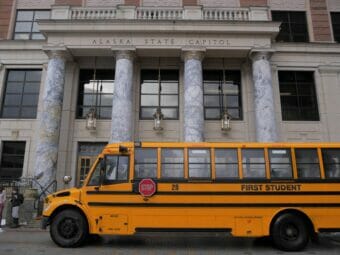
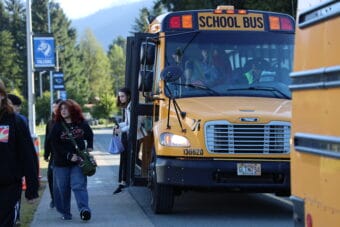
A bus parks outside Harborview Elementary School on the first day of school on Thursday, Aug. 15, 2024. (Clarise Larson/KTOO)

The Juneau School District appears to be in a better financial position going forward. That’s after major school closures and staff reductions last year.

Superintendent Frank Hauser presented budget projections to the board on Tuesday. He said that since the board addressed the district’s multimillion-dollar budget deficit last year, it should be able to move through the budget process more quickly this year.

“Because of the hard decisions that the board made last year and where we’re at, and quite honestly, because of some of the unfilled vacancies that we have, have created some opportunities for us moving forward,” Hauser said.

He said the district anticipates approving a budget earlier than other districts across the state because many are grappling with multimillion-dollar budget shortfalls.

JSD faced a nearly $10 million deficit last year that resulted in school closures, consolidations and reduced staff positions. The district added back the equivalent of 40 positions after Gov. Mike Dunleavy approved one-time funding later in the year.

About 5% of the district’s vacant positions were left unfilled this fiscal year. Hauser said he hopes earlier recruitment means they can hire more staff for next school year. Next year’s budget also factors in 3% of positions staying vacant. 

“Staff across the state and nationwide might be looking for positions,” Hauser said. “And the hope is we’re going to be able to advertise early and be able to hire earlier and get commitments from potential educators and non-certificated employees, to where that 5% that we had this year is less – closer to three, or ideally, even less.”

If the state’s school funding formula stays the same, the district would be left with about $200,000 in its operating budget after expenses. But this doesn’t account for grant-funded positions that are ending or additional expenses after union contract negotiations.

Hauser said the district could face a potential $1.9 million funding loss if the state Department of Education and Early Development changes regulations on how much local governments can contribute to education.

The board will meet this Saturday to continue budget discussions.

Tribal education compact bill takes next step into bringing tribal sovereignty into public education

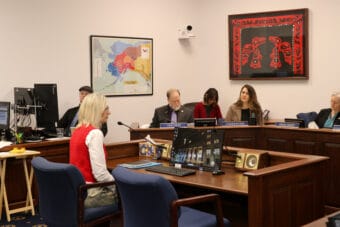
Central Council of the Tlingit and Haida Tribes of Alaska Education Liaison Mischa Jackson testifies in front of the Alaska House Tribal Affairs Committee on Feb. 6, 2025. (Photo by Jamie Diep/KTOO)

The Central Council of the Tlingit and Haida Tribes of Alaska has been working on expanding its education programs for years. One of the tribe’s next steps is building an educational campus in Juneau focused on culturally relevant, place-based learning.

This is one of many efforts Alaska Native tribes around the state are working on to improve educational outcomes for Native students. The state is joining in by working with tribes to develop an education compacting program.

An education compact is an agreement between tribal and state governments that allows tribes to run their own public schools. Alaska’s Department of Education and Early Development is working with tribes to kick start a compacting program and give tribes sovereignty over education.

Gov. Mike Dunleavy’s administration is moving things along with a bill proposal that would approve a pilot program for tribally compacted public schools. The House Rules Committee introduced it as House Bill 59 last month. 

Mischa Jackson is an education liaison with Tlingit and Haida – one of five tribes that would be part of a pilot program to see if the compact works.  

“Compacting is the mechanism to provide tribes an opportunity to play a role in the operation of schools,” Jackson said. 

Jackson presented to lawmakers in a state House Tribal Affairs Committee meeting last Thursday. She talked about what education compacts could look like in the state.

Tlingit and Haida — along with the King Island Native Community and the Village of Solomon, Inupiat Community of the Arctic Slope, Ketchikan Indian Community and Knik Tribe — negotiated with the Department of Education and Early Development, or DEED, to create a report on how compacting could work. According to the report, the program came out of a list of education priorities the state Board of Education is following. It aims to close the achievement gap between Native and non-Native students in the state. 

State testing results in recent years show a gap in Alaska Native students and other students of colors achieving proficiency in math and language arts when compared to all students.

Results from the Alaska System of Academic Readiness exam shows fewer Alaska Native and other students of color consistently reach advanced or proficient levels in math and language arts when compared to all students. The same goes for students experiencing homelessness and students in foster care.

Jackson said she’s really excited to implement the program.

“This has long term gains we’re really excited about, and I would say we have a pretty strong team and a lot of Indigenous educators throughout Southeast Alaska that are really excited to help contribute to this project,” she said.

Jackson said many Alaska Native tribes aren’t structured in a way that allows them to receive federal funding for education. Compacting would allow them to do that. She said the program would give tribes more say over education they don’t have under current state law, even if they operate as a charter school within a school district.

“For the vision that a lot of tribes have for education, we’ve never had the true opportunities to be able to work as an education system with the level of authority and autonomy,” Jackson said.

Joel Isaak is a consultant with DEED for tribal compacting. In an interview, he said the program would give tribes the ability to oversee many aspects of running their own schools.

“The tribes are the ones carrying out the education in the classroom, and the state is the one that’s providing the fiscal backing, and then ensuring safety and adequacy,” Isaak said.

This means tribes would be able to hire teachers, design curriculum and create a governing body like a school board to run the schools, as long as it follows state requirements. Isaak said tribes can also create training requirements for teachers. 

While some tribes may want to require their teachers to simply get a teaching degree at a university, he said others may want teachers to be trained in place-based or cultural learning.

“It allows the tribe to really direct how they weave together the culture, language with those regulated skill sets around, for example, reading or math or science,” he said.

Tribally compacted public schools would also receive state funding. To determine how much funding they receive from the current formulas in place, they would be treated as Regional Educational Attendance Areas. These are educational districts in places without a taxing authority like a borough.

This bill also includes start-up funds for carrying out the program. A fiscal note for the bill estimates it could cost close to $17.5 million for the next fiscal year. This includes both foundational funding and start-up funds for all five pilot schools.

Isaak said compacting is a way to improve the state’s education system.

“It does not fix every single thing in education, but it brings in another person to help carry the weight and to help think about how you get there more efficiently, or how you get there with everybody,” he said. “And that’s why it’s a systems transformation, that’s really powerful.”

Washington is the only state that uses education compacts since approving it in 2013. The New Mexico Legislature is also considering a bill to allow the state to enter tribal education compacts.

Jackson, with Tlingit and Haida, said the tribe is already working on building an education campus in Juneau behind Fred Meyer. 

If the bill doesn’t pass, Jackson said the tribe is ready to find other sources of funding for the campus.

“Our movement towards the education campus is going to happen whether this bill passes or not,” she said. “This will just be another vehicle towards supporting the infrastructure, and what will go inside of the buildings. The education in itself is going to move forward.”

If the bill passes, Isaak said DEED will negotiate compacts with the tribes to get the schools running.

The House Tribal Affairs Committee will hold a hearing on the bill on Thursday at 8 a.m.

Juneau Jazz Festival connects professional musicians with local band students

Bob Athayde leads Ketchikan High School Big Band students through warm ups during a jazz clinic on Friday, Feb. 7, 2025. (Photo by Jamie Diep/KTOO)

The second annual Juneau Jazz Festival packed nearly thirty performances, workshops and events related to jazz music into four days last week. The festival’s musicians also went into the schools and placed professionals in the seats among student musicians from Juneau, Sitka and Ketchikan. 

At Juneau-Douglas High School: Yadaa.at Kalé on Friday, the sounds of Herbie Hancock filled the air in the music wing as the Sitka High School Big Band played for a jazz clinic. Joining the students were professional musicians from around the world. While they performed, other students at the high school were just beginning their day.

The clinics were part of the Juneau Jazz Festival, a partnership between Juneau Jazz & Classics and Juneau School District. From jazz combos made up of a handful of musicians to full big bands with close to thirty members, students worked with music educator Bob Athayde and other jazz musicians to add some finishing touches to their sets before two days of concerts.

It’s the second year Juneau has had the jazz festival. Before that, the event ran in Sitka for about two decades. Athayde is based out of California, but he’s been involved with the festival since 2002. He said the students’ attitudes and ability to take feedback brings him back to Alaska each year.

“It’s always uplifting to see young people play music, be engaged. And, you know, if someone says, ‘Oh, kids.’ No, kids are doing really good things. And I think we just have to continually catch them doing something right,” Athayde said.

Brian Van Kirk is one of the organizers and teaches band at Juneau’s high school. He said these events can connect students to professional musicians.

“There’s no other festival that puts the accessibility of the artists to students like this – the Sitka Jazz and now the Juneau Jazz,” Van Kirk said. “It’s nowhere else that you sit in a section and work with Grammy award-winning musicians.”

The festival comes as the Alaska State Legislature is considering bills to increase school funding. Years without significant permanent increases have led districts across the state, like the Ketchikan Gateway Borough School District, to consider music program cuts

But Van Kirk said these programs do more than teach students about the arts.

“What we learn in band cross-pollinates to all the things that you need to be successful as an adult. Hard work, repetition, diligence, community, working together on a project – all of those things transfer,” he said.

In addition to ensembles from area schools, students from the three participating high schools – Juneau-Douglas, Sitka High School and Ketchikan High School – formed the All-Alaska Jazz Band. Juneau-Douglas senior Elijah Goins played piano for the band. He’s been playing keyboard for 10 years and has focused more on jazz through high school.

“It’s fun being able to create something and sit down at a piano or pick up an instrument and just play whatever you want. And jazz allows you to do that. It’s so improvisational that there isn’t bad jazz. There’s just different jazz,” he said.

Goins said it’s great to learn and play with different artists beyond his own school.

“It’s such a different experience to get to work with other students that have different teachers and to work with these musicians that have been playing for years and are just leagues ahead of you and can share so much information,” he said. “It’s so valuable.”

The festival is expected to return to Juneau next year.

Site notifications
Update notification options
Subscribe to notifications