Jamie Diep

Education Reporter, KTOO

"I strive to tell stories that highlight the triumphs, struggles and resilience of students from all backgrounds as they navigate a constantly changing world."

In their free time, Jamie’s probably playing their oboe or exploring the outdoors.
Juneau school board approves budget assuming $400 BSA increase

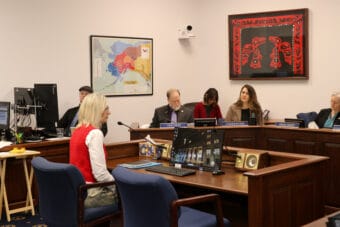
Juneau School District President Deedie Sorensen at a meeting on Thursday, March 13, 2025. (Photo by Jamie Diep/KTOO)

After months of back and forth between administrators, staff and school board members, the Juneau School District approved a budget for the next fiscal year on Thursday.

Still, the budget is based on uncertainties that could put the district in the red. It’s built on a $400 increase to the state’s base student allocation that has not happened yet. Alaska state Senators are considering a proposed $1,000 BSA increase that has been approved by the House.

And Superintendent Frank Hauser said a proposed regulation change from the Alaska Department of Education and Early Development could shake things up as well. It would modify what counts as a funding contribution from local governments and reduce how much money the district could receive from the City and Borough of Juneau.

“That DEED regulation change could have an impact of about $2.1 million for non-instructional funds,” Hauser said.

He added that the district is also in contract negotiations with three unions representing teachers, administrators and support staff. Contract changes could affect the budget, too.

Since its last meeting, the board removed anticipated savings from unfilled positions from its budget calculations, and found programs that can be paid for ahead of time with extra money in this year’s budget.

It also set aside funding for two teaching positions for the Tlingit Culture, Language and Literacy program. Those positions are funded by grants which expire this year.

While the district is working to get another year of grant funding for the program, they can’t apply for it until the fall. As a backup, Hauser recommended funding the positions through the district’s budget until grant money is secured.

Board President Deedie Sorensen moved to set money aside for the teachers, but not for the program’s principal – which is another grant funded position. 

“The program has functioned for years without its own principal,” she said. “As we have more clarity on our budget, I am happy to pick that up again, but for right now and tonight, I want to make sure that we are funding the foundational pieces of the program.”

Jamie Shanley, an assistant education director for the regional Native nonprofit Sealaska Heritage Institute, spoke out during public testimony in support of funding the program’s principal.

“The principal plays such an important role in the support and all the extra that that team is doing. Taking her out of the equation adds even more to the shoulders of the teachers who are there,” Shanley said. “Not only are they teaching full time, they’re creating curriculum in their language while they’re learning their language and doing all the extra things that we know TCLL does.”

The board is expected to present the budget to the Juneau Assembly Finance Committee on April 5.

Juneau School District approaches decision on annual district budget

Juneau School District Board of Education President Deedie Sorensen and Vice President Elizabeth Siddon at a school board meeting in Juneau on Tuesday, March 11, 2025. (Jamie Diep/KTOO)

The Juneau School District Board of Education is expected to pass a budget at a special meeting Thursday. 

The board made last minute changes at its Tuesday meeting and now needs to rebalance the proposed budget. 

The previous budget was based on savings from unfilled staff positions this year and assumed 3% of next school year’s positions would be unfilled.

But on Tuesday, board members took that assumption out. That’s because anticipating a set vacancy rate could jeopardize a financial buffer for the following year. Board President Deedie Sorensen was the only member who voted against the change.

The financial ins and outs are complicated, but what it means is savings that come from vacancies are unreliable. Board Vice President Elizabeth Siddon said she prefers to base the budget off of known savings. She said planning for vacancies ahead of time could leave fewer savings that can go toward the following year’s budget.

“Let’s utilize the previous year’s known vacancy savings. And next year we will utilize FY26 but we won’t be like, ‘Oh, it’s 99% of this year’s because we put 1% of it in, right?’” she said. “So let’s, as a practice – because we’re starting this this year, which I think is a good practice – let’s be clean about it and utilize the previous year’s vacancy factor.”

The change would throw the current proposed budget off by more than $700,000. But savings from this fiscal year mean the district has only about $100,000 to make up for a balanced budget.

The board directed the district administration to find things that can be paid for ahead of time with savings, and to find places to cut.

The budget is still based on a $400 increase to the state’s per-student allocation. The Alaska House passed a bill Wednesday that includes a $1,000 increase, which still needs to go through the Senate.

The school board is scheduled to meet at 5:30 p.m.Thursday at Thunder Mountain Middle School.

Tongass Voices: Portland-based organ experts on the future of Juneau’s nearly century-old theater organ

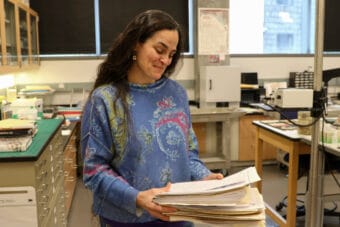
Chris Nordwall examines the Kimball theater organ at the state office building in Juneau on Thursday, March 6, 2025. (photo by Jamie Diep/KTOO)

This is Tongass Voices, a series from KTOO sharing weekly perspectives from the homelands of the Áak’w Kwáan and beyond.

Juneau’s State Office Building is home to the state’s only publicly available theater organ, and its fate is in question. The Kimball organ has been around for nearly 100 years, and it’s been part of the Alaska State Museum’s collection since the 1970s.

But now, the organ is approaching the end of its usable life. Rebuilding it would cost upwards of $250,000 and require shipping it to Portland, Oregon for a year.

Father and son Jonas and Chris Nordwall came to Juneau from Portland to take a look at the inner workings of the organ. In this episode of Tongass Voices, they talk about what’s needed to keep it going.

The following transcript has been lightly edited for clarity.

Chris Nordwall: I have a feeling those are all feather touch, right there. That one I already took down, go to the next note. Down. No, no, slowly. How quickly is it contacting?

Jonas Nordwall: Feather touch.

Chris Nordwall: All right.

My name is Chris Nordwall, and I am co-owner of Rose City Organ Builders in Portland, Oregon.

We came up to Juneau to tune the organ at the State Office Building, repair what we could in short order, and get it ready for what was the Friday afternoon lunch concert, and also then have the sit down discussion in the Q&A forum that was just held to find out what the fate of the instrument will be.

Jonas Nordwall: I’m Jonas Nordwall. I’m from Portland, Oregon, and currently I’m technically retired, but I’m at First United Methodist Church as the artistic music director, and I’ve been there 54 years.

I was approached by my son, who is a co-owner of Rose City Organ Builders, about coming up here to have a meeting with people at the museum about their Kimball pipe organ, and its possible future.

It was an opportunity to come up and see what’s going on and what the thoughts of the community are, because that’s the important thing. It’s not what the outsiders want to recommend. It’s what’s going to be the best results for your local community.

Jonas Nordwall speaks during an organ concert at the state office building in Juneau on Friday, March 7, 2025. (Photo by Yvonne Krumrey/KTOO)

Chris Nordwall: This is a challenge, because you’re coming in and trying to diagnose something that isn’t original per se. Parts of it are, parts of it have been updated. I mean, that’s always the feel good thing at the end of the day, if you’ve actually nailed something down that you know has been an ongoing thing.

You’ll do what you have to do to get that note to function the way it should. It may not be the prettiest repair, but if it works for the performance, that’s what you’re going for. And I think that’s, what this thing has seen over the last 30 years. It’s had, the immediate needed maintenance to get it through the next day. And it’s kind of hit the brick wall. 

So the other thing you have to be really careful about is you can’t start going too deep with this, because it’s like a Pandora’s box. You might be able to repair that you might cause 10 other problems in the process. 

Every project that we’ve undertaken always has its own challenges, and there’s a lot of gnashing of teeth, there’s blood, sweat and tears, but the final product, when you hear it make music for the first time, is always thrilling, and when you see people enjoying it again as they remember hearing it and whatnot. It’s, it gives you a lot of momentum to keep going in an otherwise very small, niche market.

I hope it’s still around. I hope that it’s something that we’ll see a resurgence. Everything has to die off. Hopefully it won’t completely die off, but I hope to see that it’ll sort of have its rebirth in the not too distant future.

No injuries following fire at Juneau’s Dzantik’i Heeni school that left students stuck outside

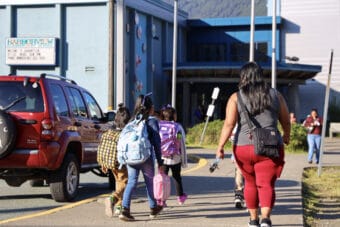
Students walking toward the Dimond Park Field House in Juneau on March 11, 2025. (photo by Jamie Diep/KTOO)

No one was hurt in a fire at the Dzantik’i Heeni campus in Juneau on Tuesday. But it left students huddled outside for hours.

Juneau School District Director of Operations Kristy Germain said the fire started in a high school science class.

“Our systems worked as they should,” she said. “The sprinklers worked to put out the fire, and we had no injuries.”

The evacuation left many students in the building’s three separate schools – Juneau Community Charter School, Montessori Borealis and Yaaḵoosgé Daakahídi High School – outside without jackets or a lunch. Montessori Borealis sixth grader Grace Blair said she thought it was a fire drill at first. 

“The alarm never stopped going off, so we were outside and our teacher had us just standing there for a while and then everyone was evacuated and we had to stay out for two hours in the cold.”

The district sent an email to families saying potential exposed wiring made the building unsafe for students to reenter. Five school buses arrived after the fire to move students to Dimond Park Field House near Thunder Mountain Middle School where families could pick up students.

Staff wheeled in white paper sacks with food for students about two hours after their normal lunchtime.

After being picked up, Blair had one thought.

“I want to be warm,” she said. 

Chava Levy, another sixth grader, shared a similar sentiment.

“It was very cold,” she said.

While Blair said the whole ordeal wasn’t too bad, there were still some intense moments. She said one of the scariest moments was seeing one of the Montessori classrooms leaving in a hurry.

“They were running and a whole bunch of kids were screaming because they had heard something,” she said.

The district reported Tuesday afternoon class will resume at Dzantik’i Heeni beginning tomorrow.

This story has been updated.

Correction: The original version of this story misstated which classroom ran out of the building on Tuesday.

University of Alaska Southeast begins reviewing uses of DEI online

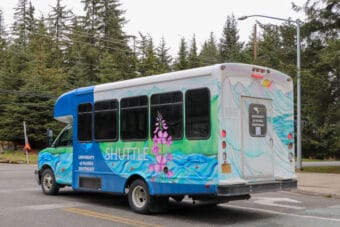
The University of Alaska Southeast campus in Juneau on Monday, March. 4, 2024. (Clarise Larson/KTOO)

The University of Alaska Southeast is taking next steps to remove mentions of DEI from its website. 

In an email to university staff and faculty Friday, UAS Chancellor Aparna Palmer wrote that the campus is updating webpages that mention “diversity,” “equity,” “inclusion” and other related terms.

This comes after a motion from the university’s Board of Regents directing leadership to comply with recent executive orders from President Trump.

As of Friday, the campus had found 165 instances of those terms that need to be reviewed.

Palmer said the university system is taking these actions to protect federal funding the university receives. That money supports more than half of UAS students.

In an interview with KTOO on Monday, Palmer said the campus will continue to be a welcoming place to all.

“I don’t know exactly where things will go or how they will evolve. What I can control is that I am dedicated to the students at this university, and I’m dedicated to the employees, and so I will work really hard to make sure that people feel accepted, a sense of belonging and safe,” she said. “That’s really important to me.”

Palmer wrote to staff that UAS will create a committee made up of staff and faculty who will recommend if a term needs to be removed or changed. Some terms will be reviewed by specific department leadership instead.

But the campus has already taken several actions without a review committee. It temporarily took down a webpage for the Chancellorʼs Advisory Committee on Diversity, Equity, Inclusion & Cultural Safety out of “high visibility concerns.” Administration also changed the name of the Office of Equity and Compliance to the Office of Rights, Compliance and Accountability.

Palmer said staff and faculty still have free speech and academic freedom protections, and may use DEI and related words as long as they aren’t speaking on behalf of UAS.

Juneau School District proposed budget continues to rely on $400 BSA increase, despite board concern

Students walk off a bus to the Thunder Mountain Middle School entrance for the first day of school on Thursday, Aug. 15, 2024. (Clarise Larson/KTOO)

The Juneau School District Board of Education appears to maintain its concerns about state funding as it moves through the budget process for the next fiscal year.

Board President Deedie Sorensen appeared troubled by some assumptions the budget is based on at a budget work session Thursday. The proposed budget depends on a $400 increase in per-student spending from the state.

“I want to feel confident that, you know, if it’s a big zero, that we have planned our contingencies based on how we can weather it without making everybody’s lives a total misery for an entire school year,” Sorensen said.

Superintendent Frank Hauser said that if the state doesn’t raise its per student contribution the budget would fall about a million dollars short. That is, after factoring in adjustments and what’s projected to be in the fund balance,

“That leaves a million dollars left over,” he said. “That could be addressed through the year, through whether we look at what the vacancy factor looks like, maybe holding back on some spending, It would be easier to absorb a $1 million difference throughout the span of a whole year. So we could do budget revisions to address what that would look like.”

The budget discussion is happening as a bill to increase the per pupil funding formula by $1000 is expected to go onto the House floor for debate on March 10. 

District Finance Director Liz Pearce said at the work session that the proposed budget that assumes the state will increase funding by $400 per student includes about $1.36 million in unallocated funds. That’s about $350,000 above the minimum the district needs to maintain.

Several board members requested a list of items that funding could be used for before its next meeting.

The board is scheduled to hold a final hearing on the budget on Tuesday.

Site notifications
Update notification options
Subscribe to notifications