"I strive to tell stories that highlight the triumphs, struggles and resilience of students from all backgrounds as they navigate a constantly changing world."
In their free time, Jamie’s probably playing their oboe or exploring the outdoors.

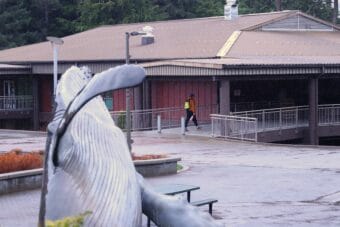
The Dzantik’i Heeni building. (Photo by Bridget Dowd/KTOO)
While the City and Borough of Juneau and its school district zero in on designs and project costs, elementary-age students at Dzantik’i Heeni play on a dirt field at recess instead of a playground.
The former middle school currently houses Yaaḵoosgé Daakahídi Alternative High School and K-8 schools Montessori Borealis and Juneau Community Charter School, after the Juneau School District consolidated to make up for budget shortfalls last year.
But that campus wasn’t set up for young kids.
Juneau student Gavin Lium lives in the area and spoke to Assembly members Monday in support of building a new playground.
“We need more than a dirt field and the hope of a future playground. You have the power to make sure we get the playground we need, not just someday, but now. This is our chance to do it right,” Lium said.
The city put $75,000 toward designing a playground last June. Now they’re working with the district to decide on a final design.
According to memorandums from December, the initial playground design would cost $1.8 million to build. The borough’s Public Works and Facilities Committee requested new designs at about a third of the price.
Denise Koch is the borough’s Director of Engineering and Public Works.
She says a joint committee made of the borough and district’s facilities committees requested new designs again in January at higher price points from $889,000 to $1.5 million.
Koch said the committees will continue discussing the designs and budget options. She said the only funding set aside for the project so far has just been to design the playground.
“There is no budget to construct that playground, so that will be part of the decision making and part of the discussion,” Koch said.
The school district’s Facilities Committee met Tuesday to discuss the new designs.
Koch says the next step is for the district board to send feedback before a joint committee meets again. A date has not been finalized for the next meeting.
Taelyn Eriksen, a freshmen at Juneau-Douglas High School: Yadaa.at Kalé, orders breakfast on Tuesday, Dec. 17, 2024. (Photo by Clarise Larson/KTOO)
The Alaska Legislature is looking at a bill from Rep. Maxine Dibert, D-Fairbanks, that would fund free breakfast and lunch for all public school students. Juneau student nutrition service employees said it would keep students fed and take the financial burden off districts across the state. But lawmakers want more information about the cost.
The state Department of Education and Early Development, or DEED, estimates the bill’s price tag comes in at $28.7 million.
Despite the costs, supporters like the Food Research and Action Center’s Clarissa Hayes told lawmakers about the benefits of providing meals for all students in public testimony on Monday.
“We know that hungry children do not have the concentration and energy they need to thrive at school,” she said. “Studies have shown participation in school meals improve students’ attendance, behavior and academic achievement, and also reduces absenteeism and tardiness.”
House Education Committee members grilled DEED’s staff about the exact cost of carrying out the program, and found there’s a good deal of information missing. For starters, DEED’s director of finance and support services Heather Heineken said the cost estimate doesn’t include the cost to carry out the program for schools that don’t already participate in the National School Lunch Program and School Breakfast Program. She told the committee that about nine districts aren’t currently in the programs.
Glennallen Republican Rep. Rebecca Schwanke said she wants to see what other programs are already in place that could help to bring costs down for the state.
“I would definitely like to to have a follow up consideration, really, of all the possible ways that we can really bolster the good things that are happening across the districts, especially when it comes to getting food to the children that really need it, and not creating a free program that’s too broad, that puts the onus on on the state to provide food that’s not necessarily needed,” Schwanke said.
In Juneau, Nutrition Service Supervisor Elizabeth Seitz said in an interview Tuesday that the bill would be a game changer for families that struggle financially, but don’t qualify for free and reduced lunch. Her district has offered universal free breakfast for close to 10 years, but it’s currently not included in next year’s proposed budget. That would mean some students will have to start paying for meals.
Seitz said the issue is twofold. Some families don’t qualify for free and reduced lunch but struggle to pay for meals. And Federal reimbursements aren’t enough to cover the full cost of meals for the Juneau School District. She said 77 families in the district have had their free and reduced lunch applications denied so far this school year.
Seitz said the program would feed a lot of these students.
“If this bill were to go through, it would be a significant relief,” she said. “For districts and students across the state.”
Love Ann Truitt is an administrative assistant for the Juneau School District’s nutrition program, and fills in at schools that need food service workers. She told KTOO some of these families just don’t meet the requirements set by the federal government.
“We unfortunately have to turn down a lot of people who apply. It’s not up to us, but they don’t hit the income limit, and it’s so close,” she said.
The regular price for lunch is $5.50, and the district gets reimbursed for just 69 cents. But each lunch costs $7.44. That means it also costs the district more than a dollar for every lunch it serves to students paying full price.
Truitt said many students rack up negative balances with schools to get lunch. She said there’s about $12,000 in school meal debt for the district this year, and it’s costing the district money.
“I know several schools have paid off debts out of donations, but at this point, right now, the school district is feeding kids regardless of whether or not they can pay, she said.“
The committee held the bill so that lawmakers could get more information.
Correction: A previous version of this story misattributed a quote from Love Ann Truitt to Elizabeth Seitz.
The University of Alaska Southeast campus in Juneau on Monday, March. 4, 2024. (Clarise Larson/KTOO)
The University of Alaska is grappling with how to respond to broad executive orders from the Trump administration that include eliminating diversity, equity and inclusion programs.
The administration is forcing educational institutions to remove DEI language and programs that it says violate civil rights as a condition to receive federal funding.
Part of those orders have since been blocked by a federal judge. But the university has already made some changes on its website, and a directive from its Board of Regents last Friday leaves the path forward unclear for faculty and administrators.
One faculty member has already been contacted by university administrators. Kathy DiLorenzo is an associate professor of Public Administration for the University of Alaska Southeast.
She got an email over the weekend about a class she’s teaching this summer. A university administrator told her to change the course name and description. The class? “The Role of Leadership in DEI in the Public Sector.”
The class’ course description said students would look at how DEI impact nonprofits, public policies and the government. DiLorenzo pushed back on the directive.
“I wrote back and said, ‘I don’t agree with this. I feel it’s a violation of academic freedom,’” DiLorenzo said. “And then it came back to me that the chancellor said, ‘Okay, you can, you can keep it,’” she said.
She said academic freedom means instructors aren’t limited in what they can teach.
“As long as we are not teaching something that is wrong, not valid, or we’re harming somebody in some way, we have the freedom to teach what is relevant to society. And DEI is relevant to society,” DiLorenzo said.
Her experience highlights a shift at the University of Alaska as it responds to executive orders from the Trump administration that target diversity initiatives. The email to DiLorenzo came just one day after the university’s Board of Regents directed its president to scrub mentions of DEI from its websites and programming.
DiLorenzo’s summer course seems like it can remain as is, but she said things could change if the university’s administration gets other instructions from its leadership as a result of federal policy changes.
“I believe that the administration at UAS wants to have the most open and inclusive environment that we can have, and they’re committed to that, but if they get direction from above them, they won’t have any choice,” she said.
Before the formal change on Friday, the university had already begun making changes to comply with federal orders. The university’s nondiscrimination statement, which used to mention affirmative action and its goals, has its own web page. Almost all of its language around affirmative action was gone as of last Thursday, according to archived versions of the webpage. Archives also show that a shortened version of the statement used in job listings and email signatures got rid of affirmative action language.
The statement used to say, “UA is an affirmative action/equal opportunity employer, educational institution, and provider and prohibits illegal discrimination against any individual.”
As of last Thursday, the statement changed to say, “The University of Alaska is an Equal Opportunity/Equal Access Employer and Educational Institution. The University is committed to a policy of non-discrimination against individuals on the basis of any legally protected status.”
Most job listings across the three universities used the updated language as of last week, but some UAS jobs still used the older language. All job postings use the new language following Friday’s motion.
UA Director of Public Affairs Jonathon Taylor said this is part of the university updating its nondiscrimination policy in response to the Trump administration’s executive order.
Taylor said it’s an informal administrative process that is based on advice from the university’s legal counsel. But, he said it isn’t related to Friday’s board motion.
“I would caution against creating a link between the updates to the nondiscrimination statement and the board action on Friday,” he said. “The action to update the language on the non discrimination statement was already in motion before the board meeting and isn’t related to the board action.”
The “about” webpage for the university’s Alaska Native Science and Engineering Program also had several changes, including the removal of the words “Alaska Natives,” according to reporting from the Anchorage Daily News.
University of Alaska Southeast Chancellor Aparna Palmer addressed the board’s motion in a letter sent to staff and students Friday.
“This was a difficult decision for the Board to make but, ultimately, they were driven by their desire to ensure the long-term success of the University of Alaska system in the face of the potential threat of losing all of the federal funding we receive to support our students and employees,” Palmer wrote.
UAS Alaska Native Languages professor X̱’unei Lance Twitchell said eliminating words around DEI violates free speech protections from the state and federal constitutions. And even with the services the universities have provided for students from underrepresented communities, Twitchell said more needs to be done – not less.
“We have some students, especially from rural communities in western Alaska, who come to us as faculty members and say, ‘I feel like I have a choice at a university. I can be myself, or I can succeed, and I have to make that choice,’” Twitchell said. “And so long as we’re hearing Native students who are saying that, we know we haven’t done an adequate job of providing a good place for them to have an education.”
Twitchell said leadership on the university’s Alaska Native Studies Council will meet soon to discuss strategies to face the various ways this directive will play out.
Chancellor Palmer stated in her letter that university leadership will begin meeting with faculty and students this week to figure out next steps.
Juneau School District Board President Deedie Sorensen and Vice President Elizabeth Siddon on Feb. 20, 2025. (photo by Jamie Diep/KTOO)
The Juneau School District Board of Education began formal discussions on next school year’s budget Thursday.
The budget is based on the assumption of a $400 increase to the state’s per-student funding contribution, also known as the base student allocation or BSA.
Board member Will Muldoon said until the Alaska Legislature passes a budget, there’s no way to know how much state money school district will actually get.
“We are currently in a situation where we either are facing a deficit on the budget we will be passing in the next 30 days, or exceeding statutory allowed fund balance,” Muldoon said.
The legislature passed a $680 increase to the BSA last year, but Gov. Mike Dunleavy vetoed it. Lawmakers later passed one-time funding equal to the BSA increase.
The proposed budget is based on the assumption that some staff positions will be unfilled for next school year.
The budget does include some additions. Lower student enrollment projections means the district would need to hire fewer positions. But at the same time, the district is lowering the pupil to teacher ratio for fourth, fifth and sixth grade students, which means it won’t lose as many positions.
Three grant-funded counseling positions are expiring this year. The district is budgeting to add back two positions to fill the gap.
But the budget also leaves several things up in the air, including universal free breakfast. The district spent about $115,000 this school year to maintain the program, but it isn’t in next year’s budget. The district is still in contract negotiations with unions as well. This could add additional costs the district hasn’t fully accounted for.
A budget work session is scheduled for March 6, and the board is expected to approve the budget on March 11.
Juneau School Board President Deedie Sorensen and Vice President Emil Mackey at a meeting in February 2024. (Clarise Larson/KTOO)
The Juneau School District Board of Education will begin the formal decision making process for the district budget Thursday. The district will present a draft budget to the board, but state funding and union contracts are still up in the air.
Superintendent Frank Hauser presented budget projections to the board last Saturday. He said the district anticipates a small deficit if there’s no increase to the base student allocation – the state’s per-student funding contribution. But he said the district will have some flexibility because it has just under $2 million in its fund balance.
Hauser recommended creating a budget based on the assumption of a $400 increase in the BSA because of that flexibility. The Alaska Legislature is currently hashing out education funding with Gov. Mike Dunleavy.
Board members like Emil Mackey had some concerns after the district faced a multimillion-dollar deficit last year. The district consolidated its middle and high schools and closed Floyd Dryden Middle school to address the budget shortfalls.
“We got into the crisis from board members wanting to artificially believe that there is a BSA that would not be vetoed, that did get vetoed, above my objections,” Mackey said. “I don’t ever want to see that happen again.”
Hauser said if the state doesn’t increase the BSA, the district would face a large deficit in the coming years.
“The district is in much more firm financial footing. It is by no means in a great position, like the majority of districts across the state of Alaska,” he said.
Projected expenditures still aren’t set in stone either, including additional spending from new union contracts. The district accounted for a small raise for teachers that it proposed with the Juneau Education Association. But it hasn’t completed contract negotiations with them or other unions. JEA proposed 10% raises to teacher salaries and additional classroom preparation time for elementary and high school teachers.
Last year, about 5% of teaching and staff roles were vacant, which meant the district saved some money. Hauser said the district hopes to get that vacancy rate down and recommends planning for a drop to 3%.
He said while unfilled staff positions means the district spends less, that comes at a cost to not having enough people working. The district won’t know how much it’s actually spending on staffing until it begins hiring for the next school year as well.
The board is scheduled to meet Thursday at 5:30 p.m. in the Thunder Mountain Middle School Library.
Children exit a school bus outside the Alaska Capitol on Feb. 14, 2025. (Photo by Jamie Diep/KTOO)
Preschoolers, childcare providers and parents flanked the hallways of the Alaska Capitol leading into the House and Senate chambers.
The children gave handmade valentines to lawmakers as they filed in. They were on a mission, explained Southeast Alaska Association for the Education of Young Children Executive Director Blue Shibler.
“There’s people in this building that just do really boring work all day, and they don’t get a lot of cheer and valentines, and so your job is to cheer them up today by giving them one of these cool valentines,” Shibler told the kids. “And you can say, ‘Happy Valentine’s Day.’”
Shibler said this is a longstanding tradition in Juneau. Their message: “have a heart for kids.” She said they’re looking for policy level support for child care across the state.
“The child care sector is struggling. The cost of care keeps going up and up and up, and operators can’t pass those costs on to parents, because child care is already really hard to afford for them,” Shibler said. “And so our work, fundamentally, is in trying to help lawmakers understand that public subsidy is needed to help childcare businesses thrive.”
Rep. Frank Tomaszewski, R-Fairbanks, receives a valentine from a preschooler at the Alaska Capitol on Feb. 14, 2025. (Photo by Jamie Diep/KTOO)
The visit comes as lawmakers are hashing out education policy with Gov. Mike Dunleavy. The House Education Committee is currently considering House Bill 69, which includes a permanent increase to education funding.
Rep. Andi Story, a Juneau Democrat, loved seeing the children.
“It’s just a really energy boost, because you see those little people, and that’s who we’re working for up here at the Capitol,” she said.
Story co-chairs the House Education Committee and said she’s keeping them in mind as she works through education policy this year.
“It means that we’ll be doing smart education funding policy where it needs to be a permanent increase, and it needs to be inflation proof for the next few years,” she said.
Michelle Adams is one of the parents in the hallway. She said she was glad the children had the chance to go into the Capitol.
“The preschool kids having this type of learning experience is just phenomenal. To like, be there, not just read the stories about it and hear the words, but actually be there. That was amazing,” Adams said.
Her kid, three-year-old Izabella Adams-Hall, wore a red dress with a matching bow in her hair. She got to shake the hand of Rep. Dan Saddler, R-Eagle River, after delivering a bright pink valentine.
The group dropped a final batch of love notes off at the governor’s office, who was too busy to meet them in person. After a well deserved snack break, they made their way back to their respective day cares across the city.
Rep. Dan Saddler, R-Eagle River, shakes Izabella Adams-Hall’s hand outside the Alaska House chamber on Feb. 14, 2025. (Photo by Jamie Diep/KTOO)
Close
Update notification options
Subscribe to notifications
Subscribe
Get notifications about news related to the topics you care about. You can unsubscribe anytime.