Jamie Diep

Education Reporter, KTOO

"I strive to tell stories that highlight the triumphs, struggles and resilience of students from all backgrounds as they navigate a constantly changing world."

In their free time, Jamie’s probably playing their oboe or exploring the outdoors.

University of Alaska Board vote to remove DEI language draws concerns of Open Meetings Act violations

The University of Alaska Southeast campus in Juneau on Monday, March. 4, 2024. (Clarise Larson/KTOO)

In the month after the University of Alaska Board of Regents decided to scrub mentions of diversity, equity and inclusion, these words have gradually disappeared from university webpages. 

That decision was in response to increasing pressure from the Trump administration to cut DEI. But critics of the decision are concerned about the lack of transparency in the process.

The Board of Regents made a lot of decisions during its regular two-day meeting in Soldotna in February. But the one that got a lot of attention from the public wasn’t actually on the agenda.

On the second day of the meeting, Board Chair Ralph Seekins suddenly brought up a motion to remove mentions of diversity, equity and inclusion from university websites.

“Are we ready for this?” Seekins said.

He asked Regent Seth Church to read it.

“I move the Board of Regents direct the President to take all necessary actions to comply with recent federal executive orders and applicable agency guidance,” Church said.

But this motion wasn’t on the agenda. And members of the UA community are wondering if the board violated the Alaska Open Meetings Act. An investigation by KTOO found that the board followed the letter of the law, but their process did leave the public in the dark until after the decision was made. 

The law ensures governing bodies, like the Board of Regents, conduct their business in the open, said Savannah Fletcher, a Fairbanks-based public interest attorney. She said suddenly bringing up the motion in the meeting means no one in the public saw it coming.

“No one had the chance to weigh in, and people still may not have heard what actually happened on the meeting because they haven’t heard the recording, whereas they might have called in and listened in real time if they knew this was on the line,” she said.

Under the Open Meetings Act, the public needs to be informed of the time and place of any public meeting before it happens. Fletcher said in an email that governing bodies generally include agenda items in public notice. She wrote that not doing so makes it meaningless to tell the public a meeting is coming up.

The agenda was posted ahead of the meeting. While it included federal regulatory compliance as a discussion topic during the board’s executive session, a motion to scrub DEI from the university websites was never included.

The way it ended up on the agenda is allowed under the board’s bylaws, but it’s complicated.

The Board can change the agenda in two ways. It can happen at the beginning of the meeting when the agenda is approved. It can also happen afterward if the change is approved by a vote of the members.

In this case, there seemed to be no vote to change the agenda. But Public Affairs Director Jonathon Taylor said instead of voting, the board approved the agenda change by an act of consent. That means no one objected to bringing the motion forward for discussion.

Regent Church declined to comment on the motion. Chair Seekins also did not respond to a request for comment from KTOO.

Albiona Selimi, the student regent and the only dissenting vote, said she wasn’t expecting to vote on a motion so soon.

“I had a very strong suspicion that it would come up, obviously, because it was a big topic that had come up within that time, I personally did not know or think that it would be coming to a motion so quickly,” she said.

Selimi said the lack of public testimony made the vote difficult for her. But afterward, Selimi said people in the university community told her she did the right thing. University organizations that represent staff and student leaders also passed resolutions condemning the decision and the manner in which it was carried out.

The public interest attorney, Fletcher, said the public still has a right to know about agenda items, even if issues were time sensitive.

“We want government to be transparent, and with transparency, there sometimes are delays, because if you want to vote on something and it’s time sensitive, you still have to comply with some kind of notice,” she said. “Even if there’s a notice for an emergency special meeting, the public needs have a chance to know about it and then accordingly comment on it.”

The Board of Regents didn’t break the law, but Fletcher said if it had, it could easily fix it. All it would have to do is put the motion to a vote again in a meeting where all parts of the Open Meetings Act are followed. 

Fletcher herself is against the decision, but she said she understands why the board made it.

“I don’t think it was the right move, but I’m also not the person in that room that has the fear of all this funding for so many professors and grad students and undergraduate research getting pulled,” Fletcher said. “It seems like they were trying to soften the blow with commentary about still supporting Alaska Native culture and the Alaska Native community within our university system, but those seem to be talking out of two sides of your mouth, if you ask me,”

University leadership said these decisions protect the federal funding Trump is threatening to pull. In the motion and communications following it, the board continues to say it’s committed to nondiscrimination. 

In the meantime, the university has already renamed different offices and committees as a result of the Board of Regents’ decision.

The University of Alaska Southeast removed a webpage on the Chancellor’s Advisory Committee for Diversity, Equity, Inclusion and Cultural Safety as it considers changes. The campus is reviewing more than 165 mentions of DEI as well. 

Other changes occurred before the motion passed, such as removing mentions of “Alaska Native” on the Alaska Native Science and Engineering Program website, or taking out the words “affirmative action” from the university’s nondiscrimination statement.

Juneau Assembly and School Board continue to grapple with Dzantik’i Heeni playground designs

The Dzantik’i Heeni campus on March, 11, 2025. (photo by Jamie Diep/KTOO)

Elementary students at Juneau’s Dzantik’i Heeni campus will continue playing on a dirt field for now. 

The building in Lemon Creek previously housed middle schoolers before the district’s consolidation plan moved Juneau Community Charter School, Montessori Borealis and Yaaḵoosgé Daakahídi High School onto the campus. 

The Juneau School District and Juneau Assembly facilities committees met last week to discuss new playground designs. So far, the designs are not up to the state’s school playground construction standards. Some of the potential issues include drainage and snow removal.

School Board member Britteny Cioni-Haywood said it’s important to make sure the playground can be used by students and people in the surrounding neighborhood.

“This asset would be kind of dual purpose and that it would serve as a park for the community, but also is a playground for the schools that are in that building now,” she said.

This is the third round of designs for a playground. The initial design was estimated to cost $1.8 million dollars. And a second round of designs at roughly a third of that didn’t comply with the Americans with Disabilities Act standards.

While the city paid for designing the playground, the Assembly never committed any funds to build it. And now Juneau Engineering and Public Works Director Denise Koch said they’ve run out of design funds.

School Board President Deedie Sorensen said the district is looking for accessibility, a usable playground and fencing that can keep students safe during the day. But she says it’s taking too long.

“We need to move forward or these children who are there now will be graduating from high school and still playing in the street,” she said.

Juneau Assembly member Ella Adkison said a decision needs to be made on the playground, but that more money shouldn’t be spent on a new design.

“If we’re not spending money on a playground at that point, it feels like money out the door with no real results back,” Adkison said. “So I agree. I want to move forward. I am a little hesitant on going back to the drawing board in any way, shape or form.”

The committee decided not to bring any plans before the Assembly just yet.

Alaskan television producer shares the importance of Indigenous representation in children’s media

A still from “Work It Out Wombats!” with characters Zeke, Zadie, Chanáa and Malik. (photo from GBH.)

Sydney Isaacs-Hulstine is a Craig-based Lingít and Haida artist. Raised in Klawock, Isaacs-Hulstine is an associate producer for children’s TV show “Molly of Denali.”

She recently wrote an episode for another children’s show, “Work It Out Wombats!” It features an Alaska Native character that draws on Lingít and Haida culture.

Isaacs-Hulstine sat down with Jamie Diep to talk about the episode and the importance of representation in children’s media.

Listen here:

The following transcript has been lightly edited for clarity.

Jamie Diep: I want to talk about this episode of “Work It Out Wombats!” that you wrote. Could you give a quick rundown of what you pitched? The process of producing this episode and watching it come together

Sydney Isaacs-Hulstine: With “Work It Out Wombats!” the team really wanted me to pitch an idea that felt like Alaska, that felt like my culture. They wanted me to really embrace it, whatever it may be. And so I was thinking and thinking, ‘What could I do? And I kept thinking of this Raven character, because he plays such a significant role in all of our cultures, for Lingít, Haida, Tsimshian, and a lot more folks hold Raven in high regard.

So I kind of pitched this character in a way, this elder character named Chanáa, which is Haida for grandfather. And they really liked it. They were over the moon for this crazy, kooky, elder, with some mischief and jokes, and [he] kind of reminds me of Tigger a little bit from “Winnie the Pooh.”

And so from there, we were like, ‘Okay, we have this character. What is he going to do?’ And again, thinking of my culture, that Raven is this trickster, the mischief. He’s smart and quick, and there’s tons of wit everywhere. And so I thought riddles, and that kind of spurred on this whole thing.

So it was like a really neat kind of balance of how tricky of a riddle is too tricky, and how is it too easy? And where’s the balance there? We spent a lot of time together trying to figure out that balance, and then from there, once the story was solid, it was design time. 

A portrait of Sydney Isaacs-Hulstine. (photo from Sydney Isaacs-Hulstine)

And I had asked at the very beginning, like even before I started writing, if it would be okay if I were to see Chanáa’s design, because I feel very strongly to make sure that we’re represented authentically and accurately. The wombats has a very unique style. So it was like, how much of my culture and balance it with their world, so that it doesn’t pop out in a weird way, but it feels natural.

And so his hat, his necklace, shirt, his vest, all of that is very much based on the culture, with references and working hand in hand. And then same with some of the props in there too, near the end of the episode that was all worked out together – and the dance movements and the drum beats – they worked with me on it to make sure it was accurate.

Jamie Diep: What’s something that stood out to you or something that surprised you about working in children’s media? 

Sydney Isaacs-Hulstine: GBH Kids and the children’s media department was really thoughtful, and I was astonished by how much they cared and how much they crafted all of our series, all of our episodes. And every single show was just very carefully done to make sure that kids were not only entertained, but they’re also getting some education. And I don’t think that exists everywhere.

Jamie Diep: What’s particularly important about having a broad spectrum of representation in children’s media and the projects that you’ve worked on, whether that’s Alaskan Native representation, Lingít and Haida representation, or just other forms of representation. Why is this important in children’s media?

Sydney Isaacs-Hulstine: The early exposure that kids can get to different cultures and diversity and underrepresented voices, the better off that they’re going to be. They’re going to grow up knowing this and just be more well rounded individuals for it, with a broader experience and lens. And it’s really important to have that, because it’s just a part of growth and life, and it’s for everybody. The more voices that you have and different perspectives that come to play their part in how these shows are made. It just gives you a deeper and richer experience and a really great quality show.

And I think it’s really good for kids to absorb that, because they can feel that through the screen and take in that information that they’re hearing and that representation and grow up knowing, ‘oh, oh, the I know exactly who these folks are. I’ve learned about this. I’ve seen it on TV.’ And then it just continues. It just spreads. It’s very infectious.

President Trump’s executive order could shutter the Department of Education. What does that mean for Alaskans?

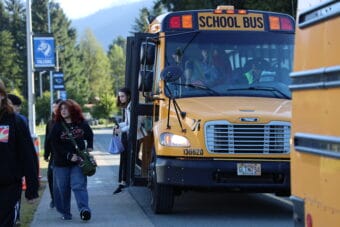
A bus parks outside Harborview Elementary School on the first day of school on Thursday, Aug. 15, 2024. (Clarise Larson/KTOO)

Listen here:

President Donald Trump signed an executive order Thursday abolishing the U.S. Department of Education. While many key programs remain unchanged, hundreds of millions of federal dollars are at stake in Alaska if the order disrupts funding.

The recent executive order is part of the Trump Administration’s long-term plan to get rid of the federal department. It currently funds special education and other programs that support rural and high poverty schools. It also makes sure all students are receiving fair public education.

Alaska Department of Education and Early Development Commissioner Deena Bishop attended the executive order signing in Washington, D.C. on Thursday, as first reported by the Anchorage Daily News.

“I truly believe that with more state and local control, Alaskans can better determine how education resources are allocated and focus on what is most beneficial for our students and their futures,” Bishop said in a written statement. 

She did not describe how the state would take on the responsibilities of the federal agency. A DEED spokesperson declined an interview request from KTOO.

The federal department manages millions that fund programs that benefit Alaska’s students and schools, and monitors the quality of services. Alaska receives the most federal funding per student in the country. Trump says many of the programs and funding will stay in place nationally. 

But Juneau School Board member Will Muldoon said he’s concerned about the lack of guidance on navigating the changes in the short term.

“I haven’t gotten any kind of roadmap,” he said. “And I think that’s always scary too, because education is a big ship, so burning it, changing it – it takes a while.”

Special education is largely funded and supported by the federal department. The Juneau School District reports that 878 students are receiving special education services this school year.

Muldoon said he’s concerned that changes to the department could make navigating the system for students with disabilities and their families more difficult.

“People don’t go to school and graduate and get a degree to be an advocate for their child. It shouldn’t be a job,” he said.

The department does more than fund special education. The federal agency also helps fund schools with high numbers of students whose families are experiencing poverty, called Title I schools. There are five Title I schools in Juneau. 

Amanda Duvall is the federal programs coordinator for the district. She said every Title I school in the district used the federal funds to hire another teacher this year.

“That is always up for discussion every year,” Duvall said. “But the reality is most of them find that additional teacher at these high class sizes is helpful.”

She said these federal funds stack on top of what goes toward general funds for the district, which mainly come from the state and local level. Duvall said insufficient state funding makes federal support critical.

“We are heavily grant dependent and grateful for all of our various partners in the community, and this federal funding allows schools to deepen knowledge for their teachers, to have cohesive opportunities for their students, provide additional experiences that we all value,” she said.

The Department Education also manages nearly $46 million in financial aid for University of Alaska students.

University of Alaska President Pat Pitney said in a message sent to the entire university system Thursday that there are no immediate changes for students. She wrote that the university will continue pushing for federal financial aid.

“Advocating for federal student aid funding remains a top priority for the UA system regardless of what changes happen at certain federal departments or agencies,” Pitney wrote. “Federal student aid is a vital component of ensuring access and affordability for students across the State of Alaska.”

More than half of the students at the University of Alaska Southeast receive federal aid. UAS Chancellor Aparna Palmer said administrators are monitoring any changes, but she encourages students to continue applying for federal aid.

“As far as I can tell, in the short term, we don’t expect to have any large impacts to our operations or to our ability to offer students federal financial aid or their Pell grants,” she said.

Despite the executive order, only Congress can abolish the Department of Education. Whether lawmakers decide to follow the president’s lead remains to be seen.

Disability advocates rally in Juneau to push for better services

Rally participants stand on the front steps of the state Capitol in Juneau on Wednesday, March 19. 2025. (photo by Jamie Diep/KTOO)

Listen here:

Outside the Alaska State Capitol on Wednesday, nearly 150 people from around the state demanded improved services for disabled Alaskans. 

Many were part of the Key Coalition, a nonprofit advocacy organization in Alaska that supports people with disabilities.

Key Coalition Director Michele Girault said they advocate for the community as a whole since anyone can develop a disability at any point in their life.

“It’s not just today, it’s tomorrow,” Girault said. “So let’s prepare and have services and accessibility for everyone, whenever the need occurs rather than having to wait for a service.”

This year’s priorities include improving the state’s Infant Learning Program, which supports infants with disabilities and developmental delays. Girault said Alaska is one of the only states in the country where the eligibility threshold for services is a 50% developmental delay.

“We want to reduce that to 25% to support more children, and in the end, it saves more money because if you intervene early, then those kids don’t need special education,” she said.

Nikki Bass co-owns TIDES, a Juneau-based agency that provides care to people with disabilities. She said the coalition is also working to improve wages for care providers.

“Everyone in their lifetime is going to need caregiving at some point and we have a whole network of strong, passionate care providers, so we’re here to support them as well and ask for a living wage and to continue supporting Medicaid,” she said.

Kim Champney, one of the rally speakers, is executive director of the Alaska Association on Developmental Disabilities. She said legislators want to hear from more than just service providers.

“It’s really the voices of people, the family members of the people that rely on the services with us in partnership,” she said. “We work together and share our story, and that’s how we build the system that we need in the future.

Advocates spent the afternoon after the rally meeting with legislators and sharing their experiences.

Juneau’s X̱’unei Lance Twitchell wins Emmy for ‘Molly of Denali’ episode

X̱’unei Lance Twitchell dancing in a Chilkat robe at the Juneau International Airport on Sunday, March 16, 2025. (Screenshot from video courtesy of Bostin Christopher)

Juneau resident X̱’unei Lance Twitchell won an Emmy Saturday for Outstanding Writing for a Preschool Animated Series. 

Twitchell won the award for writing ”Not a Mascot,” an episode for the PBS Kids show “Molly of Denali.” 

The winning episode follows the show’s main character Molly Mabray as she learns that a competing basketball team – the Sitka War Chiefs – has a mascot based on Indigenous stereotypes. She then helps the team find a new mascot.

This is the second Emmy nomination for Twitchell and his first award. He shares it with head writer Raye Lankford.

Twitchell received the award at the ceremony in Los Angeles. Juneau residents welcomed him home at the airport Sunday night with traditional song and dance. Wearing a Chilkat robe, he thanked his supporters and said they can accomplish great things together.

“I am so thankful for this opportunity to stand on the backs of all the storytellers who brought us here, all the people who work on this wonderful show,” he said. “It takes so many hands to do something like this.”

Twitchell is also an author and a professor of Alaska Native Languages at the University of Alaska Southeast.

“Molly of Denali” received a nomination for Outstanding Interactive Media this year as well. This is the show’s first Emmy award.

Listen to a Rainy Day Conversation interview with Twitchell talking about his Emmy nomination and other work with Juneau Afternoon host Bostin Christopher here.

Site notifications
Update notification options
Subscribe to notifications