"I strive to tell stories that highlight the triumphs, struggles and resilience of students from all backgrounds as they navigate a constantly changing world."
In their free time, Jamie’s probably playing their oboe or exploring the outdoors.

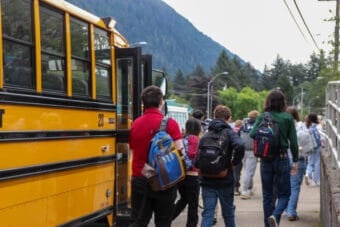
Students walk to the Harborview Elementary School entrance for the first day of school on Thursday, Aug. 15, 2024. (Clarise Larson/KTOO)
The Juneau School District announced it is ending the RALLY program Tuesday.
The after-school child care program serves more than 100 Juneau children during the summer. It will end Aug. 8.
Kristy Germain is the district’s director of operations and oversees the program. She said the district could not reliably keep the program staffed last school year. The district already closed the RALLY site at Sayeik: Gastineau Community School about a month before the end of the school year.
“This decision to close our RALLY program is not one that we have taken lightly, and our focus is in providing a continuity of supervised after school coverage, because we know that is so important to our JSD families,” Germain said.
She said maintaining child care remains a priority for the district, which is working with a local preschool to provide after-school care at the start of the next school year. While Juneau is in a better position than other parts of the state, many families struggle to access and afford child care.
The district is finalizing a lease agreement with Auke Lake Preschool, a licensed provider that currently serves children from six weeks to 12 years old. Germain said the preschool is the only provider that formally came forward to work with the district. The plan is for the preschool to provide child care at different sites independently from the district.
Derik Swanson co-owns the preschool. He said the district has been accommodating during negotiations and he’s invested in the success of a Juneau after-school program.
“I grew up in the RALLY program too, so it would be kind of sad to see it go” he said. “I know it had several closures in the past here, but it’d be an honor to kind of pick up the mantle and keep that service running as long as we’re able to.”
Swanson couldn’t give an estimate of how long it would take to set up the program after an agreement is finalized.
Emily Wright is a local parent. Her oldest child participated in RALLY both during the school year and summer. She’s a nurse and said RALLY worked best with her family’s needs compared to other providers.
“The RALLY program was really consistent for our family and affordable. I mean, we felt like we had made it, you know, getting a kid into that program – it was fantastic,” she said. “So we’re devastated to hear that it’s closing.”
Wright says she already switched to working part-time to care for her younger preschool-aged son. Without another child care option, she said she’ll probably have to take more time off work to care for both children when the school year begins.
“We don’t have a backup plan at this moment,” Wright said. “It seems like a lot of the day care centers that provide after-school care is not as affordable as RALLY was, and it was just really convenient to pick her up there at her school.”
A University of Alaska Southeast shuttle stopped at an intersection at UAS on April 16, 2025. (photo by Jamie Diep/KTOO)
Non-teaching staff across the University of Alaska system are working to form a union. Organizers delivered a petition and authorization cards to the Alaska Labor Relations Agency Monday.
The group is calling itself the Coalition of Alaska University Employees for Equity. The nascent union is organizing as part of the United Automobile, Aerospace, and Agricultural Implement Workers of America, one of the largest unions in the nation.
Bee Bequette is an organizer and program support specialist at the University of Alaska Anchorage. They said UA staff are one of the only groups not represented by a union at the university, and staff want to make their voices heard.
“Equity is something that I’ve always personally been really passionate about, and this seemed like a great opportunity to elevate UA staff to the same playing field as all of our colleagues,” Bequette said.
Organizers estimate about 2,500 people are eligible to join the union. Their estimate is based on counts from the university’s staff directory. Eligible employees work in financial aid, advising, health care and more, according to a press release.
There are still several steps to form the union. At least 30% of staff needs to opt in by signing a petition. Once the state labor relations agency verifies the number, the university has the opportunity to challenge the decision. Once any issues are resolved, staff can hold an election on forming the union.
A UA spokesperson confirmed through email that the university received a petition for a staff bargaining unit and is waiting to hear from the Alaska Labor Relations Agency.
Taelyn Eriksen, a freshmen at Juneau-Douglas High School: Yadaa.at Kalé, orders breakfast on Tuesday, Dec. 17, 2024. (Clarise Larson/KTOO)
The fate of Juneau School District’s universal free breakfast program remains uncertain after the Board of Education delayed a decision Thursday. The board will instead consider it against a list of staff positions and programs it may add to the budget following a higher increase to state education funding than anticipated.
Nicole Herbert is the district’s chief financial officer. She told board members at a meeting earlier this month that some districts saw an 8% drop in participation after free meal programs from the COVID-19 pandemic ended. She said it’s likely fewer students will get school breakfast if the district starts charging for it.
“Since Juneau has been providing universal free breakfast, I think a little bit longer than that, it’s safe to say that we could probably see a bigger than 8% drop,” Herbert said. “But that’s kind of an unknown factor going into this.”
A daily average of about 600 students ate school breakfast this year. District data from the past two school years shows the number of students eating breakfast at most Juneau schools has declined.
Herbert estimates continuing to offer free breakfast next school year would cost the district more than $220,000. The district already paid an additional $115,000 to continue the free breakfast program this year.
She says one way to reduce the cost is to get more students approved for free and reduced meals. She told board members yesterday Thursday the district is working on communicating with families and processing applications quickly.
“What I have heard is that some families, even though they know they’ll qualify, until they have that actual approval, they’re very hesitant to participate,” Herbert said. “And so making sure that we get those applications turned around quickly, and so they feel more confident that they qualify for free and reduced.”
The district gets federal reimbursements for students who qualify for free and reduced lunch. The process generally requires families to apply for the program.
Rep. Maxine Dibert, a Fairbanks Democrat, introduced legislation this session to provide free school meals to all students in the state, but it stalled in the House Education Committee in February.
The board expects to meet on July 9 to discuss what to add to its budget, including universal free breakfast.
Deena Bishop testifying before the House Education Committee on May 7, 2025. (Photo by Jamie Diep/KTOO)
The Alaska Department of Education and Early Development has opened the public comment period for a proposed regulation change that redefines what counts as a local contribution for school districts.
The proposed change would count municipal funding for non-instructional services like transportation and school meals toward the maximum amount districts can receive from municipalities.
Local municipalities are limited in how much can be contributed to a school district’s instructional services.
According to the Alaska Council of School Administrators, at least 18 school districts currently receive local funding for non-instructional services.
The Juneau School District is budgeted to receive more than $2 million this coming school year for non-instructional services.
The education department brought the proposed change to the state Board of Education earlier this month as an emergency regulation. That means it would have immediately gone into effect if approved.
Public backlash from school administrators, parents and city officials around the state urged the board to instead put the regulation up for a 30-day comment period.
The public comment period will run until 5 p.m. on July 23. Comments can be physically mailed or emailed to the state board.
There will also be a comment period at the next board meeting scheduled this October where members of the public can testify by phone or Zoom.
Ellen Carrlee looks at a stack of files folders in the Alaska State Museum objects conservation lab on March 6, 2025. (photo by Jamie Diep/KTOO)
This is Tongass Voices, a series from KTOO sharing weekly perspectives from the homelands of the Áak’w Kwáan and beyond.
The Alaska State Museum in Juneau houses a collection of tens of thousands of objects, from canoes and plants to the state’s last publicly accessible theater organ. But how do you maintain all of those items? That’s conservator Ellen Carrlee’s job.
The following transcript has been lightly edited for clarity.
Ellen Carrlee: I could actually talk about what’s in this lab for hours on end. As we go past here, I’ve got these pH strips. They measure the alkalinity or acidity of surfaces. You just get these damp and you press it gently to the surface, and in that way, we’re able to understand if we’ve got crizzling on the beads, which is a deterioration phenomenon. So we’ve been sharing and teaching that technique to our study group.
I’m Ellen Carrlee. I’m the conservator here at the Alaska State Museum in Juneau, and my job at the museum is to know what everything is made out of, and how it deteriorates over time, and how to make it last for as many generations as I can.
Conservator, like a museum conservator, is a strange profession that people don’t find themselves familiar with. I think there might be a grand total of five people in all of Alaska who have that job, and it’s really a combination of art and science.
So my training background is in chemistry, art history, studio art, anthropology. Our culture, my culture, my Euro-American culture, does not typically mix art and science, but it is really, for some of us that are built that way, it is a really rewarding career.
Here we are in the Alaska State Museum objects conservation lab. There’s a window into the lab right off the atrium that the eagle tree is in, so you can peek into the lab. And I usually keep a table in front of this window that has, kind of, our latest greatest projects and collaboration.
Right now, the window into the lab has some of our bead study group collaboration. We’re doing a survey of the glass beadwork in the collection, and monthly study groups with beaders and culture bearers about what the beaded items are and how to preserve them. And probably in the coming years, we’ll have a bead exhibit that might hopefully be co-curated by some of those participants.
Beads of various colors are placed in numbered glass vials filled with clear liquids on the windowsill of the Alaska State Museum objects conservation lab on March 6, 2025. (Photo by Jamie Diep/KTOO)
So if we’re going to make things last for future generations, we have to know how they’re deteriorating and what our role in having them deteriorate is.
For example, up until very recently, until I had a bead worker as an intern a couple years ago, I didn’t realize that glass beads could fade, and particularly pinks and purples fade. So our previous advice had been that glass colorants are very stable, and if you put them on exhibit, you don’t have to worry too much about the light levels.
But now we know if you put glass beads on exhibit, particularly if they have pinks and purples from a certain historical period, you better be careful about the light levels, because you could fade those pinks and purples, and then what the artist had intended things to look like won’t be as obvious.
Museums know about certain kinds of deterioration mechanisms with glass, but bead artists know things that museums don’t about what’s going wrong with beads, and contemporary beads, like certain beads, have coatings and dyes and they could fade.
That’s what we have up in the window there. We have some beads hanging in the window for trying to make them fade on purpose, and we have little vials of solvents to kind of show how some of the beads are not as stable as we might think glass might be. So we’re learning that from the beaders and the bead workers.
On this table, we’ve got a couple different kinds of microscopes. We’ve got another kind of binocular microscope to look at the beadwork up close. For example, on those moccasins there, you’ll see that there’s flowers on the vamps, the kind of the toe part of the moccasin, and on the petals, there’s a certain element that’s kind of a grayish bead.
A pair of tan moccasins set on a table in the Alaska State Museum objects conservation lab on March 6, 2025. (Photo by Jamie Diep/KTOO)
That grayish bead should be super sparkly and bright. So having it look grayish is really changing the artist’s intent of what that flower should be like. If you look at it under the microscope, you’ll see the hole in that glass bead is actually a square where the thread passes through, and it should be mirrored on the inside.
If you look at contemporary glass beads that have that square hole, they’re really sparkly. And so something has happened to those beads to make them not be sparkly. And you can really see that by looking through the microscope.
So it used to be in museums that the museum staff was the authority. You know, we went to school, we had these elaborate degrees, and we would be the deciders and the authority.
And nowadays that’s changing, and it’s changing fast, and I think the Alaska State Museum is doing a good job at realizing that all of us are smarter than any of us, and these collections belong to Alaskans, and there are experts in the Alaskan community who know a lot more than we do about these materials.
So bringing in the culture bearers, the materials experts, the artists, the folks to whom these collections matter the most, and collaboratively, together, looking at museum collections and deciding how best to care for them for the future is kind of the wave of the future.
Correction: This article has been updated with the correct spelling of Carrlee’s name.
Ayuq Blanchett and Josaia Lehauli receive awards from the Tlingit Culture Language and Literacy program at Harborview Elementary School on Monday, Feb. 6, 2023. (Photo by Clarise Larson/KTOO)
The Alaska Board of Education unanimously approved new reading standards for Alaska Native languages Wednesday. This means students from kindergarten to third grade can have their reading skills evaluated in an Alaska Native language instead of in English.
The new standards are broader than the state’s current reading standards. This allows schools to fit the standards to their cultural and linguistic needs.
The standards recognize students can achieve literacy in state languages other than English.
Jamie Shanley is the assistant director of education with Sealaska Heritage Institute, a nonprofit tribal organization that helped create the standards last year. She said the standards give students learning an Alaska Native language another option to meet reading requirements set by the Alaska Reads Act. But it was a challenge to create the standards.
“That was a really hard clashing of two worlds, a Western ideal of education with this standards based system and an indigenous worldview,” she said. “And so this group really has [a] beautiful way of meshing those two things.”
She said the standards aren’t meant to dictate reading in one of the state’s 23 official Alaska Native languages in a confined way.
The standards also define reading differently. Shgen George is one of the owners of Teaching Indigenous Design for Every Student, an education consulting group. She said Alaska Native cultures do read, even if there wasn’t historically a written language.
“Reading is looking at things and gathering information.,” George said. “And so we really talked a lot about how we have been reading things this whole time. And so we really had these deep discussions about reading the weather and reading our environment and reading our regalia and our art.”
There are Alaska Native language programs and schools all around the state, including the Tlingit Culture, Language and Literacy school in Juneau.
Several educators from TCLL helped to form the standards. Principal Molly Yerkes said the school already uses elements of the new standards and that they will help schools take the next steps to develop ways to assess reading in Alaska Native languages.
“In Alaska, every community has to develop their own,” Yerkes said. “It’s not like something you can buy in Texas and McDougal Littell, so I think this adoption of these standards will support the creation of quality materials and also hopefully lead to a support for more native speakers of indigenous languages to become teachers.”
She said the TCLL staff are working with researchers to develop assessments for Lingít learners.
Per Alaska Administrative Code, regulations typically take effect 30 days after they are filed by the Lieutenant Governor.
Close
Update notification options
Subscribe to notifications
Subscribe
Get notifications about news related to the topics you care about. You can unsubscribe anytime.