I bring stories from the community into the KTOO newsroom so that all of our reporting matters. I want to hear my community’s struggles and its wins reflected in our coverage. Does our reporting reflect your experience in Juneau?
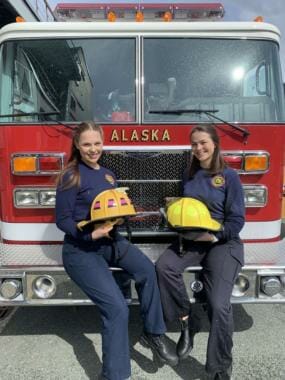
Capital City firefighters Cat Pearson, Jannelle Pine, and Sadie Inman in hazmat gear. The three women are part of Juneau’s all-female team of first responders. (photo courtesy of Sadie Inman, CCFR)
In the summer of 2019, KTOO commissioned a source audit or a report on the demographics of the people we talk to for KTOO news stories and the guests we have on Juneau Afternoon.
Last October, we started asking everyone who appeared in a news story or was a guest on Juneau Afternoon to identify their gender and race and/or ethnicity.
We’ve just finished compiling our third-quarter report, which includes reporting from our “new normal” pandemic life and the ramp-up to the 2020 election.
For the period from July 1 through September 30, 2020:
There were 404 total sources
265 appeared in news stories
125 appeared on Juneau Afternoon
82% of sources self-identified their gender
74% of sources self-identified their race and/or ethnicity
Gender
We did it! We reached gender equality. Well, not really, but our sources were split evenly between men and women for the first time since we started keeping track.
Look at the difference between news sources and Juneau Afternoon guests. This quarter is actually the best showing we’ve had for female sources in news stories: that 43% has been more like one-third in previous reports. And of the Juneau Afternoon who responded to the question, a whopping 80% were women.
We always look at subject matter expertise at this point because it helps clarify some of the gender numbers. Half of Juneau Afternoon guests for the quarter were non-expert members of the general public. This means they weren’t representing an organization or promoting an event. They are just normal people talking on our daily community program about their lives. But given that, it is puzzling to me that 80% of the show’s guests were women.
Considering that this period includes the months leading up to a big deal general election, I’m pleased to see that only 5% of our news sources were politicians or political candidates. There’s still a strong tendency to talk to government and elected officials, but there’s still a nice mix of expert and non-expert voices in a variety of fields represented here.
Race & Ethnicity
In general, the number of our sources who identify as white-only has stayed the same since we started tracking over a year ago, ranging from 75% – 84%.
The real development this quarter was the addition of Juneau Afternoon hosts from the Black Awareness Association of Juneau. They’ve been running the show on Thursdays for a few months and that’s really increased the representation of Black voices on the program.
Across all of our programs and stories, there is still very little in the way of Asian, Hispanic/Latinx and Hawaiian/Pacific Islander voices.
One thing we always look at when we look at the racial and ethnic makeup of our sources is the focus of the story. The mix changes when the story or program has a focus on race.
Stories that are not about race always feature the most white-only voices and we start to see Black and Indigenous sources appear in stronger numbers when the story addresses race or is about race. While this is one way to get more diverse voices on the air, it’s a very limited way of changing the overall inclusivity of our stories.
What’s next?
In addition to sharing all this information with you, our audience, every quarter, we also dive into it as a team. It has not been easy to set goals around our source diversity, but it is easy to see that there’s so much incentive here to try and do things differently. And as NPR’s Chief Diversity Officer Keith Woods, who has been guiding us through some of this work says, “just change something.” It doesn’t matter what. The possibilities are endless and there’s a big ol’ world out there of voices in our community that deserve to and demand to be heard.
Here are a few examples of thoughtful, inclusive sourcing:
There were only two women on Juneau’s COVID-19 Conservation Corp working at Eaglecrest this summer and Adelyn Baxter made sure to talk to one of them for this story.
Talking to teachers and parents of school-aged kids is one way to make sure we’re hearing from women in our community.
Pablo Arauz Peña highlighted the artwork on Juneau’s new ambulance and included interviews with the female Tlingit artists behind the design.
Rashah McChesney knew there would be plenty of women at the Ruth Bader Ginsburg vigil in Juneau and was able to interview a mother and daughter for this story.
In August, KTOO partnered with the Black Awareness Association of Juneau to help us host and source Juneau Afternoon a few programs each month. You can find these rich discussions on the program page.
Rashah McChesney interviewed photographer Brian Wallace, who is Tlingit, for an hour-long special on Juneau Afternoon.
Scott Burton had Haines-based Henry Nalimu Leasia, who is Pacific Islander, on Juneau Afternoon to play live music and talk about his new album.
In August KTOO aired the fourth episode of Lingít Aaní Káa Kei Nas.áx̱ Haa Yoo X̱’atángi (Our Language Is Sounding Off on Tlingit Land), a show and associated language lessons that seek to open the radio waves to Tlingit-language use and normalization
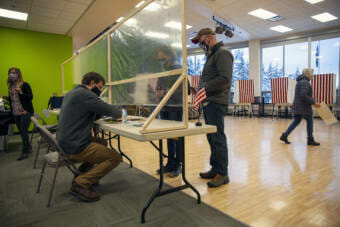
Voters sign for their ballots at the Auk Bay precinct on Tuesday, Nov. 3, 2020, in Juneau, Alaska. (Photo by Rashah McChesney/KTOO)
This is a note to the KTOO audience from VP News & Managing Editor Jennifer Pemberton.
Back in early September, reporter Andrew Kitchenman and I attended an online election prep course called “The Weirdest Election Day Ever,” but KTOO’s news team started prepping for today long before that.
Like preppers who actively prepare to survive major disruptions, we’ve been anticipating the potential social disorder or other big news events that could be awaiting us.
Here’s our plan for making sure you get timely, fair and accurate news from KTOO today…and in the news-heavy days to come:
We take the time to fact check everything we report and make sure it goes through multiple edits so that several people besides the reporter read through the story to make sure it’s accurate, fair and understandable.
We care about being right and not necessarily being first– especially when it comes to something like elections. You might hear or see reporting from other outlets first. That’s okay. We’re seeing them, too, but will wait until we can confirm the reporting ourselves.
We’ll be up late. A team of KTOO reporters and our partners at other stations across the state will be updating our websites and writing news stories for the morning until at least midnight here in Alaska. And when that team heads off to bed, some fresh journalists will take over in the morning.
We will follow NPR’s lead and rely on The Associated Press (AP), a news organization with a track record of fairly and accurately calling election results. For races that aren’t covered by the AP, we’ll wait until all votes are counted.
We will keep you frequently updated throughout Election Day and Night, but we will not speculate or project any results. We’ll keep reporting on the counting process until there’s a clear winner — even though that could be days or weeks away.
When we make mistakes, we will correct them as soon as possible. When that mistake is on the web, we correct it on the web. When it’s on the air, we correct it on the air. When it’s in a social media post, we correct it on social media.
We’ll bring you live national coverage from NPR from 4:00 – 9:00 PM on Nov. 3 and then live statewide coverage from our partners at Alaska Public Media from 9:00 – 11:00 PM.
We’ll be updating an elections results post on KTOO.org starting at 4:00 PM on Nov. 3. NPR’s elections results map as well as vote counts for Alaska’s national races and ballot measures will be available at KTOO.org/elections starting at 4:00 PM on Nov. 3.
Close
Update notification options
Subscribe to notifications
Subscribe
Get notifications about news related to the topics you care about. You can unsubscribe anytime.