Jennifer Pemberton

Managing Editor, KTOO

I bring stories from the community into the KTOO newsroom so that all of our reporting matters. I want to hear my community’s struggles and its wins reflected in our coverage. Does our reporting reflect your experience in Juneau?
Seeing the value of the forest in the trees: Chugach enters California’s carbon market

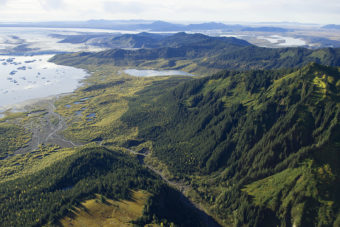
An aerial view of the eastern edge of Alaska’s Copper River Delta. The area is the focus of an innovative deal that safeguards old-growth forests and major coal reserves. (Photo courtesy David Little/Eyak Preservation Council)

“Anyone who’s been to Prince William Sound can tell you it’s an area of tremendous beauty,” said Josie Hickel, Senior Vice President of Chugach Alaska Corporation. “Glaciers, forested acres, wilderness areas. The area is full of wildlife and birdlife, and the fishing is obviously fantastic.”

Among Chugach Alaska’s 900,000 acres are hundreds of thousands of acres of forest — some of it old growth and a lot of it hard to get to. Instead of selling their trees directly, they’re selling the carbon stored in those trees. There’s a market for this in California, and it recently opened up to Alaskan landowners.

“The major emitters  of greenhouse gas have to have a permit or an offset for every ton of pollution they emit in the state of California,” said Brian Shillinglaw with New Forests, the group in California that will help Chugach manage its carbon assets.

Maybe you’ve heard California’s system called “cap and trade.” There’s a cap — or a limit — on how much pollution companies can emit and then there’s a trade for anything above and beyond the cap.

Think of any excess pollution as a carbon sin. Companies in California can pay to have their sins absolved. That absolution comes in the form of sustainably managed forests in other parts of the country.

“Five million acres of forest land are enrolled in this system nationwide,” Shillinglaw said. “This is the first time there’s been a real market for growing older growth forests. The system will pay you to not cut down your forest and to grow inventory.”

Basically, companies in California can emit more carbon because places like Alaskan forests are storing carbon in exchange.

A forest carbon offset project on Chugach Alaska Corporation land relies on a forest inventory based on field measurements conducted by New Forests. (Photo courtesy New Forests)

The California cap and trade market is the largest carbon market in North America, but currently there isn’t enough supply of carbon offsets to meet the demand of California’s polluters. Alaska’s entrance to the market could help change that.

Josie Hickel says other Alaska Native Corporations are considering similar deals, but Chugach’s is the first one that’s been finalized.

Chugach is waiting for spring for a complete forest inventory to take place, but Hickel says they estimate that they have several million carbon credits in their forest land. The carbon market fluctuates like any other market, but right now offsets are selling for around $13 per ton of CO2 emissions. That means that Chugach owns tens of millions of dollars worth of carbon credits that can be sold anytime a California polluter goes over their cap.

In the same deal, on the same piece of land, Chugach sold their right to develop the Bering River coal field to The Nature Conservancy. The Nature Conservancy doesn’t own a lot of coal rights and they’re not planning on doing any coal mining any time soon, according to Rand Hagenstein, Director of the Alaska Program for The Nature Conservancy.

“Our intent is to keep the coal underground in perpetuity,” he said.

And keeping that coal in the ground has positive impacts downstream — all the way to the  Copper River Delta.

“This area is globally renowned for its wildlife habitat. We all know about Copper River red salmon. Many people are also aware that this is one of the world’s premier migratory shorebird and waterfowl sites,” Hagenstein said. “So, there’s a tremendous amount of biological value there.”

For Josie Hickel, with the Chugach Alaska Corporation, the deal means more than just a new revenue source.

“We need to be able to have financial benefits for our shareholders as well as making sure we have the  funding for many generations to come in terms of upholding our heritage and our culture and our language,” she said. “This is a great way to be able to do that.”

This is uncharted territory for Alaskan landowners, but the economic benefits to the Corporation as well as to subsistence and commercial fisheries make California’s carbon market an attractive new frontier.

The lure of John McPhee’s “Coming into the Country,” 40 years later

“Coming into the Country,” John McPhee’s book about Alaska, was published in 1977, introducing readers across the country to a wild place, less than 20 years into its statehood. The book quickly became a best-seller and is still popular with tourists and Alaska residents alike.

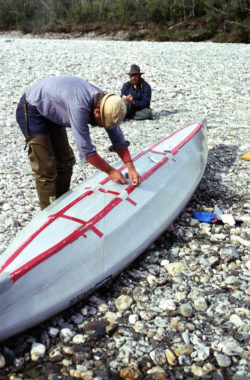
John McPhee watches as Pat Pourchot patches their kayak so they could continue down the Salmon River. McPhee traveled to Alaska in the late 1970s for a series of articles that eventually became the book “Coming into the Country.” (Photo courtesy Pat Pourchot)

Between 1975 and ‘77, a writer from Princeton, New Jersey, made four long trips to Alaska for a story that would eventually become “Coming into the Country.” John McPhee had been writing for the New Yorker magazine for about ten years. He was the master of a new literary genre that most modern readers are very familiar with: creative nonfiction.

The book is written in three parts, every word published first in the pages of the New Yorker before coming together for the book’s publication late in 1977. The book describes an Alaska both wild and settled, sometimes contentiously so.

“It is about what McPhee came to believe was the real Alaska and part of the reason for the book’s’ continued popularity is that many Alaskans also feel that that’s the real Alaska,” said Eric Heyne an English professor at the University of Alaska Fairbanks. He’s been teaching Coming into the Country since the late 1980s.

The real Alaska described in the book is a place sparsely populated by trappers, prospectors and squatters, living very much off the land and off the grid in the area around the Yukon River.

Heyne specializes in Alaskan literature, and so it makes sense to him that the profile of these characters is inherently relateable to so many Alaskans, then and now.

“A lot of people still have an image in their heads of that Alaska being what they identify  with,” Heyne said, “Mining. Trapping. Dog mushing. Canoeing. Homesteading.”

For Alaskans, Coming into the Country is familiar, but Alan Weltzein at the University of Western Montana says there’s also an exoticism to the book that appeals to readers outside the state .

“A lot of people still in the 1970s didn’t know anything about Alaska,” Weltzein said. “Part of what McPhee’s trying to capture is its lure and there’s nothing more American than that. The lure is always to go west and find bigger space. I think Coming into the Country an invitation for some Americans — maybe just an imaginative invitation more than actual for most — probably to the relief of a lot of Alaskans.”

Eric Heyne agrees that the book is alluring to outsiders as well as requisite reading for anyone already living in the state.

“I absolutely recommend it as the first book to read if you’re coming to Alaska,” he said. “It remains the best blend of comprehensive, accurate, and well written. McPhee’s a fabulous writer.  There’s no question about that. But also it’s remained remarkably accurate to today’s Alaska.”

The question of accuracy and relevancy comes up again and again when talking to people about Coming into the Country. For one, it was written 40 years ago. Hasn’t Alaska changed since then? Also, the guy who wrote it is from Princeton, New Jersey. How could Alaskans possible identify with that?

“I distinctly remember feeling like I was having a love affair when I was reading Coming into the Country in the late 1970s,” said Alan Weltzein, who hadn’t even made it as far west as Montana when he read the book for the first time. “I had this kind of trust in his representation, so I could ride along with him when he defined what the country means if you live in Alaska.”

John McPhee camping on a gravel bar below the Charley River. (Photo courtesy of Brad Snow & Lilly Allen Collection, Alaska and Polar Regions Collections, University of Alaska Fairbanks)

It’s an old American tradition: the self-sufficient, independent individual. It’s a myth we’re all familiar with, but for as much as it reads like one, Coming into the Country isn’t a novel. The characters are real — many of them still living in Alaska, some of them still in cabins they built with their own hands.

Cable television is littered with reality shows about modern-day Alaskans living in the bush, but Eric Heyne would rather go with McPhee’s portrayal from 40 years ago.

“What you get in the reality shows these days are sort of cartoonish portraits of the kind of people who live off the road system, who have small mines, who run traplines,” he said. “What we get in McPhee’s book are deeper portraits of the actual people.”
At the end of the book, on his last trip to Alaska, John McPhee talks to one of the young prospectors on the Yukon, confirming his understanding of what Alaska represents and what this lifestyle means.

“In the society as a whole,” he writes “there is an elemental need for a frontier outlet, for a pioneer place to go. People are mentioning outer space as, in this respect, all we have left. All we have left is Alaska.”

In some ways, all we have left is this book as a snapshot from 1977 of a vastly unknown but very real place.

40 years later, John McPhee’s book still brings fans to Eagle, Alaska

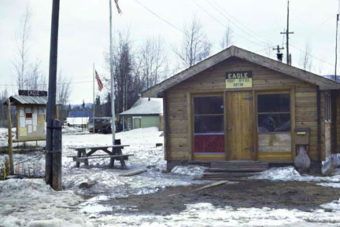
Post Office building in Eagle during spring ice break-up. John Borg was the postmaster and mayor of Eagle when author John McPhee came through in 1976. (Photo courtesy of Brad Snow & Lilly Allen Collection. Alaska and Polar Regions Collections, University of Alaska Fairbanks)

John Borg was the mayor and postmaster of Eagle, Alaska, in the late 1970s when author John McPhee came through to research for his best-selling book “Coming into the Country.” For 40 years now, readers come into Eagle every summer without fail asking about the characters they met in the book. John Borg shared his thoughts with Alaska’s Energy Desk about what it’s like to host these literary tourists.

Alaska’s Energy Desk celebrates ‘Coming into the Country’

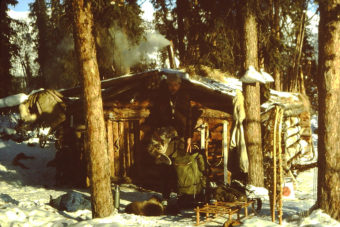
A trapper stands in front of his cabin in the Brooks Range, c. 1980. (Creative commons photo by Karl Friedrich Herhold)

Coming into the Country: Alaska’s Energy Desk celebrates the 40th anniversary of the book that shared Alaska with the world

When it was first published 40 years ago, John McPhee’s bestselling book “Coming into the Country” described a state so distant and remote from most readers that McPhee called it “a foreign country significantly populated by Americans.” The book is a snapshot of a pivotal moment in Alaska’s timeline: after the discovery of oil but before the first barrel flowed down the Trans-Alaska Pipeline. When read today, the book seems almost prophetic in how it sets up the enduring tension between preservation and development that drives the state today.

In January, Alaska’s Energy Desk celebrates the anniversary of “Coming into the Country” with a series of stories and programs that explore the Alaskan landscape of 1977 and today.

  • Tune in to Talk of Alaska with special guest John McPhee, January 24, 2017, 10am (What should we ask him? Submit your questions for the author)
  • Join us in studio for a forum with Pat Pourchot (in Anchorage), Willie Hensley (in Juneau) and other guests who can speak first-hand about the book, January 24, 2017, 7pm
  • Listen to Alaska’s Energy Desk reports throughout the week as we follow up with characters from Coming into the Country and the legacy the book holds in Alaska
Site notifications
Update notification options
Subscribe to notifications