Jennifer Pemberton
Managing Editor, KTOO
I bring stories from the community into the KTOO newsroom so that all of our reporting matters. I want to hear my community’s struggles and its wins reflected in our coverage. Does our reporting reflect your experience in Juneau?
Denali National Park plans to adjust poop haul-out rules

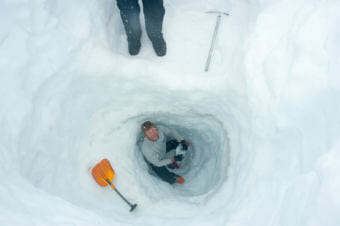
Denali National Park plans to toughen poop hauling requirements for climbers on the popular West Buttress route up North America’s tallest peak. The rules are based on research that indicates the Kahiltna Glacier is working more like a slow-moving poop conveyer belt and less like a natural toilet than previously believed.
More than 1,000 mountaineers per year have tried to climb Denali in recent years, most of them on the West Buttress route, which begins on the Kahiltna Glacier. By a conservative Park Service estimate, they have left more than 150,000 pounds of poop in crevasses on the Kahiltna Glacier since Bradford Washburn pioneered the West Buttress route in 1951.
Under the proposed rule changes up for public comment through February 15, mountaineers on the West Buttress below Camp 4 (14,200 feet) will be required to cache their poop in biodegradable bags, haul it back to base camp on their descent and fly it back to Talkeetna. Higher on the mountain, they’ll still be allowed to dispose of feces in a crevasse. The Park Service will mark a crevasse near Camp 4 that will be used for human waste disposal on the upper mountain.
Since 2007, climbers have been required to collect their poop in biodegradable bags, but much of it has been thrown into crevasses on the lower mountain.
People previously believed that the glacier would grind up the human waste. This belief was based on misconceptions about glaciers, said Michael Loso who has been studying poop on the West Buttress route since 2007, when he was a professor at Alaska Pacific University in Anchorage. He now works for Wrangell St. Elias National Park and Preserve and is still studying feces on the Kahiltna.
The powerful grinding force of a glacier doesn’t act on human waste dropped in a crevasse because the poop doesn’t fall between the glacier ice and the underlying rock.
“They’re grinding, but they’re grinding at the bed, and the poop is at the surface, and then it’s shallowly buried a few feet from the surface. So there’s nothing to grind it,” he said.
“It’s the same thing as when your dog poops in the yard all winter,” he said. “And I may not scientifically think it has all gone away, but, nonetheless, I’m always surprised in the spring when the poop is still there.”
Glaciers move slowly, but parts of the lower Kahiltna are moving as fast as a quarter mile a year. Loso estimates that in the next decade poop from early mountaineers will resurface on the Kahiltna Glacier about 7 miles below Denali basecamp in a region where the glacier’s snow is melting faster than it is accumulating.
In addition to estimating the speed human waste is traveling down the glacier, Loso and his colleagues are studying whether bacteria in feces can survive the long ride down a glacier. To do this, they buried mountain climber feces in the glacier and found bacteria survived exposure to the cold for at least a year. The team has also detected E. coli bacteria in the Kahiltna River downstream of the glacier, but it’s not clear whether it’s from meltwater flowing through mountain climber feces or animal poop in tributary streams.
In an interview this week, Loso emphasized that while he wanted to bring this issue the attention of the Park Service, he doesn’t have an opinion on whether the Park Service should do anything about it. He said the E. coli in the river isn’t a public health concern, and that the biggest consequence of the climber poop moving through the glacier may be aesthetic, an ugly brown mess emerging from the glacier.
“The amount of E. coli is very low. It’s not like if you go swimming in the Kahiltna you’re going to get sick. Not to mention that no one does go swimming in the Kahiltna,” he said. “It’s more just kind of astonishing. That’s got to be a lot of poop to make a huge glacier river like that show signs of it.”
Asked about the new rules last week, Denali mountaineering ranger Chris Erickson said the proposals reflect practices that mountaineering rangers had already been asking climbers to follow voluntarily.
“The climbers who come here are just as concerned with human waste management as we are, generally speaking,” he said. “There have been several times we’ve been considering some changes, and we’ll pitch it to climbers as optional, and almost every time they’ll do it.”
Nonetheless, the rules represent a significant additional weight for climbers. The average climber produces between a third and half a pound of poop per day and spends about three weeks on the mountain. Erickson said the new rule will still allow the use of the Camp 4-area crevasse for the upper mountain because the route gets harder above Camp 4 and it would be impractical for climbers to pack their poop from this elevation all the way back to base camp. Also, the Park Service hopes the topography of the designated crevasse means it will do a better job grinding the poop than the crevasses lower on the mountain.
“Below 14,000 feet there’s a gigantic ice fall that goes down seven- or eight-thousand feet,” he said. “Our hope is that in the process of going through that ice fall, the snow, ice and human waste will get pulverized and basically spread out and the UV (ultraviolet light from the sun) will decontaminate it by the time it goes into Northeast Fork of the Kahiltna Glacier.”
The rules changes for mountain climber waste are part of this year’s compendium, a list of rules changes recommended every year by the park superintendent.
In addition to reworking Denali’s human waste rules for West Buttress climbers, this year’s compendium also prohibits fishing from the Savage River Bridge on the Denali Park Road because of traffic congestion concerns. The compendium also revises the rules for protesting and leafleting in the park, designating areas where these activities can take place. For more information, including a list of all the rules changes at other Alaska parks, go to bit.ly/2EjSitA.
Walker re-funds Ambler Road Project to EIS process

Alaska Gov. Bill Walker said he plans to re-fund the Ambler Road Project to the same point it was funded previously. The project lost its state funding in 2015 when Walker defunded several bond funded construction projects due to budgetary issues.
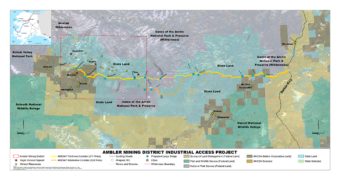
The Ambler Road Project is a proposed 200-mile road that would connect the Ambler Mining District in Northwest Alaska with the Dalton Highway and Fairbanks.
In a recent interview with the News-Miner, Walker confirmed that, if his FY19 budget proposal is passed, the project will be funded at the same level.
“Our commitment to the Ambler Road was to get it up through the EIS process,” Walker said. “We are going to go ahead and advance that.”
The Bureau of Land Management is working on an environmental impact statement for the project, identifying and analyzing concerns associated with the Alaska Industrial Development and Export Authority’s proposal. The EIS must be complete before the project can move to the permitting phase. The public comment period just ended after months of gathering input.
Walker said the scoping process will not change and the goal of getting the environmental impact statement completed remains the same.
“We aren’t going to change anything on that,” Walker said.
The governor said that some changes might cost slightly more than before, but not significantly more.
“We’re going to spend a little more money on that,” Walker said. “It turned out that the regulatory process has been changed from the Corps of Engineers over to BLM, and that’s going to cost a little more to do that. But we’re going to take it to the same point in time that we committed to before.”
The Ambler Road Project has been in the works since 2014, drawing criticism from Interior Alaska residents concerned about increased access to traditional hunting and fishing grounds and an added risk of industrial contamination.
After some problems with funding, the Alaska Industrial Development and Export Authority took over the project and recently completed a proposal for the road. BLM is working on an environmental impact statement, identifying and analyzing concerns about AIDEA’s proposal.
Walker said he didn’t know who would take over the project after the EIS was completed.
“Does it turn over to a private sector group that goes out and does it? Does it go through the mine? Do we do it? How do we do it?” Walker said. “It’s just the permitting process at this point.”
The BLM estimates that the EIS will not be completed and signed until 2019.
Winter rain is compromising baby muskoxen in western Alaska

A warmer Arctic means big changes for sea ice and the animals that depend on it. But a new paper shows how warmer ocean temperatures are impacting animals on land in the Arctic as well.
“As temperatures are warming, what we’re seeing is that events that are weather triggered offshore are having onshore consequences on land mammals,” said Joel Berger, a biologist at Colorado State University.
Berger studies polar bears in western Alaska and Russia’s Wrangel Island in the Chukchi Sea. But he has a special place in his heart for another Arctic animal.
“Scientists aren’t supposed to say this,” Berger said, “but sometimes they fall in love with the animals they study and clearly that’s the case with muskoxen and me.”
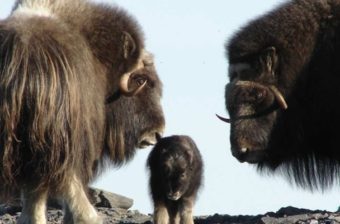
The muskox is basically a giant circumpolar goat. It’s well adapted to living in the far north. It hunkers down in the winter, conserving energy by not moving around a lot — a kind of waking above-ground hibernation. It also has a long coat and special woolly undercoat called qiviut. It’s 8 times warmer than sheep wool, Berger says — perfect for winter field work on the tundra.
For thousands of years muskoxen have dealt with all the blows of the Arctic.
But things are changing.
“Summers are longer. Winters are shorter,” he said. “But we’re also seeing rain on snow events.”
Rain on snow. It sounds like something that happens in Juneau every week during the winter.
“Your listeners are going to be thinking ‘What? We get this all the time. Why is that a problem?'” Berger said.
It’s a problem because rain in the Arctic instantly turns to ice when it hits the frozen ground, trapping the low vegetation muskoxen depend on.
But this isn’t having the effect you might think. They’re not starving to death.
It’s a problem for pregnant muskoxen. At the end of their pregnancy — in February, March and April — the rapid growth of their babies is most susceptible to being impacted by rain on snow events.
And when there’s diminished food for the mother during this last trimester, her babies are “runtier” Berger says. When his team measured them at one, two and three years old, they had smaller heads than others whose mothers experienced fewer rain on snow events during pregnancy.
In general, smaller animals have higher mortality rates and if they survive, they reproduce at lower rates. Which means that one winter storm in the Arctic that brings rain instead of snow, can result in a nutritionally deprived baby that will have lower odds of growing up and reproducing. The ripple effect here, you can see, is serious.
“Even subtle rain on snow events can have these prolonged effects on young muskoxen,” Berger said.
So far, Berger and his team have tracked these impacts on the first 3 years of the animal’s life. And they’ve seen that a 3 year old muskox will still carry the impact of a rain on snow event that happened when it was in utero.
Berger is on his way back to Wrangel Island in Russia in a few weeks. He’ll see how the 4-year-old muskoxen are faring. It’s unknown whether these runty individuals will be able to make up for their small size later in life.
New Pebble advisory committee meets indoors, while mine protesters gather outside

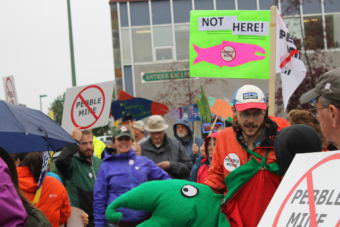
While the new advisory committee for the Pebble Partnership met for the first-time in Anchorage on Monday, opponents of the Pebble Mine gathered outside for a rally.
Alannah Hurley with United Tribes of Bristol Bay was invited to the meeting, but she said they declined because the tribal governments that she represents have already made their position clear.
“Why would the people of Bristol Bay waste our time to do this again so that the Pebble Limited Partnership could pretend that they’re listening to the stakeholders, the people of Bristol Bay, and Alaskans?” she said. “If they were listening, they would have been gone a decade ago.”
Hurley said the rally was meant to highlight unity against the mine across the political spectrum.
“We are really at a turning point in history where we’re either going to trade the last great salmon sockeye fishery on the face of the planet for a foreign mining company to develop a gold mine at the headwaters of that fishery or we are going to choose a sustainable way of living and a sustainable economy,” she said.
Mike Heatwole, a spokesperson for the Pebble Partnership, said the company formed the advisory committee to include local people in the conversation.
“That’s really to give us a range of feedback, ask us hard questions, potentially offer ideas that we might not have thought of and really kick the tires aggressively, if you will, on all the things that a development at Pebble could be – the social concerns, the environmental concerns, the economic opportunities,” he said.
The company plans to release a plan for the mine this fall, says Heatwole, along with a transportation plan to get minerals out.
With a more favorable administration in Washington and an EPA proposal to withdraw a determination blocking development of the mine, Heatwole says the company is forging ahead.
“The remaining goals are to file a permit by the end of this year along with having a longer-term partner to get us through that permitting window,” he said.
The 90-day comment period for the EPA proposal to withdraw their opposition to the mine kicked off July 17. It officially ends on October 17.
Human intervention: scientists propose plan to help refreeze the melting Arctic

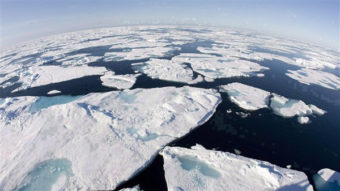
The Arctic could see its first ice-free summer as soon as 2030 as the region continues to warm faster than the rest of the planet.
Some scientists think we’ve reached a point of no return, where no amount of reducing carbon emissions will save the Arctic, and a small group of scientists think it’s time for an intervention to help Mother Nature out.
Douglas MacMartin at Cornell University works in a field called geoengineering, which sounds like a branch of geology or something, but it’s a little more out there than that.
“The idea is any large-scale project that is designed to intentionally deal with some of the consequences of climate change,” he said.
Examples of these large-scale projects are manipulating ocean currents with heat pumps or spraying reflective particles into the troposphere to reflect solar radiation back into space.
It sounds like science fiction, but with math to back it up.
Arizona State University astrophysicist Steve Desch recently published a paper describing his geoengineering idea: placing sea water pumps in the Arctic that would assist nature in making sea ice.
“What we’re proposing doing is helping the ice freeze over 10 percent of Arctic,” he said.
Desch mostly studies the climates of other planets and moons — especially the really icy ones. But he found himself at more and more conferences with scientists focused on planet Earth.
“I came away thinking the problem is urgent, but I didn’t feel like they were addressing solutions or actions we could take, other than reducing CO2,” he said. “That’s when I decided to contribute something.”
The motivation behind Desch’s recent paper is that reducing carbon emissions from our cars and our factories and homes is not enough to reverse global warming.
Basically, desperate times call for proactive and potentially costly engineering measures.
Desch’s plan would require 10 million wind-powered pumps spread out across the sea. They would create a meter of sea ice across 10 percent of the Arctic.
It’s a lot, but not impossible.
“It sounds like a ridiculous number at first,” Desch said, “but on the other hand we make 10 million cars in this country every year.”
Made of steel, each pump would cost about $50,000 to manufacture. The total price tag would be somewhere around $500 billion. Desch says that amount is comparable to the Manhattan Project or the Iraq War.
The plan may be grandiose in scope and cost, but the idea itself is relatively simple. It’s relatively natural as far as geoengineering projects go.
Even Doug MacMartin, the engineer, thinks it’s an elegant solution.
“I grew up in Ottawa where every winter they flood the canal with ice. If it’s going to be a cold night they pump more water on the ice to make it thicker so you can skate on the canal,” he said. “So I’ve always thought why can’t we do that in the Arctic?”
Even if you think of geoengineering as a last resort, scientists like MacMartin don’t want people to stop trying to reduce carbon emissions.
“It seems hard to imagine why one would consider some of the more radical solutions if we hadn’t taken the first step to cut our carbon emissions,” he said.
Anchorage-based climatologist Brian Brettschneider thinks geoengineering projects are starting to sound less crazy than they did a few years ago.
“I’m still an optimist that we can do some dramatic reductions in greenhouse gas emissions, but maybe we can’t,” he said. “At what point do we say now we’re in emergency mode?”
“Maybe we’re there. I don’t know.”
One thing’s for sure, if and when we can agree that we are there, the geoengineers will be ready.