Jennifer Pemberton

Managing Editor, KTOO

I bring stories from the community into the KTOO newsroom so that all of our reporting matters. I want to hear my community’s struggles and its wins reflected in our coverage. Does our reporting reflect your experience in Juneau?
KTOO’s source diversity report from the last quarter of 2020

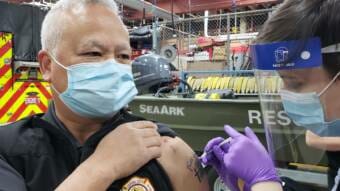
Asst Chief Ed Quinto and Lily Kincaid COVID vaccination
Capital City Fire/Rescue paramedic Lily Kincaid injects a dose of Pfizer’s COVID-19 vaccine into Assistant Chief Ed Quinto’s arm at the downtown station in Juneau on Dec. 17, 2020. Quinto said he didn’t have any anxiety about it and it felt like just another shot. (Photo by Jeremy Hsieh/KTOO)

In the summer of 2019, KTOO commissioned a source audit, or a report on the demographics of the people we talk to for KTOO news stories and the guests we have on Juneau Afternoon.

Now, we ask everyone who appears in a news story or is a guest on Juneau Afternoon to identify their gender and their race and/or ethnicity. We do this in order to understand whose voices we are relying on too much and whose voices we might be leaving out.

We’ve just finished compiling our 4th quarter report of 2020, which includes most of the lengthy election season, the arrival of the COVID-19 vaccine in Alaska, and extreme weather in Southeast Alaska that displaced dozens of people and killed two residents in Haines.

For the period from Oct. 1st through Dec. 31st, 2020:

  • There were 376 total sources
  • 242 appeared in news stories
  • 134 appeared on Juneau Afternoon
  • 77% of sources self-identified their gender
  • 80% of sources self-identified their race and/or ethnicity

Gender

In total, 57% of our sources for the quarter were male. The percentage was slightly higher than that for news sources, but for Juneau Afternoon, female voices were the majority at 51%.

In the KTOO newsroom we are engaged in an ongoing conversation on including more female sources in our reporting, especially subject matter experts. It is especially difficult to keep the balance during events like a general election, where we don’t have any control over who is running for office or the fact that there are frequently more men than women in political races.

A graph showing the gender breakdown of sources who appeared on KTOO programs Oct - Dec 2020


We always look at subject matter expertise at this point because it helps clarify some of the gender numbers. Most of the guests on Juneau Afternoon for the quarter were non-expert members of the general public, which means that they are not pre-sorted by gender in the same way that subject experts are.

For the news department, 39% of the sources were either elected officials or government spokespeople and 8% were politicians, who are more likely to be male. That makes sense given that all three months in the reporting period were dominated by election coverage.

A chart showing the subject matter expertise of KTOO sources from Oct - Dec 2020

Ethnicity

In general, the number of our sources who identify as white-only has stayed roughly the same since we started reporting (between 75% and 84%) but at 72%, this period had the lowest overall. That’s mostly due to the weekly addition of Juneau Afternoon hosts from the Black Awareness Association of Juneau, which has made Black voices the majority on the program. Sources for news stories, however, were 85% white.

In the news department, the largest percentage of non-white sources was Alaska Native, at 8%.

Across all of our programs and stories, there continues to be very little in the way of Asian, Latinx and Hawaiian/Pacific Islander voices. This is especially concerning with the rise of hate crimes against members of the Asian American and Pacific Islander community in the past year. We know we need to do better.

One thing we always look at when we look at the racial and ethnic make-up of our sources is the focus of the story. The mix changes when the story or program has a focus on race.

Stories that are not about race tend to feature the most white-only voices and we start to see Black and Indigenous sources appear in stronger numbers when the story addresses race or is about race. While this is one way to get more diverse voices on the air, it’s a very limited way of changing the overall inclusivity of our stories.

A graph showing the breakdown of the race of KTOO sources by story focus for Oct - Dec 2020

What’s Next?

We’re learning Lingít , the Tlingit language! Thanks to a grant from the Alaska Community Foundation, the entire staff at KTOO is taking a semester-long language class with X̱ʼunei Lance Twitchell.

As a publicly owned media organization, it is our job to reflect the community we serve. Language is culture, and even with a very basic, entry-level understanding of the language, we hope we can do a better job at serving more of our audience’s informational needs. Also, as more places and individuals in our broadcast area reclaim their Lingít names, we have an obligation to properly pronounce them on the air, spell them correctly online and understand their meanings.

It will be interesting to see if this deeper understanding and connection to the land will yield new sources or story ideas for KTOO.

Juneau sets up evacuation center for residents affected by extreme avalanche danger

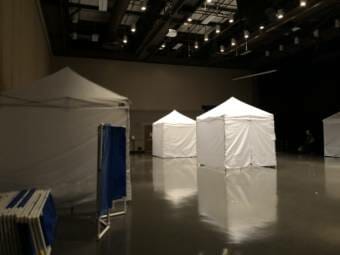
Tents and cots are set up at the city’s evacuation center at Centennial Hall on February 27, 2021. The center is set up for residents in the path of a potential avalanche. (Photo by Jennifer Pemberton / KTOO)

At 10 a.m. Saturday, Juneau’s urban avalanche forecast was for “extreme” danger. That’s a five on a scale that goes to five. The city’s emergency manager, Tom Mattice, said it was the first time he’d ever forecasted an extreme avalanche condition for Juneau.

It was also the first time since 2008 that the city was recommending people in the Behrends Avenue neighborhood evacuate their homes due to the avalanche danger.

The Behrends Avenue avalanche path runs down Mount Juneau on the side facing Gastineau Channel, near Juneau-Douglas High School. It’s obvious where the path is, especially in summer when you can see a distinct lack of trees. At the bottom of the path is three rows of houses.

“I knocked on 39 doors today,” said Tom Mattice from the city’s evacuation center on Saturday night. “Couple of them are on the edge of the avalanche path, but that’s how many I logged.”

He said most people are staying at friends houses or hotels.

“Several people have motor homes or boats or relatives in town,” he said. “We wanted to make sure that people had options.”

So, the city teamed up with the Red Cross and opened up Centennial Hall. There were only a few people registered shortly after it opened at 8 p.m.

One of the ballrooms was set up with about a half dozen white tents, each with a few cots inside so families could stay together and spread out from other groups of people for both privacy and COVID-19 safety.

“We’ve got wool blankets, fleece blankets and pillows in there for folks. There’s a shower house outside,” said Michelle Brown, a Juneau city employee and Red Cross volunteer.

Two officers with Juneau Animal Control were there, too, so that people could bring their pets with them, or even drop them off if they needed to stay somewhere pets weren’t welcome. They had a few cat carriers and some leashes at the ready.

“What we’re offering is holding people’s animals for up to ten days if need be free of charge,” said Jordan Bales. “Also vaccinating and applying treatments that they may need to keep them safe in the shelter.”

Jordan Bales and Diana Moon from Juneau Animal Control are volunteering at the city’s evacuation center at Centennial Hall on February 27, 2021. The center is set up for residents in the path of a potential avalanche. (Photo by Jennifer Pemberton / KTOO)

No pets were at the center at the time, but someone had stopped by to say his cat had run away in the avalanche zone. They filed a lost pet report for him and were hopeful the cat would be found.

The next day, the avalanche advisory was high, but no longer extreme. And there didn’t end up being any slides in the Behrends Avenue area. The forecast for Sunday was for colder temperatures and less precipitation, so even though conditions were right for large avalanches, Mattice wrote in his report that “we may have dodged a bullet for the time being on the big one.”

For now, that top layer of new snow, called the storm slab, doesn’t seem like it’s going to come down. It’s deep enough that an avalanche would reach the houses at the bottom of the Behrends Avenue avalanche path.

Underneath the storm slab is a deeper layer of snow from earlier in the year called the “persistent weak layer.” If that layer slid down the hill with everything on top of it, that avalanche would go all the way past the houses and Glacier Avenue and down to Gastineau Channel.

That persistent weak layer of snow is still there and Mattice says, it’s there under the snow throughout the whole region.

“This year is going to be dangerous and this year is going to be spooky,” Mattice said. “And it may not end until all the snow is gone in the spring.”

On Sunday, Mattice went up the Dan Moller trail on Douglas Island. He said he saw what he called 30 to 100 year avalanches — meaning big ones. The kinds that snap off branches and knock down whole trees.

There’s still significant danger in the backcountry and in urban areas and there’s more rain and snow in the forecast for this week.

This story was been updated on Sunday with the lowered avalanche danger.

Juneau’s COVID-19 community risk downgraded to lowest level

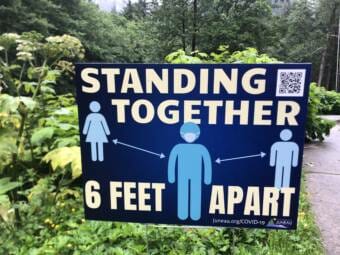
A sign that says "Standing Together 6 Feet Apart"
A message from the City and Borough of Juneau at Cope Park in July 2020. (Jennifer Pemberton/KTOO)

In Juneau, the pandemic risk level is being downgraded to the lowest level (Level 1: Minimal Risk).

There is still community spread of COVID-19 happening in Juneau but according to a press release from the city, hospital capacity and contact tracing are at manageable levels.
Masks are still required indoors and city officials are asking people to continue to practice social distancing — even people who have been vaccinated against the coronavirus.

The new, lower level mitigation strategies go into place at 12:01 a.m. on Thursday, Feb. 18, 2021.

Restaurants, bars and gyms will no longer have limited capacity but still need to provide space so people can keep six feet away from non-family members.

City fire department staff check COVID-19 testing paperwork for people who arrived in town on a flight from Seattle on August 14, 2020, in Juneau, Alaska. (Photo by Rashah McChesney/KTOO)

Travelers arriving in Juneau from out of state still need to get tested on arrival and practice strict social distancing until they get their results.

On Wednesday, city officials reported two new cases of COVID-19, bringing the city up to 19 active cases. That includes two cases in the Juneau School District, one at Harborview Elementary School and another at Juneau-Douglas High School: Yadaa.at Kalé. City officials say there is still in-person learning happening at both schools.

Canada bans cruise ships for a year, taking another Southeast Alaska tourism season off the table

Juneau’s cruise ship docks are empty on April 23, 2020. The cruise ship season was supposed to begin, but sailings have been suspended due to the coronavirus pandemic. (Jennifer Pemberton / KTOO)

On Thursday, the Canadian government announced a ban on cruise ships in Canadian waters until February of 2022.

This order effectively shuts down Alaska’s 2021 cruise season.

U.S. maritime law says foreign flagged cruise ships need to stop in Canada between U.S ports. That’s why large cruise lines like Holland America, Norwegian Cruise Line and Royal Caribbean stop in British Columbia before they begin their trips in Alaska.

So when the Canadian government prohibited cruise ship travel to its ports last year, it effectively ended cruise tourism in Alaska too. That cruise ship ban has now been extended until February of 2022.

Juneau city manager Rorie Watt said he isn’t surprised.

“Since the new year, the tea leaves and the news has been progressively more pessimistic for the return of cruise ships for the summer,” he said.

But he thought the extension of the ban might be for a few months, not the whole year.

“Three months ago we thought we’d see ships in May, a month ago maybe we’d see them in June, two weeks ago maybe we’d see them in July, and last week, we thought maybe we’d see them in August,” he said.

It’s not a done-deal in Watt’s mind, though. And the order from the Canadian government could be rescinded if the pandemic conditions improve before next February.

But in Skagway, mayor Andrew Cremata doesn’t see any way forward in the meantime.

“Any idea that there could be some kind of workaround is off the table now, because the Canadian government has stated very clearly, that cruise ships will not even be allowed in Canadian waters,” he said.

Some members of the cruise industry are hoping for an exemption from that law that requires cruise ships to stop in Canada before heading to Alaska.

Ketchikan Visitors’ Bureau President & CEO Patti Mackey says that a request for a waiver has already been made to Alaska’s lawmakers in Washington D.C.

“There’s been considerable talk to our congressional delegation already,” she said. “And I have a feeling it’s going to amp up a little bit more now with this latest announcement.”

Hours after the announcement, the office of Alaska Congressman Don Young sent a three-page letter to the White House urging the Biden administration to help find a legal workaround with Canada that could salvage Alaska’s 2021 cruise season.

Not all cruises are affected by Canada’s ban. Small cruise ships that start and end in Alaska will be able to operate when they meet COVID-19 protocols from the U.S. Centers for Disease Control and Prevention.

But if Southeast Alaska port communities are going to weather another year without any revenue from cruise ship passengers and related businesses, Rorie Watt in Juneau said, it’s not going to happen without some help.

“We are going to be hoping and praying for a large federal stimulus package,” he said.

According to the Cruise Lines Industry Association, cruises contributed $1.3 billion in direct spending to Alaska and generated 23,000 jobs before the pandemic.

Businesses in Skagway have struggled to stay afloat after a year without any cruise tourism. It’s pretty much the town’s only industry. The municipality has scheduled a town hall meeting on February 10th to discuss backup plans now that it’s clear ships won’t be back this summer.

Jacob Resneck and Eric Stone contributed reporting to this story. The story has been updated from the original with additional information.

Correction: An earlier version of this story misspelled Royal Caribbean. 

After months on high alert, Juneau drops to ‘moderate’ COVID-19 community risk level

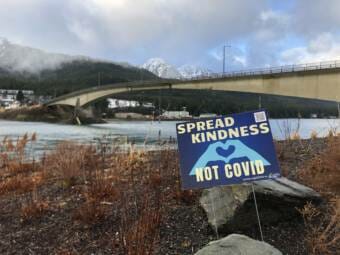
A City & Borough of Juneau sign reads "Spread Kindness, Not COVID." Photographed Nov. 26, 2020, at Overstreet Park.
A City & Borough of Juneau sign reads “Spread Kindness, Not COVID.” Photographed Nov. 26, 2020, at Overstreet Park. (Jennifer Pemberton/KTOO)

City officials are lowering Juneau’s COVID-19 risk level to moderate. The community has been at the high-risk level since late October.

Overall cases of COVID-19 have dropped in Juneau, but there is still community spread occurring, which means that the source of some people’s infections is unknown.

With this lower community risk level, the limit for indoor gatherings goes up from 20 people to 50. Capacity at gyms will increase from 25% to 50%. And bars will remain at 50% capacity.

There’s no limit on restaurant capacity at this level, but restaurant owners are encouraged to reduce capacity and space dining areas out. The city is still encouraging people to utilize take-out and delivery options.

City officials want people to keep practicing social distancing, and masks are still required in indoor public places. People who have already gotten the COVID-19 vaccine are not exempt, because it’s not known if people who have been vaccinated can still carry and spread the virus.

There are currently 19 active cases of COVID-19 among Juneau residents. The city announced eight new cases on Monday, which includes infections discovered over the weekend. There’s currently one patient with COVID being treated at Bartlett Regional Hospital.

Site notifications
Update notification options
Subscribe to notifications