Jennifer Pemberton

Managing Editor, KTOO

I bring stories from the community into the KTOO newsroom so that all of our reporting matters. I want to hear my community’s struggles and its wins reflected in our coverage. Does our reporting reflect your experience in Juneau?

It’s not a typo: Why we are using ‘Lingít’ instead of ‘Tlingit’

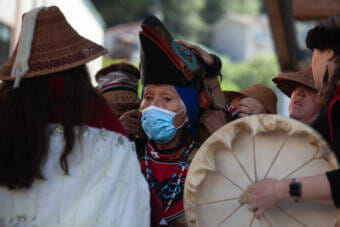
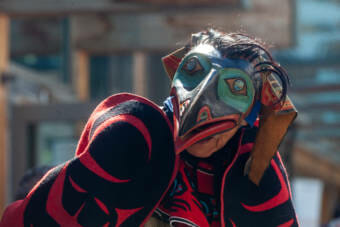
Several Lukaax.ádi clan dancers help Nathan Jackson Yéil Yádi (Raven Child) into his regalia during a stamp dedication for artist Rico Lanáat’ Worl’s new postage stamp “Raven Story,” on Friday, July 30, 2021 in Juneau, Alaska. (Photo by Rashah McChesney/KTOO)

Lingít or Tlingit — no matter how you spell it — is the name of one of the Indigenous groups of people of Southeast Alaska and the name of their language. In the language itself, it’s spelled Lingít.

The letter “l” in Lingít, though, is pronounced by placing the tip of your tongue on the roof of your mouth and blowing air out the sides of your tongue. It’s also not vocalized, meaning you don’t engage your vocal chords; you just blow air like you would for a “t” or a “k” in English. That’s why you’ll see the name of the language and the people spelled “Tlingit” in English. The closest sounds in English are “tl” or “kl,” so you’ll hear it pronounced “TLING-it” or “KLING-it.”

Tlingit is the accepted English spelling of the language and we do write and present news in English. But KTOO supports the normalization and familiarization of the Lingít language, especially in the region that includes and surrounds Juneau known as Lingít Aani or “land of the Tlingit.”

We use Lingít words to convey respect for the people whose homelands we live and work on. Using Lingít and trying our best to pronounce Lingít words accurately is one of the ways we are trying to lift up the voices of people who have been underrepresented on our airwaves.

Gunalchéesh (thank you!) for your patience as we learn and put that knowledge into practice.

Native-designed Raven Story postage stamp enters circulation with ceremony in Juneau

Nathan Jackson Yéil Yádi (Raven Child), leader of the Lukaax.ádi clan peforms with the clan dancers during a stamp dedication for artist Rico Lanáat’ Worl new postage stamp “Raven Story,” on Friday, July 30, in Juneau, Alaska. (Photo by Rashah McChesney/KTOO)

Eighteen million postage stamps featuring an Alaska Native raven design were released to the public on Friday. A ceremony in Juneau celebrated the first stamp ever designed by a Lingít artist and the importance of the design and its story to the people who live in Lingít Aaní today.
There’s not even a Lingít word for “postage stamp.”

“X’úx’ daakax’úx’u is an envelope,” said X̱’unei Lance Twitchell, the emcee for the ceremony. “Which is ‘the paper around a paper.’ So, I thought maybe a stamp could be x’úx’ daakax’úx’u kalis’éex’u x’úx’. So, ‘paper around a paper, sticky paper’.”

X̱’unei Lance Twitchell addresses a crowd of at least 200 people who showed up to celebrate the release of Rico Lanáat’ Worl’s new postage stamp on Friday, July 30, in Juneau, Alaska. (Photo by Rashah McChesney/KTOO)

It’s called the Raven Story stamp, designed by Rico Lanáat’ Worl. Worl is the owner of the Trickster Company, which is known for selling everything from skateboard decks to leggings with formline designs. It was one of his items at the gift shop at the National Museum of the American Indian in D.C. that caught the eye of an art director at the U.S. Postal Service.

“And he said, he was really drawn to the, to the kind of the feel of traditional kind of design work, but in a modern context. And so that’s where it all started,” Worl said on Juneau Afternoon Friday.

Rico Lanáat’ Worl addressed a crowd of at least 200 people who showed up to celebrate the release of his new postage stamp “Raven Story,” on Friday, July 30, in Juneau, Alaska. (Photo by Rashah McChesney/KTOO)

The postal service gets tens of thousands of art submissions for stamps every year. And only 30-40 of them will end up in mailboxes across the country. This is a huge feat for Worl as an artist. But for the Lingít people, it’s bigger than that.

“He has the goal to tell the story of Indigenous people today,” said Marlene Johnson, the Chair of the Board at Sealaska Heritage Institute, which sponsored the ceremony with the postal service. “The story that we are all still here. We have been here for at least ten thousand years and we’ll be here ten thousand more.

Postage stamp designed by Rico Worl. (U.S. Postal Service)

That brings a whole new meaning to the term “forever,” which is featured next to the letters USA right on the stamp.

Native Northwest Coast art is well-known for telling stories through large forms like totem poles and clan houses.

“But Rico had to tell all of our origin story on the smallest canvas imaginable,” Johnson said. “A canvas that was less than an inch on the longest side.”

The stamp has a formline drawing of a raven with a gold ball in its mouth surrounded by stars. It’s mostly black and white with flecks of gold that sparkle in the light. It’s a depiction of the dramatic conclusion of the story of how raven gave light to the world — by stealing it from a box. In the stamp he’s in a mess of stars with the sun in his mouth, on his escape through a smokehole in a longhouse.

Frank Henry Kaash Katasse tells a story of Raven bringing the sun, stars and moon to humanity during a ceremony celebrating the release of Rico Lanáat’ Worl’s new postage stamp “Raven Story,” on Friday, July 30, in Juneau, Alaska. (Photo by Rashah McChesney/KTOO)

While the illustration speaks for itself, author and playwright Frank Henry Kaash Katasse told the story of Raven and the box of daylight at the ceremony. And of course, the ravens themselves had to have their say, too, punctuating the entire program with their caws.

Note: It’s not a typo. Lingít, or Tlingit, is the name of one of the Indigenous groups of people of Southeast Alaska and the name of their language. In the language itself, it’s spelled Lingít. “Tlingit” is the accepted English spelling of the language and we do write and present news in English. But KTOO supports the normalization and familiarization of Lingít. Learn more.

Cruise Town, Season 3, Ep. 1: ‘Cruise ships are back, baby!’

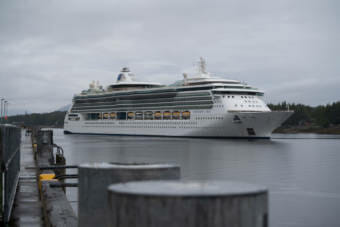
The Royal Caribbean ship Serenade of the Seas approaches Ketchikan during a test cruise with volunteer passengers on July 9. (Eric Stone/KRBD)


Last summer Dan Blanchard, the CEO of Uncruise, said that one of two things needed to happen for cruising to resume safely — rapid testing or a vaccine. It seemed certain at the time that rapid testing would come first. But by December, people were getting COVID-19 shots here in Alaska.

The cruise companies have been raring to go since then. But there were two giant hurdles preventing cruise ships from coming back to Alaska in April when they usually start showing up.

For one, the Canadian border is still closed. And all cruise ships have to stop in Canada on their way from a U.S. port like Seattle or San Francisco to another U.S. port like Ketchikan or Juneau. That’s an ancient U.S. law.

Also, the CDC banned cruises last year. And even though it lifted its ban on cruises late last year, it was replaced with a long list of hoops that cruise companies and ports have to jump through before ships can operate in the U.S. again.

For more than six months, Alaska’s cruise towns have been staying hopeful but also realistic about the fact that getting around Canada and the CDC seemed pretty much impossible.

We’re back with a new season of Cruise Town because — spoiler alert — large cruise ships are coming back to Alaska in July.
Juneau’s avalanche history is locked up in the region’s trees

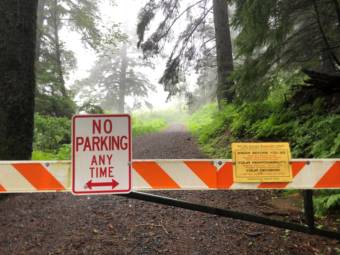
A sign at the end of Judy Lane in Juneau warning about the avalanche path on Mount Juneau. (Jennifer Pemberton/KTOO)

There’s not a great written record of urban avalanches in Juneau. There was a well documented big one in 1962, but most of what we know about destructive slides from before that comes from one lost photograph and stories from old-timers. There is, though, a vast library of climate data and avalanche records that goes back more than a thousand years — it’s inside the region’s trees.

On the side of Mount Juneau: Yadaa.at Kalé there’s a swath of the mountain that has been scoured year after year by avalanches. It’s called the Behrends path because it crosses over Behrends Avenue in a downtown subdivision. There are about two dozen houses there, which study after study has determined are in an unacceptably dangerous place.

The avalanche path itself doesn’t have trees, just a tangle of alder and other bright green spring bushes. But there are trees along its edge, and Erich Peitzsch with the U.S. Geological Survey is visiting from Montana to collect data from those trees.

He drills into a big evergreen with a long, thin, corkscrew instrument called an increment borer, which he says doesn’t hurt the tree. It has a nice long handle for leverage, so it looks a little like he’s changing a tire on a giant Sitka spruce.

It’s not backbreaking work, but it’s hard. Peitzsch and his colleagues are going to sample at least 70 trees over three days. One of the grad student’s hands are all bandaged up from gnarly blisters he got cranking on the borer all day.

Erich Peitzsch uses an increment borer to take a tree ring core sample in the Behrends avalanche path on June 2, 2021. (Jennifer Pemberton/KTOO)

When the core comes out, it’s thinner than a pencil and about four times as long. The rings will have to be counted under a microscope in a lab. In addition to figuring out how old these trees are, Peitzsch and his team are also looking for telltale signs of avalanches.

When an avalanche hits a tree but doesn’t knock it over and kill it, it can leave a scar on the uphill side — a place where the bark is gone, leaving a kind of bumpy ridge on an otherwise perfect column of tree trunk. Under the microscope it looks like a little black line on the tree ring for that year.

An avalanche has left a scar on this tree in the Behrends avalanche path on Mount Juneau — a place where the bark is gone and leaves a bumpy ridge. (Photo by Jennifer Pemberton/KTOO)

Juneau is unique in how much of the city is at risk from avalanches.

“In all the places I’ve worked and lived — in Colorado and other places, I’d never seen that many houses right at the bottom of a major path,” said Eran Hood, one of the local researchers from the University of Alaska Southeast.

By looking for clues in the tree rings, these researchers are trying to reconstruct the frequency of avalanches all around the region — especially in places with impact to human infrastructure like power plants, mines, houses and the ski area. Eventually, they’d like to match that timeline to climate data.

Avalanche mitigation often takes the form of intentionally setting off small slides with explosives to sort of relieve the pressure for potential big ones, which is what Alaska’s Department of Transportation does along a stretch of highway that goes to Juneau’s Thane neighborhood.

“You close the road, you bomb it, the avalanche comes down, and you clean it up,” Hood said. “But that’s not an option here in the Behrends path.”

It’s way too dangerous to set off small avalanches above the Behrends neighborhood. The path is just too steep, and it’s too hard to control how much snow might come down. Houses could get hit, people could get hurt. You could evacuate the homes while you did it, but then you’d also have to close the main road that connects downtown Juneau to its only hospital.

So far these researchers have crunched the numbers for six different avalanche paths around Juneau, going back more than 500 years. They found that regionwide the median return rate for damaging avalanches was nine years.

A 2011 study estimated that an avalanche reaches the Behrends neighborhood every 15 years. And every 20-30 years, there’s a slide big enough to cause damage to those homes. But that’s a number based on data and models. In reality, Hood says, it’s been much longer than that since there was a big one here.

“There hasn’t been a big avalanche into town really in more than 50 years that’s done damage,” he said. “And so if you think about that, as a generational timescale, there are not a lot of people living here that are that worried about it, right?”

Eran Hood (right) gets a label ready for a tree ring core sample for Erich Peitzsch (left) in the Behrends avalanche path on June 2, 2021. (Jennifer Pemberton/KTOO)

Ten years ago, that study by some Swiss engineers recommended that the best way to reduce the risk of a dangerous avalanche in the Behrends neighborhood is for the city to buy out the houses in the danger zone and make sure no one lives at the bottom of that hill. It wasn’t the first time that had been recommended. But the city has never been willing or able to do that. And when the city asked residents in the path if they were interested in getting bought out, they received very little response.

So scientists and policy makers keep studying in finer and finer detail a risk that you can see plain as day from just about anywhere in town. And, on top of that, they’re trying to figure out what wetter, warmer weather might mean for these trees, this hillside and the people living down below.

Alaska’s Avalanche Capital

This story is part of a KTOO series about Juneau’s urban avalanche risk.

Site notifications
Update notification options
Subscribe to notifications